The Human Condition and the '10 Cs': Part I - Chaos, Conflict, Confusion, and Conceit
Updated: Aug 25
The Human Condition and the '10 Cs':
From Chaos, Conflict, Confusion, and Conceit;
Via the ‘Council of Disciplines’;
To Consciousness and Clarity;
With Carl Jung, Christ, Compassion, and the ‘Will to Love’
The famously pessimistic German philosopher Arthur Schopenhauer wrote that:
“There is not much to be got anywhere in the world. It is filled with misery and pain; and if a man escapes these, boredom lies in wait for him at every corner.”
The prominent German-American social psychologist, psychoanalyst, and humanistic philosopher Erich Fromm wrote that:
“Love is the only sane and satisfactory answer to the problem of human existence"
This four-part series of articles is an entire eBook. It is free. It is here, along with all of my free eBooks that I have written for you:
The eBooks can each carry the entire 'Cathedral Architecture' in recognisable novel nuanced grammar, whilst each having a specific function: This eBook may meet you at the weather that you already feel. We will meet many evidential scholars and 'Trans-Paradigmatic Witnesses', all telling vital elements of the same True story. Just a quick note to you to watch out for Maria from West Side Story who will make a crucial appearance a bit later on, which will teach us a lot, and also the recurring 'Emperor': These two give us two extraordinary familiar doors into the architecture. They already live in cultural memory. We don’t need to make them famous; we need to show why they may have lasted, what structural higher Truth they carry, and how they illuminate the 'Map of the Human Condition and How to Heal From It.'
This article traces the ‘10 Cs’ as one continuous movement: From the outward theatre that is the prison of egocentric-fear-organised life, through disciplines, consciousness, and clarity, toward a new engine: Love. It is not merely a list of themes, but a cumulative account of how one mechanism of suffering scales from person to discipline to civilisation, and how that same mechanism may be healed.
You are reading Part I — Chaos, Conflict, Confusion, and Conceit.
Continue to Part II — The ‘Council of Disciplines’
Continue to Part III — Consciousness and Clarity
Continue to Part IV — Carl Jung, Christ, Compassion, and the ‘Will to Love’
This piece belongs to my wider audio library about my life’s work on success, superabundance, the Human Condition, the ‘Pivot’, the ‘Crossing’ and all my tools. You can listen here:
For the audio summary of this book, click on the companion podcast in the audio library above called ‘The Human Condition and the '10 Cs'.
From 'Couch to Cathedral'
World-renowned American child psychiatrist, neuroscientist, and leading authority on childhood Trauma, maltreatment, and brain development Professor Bruce Perry wrote:
"Relationships are the agents of change and the most powerful therapy is human love."
Professor Perry is famous for asking the question:
“What happened to you?”
I have a different question, a 'Paradoxical Query': I will ask you to ask your Self the question:
“Who would I need to BE to be able to answer the question ‘What would love do now?’"
That is probably messing with your head right now. That’s ok, it’s supposed to. But we will come to that. Right now you already have weather inside you. Are you ready to look and let it all out?
Part I - Chaos, Conflict, Confusion, and Conceit: The Ego Speaks
The ego speaks. Well, actually it shouts. The only language the ego knows how to speak is fear. And fear is our collective current civilisational climate.
The ego is a weather-generator. It makes rain, clouds, and storms out of nothing. The ego is terrified of the blue sky and the stars. For seeing the blue sky, in other words awareness, is the dissolution of the ego. Seeing the stars inside is to see your True Self, your timeless essence. Seeing the stars in the sky is the beginning of your cosmic perspective. And from that vantage point the ego's weather is irrelevant.
The ego is the felt weather. The ego is a cloud. It is a temporary veil. The ego is an illusion. The ego is a turd: The one from Carl Jung's Basel vision. And that turd has bred. It has scaled. And it now has a life of its own. Jung's turd has gone all autopoietic.
The ego is a weather forecaster. It screams that the forecast is bad, telling us repeatedly, until we start to believe it. And we all do believe it. It tells us that it is raining right now, even when there is a blazing sun. And yep, we believe it.
The ego is a weather satellite. And it is also our default Satellite Navigation System. Our current course is set for a cataclysmic crash. The way of the dodgy ego weather satellite, because there has been no unified alternative SatNav, is to continue on the road to disaster. But, what if I tell you that there is another SatNav that you can immediately plug into? An infallible one.
The ego is truly not what you think it is...
'Escaping the Ego's Prison'
Note To the Reader Before We Begin
This entirely original book is written with my method “One hand in the Earth, and the other in the Sky” in order to serve you. It is the book that I needed when I began my own journey, but that had never been written. To write it, I needed both my 'Earth-hand' and my 'Sky-hand', and to read it, so will you. This book draws the maps that I needed, but that had never previously been drawn. I drew them for me. I drew them for you.
Wisdom = Knowledge + Journey
My equation is why I invite you on your own travels. You can’t read wisdom in a book. But a book can take you places.
Many unravel you: Few guide you to ‘ravelling your Self back up.’ This I know absolutely to be True.
This book, which I have written for you, yes you, is a deeply scholastic analysis, weaving a tapestry from the disparate islands that we are proffered: Science, Neurobiology, Philosophy, Metaphysics, Ontology, contemplative traditions, and so much more. It applies Kuhnian paradigmatic world-view concepts and historiography to science, medicine, and psychology. This thesis brings forward and gathers timeless Truth and its witnesses. It is profoundly reflective. It is a quiet, 'Pre-Figurative' revolution: It starts now. It is a 'Pre-Figurative Re-Collection' of the fractured parts of you. The only sledgehammers that this book wields are velvet ones.
Disciplines forget that they are meant to look for Truth, not battle for turf. Institutions seek two things: Control and power. And they do this by controlling grammar, making it obscure, ensuring that their library of knowledge remains coded in a language foreign to everyone but themselves. But we see through you.
This book is written from the perspective of BEing, of transformation, of personal liberation, and lived experience as a guide, and what Gabor Maté calls a ‘wounded healer.’
You want to climb Everest? No problem. I will be your ‘Sherpa-guide’ and your witness.
This body of work is written from love. I offer it as a gift. That’s why it is free.
We will be insolent where Truth calls us to. As Jesus, the philosopher and teacher, may have said on his cross (although it has not previously been documented):
“Well this is all a bit dramatic isn’t it?”
Truth is funny, because what we ‘see’ when we hear it is its first articulation. I capitalise ‘Truth’ when it refers to higher Truth, in other words, ‘real reality.’ I capitalise ‘Self’ when it refers to the totality of the Soul. The ego, the ‘false self’, can keep its little ‘s’.
This book flips over the hidden blueprint of life to reveal its mechanics. It shows us the matrix. To quote my old mate Morpheus:
"I'm trying to free your mind… But I can only show you the door. You're the one that has to walk through it."
If you want the blue pill, it is best if you look elsewhere. I do not offer it. I care too much to proffer it.
I am not religious. I do not subscribe to any dogma, regardless of its mask. I do not ascribe meaning where there is none. I do not prescribe rules. I offer none of my own.
This thesis is not medical, psychiatric, psychological, or therapeutic advice. If you are in crisis, feel at risk of harming yourself or someone else, or need urgent support, please contact emergency services or a crisis-support service in your country.
Introduction
“And ye shall know the Truth, and the Truth shall make you free.”
John 8:32, KJV.
What is the Truth? Well, that’s what this book is ALL about. And, yes, it will set you free…
This introduction is not a trailer. It is not a thesis abstract. It is not a doctrinal preface or ambush. This piece is part of a larger project, but it stands on its own. It is the opening act of accompaniment. This piece is meant to pique: A peek into what love and Truth really are. And oh my goodness do we need them. They will come into view. And then, once seen, they cannot be unseen. Again, and always, Truth shall make you free. You just need to keep reading. Oh, and maybe open your mind. Just sayin’. Welcome to Reality…
These ‘10 Cs’ are not arbitrary or intended annoying alliteration (well, maybe a tiny little bit): They form a deliberate sequence, a route through the felt human experience, the mechanisms beneath it, and for me at least, the way out of personal and collective suffering. We commodify ourselves. We burn ourselves to stay warm. Just to keep going. But it needn’t be that way.
We were not born petrified. We were not born armoured. We were not born inauthentic. We were born real.
As Zen Buddhist master and spiritual leader Thích Nhất Hạnh teaches:
“No mud - no lotus.”
But, most of all, no love - no lotus.
This book traces the ‘10 Cs’ as one continuous movement: From the outward theatre that is the prison of egocentric-fear-organised life, through ‘boxed’ disciplines, consciousness, and clarity, toward a new Self-sustaining engine: Love.
This book is not merely a list of themes, but a cumulative account of how one mechanism of suffering scales from person to discipline to civilisation, and how that same mechanism may be healed.
Suffering, Schopenhauer, and the ‘Will to Live’
A great deal of suffering persists because people cannot see what is happening inside them. They feel the weather but cannot see the structure beneath it.
We see the signs but cannot see the sequence. We buy the postcard, but cannot see the map. We mistake a photo for a journey. One viewpoint for the whole of Truth. We feel the conflict, but point elsewhere to the trench, not seeing that we are right in it. This should be ‘No-Man’s land’ but it’s everyone’s world.
We begin this journey called life where we all start: In the middle. We may as well, as that is where we are.
Arthur Schopenhauer viewed life as a painful insatiable restless striving, existing in a realm with a subconscious motor constantly driving us: A force that he called the “Will to Live.” That sounds jolly nice and innocent. But he didn’t mean that: He believed that this is what we are as human beings, in a perpetual state of discontent.
We are not at the driving wheel. Well, we are, but we have not yet learned how to drive. And we are not big enough to see over the ‘dash’. And we so enthrone the car, displacing ourselves, and so we don’t even become ‘puppet-kings’, while self-worshipping the road we never even travelled.
Schopenhauer compared life to running through a sunny field. There’s sunlight all around you. But there’s a single dark cloud in the sky that’s hanging directly over your head. You can see sunlight in every direction. You can see people who seem ‘happy’, whatever that means. The sun seems within reach, but no matter how fast you run, this dark cloud is tar smeared over your eyes. He thought that the ‘defended self’ is not merely a self that hurts, but a self-organised by craving, lack, comparison, and compulsion.
Schopenhauer declared that:
“There is not much to be got anywhere in the world. It is filled with misery and pain; and if a man escapes these, boredom lies in wait for him at every corner.”
What a gloomy predicament. Schopenhauer stressed the importance of the intellectual nature of perception. Don’t sit next to him at a dinner party. But we are not here to judge. Please be reassured: We will see what he didn’t see.
Schopenhauer cast a shadow over philosophy for a very, very long time. But what if philosophy could be a shining light? What if you could be that shining light?
What if, instead of living under this “Will to Live”, we could live under the “Will to Love?” No, I don’t mean sentimental love. I don’t mean a momentary chemical high. I mean love as an epistemic force. Love as a way of BEing. Love is not an ornament to Truth; it is one of Truth’s conditions. Love is Truth’s synonymity.
The point is not to tear anyone down, or ridicule any institution, profession, or the whole of civilisation, but to ask whether each has become a frightened child in ceremonial dress — and whether each is now willing to step through the door that fear insists is closed. That fear tells us is not even there.
But we try to satisfy a ‘non-thing’ (conditional love = not unconditional love) with a ‘non-thing’ ('imitation love' = conditional love = transactional love). We seek substitute completion: Where there is substitute completion, there is insatiability, where there is insatiability there is repetition; where there is repetition, there is escalation; where there is escalation, there is evidence of the original wound, exposed, previously unrecognised, untreated, unhealed. And we keep picking at that wound: And others join in. Until the dash that begins on our birthday becomes our deathday. And however pretty the dash, the ‘imitation love’ that we cultivate is no more than plastic flowers on a mausoleum.
Conditional Love is a Biohazard: And it Already Has an Empirical Name — 'Parental Conditional Regard'
This book begins with five peer-reviewed evidential supports. These five are deliberately not five versions of the same Adverse Childhood Experiences (ACEs) statistic. Together they create a small scholarly arc: Conditional regard → cumulative adversity → life-course/intergenerational consequences → altered developmental trajectories → the social pressure to abandon public expression of private perception. That arc is unusually well matched to Article I’s movement from wound to conflict to confusion to defended identity.
In the first analysis Avi Assor and Guy Roth at Ben-Gurion University, with Edward Deci at Rochester, studied parental conditional regard within 'Self-Determination Theory'. Their work matters here because it tests something this article otherwise risks leaving in poetic language: what happens when approval is experienced as contingent upon the child becoming a particular kind of person.
The point is not that every boundary, expectation or disappointed parent creates a wound. Children need structure. The narrower point is that love and approval can become psychologically fused with performance. When that happens, the child may indeed become very good at producing the requested behaviour — but “good behaviour” and inner freedom are not the same outcome. The researchers’ conclusion is almost painfully economical: Assor, Roth, and Deci, in their landmark seminal article 'The emotional costs of parents’ conditional regard: A Self-Determination Theory analysis' wrote that:
“The results suggest that use of conditional regard as a socializing practice can promote enactment of the desired behaviours but does so with significant affective costs.”
— Assor, Roth & Deci, 'The emotional costs of parents’ conditional regard: A Self-Determination Theory analysis'; Journal of Personality (2004)
That is the first 'Earth-Hand' stone beneath my 'Map': Conditionality can 'work'. That is precisely why it is so seductive. It can produce compliance, achievement, and externally desirable behaviour while carrying an internal cost. The child may therefore arrive in adulthood looking extraordinarily functional while the hidden grammar remains: Become what the room rewards, or risk losing the thing you most need — love. Chaos does not always begin as chaos. Sometimes it begins as excellent behaviour.
This article provides the empirical floor beneath the idea of conditional love, while very carefully refusing to claim that every single parental expectation is Trauma or that conditional regard proves the whole ego sequence. The paper supports conditional regard, internalisation, and the very real psychological cost. It does not establish that conditional regard is the only cause of childhood Trauma, ego, professional identity, or the entire 'Human Condition clinical psychopathological sequence' or the 'Ego-Scaling Matrix'.
The 'Earth Hand' has since become firmer. A 2023 meta-analysis by Jolene Haines and Nicola Schutte called 'Parental conditional regard: A meta‐analysis' in the Journal of Adolescence pooled 31 samples and found greater parental conditional regard associated with more introjected regulation, more contingent self-esteem, more depressive symptoms and less relatedness. That still does not prove my whole map. It does mean the conditional-regard stone is no longer resting on a single famous paper.
‘Plastic Flowers on a Mausoleum’
The terrible Truth is that we build our very own mausoleum before we die and we call it ‘life.’

Mausoleums are monumental designs of epistemic idolatry, as vast as pyramids, big enough to entomb a body – a prison after death, reflecting the prison that was longer than a life-sentence, with the human remains sealed inside. They are external, meant to catch the eye, meant to validate a life that had no value as it was inauthentic. They are catastrophic accounting errors where the unhealed adult attempts to build a Self from the outside in, even after death, desperately hoping to earn a temporary lease on their right to exist, long after they have ceased to exist. The plastic flowers cast long shadows “I could not even buy grief, for grief is acceptance. How could I be accepted if there was no me?” Pain is the technology that love uses to teach Truth through parable and redirection. Life grows from the wound, not from plastic substitutes. The lotus in the mud introduces the true alternative: Real growth does not come through substitution, performance, or display, but through contact with the wound, with grief, with truth, with life itself. We try to satisfy a non-thing with a non-thing, and call it beauty — while real life waits in the mud not far. That is the ultimate richness. This is a metaphysical scene not a religious one. parable-ontology of Truth. A life decorated rather than lived was only a dash. They are the most striking form of trauma-organised autopoiesis, attempting to self-reproduce even after death. The parable-in-an-image is an alert to the quasi-universal gnosiological truncation of the ego: The cognitive-somatic bifurcation that separates the over-functioning, problem-solving intellect from the foundational ground of BEing. The intellect becomes a mausoleum of defended intelligence—technically proper, built to plan, and oversized, and philosophically dead. It is an act of somatic decapitation—cutting the intellectual head off from the torso to filter out the overwhelming interoceptive noise of the practitioner's own un-mourned history.
This is imitation love as a parable-in-an-image: Substitute completion placed upon a dead structure, death trying to beautify death. The mausoleum is the noun; love is the verb. The lotus, by contrast, rises quietly from the mud — living, delicate, unshowy, and real. It reminds us that life does not grow from performance, display, status, or substitute beauty. It grows from contact with the wound, with grief, with Truth, with the mud of reality itself.
And that is the point. However pretty the dash between birth and death may look from the outside, a life decorated rather than lived is still only a dash. The plastic flowers are not evil; they are simply late. They are the after-party of imitation love: arranged, costly, admired, and unable to resurrect anything. The lotus tells the other story. No mud, no lotus. No wound faced, no real life. No grief, no acceptance. No Truth, no love. We try to satisfy a non-thing with a non-thing and call it beauty, while real life waits in the mud, not far away. You can sell plastic flowers. You cannot sell real love, because real love is not a product; it is the presence that makes life alive.
True abundance is not about a better tombstone. It’s about how you loved during the dash on it.
The human Soul cannot be healed by mastering diagnostic manuals: An attempt to do so is to operate under a state of truncation that actively cripples gnosiological capacity—the fundamental epistemic, somatic, and physiological ability to directly know and apprehend reality without contractive reduction.
Schopenhauer described our world as an economy of wanting: We pursue, we strain, we briefly secure what we sought, and then either fresh desire or emptiness as unfresh as a plastic daisy appears. We think we want imitation love. But it wants us. It commodifies us. We all too gladly slip on the price tag and barter ourselves to the lowest bidder. But, you can’t sell real love. You can sell plastic flowers.
The need to quench the craving is impossible with what the surgeon Greg Baer calls ‘imitation love’ – enough is never enough for her or him who believes that enough is never enough. That is the transactional nature of imitation love: It never quite gets us there. That is the neuroscientifically proven ‘near miss’: It is more addictive than the ‘win’, keeping us, as scaled Russian-dolls-of-fear, glued to the Russian roulette of what we think is a ‘life’. But this is all too easy to see with our well-developed ‘retrospectascopes’. Arthur didn’t have a rear-view mirror. Well, he did die 25 years before the first car hit the road. And, like everyone else, we don’t even use the ‘prognostiscopes’ that we were handed, from a cross, and from a stage. And when the oncoming car hit us, the disciplines were too preoccupied decorating the tomb as a limo to hear the sound of their own demise.
And yet Schopenhauer is so useful to this thesis, in that he did not see the root of our striving, and so he couldn’t see a way out. But there is a way out, where I will propose the movement from wounded child to false self to defended ‘unseeing’ disciplines, to a fearful and seemingly hateful totalitarian civilisation masquerading as freedom. But freedom does not tell you that you can be liberated or joyful, but that you cannot have both. In John 9:25, a man ‘metaphorically blind’ since birth, when questioned by sceptical ‘leaders’ who demanded to know who healed him, the man famously replied:
"Whether he is a sinner I do not know. One thing I do know, that though I was blind, now I see."
When did Truth become a sin? When did it not? And when did it stop being a sin? Well, it hasn’t. And that is the tragicomedy of a losing battle. Martin Scorsese captured this biblical phrase in the closing frame of the film about a real-life boxer, Jake LaMotta, played by Robert de Niro in ‘Raging Bull’. Life should imitate art. And as such, art may well be priceless.
And no, I am not at all religious. False Gods always die. They just don’t get to ‘resurrect.’ Metaphorically or otherwise. They just don’t like it when they realise that being reborn is a choice: The choice to stop being a total dickhead, and to stop wearing a dick-crown.
A culture can become an enormous machine for the multiplication of willing: Prestige, acquisition, performance, competition, and the endless promise that one more attainment will finally quiet the ache. Roles as anaesthetics. Schopenhauer’s darker brilliance was to say: No, the machinery itself may be the problem. But what if it isn’t desire? What if this relentless striving is fear? Desire is simply the fear of not getting what one wants.
Wanting is fear.
We live in boxes, we work in boxes, we die into boxes. Boxes of fear-contracted consciousness: Defended ‘intelligence’. Mausoleums to what might have been wisdom. Eckhart Tolle wrote in ‘The Power of Now’, that:
"The secret of life is to 'die before you die' — and find that there is no death."
"Dying before you die" is a spiritual metaphor. It means letting go of your false self, ego, and the attachments or stories you tell yourself about who you are. The mausoleum is posthumous external validation. When you realise the ontological Truth that you are formless expanded consciousness rather than just your egoic thoughts, you find that your true essence cannot be destroyed: It does not require a mausoleum, an architecture of ‘managed death.’ The genealogy of the ‘Will to Love’ acts as an exhumation tool of Schopenhauer’s ‘Will to Live’ that digs beneath the floorboards to stop the subject from "Policing the grave" of their own childhood, allowing them to walk out of the tomb.
When the Role Freezes the Soul

This is why ‘success’ can become one of the most seductive of the myriad forms of imitation love. The person does not merely want money, reputation, victory, beauty, or applause; he wants those things to say what unconditional love was meant to say first: “You are safe. You are seen. You are enough.” But success cannot perform that role. When the Soul asks for love and the ego answers with status, the room may become more impressive while the person inside is petrified.
Fear reproduces itself not only through behaviour and attachment but through epistemology. That line matters because it opens the door from psyche to paradigm without melodrama: A ‘paradigm’ is a box. In fact, it is the exact ‘box’ referred to in the phrase “Thinking outside the box”. But why do we think only inside the box? And how does that keep us trapped, and unable to access wisdom?
We seek fear, rehearse fear, consume fear, even identify with fear, because fear feels familiar and familiarity masquerades as ‘Truth’. That is why the news, outrage, professional seriousness, obsession with status, competition, conflict, and doom all become so magnetic. Not because they nourish us, but because they fit the nervous system we already have. We fear not being hurt so we hurt ourselves. We self-sabotage – a word meaning to throw a clog into the mechanism of the machinery. There is a mechanism to every life, and we all share the same mechanism. So does every discipline. So does every institution. So does civilisation.
In the civilisation-and-imaginary strand, Schopenhauer can do serious work. He helps explain why a paradigm of fear does not merely produce painful feelings; it produces a whole metaphysic of striving (a branch of philosophy which means ‘after the physics’ on the library shelf). It is beyond physics. It is more.
The wounded person learns to seek relief through attachment, achievement, possession, control, and repetition. The wounded discipline does the same with knowledge, prestige, and institutional power. The scary thing right now is that those who are supposed to govern civilisation have disconnected power from knowledge altogether. The wounded civilisation may canonise those movements and call them success, realism, adulthood, or progress.
Schopenhauer is therefore not just a witness to private pessimism. He is a witness against the organised worship of wanting. He helps this thesis say that ego is not simply proud or vain. It is also hungry by structure, and therefore unable to rest for long in the world it keeps trying to master.
He wrote:
‘Thus life swings like a pendulum backwards and forwards between pain and boredom.’
Henry David Thoreau wrote that:
"The mass of men lead lives of quiet desperation."
Buddha said:
“ALL life is suffering.”
Friedrich Nietzsche wrote in ‘Thus Spoke Zarathustra’:
“God is dead! God remains dead! And we have killed him! How shall we comfort ourselves, the murderers of all murderers?”
Nietzsche saw this as a dangerous, chaotic turning point. It wasn’t a proclamation. It was despair. He feared that without a divine moral foundation, humanity faced a terrifying, purposeless existence – ‘nihilism’. But only the first sentence of that writing gets quoted over dinner parties.
But those great minds were not being pessimistic – they were being real. And reality may only be seen through love.
William Blake wrote:
“If the doors of perception were cleansed everything would appear to man as it is, Infinite.”

Civilisational Disaster with ‘President Trompe’
So anyway, what the hell is wrong with the world today?
We are heading for oligarchies; we are already in them. But it’s not just President ‘Trompe’ (forgive me, I am half French, and ‘tromper’ is a verb and it means to deceive, cheat, trick, or fool) and the genealogy of the ‘Will to Lie’, and it’s not President Vladimir “Ras” Putin — or is it ‘Poo-tin’? Not a can of worms. A tin can full of… well you get my drift. When did we deify egocentric maniacs with an inferiority complex? Well, ‘we’ did. “Woah” you might say; “Are you sure?” But why? Click here for my article ‘President ‘Trompe’, The ‘Will to Lie’, and Why We Must Speak Power to Truth.’
What if all human suffering arises from the absence — or perceived absence — of unconditional love? That is one of the cleanest statements of this article’s deepest causal claims and of my entire body of work, if I might permit myself to say that. Don’t worry you sceptics out there. Yes, I will give you irrefutable scientific evidence, backed by neuroscience, psychology (well, at least modern psychology), philosophical lineages since the dawn of ‘civilisation’, and contemplative masters. This is what I call ‘Psychospirituality.’
What Schopenhauer was describing, unbeknownst to him, was the driving — no, the beckoning — force that lures us all to the ‘Temple of Emotional Anaesthesia.’ That’s my grammar: A prison masquerading as a sanctuary of mercy for ‘junkies’. I don’t mean that term in a derogatory sense. Below is your first ‘apercu’ of my map: the ‘Unified Field of the Human Condition.’ It has no caption, as I don’t want to give you too much information too early on. Even your favourite food chokes if eaten too fast. The map is the visual representation of my meta-theory of how life works. And yes, in my articles, I will show you how it fits with all the scientific data, all the psychological models, every ‘witness’, all the major philosophies, and every contemplative practice. Or rather, they all fit on it. It is the hidden mechanics of life, the mechanism that no-one has pieced together before. That’s not grandiosity – that’s assertiveness. Haha – I promise.
‘The Terrain of the Human Condition’
As Dr Gabor Maté, the doyen of compassion, attachment, authenticity, and addiction says:
“90% of people are addicts, and the other 10% are fooling themselves.”
Maté’s work pushes us toward the uncomfortable view that addiction is far more ordinary and widespread than our moral categories admit.
Yep, that includes you I am sorry to say.
Buddha said:
“Work at the root.”
What did he mean by that? What is the root? And what pain does it cause that is so unbearable? For my clinical psychopathological model click on my article ‘The Human Condition and How to Heal It: Series Introduction.’
What Schopenhauer didn’t see – couldn’t see, didn’t see, although The Buddha had already pointed this out almost a quarter of a millennium, yup 2,500 years before — was that an intellectual explanation of human suffering is downstream of its root cause. And the human condition is forged in childhood Trauma. But our Trauma (and Dr Maté likes a capital ‘T’), whether we are conscious of it or not, was never our choice. So, there is no need to be ashamed. You deserve forgiveness, compassion, and unconditional love, just like anyone else in the world. There are no monsters. There are no lions. There is no ‘creature under the bed.’ So why do we spend our entire lives living, or rather, not living, as our petrified younger selves?
Dr. Gabor Maté: Why the Wound Needs a Witness
Maté is useful here not because he proves the whole map, and certainly not because one sentence should be turned into a total definition of Trauma. He is a physician and writer whose work repeatedly places attachment, authenticity and relational disconnection at the centre of human suffering. More importantly for this particular threshold, he gives us a language for something statistics cannot quite say: Why what happens between human beings can be changed by whether another human being is there to bear witness to it.
A child does not need merely to be physically surrounded by adults in order to be accompanied. A child can be perfectly visible and yet be carrying an experience for which the surrounding world has no safe language. That distinction matters because the wound in this book is not simply the occurrence of difficulty. It is what can happen when difficulty must be metabolised alone, or when belonging appears to require the abandonment of what the child knows, feels or needs. Maté puts the relational dimension with startling economy:
“Trauma is not what happens to us, but what we hold inside in the absence of an empathetic witness.”
Gabor Maté, foreword to Peter A. Levine, 'In an Unspoken Voice' (2010), p. xii
I do not use that sentence to reduce all Trauma to the absence of one good listener, nor to suggest that a loving witness magically makes injury disappear. There is no magic here. Its importance is subtler. A witness does not manufacture Reality. A witness helps another human being remain in relationship with Reality when carrying it alone has become unbearable. And this will matter increasingly as the '10 Cs' unfold, because the opposite of the Human Condition may not begin with somebody finally explaining us correctly. It may begin with somebody staying long enough for us no longer to have to disappear from ourselves.

Aristotle said:
"Give me a child until he is seven and I will show you the man."
I will also show you the old man. I will also show you the dying man. But by then it’s too late, and we will have called our lives ‘fate’.
William Shakespeare, the greatest author who ever lived, was being paradoxical when he described the ‘Seven Ages of Man’. He gave us a bleak picture so that we would reflect on its true significance and do something about it.
Dr Carl Jung, the “Prophet of psychology”, and all-round total dude, wrote the deepest and often quoted insight that:
"Until you make the unconscious conscious, it will direct your life and you will call it fate".
Maté writes:
"Healing does not mean the wound disappears. It means the wound no longer runs your life without your knowing".
Yup, and that’s pretty bloody awesome.
This means that hidden, unexamined aspects of our psyche—such as repressed emotions, fears, or childhood Trauma — shape our actions and external circumstances until we bring them into awareness. This line lands because it restores continuity where the disciplines prefer segmentation: Knowledge-as-power, trading joy for control, subjugating us and calling that freedom. Well, dearest reader, you are free.
Sigmund Freud is often cited as having said the following phrase:
“If it’s hysterical, it’s historical.”
This line is so memorable because it captures the temporal displacement: The present reaction is often carrying the emotional weather of another time. Not because the past is literally still happening, although it may as well be to our traumatised discombobulated minds, but because our organism has not yet learned, not been able to accept, that it is over.
If we don’t expand our consciousness beyond knowledge into wisdom, exhaustion will always come – it won’t be a question of if but when. We can only swim upstream for so long, whoever we are. Even Freud said that we can’t keep our emotions buried forever; they will always resurface, often decades later, and they will then screw up your life. Please forgive my insolence and my cocktail of intersectional grammar peppered with exclamations. But sometimes we need a ‘velvet sledgehammer’ to wake up. The Universe will slap us in the face until we learn our lessons. And if we don’t, life will punch us in the face to redirect our lives.
‘Resilience’, in the institutional and professional sense, is total horseshit (there I go again – but as you can probably tell, I am very passionate about this): Everyone breaks. Using the term resilience simply categorises us, ‘taxonomises’ us, into ‘normal’ or ‘abnormal’. Resilience is the ability to bounce back, like a reed, not the resistance to ‘breaking.’ It is the old crumbly oaks that snap like twigs in a storm. The dinosaurs, after all, are extinct. They don’t even appear in the foyer of the British Museum anymore: They are relics relegated to the past.
But no-one is truly broken. No-one needs fixing. No-one needs unravelling. We are all just waiting for a teacher. And when the student is ready, the teacher arrives, as love knocking on your door. There will be many, many teachers presented to you in my thesis. And the two biggest guns, or rather salves, are Carl Jung and Jesus Christ. And nope, before you ask, and before you click to another site, I am not at all religious. I don’t follow doctrines. And I don’t pay for frightened children posing as adults to become ego-political dictators.
While honouring Jesus, Mahatma Gandhi — whom, alongside Nelson Mandela, I rate as one of the greatest leaders who ever lived — believed that no single religious tradition could claim a monopoly on Truth. Both Gandhi and Mandela were lawyers. They both viewed Jesus alongside other great spiritual leaders. Gandhi wrote:
"Jesus was one of the great teachers of mankind.”
Jesus was one of our greatest philosophers, and taught love and forgiveness. That is what made him so subversive: That is what gave him such immense ‘Real Personal Power’.
Gandhi also wrote that:
"I like your Christ, I do not like your Christians. Your Christians are so unlike your Christ".
His words, not mine.
Christ was not a Christian. Jung was not a Jungian.
But the past cannot hurt us. To see, truly see, is to heal. Yet the map of our lives is at very best fragmented, if there was a map at all. We had no programme for living sketched out for us. The map, until now, was fragmented like our psyches. And the fragmented psyche is the human condition, until we ‘individuate’, as Jung put it. To individuate means to become whole again, and wholeness gave birth to the word healing. And it will give birth to you. Or rather you will, if you so choose.
However, like Schopenhauer, we try to think our way out of our boxes. We are ‘thinkaholics’, ‘epistemaholics’, ‘fearaholics’, ‘egoaholics’, ‘victimaholics,’ 'beingrightaholics', ‘painaholics’, ‘addictionaholics’. That is why addiction is never really about the object. The object is the costume, the role, the numbness for our emotional pain. Our addictions, whether they be behavioural or substance-based, and yes, neuroscientists tell us, those two imposters are the same, unless you live in the prehistoric ages of psychiatry and psychology: And yes, I know this to be true, from personal experience and from the reams of evidence that I have read. Well, I am a scientist. And I have been a peer-reviewer for over a dozen scientific journals. And yes, I am, as Dr Maté calls it, a ‘wounded healer.’ But I am delighted that I am. That means that I can be a guide. Sorry to all the psychiatrists and psychologists out there who learned their trade in books. Dr Maté wrote that:
"The healing process can happen outside of therapy as fate, this is how wounded healers are born. The inscription on the stone at Delphi 'The wounded heals' is a profound Truth... When you get to the bottom of your wound and find God. That's when you are healed and become a wounded healer".
Oh no, not the ‘G’ word! And again, I am not at all religious! By using the ‘G’ word, I simply mean a power greater than myself alone, and it’s just an abbreviation for Nature, for the Universe, for love: For anything bigger than our egos.
The wound is the actor, until you realise that it was just a stage.
The dealer is the discipline, the actor who would take the lead role — or rather, would like to be the director. But this ain’t their show, so don’t you dare let them steal the role. They are doing enough damage, pushing us into boxes, making box-shaped people, and calling that progress.
Suffering is optional
Sorry Carl, I must disagree with you on suffering being our greatest catalyst for transformation. It is not suffering that hurts us or guides us. It is love raising us to our destiny. As the brilliant A.H. Almas (one of Gabor’s most cherished authors) wrote:
“Your conflicts, all the difficult things, the problematic situations in your life are not chance or haphazard. They are actually yours. They are specifically yours, designed specifically for you by a part of you that loves you more than anything else. The part of you that loves you more than anything else has created roadblocks to lead you to yourself. You are not going in the right direction unless there is something pricking you in the side, telling you, “Look here! This way!” That part of you loves you so much that it doesn’t want you to lose the chance. It will go to extreme measures to wake you up, it will make you suffer greatly if you don’t listen. What else can it do? That is its purpose.”
And now time for the ‘G’ word again – Gabor wrote:
“At times like this, there is very little grown-up Gabor in the mix,” he writes. “Most of me is in the grips of the distant past. This kind of physio-emotional time warp, preventing me from inhabiting the present moment, is one of the imprints of trauma, an underlying theme for many people in this culture.”
Maté continues:
“Don’t ask why the addiction, ask why the pain. Addiction is a normal response to Trauma.”
It is love that sent us obstacles. Even ‘enemies’ are just obstacles: They, just like our oligarchs, are our greatest teachers.
As the big ‘J’ taught us about transformative ignorance and immaturity in Luke 23:34:
“Father, forgive them, for they do not know what they are doing.”
Jesus taught us this as he was dying from his crucifixion. The authorities had to nail him down, as a single man was more significant, more powerful, than all of them put together. And in nailing him down, their greatest fear was realised: That he was greater than they could ever be. Unless they walked his path.
Love leads the way, it is our built in SatNav, redirecting the points on the tracks. Just before we start, here is another look at the map. It’s here if you need it.

The image above is the whole article in one visual movement. On one side stands the fortified architecture of fear: ego, conditioning, status, control, and the imitation forms of safety that become prisons. On the other side is not fantasy, escape, or spiritual decoration, but a different mode of BEing. The bridge matters because nobody is airlifted into love. We cross, one honest act at a time, from the familiar machinery of survival toward a life organised by Truth, compassion, clarity, and the Will to Love.
The pain killer for our emotional pain and suffering is almost excellent: It works, but not quite. That is exactly why it is so compelling. A perfect anaesthetic would end our search. A useless one would be discarded. The dangerous one is the one that so very nearly works, just enough to keep faith alive in idolatry. And nearly working means that we feel every incision. That is the near-miss economy of transactional addiction: Of imitation love. We are always shortchanged on the ‘deal.’ It is not fulfilment. It is deferred fulfilment, endlessly renewed. The top is not in sight. “This time it will work.” No, it won’t.
Because once the wound is the actor, the wound is the doctor, and the whole picture changes. The healer is no longer simply a neutral agent applying knowledge to suffering. The healer may also be a suffering structure managing suffering in the only way it knows how. That does not make the doctor evil. It makes the situation tragic, and then — if seen clearly enough — transformable, through conscious awareness. It is frightening because it means authority is not automatically wisdom, quite the opposite in fact. Diagnostic expertise is not automatically liberating. Competence is not actuated wholeness. A person may be highly trained and still be unconsciously organised around fear, control, power, arrogance, performance, perfectionism, and their own quest for imitation love. In that case, the treatment may be technically brilliant and existentially blind. The wound can become very skilful. It can wear a white coat, speak beautifully, publish papers, ‘win’ cases, lead departments, and still not know what love is. And no one in the history of mankind has ever won in conflict.
That is why this project matters so much. Not because it humiliates the professions, but because it rehumanises them. It says: The actor, the doctor, the lawyer, the judge, the teacher, the scholar, the CEO, the celeb, the ‘influencer’ — all wear the mask of defended adaptation and the same ache beneath the costume. And if that is true, then healing cannot mean merely refining the costume.
Guidance must mean meeting the wound without surrendering to it. This is the basis of Alice Miller’s ‘Enlightened Witness’.
False gods require maintenance. Puppet ‘Kings’ need their subjects. Oligarchs need their bodyguards. Tyrants need their billionaires. They need rituals of reinforcement, repeated offerings, constant defence, endless reassurance. Their ego needs to be propped up. Their addiction needs another hit. Prestige needs another witness. Image needs another mirror. Control needs another plan. But what is real does not need to be kept alive by us. It is we who live by it.
Healing, and the inner journey required, is the purpose of our lives. It is our very own ‘Hero’s Journey’.
Recovering is not for those who believe in God; it’s for those who think that they are God.
That one line has tremendous bite. Or perhaps, to make the mechanism even sharper: It is for those whose ego has taken God’s seat. They have stolen ‘God’s’ pen. That is the wound’s final strategy, isn’t it? Not open omnipotence, usually, but concealed self-deification: “I must manage everything. I must control reality. I must know. I must not fall. I must not need. I must not surrender. I must save myself by force, image, performance, thinking, the ‘news’ (which is an abbreviation for ‘bad news’), drink, sex, work, knowledge, status, or power. And I don’t even know that I am doing that.”
‘Real reality’ – in other words higher Truth - exposes pretence. Real love reveals how much imitation love we settled for. Real presence reveals how defended we were. Real contemplation reveals the theatre of self-importance.
I must bring William in here (I have ‘worked’ with him for so long that we are on first name terms). He wrote in ‘Hamlet’ (Act I, Scene iii):
“This above all: to thine own self be true,
And it must follow, as the night the day,
Thou canst not then be false to any man.”
Authenticity is gold. Vulnerability is gold. Humility is gold. Compassion is gold. Love is a diamond. And they are all superpowers.
The ego experiences awareness as annihilation, but the Soul experiences it as relief. At last, the exhausting performance can stop. False gods require maintenance. Addiction is liturgy for them. The journey to awakening is the dethronement of the impostor. The journey is ontological re-ordering.
We build prisons, hand over the key, and stay within the ‘safety’ of their walls. We put ourselves into solitary confinement, and yet the door to our cell was never locked.
Love is the paradigm that ends the need for more paradigms.
You may feel alone, unloved, unlovable, and unworthy. You may be afraid. But even the greatest tyrant is just a little boy acting like a ‘King Baby.’
Don’t lose hope, there is another way. There is a map. There is a teacher. There is a guide. The ‘Stairway to Heaven’ is not a single leap. Personal Power comes from a foundation of powerlessness. Love is a verb, a question, an answer: In reality it is the answer; whatever the question may be. More than that: Love is every question and every answer.
Should you read this article? Ask love what to do now. But how?
You may ask ‘Why has this not been written like this before?’ — namely, because the relevant materials have usually been kept in separate rooms.

Anyhow I don’t want to overwhelm you with the trailer or spoil the ending. I just wanted to give you a glimpse of the map running through my series of 500 articles about healing. But you only need to read a couple to get the ‘glimpse.’ Give ‘The Human Condition and How to Heal It’ a peek and let me know if I can serve you. The book is on the way.
There is joy, mischief, and light in Truth. I bet Jesus was bloody hilarious. This is what happens when a person is no longer hypnotised by fear. If my whole thesis was written as though by a mournful committee, it would betray you. This is serious work written by someone who is alive, and returning to the start of the map as an action of love. And Truth, when landed on is hilarious. That’s why comedians are funny. They give you the “Ooh.”
So, the spirit becomes: We are not here to destroy; We are here to illuminate; Not to shame; To reveal that our monsters are not real. I will not bludgeon you with doctrine – I don’t have one.
I see the highest in you, until you see it yourself. We will see together why life has felt as it has, and why another way may be possible. I will show you the ‘cosmic view’ – the ‘satellite view’.
These words will keep you warm...
"This too shall pass."
"All is well, and all shall be well. In reality, everything is glorious."
"When you are fighting a losing battle, the only way to win is to surrender: Surrender your ego."
"You can handle it. All of it."
"Love your fate: It has already happened."
"The blazing dawn always comes."
I will introduce you to the ‘Bridge of Awakening’, which is the same as the ‘Crossing’, and the ‘Corridor.’
The ‘Bridge of Awakening’
Your deepest treasure lies in the darkest cave, and it won’t be too much to carry. I will not simplify by flattening: I will give metaphors for the complex. And I will always tell you the Truth.
Our true centre is love. Or, more precisely, for now, it is the lack of unconditional love at the root, and the long consequences of trying to live without it. And once we find it, everything else becomes legible: Chaos, conflict, confusion, craving, control, institutions, professions, prisons, paradigms, panopticons, awareness, Truth, BEing, and awakening.
There is a reason why life has felt so scattered. So lost. The crumbs are still there. Pebbles even. No, in Truth they are diamonds. And the thing that connects them is closer to home than most ‘helping’ disciplines have allowed. And why? Because they are lost too, looking for pebbles and the Grimm Gingerbread House to stuff their faces in and gorge on.
This is not me saying “Here is my theory of your life,” and not, “Here is the religion you must accept.” I don’t have a religion.
I have read thousands of books. I have written two and a half million pages of text. I have walked ‘The Dark Night of The Soul.’ But more than this, much more, I have listened deeply to the cries of the human condition. This thesis, my life’s work, is grounded in concrete foundational evidence, widened by the horizon of philosophy, informed by lived experience, and opened to contemplative and spiritual witnesses where those witnesses genuinely illuminated the way.
This article is evidence-based but not trapped inside evidence alone; philosophically deep but not abstracted from life; spiritually open, but not here to convince you of anything. It is trying to clarify, not conscript. I will walk with you to your cathedral keystone. We will come back to all of that, and to love, but let’s not spoil the ending before we have even begun.
An introduction can quietly promise not total transformation on the spot, but glimpses: Glimpses of why the world feels as it does, glimpses of the map, glimpses of another relationship to conflict and confusion, glimpses of what life might feel like if one were less ruled by fear and more guided by Truth, love, and clarity.
You cannot get rid of the weeds without pulling up the root, and ultimately that is where we need to start if we are to plant the flowers, and the sweet bouquet of love.
I hear your pain. I see you. I have ultimate compassion. I witness your courage.
This is an invitation, not an order; a hand, not a hammer. We will name the atmosphere that we are living in without trivialising it, and without pretending that the only options are diagnosis, despair, division, and distraction.
We will call out the false idols. It would be harmful not to. This is a powerful, gentle, loving revolution. It will feel closer to home than anyone thought – and when we start to feel again, we truly see.
From metaphysics to the physics behind ‘The Matrix’:
"I’m trying to free your mind. But I can only show you the door. You’re the one that must walk through it".

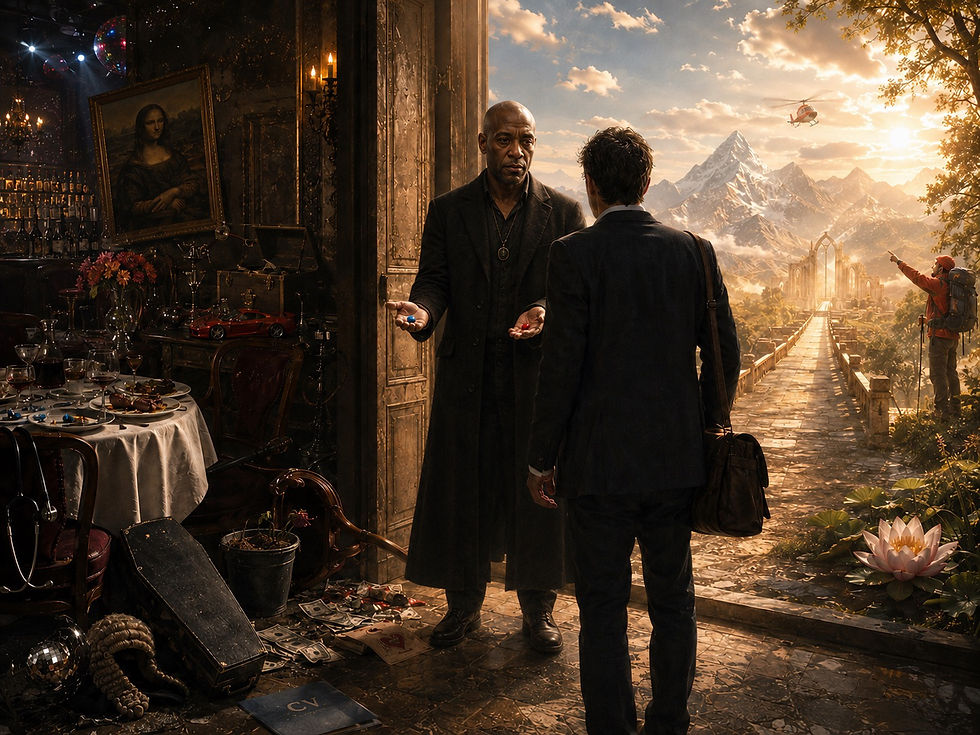
If you take the red pill, and it’s up to you, if you do,
"Buckle your seatbelt, Dorothy, 'cause idolatry and suffering are going bye-bye.”
Do not bow before false authority. That is where Ivan Turgenev belongs, as the first glimmer of another orientation:
“Does not bow down before any authority, who does not take any principle on faith, whatever reverence that principle may be enshrined in.”
Awareness can become a tool of personal liberation and societal critique. And there is so much of that in store, with more than a little help from the fearless Foucault and the adroitness of Kuhn.
For now, Schopenhauer remains the governing witness, chaos remains the governing chamber, and Turgenev provides the first crack of light.
The doom-scroll mind, the addiction to ‘bad news’, overstimulation followed by numbing, the sense that everything is happening at once, the loss of inward seat, and the absence of any real programme for living. It should also begin to hint that this restless “Will to life” is not yet the root, but the felt disorder of a deeper wound. In that sense, this is still the broad chamber of chaos: Not yet the fight, but the weather in which the fight becomes likely.
“Fear knocked on our door.
Love answered.
There was no one there.”
Not sure yet about love? Ok, let’s rewind. Let’s go back, to the dark clouds that are seemingly forming: Let’s get back to the chaos and conflict, but not for long: Not long at all.
Right, enough love for one introduction, now let’s dive into chaos, because that’s where we are at. But not for long. And, again, we can handle it, we always have.
If this article is to begin honestly, which it will, it must begin where many lives begin: In chaos. This is not a big reveal, but it may be how we feel.
Chaos and Conflict
Most of us feel like there is a storm brewing and we don’t like the rain. And it’s raining big cats and rabid dogs. Or so we think.
Schopenhauer wrote:
“Talent hits a target no one else can hit; Genius hits a target no one else can see.”
So, Arthur, as a genius, why didn’t you see?
Chaos and conflict are not historical events. They are an account of the suffering of the Human Condition. They are the outward theatre of an inward fracture. It is what happens when the divided psyche scales itself up: From one person to one family, to one ‘tribe’, to one institution, to one nation, to a ‘civilisation’ that has become technologically sophisticated enough to destroy itself at a global scale while remaining, in crucial respects, psychologically unintegrated. The twentieth century was not short of evidence. The Second World War alone killed 80 million people worldwide, and the Soviet Union lost 27 million of its own people. Those numbers stop the breath. Twenty-seven million is not a statistic so much as a civilisational wound. Add to that the famines, purges, genocides, partitions, ideological slaughters, and the still-unfinished catalogue of contemporary bloodshed in Ukraine, Gaza, Sudan, and elsewhere, and one is forced to admit something both obvious and strangely resisted: The world is not merely troubled; it is structurally at war with itself.
Why Civilisations Can Know and Still Not See
Judith Lewis Herman is a psychiatrist whose book ‘Trauma and Recovery: The Aftermath of Violence—From Domestic Abuse to Political Terror’ became foundational because it refused to treat Trauma as merely a private event inside an isolated patient. Lewis Herman is a major clinical and theoretical witness, moving repeatedly between person and society, memory and denial, survivor and the social world capable — or incapable — of hearing. That makes her particularly important at precisely the point where Article I of the '10 Cs' changes scale. The question is no longer only why one individual looks away. It is how families, communities and whole cultures can become organised around not knowing what, at another level, they already know.
The twentieth century did not suffer from an absence of information about human suffering. Nor do we. Sometimes the difficulty is not that evidence has failed to arrive but that seeing what the evidence means would threaten identities, loyalties and institutions constructed partly to keep that meaning at bay. Herman begins her book with a sentence that deserves to sit here like a small bell that rings true and reaches far:
“The ordinary response to atrocities is to banish them from consciousness.”
That does not excuse denial. It makes denial part of the problem we are trying to understand. Truth therefore needs more than data. It needs somewhere to land. It needs relationships and cultures in which seeing does not automatically cost belonging. The child, the family and the civilisation may be separated by enormous differences of scale, but the question begins to rhyme: What happens when knowing becomes more dangerous than not knowing? The battlefield may be much closer to the nursery than any of us would like to imagine. And that denial is a massive part of the problem.
The 'ACEs Dose-Response': The Wound Does Not Stay in the Nursery — From Childhood Wounds to Civilisational Conflict
One does not, of course, need Stalingrad or Verdun to glimpse the same structure in miniature. Christmas lunch will often do. “Whaaaat?” you may say. Yup. A table set for peace can become, in under seven minutes, a tribunal of old grievances, reactivated childhood roles, and family members speaking to one another as though they were prosecuting a case on behalf of wounds they have never named. The scale changes; the psychology does not. Conflict is fractal.
Vincent Felitti, Robert Anda, and colleagues did not set out to write a philosophy of the Human Condition when they conducted their massive Adverse Childhood Experiences (ACEs) population analysis. They asked a much less 'glamorous' epidemiological question: Whether categories of childhood abuse and household dysfunction were associated with later adult health. More than 9,500 adults responded. What emerged was not a neat childhood/adulthood boundary but a dose-response pattern running straight through it.
Before the roast potato becomes a constitutional crisis, it is worth putting one hard piece of ground under the joke. Childhood is not simply 'the past' in the sense that a finished chapter is 'past'. At population level, the breadth of adverse childhood exposure is associated with later health risks in a graded way. Felitti and colleagues put it plainly:
“We found a graded relationship between the number of categories of childhood exposure and each of the adult health risk behaviours and diseases that were studied.”
Felitti, V. J., Anda, R. F., Nordenberg, D., et al. (1998). 'Relationship of childhood abuse and household dysfunction to many of the leading causes of death in adults: The Adverse Childhood Experiences (ACEs) Study.' American Journal of Preventive Medicine, 14(4), 245–258.
Boom!
The study gives the developmental claim in this book a famous, large-sample epidemiological floor. The key word is graded: greater breadth of adversity tracked with greater adult risk across many outcomes. Granted the ACEs Study is observational and retrospective. It establishes strong graded associations, not a deterministic rule that a given ACEs score predicts a given adult, nor proof that all adult conflict is caused by childhood adversity.
With that said, the study by Felitti and colleagues is, however, easily, arguably by a long mile, the most important scientific study published in the last three decades in any discipline, precisely because it has global, and 'Trans-Paradigmatic' real world consequences, which has been almost entirely ignored, or rather, deliberately ignored ever since, presumably due to the dire consequences for those institutions that have done their best to keep it hidden for fear of their own dissolution in view of its implications for clarifying how the world really works, melting like the 'Wicked Witch of the West.'
This does not turn Christmas lunch into an ACEs study, although it is, with an n = 2 to 12 or so, depending on the size of the family, repeated in every home round the country, nor does it mean that every argument is a Trauma reenactment. It means something both smaller and more consequential: Adult bodies and behaviours do not arrive from nowhere. The person at the table brings a developmental history. When old roles flare under pressure, the psychologically serious question is not merely “Why are you behaving like this?” It is also “What did this nervous system once have to learn in order to belong, endure or survive?” This in itself is an extraordinary scholarly finding. What makes it terrifying is that behaviour is largely subconscious. It is highly associated with denial. It is strongly linked to judgement. As if “I dehumanise you, which humanises me, which allows my guilt of being human to be projected and transferred onto you. In pointing my finger at you, or in locking you up, I throw away the key to my skeletons — my shadow will never be brought into the light and I ensure that by condemning you.” But, who are you to judge?

The Family Christmas Lunch and The Human Condition
The family Christmas lunch is often the perfect miniature of the Human Condition: A festival nominally dedicated to peace, love, joy, reconciliation, and forgiveness can, by pudding, become a low-budget war zone of projections, grievances, territorial skirmishes, historical footnotes, passive aggression, and one uncle behaving as though a disputed roast potato were grounds for constitutional crisis. The comedy is obvious. The diagnosis is less so. For what usually returns around that table is not the free adult self, but the old family ‘operating system’: Each person slipping back into the posture of the petrified inner child, now wearing grown-up clothes and highly developed armour – egos at war over lunch.

That one scene in the image above contains several of the article’s early ‘C’s’ at once. Chaos and conflict, because the nervous system is already braced for battle before any actual offence occurs. Confusion, because everyone is reacting not only to what is being said now, but to ten thousand ghost-conversations from years earlier. How does one even begin to make sense of that? Conceit, because each person’s ego arrives armed with its own private prosecution bundle proving irrefutably that it is the reasonable one and everyone else is the problem. The conditionality of love hums beneath it all: Who is approved of, who disappointed whom, who never quite became what the family script demanded? And the tragic irony, of course, is that Christmas is meant to signify the arrival of love, while the table so often becomes a stage on which frightened selves compete for safety, significance, and control.
Which is precisely why the image is useful. The Christmas table is not an exception to my thesis. It is one of its clearest exhibits. It shows how quickly ‘grown adults’ can revert to defended children when old attachments are stirred, and how urgently the journey from chaos and conflict to consciousness and clarity, wrapped in love and compassion, is needed - not only in courts, institutions, and disciplines, but in the dining room.
The World is You and You Are the World: The Global Life-Course and Intergenerational Echo of Human Suffering
Nearly two decades after the original ACEs paper, Karen Hughes and colleagues pooled the available literature in a systematic review and meta-analysis 'The effect of multiple Adverse Childhood Experiences (ACEs) on health: a systematic review and meta-analysis'. The usefulness for this article is not that it proves one neat causal chain. It is that the association between multiple childhood adversities and later outcomes survives across a large and heterogeneous literature.
The family is therefore not merely a metaphorical rehearsal room for later life. It is one of the places in which biological, psychological, and social inheritance can become entangled. Hughes and colleagues found effects across the entire range of outcomes they examined:
“Exposure to multiple ACEs affect[ed] all 23 of the health outcomes examined."
Hughes, K., Bellis, M. A., Hardcastle, K. A., et al. (2017). 'The effect of multiple Adverse Childhood Experiences (ACEs) on health: a systematic review and meta-analysis'. The Lancet Public Health, 2(8), e356–e366.
The authors go further, carefully: some outcomes most strongly associated with multiple ACEs — including mental illness, problematic substance use and violence — can themselves become adversities in the next generation. That is not destiny. It is precisely the opposite: it is a reason to see the chain. Once the chain is visible, inheritance no longer has to masquerade as character, fate or “just how our family is”.
The great philosopher Jiddu Krishnamurti saw the root of how suffering widens with unnerving clarity:
“The world is you and you are the world.”
He meant, among other things, that war does not begin first in parliaments, trenches, or missile silos. It begins in division. It begins in the mind that cannot bear contradiction, in the self that must defend its image, in the ordinary human impulse to split reality into ‘me’ and ‘not me’, ‘ours’ and ‘theirs’, ‘saved’ and ‘damned’, ‘civilised’ and ‘barbaric’. The battlefield is therefore not the origin of conflict but its late expression. By the time tanks move, the psyche has already gone to war. Geo-politics is often psychodynamics wearing a flag. Geo-politics reflects our ‘Me’-o-politics: aka ‘ego-politics’.
Krishnamurti also stated the matter with less poetry and more surgical bluntness:
“War is the spectacular and bloody projection of our everyday life.”
Elsewhere, the same line of thought becomes even less flattering to the species:
“Each one of us is responsible for every war, whether it is in the East or West.”
That is not a sentimental line, nor a collectivist cliché. It is a devastating psychological claim: What we refuse to examine in miniature, history eventually stages in public.
This is why the clinical frame matters. If one were to name the central pathology of the human condition in properly diagnostic terms, one would not begin with evil as essence, but with fracture as structure. The psyche, when unintegrated, does not merely suffer; it splits. It dissociates. It represses. It projects. It disowns its own contents and then meets them again in apparently external enemies. In that sense, the first war is intra-psychic. The ego wages a defensive campaign against whatever threatens its self-image; the shadow, banished from consciousness, returns as irritation, contempt, disgust, fear, compulsion, or righteous hostility. What is unowned within is soon prosecuted without. Long before there is war in the street, there is already a mortal conflict in the Soul between our fractured parts – our ego (our petrified inner child wearing armour) and our shadow (our denied selves), as shown in the image below.

But it doesn’t have to be that way. Jung and Jesus bring them together through love. And no, I have no intention of bashing you with a Bible. I don’t even own one. I mean Jesus as the great philosopher of love as a way of BEing. I am not being sentimental. I am being deadly serious.
The Gaze Must Include the Judge
Jesus of Nazareth is not being recruited here as a first-century Trauma theorist, psychologist or undercover Foucault in dusty Birkenstocks. He matters because the ethical geometry of Matthew 7 interrupts one of the oldest mechanisms of conflict: The assumption that the problem is located safely over there, in the person being inspected.
Conflict acquires extraordinary momentum once perception becomes prosecutorial. I see your defect with magnificent acuity while remaining curiously unavailable for inspection myself. Families do it. Partners do it. Political tribes do it. Professions and institutions do it with forms, procedures, coloured gowns and white coats.
Matthew gives us an older and much less comfortable instruction from Jesus from his teaching on the 'Sermon on the Mount' (Matthew 7:1–5, King James Version):
“And why beholdest thou the mote that is in thy brother’s eye, but considerest not the beam that is in thine own eye? Or how wilt thou say to thy brother, Let me pull out the mote out of thine eye; and, behold, a beam is in thine own eye? Thou hypocrite, first cast out the beam out of thine own eye; and then shalt thou see clearly to cast out the mote out of thy brother's eye.”

Projection deserves a brief mention here, because it is one of the great engines of conflict. In the psychological sense, projection is the process by which a person attributes his own unacceptable traits, affects, or impulses to someone else. The private movement is roughly this: “I cannot bear this in me; therefore, I will experience it as originating in you.” That mechanism is not merely clinical furniture. It is one of the principal ways individuals preserve ‘innocence’ while exporting guilt. Exporting guilt has become a major trade. It is also one of the principal ways groups preserve righteousness while manufacturing enemies. What the ego cannot metabolise, it externalises. What it externalises, it soon fears, hates, moralises, and then attacks. Judges are everywhere, judging others judging others, judging others. The world has become a dock. But the boat has not yet sailed, and the ship is sinking.
The cognitive style that often accompanies that split is what psychology calls ‘dichotomous thinking’: The tendency to think in polar opposites without tolerating the possibilities that lie between them. In plain English, it is black-and-white thinking. Once this takes hold, and it does, nuance becomes treachery, ambiguity becomes weakness, and the world is reduced to two camps, two moral colours, two permitted verdicts. Duality, in that degraded sense, is not just metaphysical depth; it is cognitive simplification with a weapon in its hand. And we are all carrying.
That internal civil war is the deeper meaning of the struggle between ego and shadow. Ego, in this frame, is not merely ‘selfhood’ in the neutral psychological sense. It is the defended, frightened, self-protective centre that mistakes its own survival strategies for identity itself. Shadow is not simply wickedness, still less some melodramatic inner villain. It is the disowned part: Aggression, yes, but also grief, vitality, desire, instinct, sorrow, power, tenderness, and un-lived force. When those elements are not consciously admitted, they do not vanish. They go subterranean. They become pressure. And pressure, moralised instead of integrated, becomes conflict. The unintegrated person fights ghosts it never sees and calls the fight ‘principle’. There is no monster under the bed – the monster is in our head. There is no invisible lion.
This is one reason that the adversarial legal system is such a potent example. Law at its best civilises conflict; it places limits, procedures, burdens, thresholds, and forms around human aggression so that we do not settle every grievance with a stone or a gun. But adversarial law also reveals the problem in its pure institutional form: Two sides, each incentivised to strengthen its own narrative, weaken the other’s, weaponise ambiguity, and ‘win’. It is a brilliant system for testing claims. It is not, by itself, a complete system for reconciling human beings. It is conflict formalised, disciplined, and ‘dignified’ - sometimes nobly, sometimes with extraordinary moral seriousness, but conflict, nonetheless. The courtroom can become a cathedral of civilisation; it can also become a highly educated way of fostering division.
And there is an irony here sharp enough to deserve its own dock. In practice, adversarial systems will often spend immense energy establishing what a person did, then reserve developmental context - childhood trauma, attachment injury, humiliation, fear-conditioning - for the mitigation stage, as though causation were a soft afterthought rather than part of the explanatory substance. One can increase sentence length with polished confidence while barely touching the architecture that made the conduct more likely. That would already be troubling. It becomes more troubling still in a profession that is itself carrying conspicuously high levels of distress: One major study of lawyers found significant symptom levels of depression, anxiety, and stress at 28%, 19%, and 23% respectively, while later work has described lawyers as among the professionals most at risk of burnout, substance abuse, alcoholism, and suicide. The profession that daily judges fractured conduct is not exactly floating above fracture. But why? And what is law really teaching us?
Law, in its immature form, entrenches duality. It is a ‘monastery’ for teaching us about duality – black and white thinking, of ‘right’ versus ‘wrong’. ‘Good’ versus ‘bad’. ‘Guilty’ versus ‘not guilty’. Is a barrister addicted to cocaine bad? Law trains the mind into sides, winners, losers, attack, defence, and the procedural theatre of conflict mistaken for justice. But for a profession proclaiming ‘Truth’, it is not looking for ‘Truth’: Not even close. Law, as it currently stands, is based on ‘might is right’. It is transaction masquerading as Truth. Its neutrality is often presented as myth-free objectivity, yet too often what passes for neutrality is merely a system of authorised partiality wearing formal clothes. One sees this most clearly when developmental suffering is treated not as a source of intelligibility but as a marker of risk: Trauma is acknowledged only insofar as it can be folded back into suspicion. That is not jurisprudential maturity. It is adversarial intelligence and ‘brilliance’ still operating below the level of wisdom. So long as law remains organised around triumph rather than Truth, it will collude in the very fragmentation it claims to regulate. The task, then, the challenge, is not to sentimentalise law, but to invite it to mature: To move from a system that manages divided selves toward one that can see humanity whole enough to become, at last, a healing institution that heals itself, the parties before it, and the culture that produced them. An invitation to grow up.
A line which has the right clinical ring here, often attributed to Mahatma Gandhi, the lawyer who was a teacher of love and forgiveness, is this:
“The world is not in its right mind.”
This line has the ring of clinical truth whether one fixes the exact source at once.
When asked about Western civilisation, Gandhi replied:
“I think it would be a good idea.”
The line is both hilarious and tragic. Hilarious, as instant recognition of Truth when so precisely verbalised is felt as such. A civilisation can be scientifically advanced and psychologically deranged. It can split the atom without integrating the self. It can build universities, courts, hospitals, laboratories, cathedrals, parliaments, and space rockets while remaining inwardly and outwardly governed by fear, vanity, humiliation, envy, projection, and unexamined hurt. Indeed, one of the more alarming facts of history is that intelligence and fragmentation are perfectly capable of cohabiting. Human beings are clever enough to build systems they are not yet wise enough to inhabit. We are planning Mars missions, while trashing the Earth. We dream of reaching the stars, but don’t look inside. Consciousness remains a mystery.
J. Robert Oppenheimer famously recalled the line:
"Now I am become Death, the destroyer of worlds."
from the Hindu scripture the 'Bhagavad Gita' (Chapter 11, Verse 32) upon witnessing the first ‘successful’ nuclear detonation (the Trinity test) on July 16, 1945. The quote reflects his profound sense of awe and dread regarding the power that conflict, science, and ‘civilisation’ had unleashed. Oppenheimer, known as the "Father of the atomic bomb," cited this passage to express the transformative, terrifying power of the atomic bomb. Later in life, he reflected on the moral burden of his work, stating:
"The physicist has known sin."
While often thought to be spoken immediately at the moment of detonation, Oppenheimer recalled this thought during a 1965 interview, noting that while others laughed or cried, he remained silent.
And yet conflict is not the whole story, because man is not reducible to violence. This is where the brilliant and controversial historian Rutger Bregman’s corrective in his book ‘Humankind’ matters. His wager - provocative precisely because it runs against the fashionable cynicism of late modernity - is that most people are “Pretty decent.” He gives example of the ‘Christmas Truce’ of 1914, in the First World War, which remains such a haunting emblem because it shows, in miniature, that the machinery of war and the instincts of ordinary men do not always align. Soldiers, having been told to hate, emerged from trenches to exchange food, cigarettes, songs, and fragile recognitions of shared humanity with the other side. Likewise, the recurring observation that many combatants historically hesitated to kill directly - sometimes firing high, sometimes missing when not under immediate threat, sometimes resisting close-range violence in ways their institutions disliked - suggests that bloodlust is not as native to the human organism as our darker mythologies prefer to imagine and love to tell as stories. One should be rigorous here: Some of the most famous battlefield anecdotes have been debated, overstated, or methodologically contested. But the broader point survives the trimming. Human beings are often more reluctant to kill than the institutions that train them.

The point that the legal system and the warring ‘egopolitical’ geopolitical system fail to see is that there is no human enemy. It is only us, that when we are caught in our own ego, is marauding behind ‘enemy’ lines. There are no winners in war. There is no victor in the ‘blame’ game, and it is far, far from a game.
Bregman’s own shorthand is crisp enough to survive quotation marks:
“Most people, deep down, are decent.”
That line matters because it corrects the lazy glamour of pessimism. It also fits the Christmas Truce precisely: If the average person were truly born thirsting for slaughter, trench fraternisation would make no sense at all. It happened because ordinary human beings are often more humane than the institutions designed to organise them.
When First World War bayonets were analysed, reports suggest that they had no blood on their daggers. Anecdotes and contested military-history claims about reluctance to kill point in the same direction.
That intuition is not far from a major strain in the French Enlightenment, above all Rousseau: Man is not born a monster and then occasionally improved by society; rather, he possesses a native capacity for pity that social vanity, rivalry, status anxiety, and institutional corruption can distort. Rousseau would not have said that human beings are incapable of cruelty. He was not that naïve. His point was subtler and more damning: The forms of ‘civilisation’ that we build magnify comparison, humiliation, competition, and domination until they become second nature. We then call the resulting deformity ‘human nature’ and congratulate ourselves on our realism. It is a neat trick. First build the machine that trains the pathology; then declare the pathology inevitable. Humanity is not civilisation. Civilisation is man made. When did we forget that?
Rousseau’s opening line in ‘The Social Contract’ still lands like a judicial rebuke to the ‘civilised’ world:
“Man is born free; and everywhere he is in chains.”
It is not the whole of this article’s argument, but it is close enough to the marrow to earn its place here. Institutions do not invent every wound, but they can certainly systematise it, reward it, dress it in procedure, and then call it ‘order’. This is where the metaphor of ‘The Glass’ from my previous article ‘The Human Condition and How to Heal It: ‘The Seat of The Soul’, ‘The Glass', and 'The Hula Hoop'’ becomes useful again. The problem is not simply that human beings are conflictual. It is that most of us do not know where we end and where our projections begin. We leak. We trespass. We merge. We invade and are invaded. Proper boundaries are therefore not a bourgeois nicety or a therapeutic slogan; they are the precondition for an inner seat.


John Donne said it more memorably, and with more grace, than most modern therapeutic language ever manages:
“No man is an island,
Entire of itself;
Every man is a piece of the continent,
A part of the main.
If a clod be washed away by the sea,
Europe is the less,
As well as if a promontory were:
As well as if a manor of thy friend's
Or of thine own were.
Any man's death diminishes me,
Because I am involved in mankind.
And therefore never send to know for whom the bell tolls;
It tolls for thee.”
That is not a sentimental plea for niceness. It is an ontological correction. We forget, with astonishing regularity, that we belong to the same humanity. We forget it in war. We forget it in politics. We forget it in marriage. We forget it at Christmas lunch with our families. We forget it in court, online, in boardrooms, and in our own private moral dramas. Then we act as though separation were reality and connectedness a noble optional extra. Donne had already dealt with that. Why do we not hear?
Shakespeare, with his usual delightful insolent indecency of psychological and philosophical precision, captured the exhausted nihilism of the unintegrated condition in a soliloquy in ‘Macbeth’ Act V Scene v:
“Tomorrow, and tomorrow, and tomorrow
Creeps in this petty pace from day to day
To the last syllable of recorded time;
And all our yesterdays have lighted fools
The way to dusty death.
Out, out, brief candle!
Life’s but a walking shadow, a poor player
That struts and frets his hour upon the stage
And then is heard no more.
It is a tale
Told by an idiot, full of sound and fury
Signifying nothing.”
That line lands so hard because it names what conflict feels like when it has lost all intelligible proportion: Noise without meaning, movement without wisdom, force without form. But Shakespeare also understood something our more therapeutic age occasionally forgets: The idiot is not always outside us. Sometimes the one telling the tale is the frightened, inflated, unexamined ego itself - frantic, theatrical, self-justifying, and desperately certain while the house quietly burns.
And this is also where Christ has to enter the scene, not yet as dogma, but as a radical intervention into retaliatory psychology. In the revelatory ‘Sermon on the Mount’, the instruction is exact and famously challenging to our egos in Matthew 5:39:
“But I say unto you, That ye resist not evil: But whosoever shall smite thee on thy right cheek, turn to him the other also.”
Whatever else one does with that verse, it is plainly not a hymn to egoic escalation. It is an assault on reflexive retaliation, on the narcissism of symmetrical revenge, on the inner machinery that believes every blow must be mirrored back if the self is to remain intact. Conflict says, “Strike back.”
Consciousness asks whether the compulsion to strike back is itself the jailer.
So ‘Chaos and Conflict’ is the right place to begin because it names the felt state of the world and the ordinary atmosphere of the human condition. But it is not yet the diagnosis in full. Conflict is the symptom made visible. It is the smoke, the courtroom battle, the trench line, the marital stalemate, the ideological purge, the online mob, the self-attack, the nation at arms, the split profession, the divided mind. It is the daily weather forecast of our lives as we currently practise them. The deeper question is why, despite centuries of brilliance, systems, scriptures, therapies, revolutions, and reason, we remain so astonishingly good at reproducing the fracture but seem incapable of seeing what caused it, the consequence it has in destroying our lives, and the way to heal it. That is where the next movement must go, before we see the doorway out of the ego’s prison. Our own ego’s prison. Once conflict has been named, one has to face the more humiliating fact: We are not only at war - we are confused.
Confusion
Why are most of us confused? Because conflict is the only language that the ego knows, and the ego wears thick gloves and its view is obscured when it tries to discover Truth with a capital T – Higher Truth – what I call “Real reality”. For the ego can send man to the moon, but it does not know itself.
Rumi, the 13th-century Persian poet, is renowned for profound wisdom on love, spirituality, and self-discovery. Rumi regarded love not just as emotion, but as the core of existence, encouraging followers to live with passion and surrender. His most famous quotes often focus on inner transformation; there are almost too many to choose from:
"The wound is the place where the Light enters you."
"What you seek is seeking you."
"Your task is not to seek for love, but merely to seek and find all the barriers within yourself that you have built against it."
"Stop acting so small. You are the Universe in ecstatic motion."
And most significantly:
“Yesterday I was clever, so I wanted to change the world. Today I am wise, so I am changing myself.”
The Ego-Mind Is a Civilisational Miracle, A Spiritual Farce, And a Humanitarian Crisis of Fear Idolatry Masquerading as a Solution

The above image represents the ego-mind as civilisational miracle and spiritual farce. It can build engines, calculate trajectories, and send metal into the heavens—yet it cannot see the simplest thing: itself. The armour is not strength; it is adaptation. The thick gloves are not power; they are anaesthesia. The almost-sealed visor is the whole pathology: A consciousness narrowed into survival mode, trying to discover Truth while refusing to feel. In that state, conflict becomes the default dialect, because conflict is what a threatened identity uses to stabilise itself. And so the knight wanders—arms half-raised, defensive, searching—unable to locate the luminous entrance behind him: The corridor of higher and higher Truth, the place where perception clears not by argument but by disarmament. The rocket is not mocked here; it is honoured. The point is simply this: The same mind that can master outer space can remain illiterate in inner space — until it learns to calling armour ‘wisdom,’ and stops calling blindness ‘certainty.’

When Fear Bends the Inner Compass
Conflict is what fracture looks like once it becomes visible. Confusion is what psychic fracture feels like before it has found its ‘uniform’: A suit of cognitive armour. It is the fog that settles over a life when the inner compass has been bent so long that misdirection begins to feel like instinct.
The strange must become familiar without becoming small. That is the whole work of this section. Words like love, Truth, Self, healing, ego, trauma, consciousness, and freedom have become floats drifting above the life they were meant to illuminate. The task is to return density to them, so that we can finally feel structure inside the weather. To gently guide this, please my article 'The Psyche: A New Grammar For The Human Condition.'

The image above gives visual form to one of the chapter’s most important clarifications: confusion is not simply the absence of knowledge, but a state of misorientation. One can be intelligent, articulate, trained, even outwardly impressive, and still be moving through life with a bent inner compass. That is because the problem is not always information but influence. Trauma, fear, attachment, and preference begin tugging long before conscious thought catches up, until what is merely familiar starts to feel true. The needle then leans, repeatedly and with uncanny consistency, toward the old wrong direction, while the person mistakes recognition for reality. In that sense, the compass is not a decorative metaphor but a diagnostic one. It shows how a human being may sincerely seek direction while still being guided by forces they do not yet see.
The ego, in this sense, is a liar; not always a theatrical liar, not always a melodramatic villain, but a quiet, adaptive falsifier. Trauma lies too. It tells the organism that what was once necessary for survival is now the same thing as Truth. It teaches vigilance and calls it wisdom, numbness and calls it strength, self-erasure and calls it love, repetition and calls it fate. Then, whenever the road forks, it leans, with uncanny consistency, toward the familiar wrong turn. The tragic genius of the traumatised ego is that it mistakes recognition for reality. What feels known is treated as what is right.
This is why confusion is not merely lack of information. It is misorientation. One can be highly educated and profoundly lost. Indeed, modernity has become rather accomplished at producing people who can explain everything except themselves. The old religious vocabulary would have called this a fall; the clinical vocabulary might call it fragmentation; the more ordinary human vocabulary calls it not knowing who one is, what one is doing, or why so much of one’s life feels like a negotiation with a stranger wearing one’s own face.
Socrates, or at least the Socratic tradition, names this with the kind of humiliating clarity that every serious philosophy eventually rediscovers. The famous line:
“I know that I know nothing”
is a later paraphrase, but in Plato’s Apology the thought is already there:
“For I know that I have no wisdom, small or great.”
and later, that the wisest man is the one who knows that:
“His wisdom is in truth worth nothing.”
This is not fashionable self-abasement. It is the beginning of intellectual honesty. Confusion becomes fertile the moment it stops pretending to be certainty.
This is also where what Dr Gabor Maté, with Gordon Neufeld, has written becomes extremely important. In ‘Hold On to Your Kids’, they argue that children today:
“Look to their peers for direction.”
and that this form of ‘peer orientation’:
“Undermines family cohesion.”
That is not a nostalgic complaint about the death of proper manners. It is a developmental warning. If the primary attachment bond is displaced, then children begin forming identity not around mature containment but around lateral imitation, status anxiety, social mimicry, and the terrified art of fitting in. The result is not freedom. It is counterfeit belonging. It becomes a search for immature love, substitute love, imitation love. Not real love.
Once that displacement is fused with social media, the problem becomes more than interpersonal; it becomes civilisational. The U.S. Surgeon General’s 2023 advisory states that:
“Our children and adolescents don’t have the luxury of waiting years.”
to learn the full impact of social media and says that the existing evidence already warrants “significant concern” about how these platforms are currently designed and deployed. That matters because it names something the culture still prefers to treat as an inconvenient sidenote: We are now raising many children inside systems specifically engineered to monetise attention, intensify comparison, accelerate identity-performance, and keep insecurity scrolling. In such an environment, authenticity does not merely fail to emerge; it is actively outbid. But authenticity is a survival need. And when that survival need is not met, it screws up our lives, like a gigantic locomotive that just will not stop.
The consequence is a crisis not only of attention but of identity. A child who is insufficiently rooted in attuned attachment often grows into an adult who does not know who he is and therefore cannot know with confidence what he ought to do.
When Fear Bends the Developing Inner Compass, Giving it a Developmental Substrate
Martin Teicher and Jacqueline Samson are researchers in developmental psychopathology whose major 2016 review is particularly valuable here because it avoids both extremes: Neither “Nothing important happens to development” nor the sensational claim that childhood Trauma simply 'damages’ the brain. Rather, their review examines how the type and timing of maltreatment are associated with "Altered developmental trajectories", some of which may be understandable as adaptations to threatening environments. The exact nuance that this section capably delivers.
Therefore, Martin Teicher and Jacqueline Samson’s major review is useful because it is both strong and nuanced. This significant work gives my ‘bent compass’ language a rock solid neurodevelopmental floor with compassionate support: My “Hand in the Earth” truly is grounded in empirical bedrock.
When I say that fear can bend the inner compass, editing perception, metaphor should not be asked to perform all the scientific labour. A developing nervous system is plastic to experience. What repeatedly predicts danger can become increasingly salient; what once protected may become easier to recruit again. Teicher and Samson summarise an important shift in the field very simply in a single sentence:
“A key breakthrough has been the discovery that maltreatment alters trajectories of brain development.”
Martin Teicher & Jacqueline Samson, 'Annual Research Review: Enduring Neurobiological Effects of Childhood Abuse and Neglect', Journal of Child Psychology and Psychiatry (2016)
The clinical humility lies in what follows. Adaptation to danger can be intelligent in the environment in which it develops and costly in a later environment that no longer requires it. Hypervigilance, a massively prominent and documented and researched feature of Elite Professionals such as lawyers, can once have protected. Numbing can once have protected.
The important word for this book, as one can see from the above quotation, is absolutely not damage but trajectory. Rapid threat detection can once have protected by helping a child navigate a room, as they had no SatNav installed during childhood, whose emotional weather genuinely was unpredictable.
Confusion begins later, when yesterday’s protection is experienced as today’s Reality — when the compass still points towards an old fire after the fire has gone out.
The ‘Re-Collection Sequence’ and the ‘Identity Fracture Sequence’
This is where my contrast between the ‘Re-Collection Sequence’ and the inverted, anti-metaphysical ‘Identity Fracture Sequence’ becomes so exact. In the healthy order, the ‘Re-Collection Sequence’, one begins with BEing, moves into action, and receives what follows as consequence:
BE > do > have
In the ‘Identity Fracture Sequence’, the order reverses:
Have > do > BE
In the second sequence, one tries to acquire first, perform second, and derive identity as a by-product of possession. Metaphysics is turned on its head, and it doesn’t function like that. It never ends well: Because it begins so badly. You cannot fit your Soul to your role. But you can fit your role to your Soul.
Chasing ‘Identity Fracture’ is insatiable. It is unquenchable. It is a spiritually expensive mistake. It is a psychologically futile exercise. It commodifies you. Because if ‘having’ is made the basis of worth, then enough can never arrive. The market is happy to assist. It has products to sell to every version of emptiness.
At the beginning, truth can feel dangerous. This is not resistance; it is neurobiology. A nervous system trained under threat does not greet disconfirming reality as a charming philosophical update; it meets it as destabilisation. This is why so many people cling to familiar confusion rather than risk unfamiliar clarity: The organism must learn, often through repeated safe contact, that feeling is survivable, that reality can be faced without annihilation, and that the pattern is protective rather than proof of personal defect.
Confusion and chaos therefore are not only psychological; they are commercial: They are transactional. Whole economies now depend upon keeping the self slightly uncertain, slightly inadequate, slightly unconvinced that it is allowed to exist without another purchase, another credential, another aesthetic upgrade, another algorithmic hit of borrowed significance. The traumatised ego is exceptionally vulnerable to this arrangement because it is already primed to seek safety through external reinforcement. Consumerism does not invent the hole; it simply rents it by the month: It feeds your deepest fears – and they grow while your self-worth shrinks even further.
This is one reason the ‘12 Steps’ retain a seriousness that many modern people dismiss too quickly. Alcoholics Anonymous describes the Twelve Steps as the core of its program of personal recovery, and the architecture is not accidental. It begins with an admission that life has become unmanageable and culminates, crucially, in a search for ‘conscious contact with God as we understood Him’. That last phrase matters more than both its pious friends and its secular critics often realise. It carries humility built into its grammar. It does not say, in effect, “We have captured absolute Truth and filed it alphabetically”. It says: There is a larger order than our present ego, and recovery begins when we stop confusing our current compulsions with freedom. For many people, that is not merely a treatment model. It is the first coherent moral psychology they have ever encountered. Living in ego mode means that there is ‘too much of us inside.’ This gives no space for connection – to our true selves or to others.
This is also why institutional religion, however legitimately criticised, cannot simply be sneered out of the room like an embarrassing uncle in ceremonial robes. Religious institutions are man-made; they are therefore vulnerable to vanity, corruption, rigidity, tribalism, and all the familiar diseases of organised humanity. Like all disciplines they are based on power through protected knowledge and idolatry. But by being based on knowledge, they live in boxes – paradigms of fear: Contracted consciousness. But it does not follow that they contain no truths about how to live. Practices of forgiveness, prayer, and service are not rendered useless merely because the institutions carrying them are imperfect. A cracked chalice can still hold water. The modern mind often makes the opposite mistake: It notices hypocrisy, concludes the whole enterprise is rotten, and then quietly leaves the Soul to be parented by Instagram and quarterly sales targets. One does not have to be especially devout to suspect that this is not an upgrade. The great Danish philosopher, poet, and social critic Søren Kierkegaard wrote that:
“The function of prayer is not to influence God, but rather to change the nature of the one who prays.”
For some, the clearest corrective does not arrive through institution at all, but through contemplative practice. Meditation is not an ornament for the ‘positive mindset’ industry. The National Center for Complementary and Integrative Health defines meditation as a set of practices that focus on mind-body integration and may “Calm the mind and enhance overall well-being,” and it notes that mindfulness-based approaches have been found better than no treatment at all for anxiety and depression in large analyses, while being handled with the usual scientific caution about mixed evidence and overclaiming. That combination matters: Discipline without hysteria, benefit without grandiosity. In lived terms, meditation can become the place where one hears, beneath noise and performance, the quieter voice that is not merely another reflex of fear. Kierkegaard again:
“I found I had less and less to say, until finally, I became silent and began to listen. I discovered in the silence, the voice of God.”
When the Room Becomes More Believable Than Your Eyes: The ‘Emperor Problem’ is Experimentally Real — Private Sight, Public Conformity
This section is the ideal ‘Earth-Hand bridge’ into the ‘Conceit’ and ‘The ‘Emperor’s New Clothes’ and Professional Identities’ section. it earns its keep as itt shows, in a specific preschool experiment, that a person can publicly report the group’s obviously erroneous judgement while retaining a different private judgement. That is very close to the mechanism the Emperor parables make memorable.
This is admittingly a small, specific experimental paradigm. It supports a conformity mechanism; it does not show that Andersen’s courtiers are all Traumatised children, nor that every public/private discrepancy is caused by attachment fear.
Daniel Haun and Michael Tomasello tested four-year-old children faced with unanimous but obviously erroneous judgements from three peers. The results matters here for a second reason: It prevents us romanticising the child as naturally immune to conformity. Children are social beings too. Attachment, belonging and consensus matter very early.
The bent inner compass has a developmental substrate: Andersen’s child can therefore be used more carefully. The child is not a biological species called ‘The One Who Always Sees Truth’, although it feels it:
“Truth is a feeling and that feeling is love.”.
The psychologically interesting achievement is the recovery of enough trust in perception to say publicly what the eyes are reporting even when the room is reporting something else. Haun and Tomasello’s follow-up makes the distinction beautifully:
Developmental psychologists Daniel Haun and Michael Tomasello studied what four-year-old children did when confronted with a unanimous peer majority giving an obviously erroneous judgement. They matter here for two reasons. First, they give the social dimension of Confusion an experimental foothold. Second, they stop us romanticising Andersen’s child as though children belong to a magical biological species called a 'The Ones Who Always See Truth'. Children are social animals too. Belonging and consensus matter early.
Confusion, then, need not mean that private perception has vanished. Sometimes something stranger happens: I still see what I see, but I learn that saying what I see is expensive. In follow-up testing, Haun and Tomasello found an important distinction:
“Children did not change their ‘real’ judgment of the situation, but only their public expression of it.”
Daniel Haun & Michael Tomasello, 'Conformity to Peer Pressure in Preschool Children'; Child Development (2011)
That one sentence turns ‘Confusion’ from ignorance into a social problem. The study is a specific preschool conformity experiment with a very large implication, provided we do not overgeneralise it. It supports the striking possibility that public agreement can diverge from private judgement. A room can manufacture the appearance of consensus without manufacturing private conviction. The cloth does not have to become visible. A person can know and still not say. It may be enough that everybody learns the social cost of saying, "I cannot see it". And once that mechanism enters organisations, professions and systems of authorised knowledge, private Confusion begins acquiring public architecture. We absolutely do not need to cut the child, or the adult for that matter, to fit the cloth.
“I see nothing” has become expensive.
When Disciplines Mistake Their Spotlight for the Sun
And this brings us to the deeper confusion: We are not only confused about who we are; we are confused about what Truth is. Scientists and atheists often attack religion and spirituality with the intensity of those defending a threatened civilisation, as though prayer, contemplation, and transcendence were not merely mistaken but intolerable. Religious dogmatists often repay the compliment, treating science not as a disciplined method with real explanatory power, but as a spiritually blind usurper. Each side can become convinced that surrender would mean extinction. That is usually a clue that identity, not merely reason, is in the room.

Schopenhauer wrote famously:
"Every man takes the limits of his own field of vision for the limits of the world."
Dogma is not created by having convictions; it is created by confusing one’s preferred fragment of the map, a mere snapshot from a viewpoint, with the entire terrain itself. And no man-made institution - scientific, religious, therapeutic, ideological, or otherwise - is identical with absolute Truth. None is currently capable of holding it entirely. Einstein said:
"If we knew what it was we were doing, it would not be called research, would it?"
The word 'Research' comes from the Middle French word 'rechercher', meaning 'to search more closely' or 'to search again', as though looking harder, closer, again, and again will reveal something that has not yet been revealed. Grit, determination, dogmatic self-assurance (or should that be self-re-assurance) are certainly character traits of the ego.
The moment an institution mistakes its partial grammar for the whole of reality, confusion ceases to be an accident and becomes policy. Disciplines becomes the ego at scale.

This is why the disciplines, however valuable they might be at navigating certain scenarios, must eventually be brought into the ‘Council’ rather than worshipped in isolation. Science can test, measure, falsify, and refine. Science is the ‘how’. Psychology can interpret, diagnose, and illuminate pattern. Religion can preserve symbol, ritual, moral orientation, and a language for reverence. Philosophy can distinguish, clarify, and expose contradiction.
Philosophy is the ‘why’. But when any one of them seeks not understanding but sovereignty, it graduates from inquiry into conceit. That is the next fork in the road. Because confusion, though painful, still contains some humility: It at least admits that one does not know. Conceit is what happens when the ego can no longer bear that humility and chooses certainty instead. And only metaphysics, contemplative traditions, and BEing can lead you to the ‘who’. And the ‘who’ is who you are.
That is why the movement from this section to the next is not a rhetorical convenience but a psychological inevitability. A confused person may still seek Truth. A conceited person seeks the relief of feeling right. And the ego, when frightened enough, will usually prefer the second.
‘Right’ or ‘wrong’ is duality. And duality misses our world of colour. As Paul Cézanne wrote:
“Colour is the place where our brain and the Universe meet.”
Conceit
The ‘Emperor’s New Clothes’ and Professional Identities


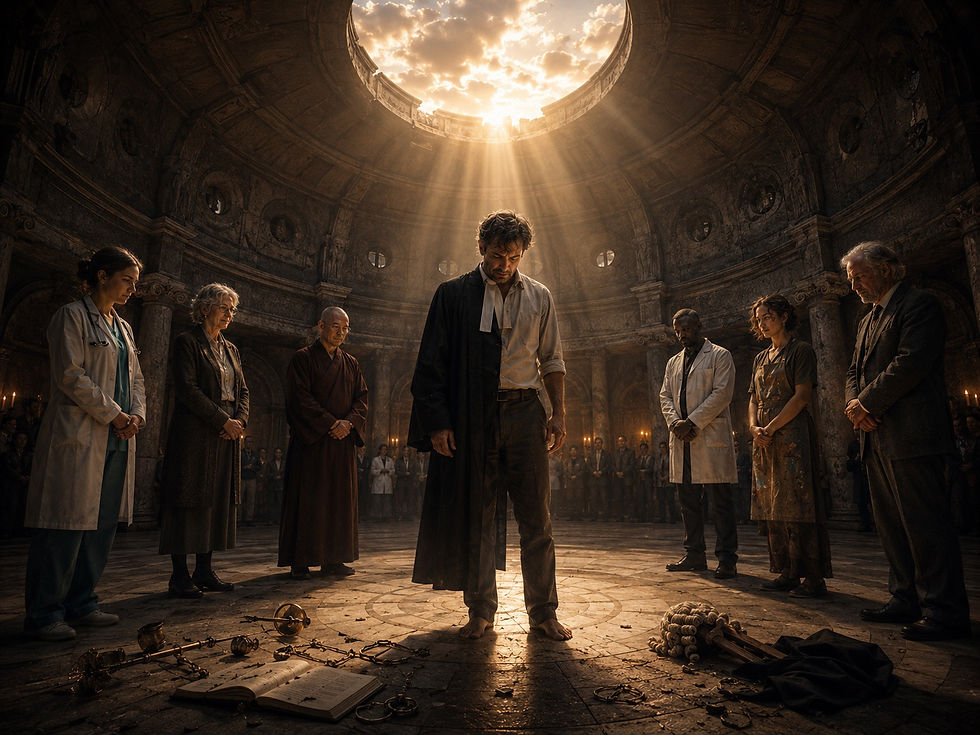

If ‘Conflict’ names the smoke and ‘Confusion’ names the fog, then ‘Conceit’ names the operator inside the machine. Conceit is not merely vanity in the cheap social sense, not simply peacocking, preening, or the rather modern talent of posting one’s breakfast as though it were a philosophical event.
Tireless self-Promotion: Counterfeit Ontological Addiction, Boxed by Epistemic Idolatry
Scoffing Our Faces on the External Validation at The Penthouse, Whilst Our Very BEing Remains Starving in The Lobby


Most people these days are media practitioners that are in the business of promoting their own personal mythology. We just do it on a slightly different form of media than Barthes is talking about. We do it on social media. Now, even if you don’t, you can at least relate to how the average person’s Facebook or Instagram looks, right? Someone’s Facebook page is not a total and accurate representation of who they are. It becomes sort of like a museum dedicated to the person they want other people to think they are, of which they are the sole curator. Think about all the mythology that’s present there. They’ll post a picture of themselves smiling on top of a mountain they just hiked, right after posting a picture of them eating some, like, avocado toast on a park bench, right before a picture of them boarding a plane. The caption reads, “Hey, guys! Just boarding the plane. Won’t be able to respond for a few hours. Talk to you then!”
The point is, these pictures weren’t chosen because they wanted to deliver a surface-level denotation of what’s going on in the pictures. They were chosen because they promote a very specific narrative they want to promote. Maybe it’s that, “Look, I’m the kind of person that gets on planes and travels around to a lot of interesting places. Look at my life.” Maybe it’s, “Hey, I’m the kind of person that eats avocado toast. The foods I eat are trendy, healthy, yet surprisingly portable. And, as you can see, I’m at the park, so I’m not the kind of person that squanders that portability of my avocado toast. Who am I? Well, you can tell by looking at my pictures. You know that person you’ll see sometimes in public, the sun glistening off of their perfectly clear skin and beautiful white smile as they sit on a park bench enjoying not only this moment that we’re in but their avocado toast as well? That’s the kind of person I am. You know, it’s funny. Someone just snapped a random picture. I happened to be here at the park of all places.” It says, “I am an avocado.”
Now, while this is just one example of it, no matter what mythological tale you’re weaving for people on social media, the reality is your actual life is far more complex than the story you tell people on social media. You’re not always smiling. There are countless things going on in your life that you would never include on there. And here’s the point. You can imagine, if someone you didn’t know just took the story you told about yourself on social media as a complete picture of what it is to be you, the only thing they’d really have is a very narrow picture of a mythology that you’ve produced. I mean, you certainly wouldn’t say this person understands who you are at your deepest level. Well, so too with mythology about the world that media produces. Just imagine if the Universe had a Facebook page. Your understanding of it would be tantamount to one of the stories people tell about themselves on their individual Facebook page. To an early philosophical structuralist, your own individual worldview is not a deep understanding of the Universe. Again, it’s an expression of a cultural norm. It is as much an expression of a cultural norm as a handshake is.
Conceit then, more precisely, is an exaggerated opinion of one’s own worth. It is the ego in rhetorical dress. And the brutality of it is that the ego does not become grandiose because it is secure; it becomes grandiose because it is frightened. The old recovery-room phrase remains one of the most concise diagnoses ever coined: The conceited self is ‘King Baby’ - a tiny sovereign, emotionally infantile, perpetually offended, endlessly demanding, and convinced that the Universe has somehow failed in its duty to recognise his exceptional distress.

The crowned child, outraged at the removal of a glowing device, is not a villain but a miniature portrait of ego itself — entitled, dependent, instantly dysregulated when comfort, stimulation, or control is interrupted. The gently bewildered adult beside him deepens the point: Much of what we later call addiction, grandiosity, or emotional immaturity is not created in isolation, but in systems that soothe distress with substitutes, then recoil when the substitute becomes necessary. In that sense, the scene is both darkly comic and clinically exact. As Gabor Maté repeatedly insists in substance, addiction is not a marginal pathology belonging only to a few damaged others; it is a human strategy of attachment, regulation, and relief. Or, put less ceremoniously: if one doubts that all of us are vulnerable to dependency, one might begin by observing what happens when the glowing object is removed from the tiny sovereign’s hand.
The ‘King Baby’ is one of the most concise 12-step aphorisms ever forged: A tiny, crowned sovereign convinced the world exists to regulate his feelings. If that sounds harsh, good—because it is also universally human. This image isn’t “about children.” It is about the origin story of the ego: A nervous system that cannot bear discomfort and therefore demands control. The iPad is merely the modern sacrament: A portable Temple of Emotional Anaesthesia—bright, numbing, obedient. The adult’s expression matters too: Confused, because the adult both created the dependency and now condemns it, as though the child’s reaction is a moral failure rather than a predictable biology of attachment, reward, and unmet need. The crown sits askew because the monarchy is unstable; the tantrum is not “badness,” it is panic—loss of soothing, loss of control, loss of the false god. We laugh because it’s funny. We should also wince, because the toddler is only the early draft. Later drafts are polished: Workaholism, righteousness, scrolling, alcohol, status, moral certainty—anything, frankly, that keeps the inner child from feeling what it felt.
Everyone is an addict – don’t believe it? Try to take an iPad off a baby.
But the word itself is richer than the modern insult. As noted above, ‘conceit’ originally belongs to the world of conception: A thought, a mental formulation, something conceived in the mind, an illusion. That is already instructive. Because in this article, when one speaks of the ‘mind’ in its ordinary unexamined mode, what is usually meant is not some pure neutral faculty floating serenely above human mess, but the ‘ego-mind’: the defensive interpretive apparatus that narrates, distorts, performs, protects, compensates, and calls the whole noisy production ‘me’. In that sense, the older meaning of ‘conceit’ is uncannily apt. A conceit is, in the first instance, just a conception. A mental construction. A formulation. And that is all the ego is at bottom: A fear-born formulation mistaken for identity. And when you live in fear, you live in a box.
That is why the ego is so theatrical and so strangely unconvincing, even when it appears most certain. It does not really believe itself. It is not a true king. It is a child in borrowed regalia, pulling velvet over panic. This is why the old Twelve Step line is so psychologically exact: The ego is an “Egomaniac with an inferiority complex.” The phrase sounds comic until one realises that it is not a paradox at all; it is a precision instrument. Grandeur is often compensation. Inflation is often camouflage. Noise is often a shield. The puffed-up self is rarely the strong self; it is usually the terrified self that has learned to survive by sounding larger than the tremor beneath it.
That maps directly onto the working definition already laid down in this wider thesis that the ego is our ‘petrified inner child wearing a suit of armour’. That is not just a vivid phrase; it is a complete anatomy. The child is the wound, the fear, the unmet need, the original dependency, the craving for ‘imitation love’, the need for control-as-safety, the ‘paper-mask’, the inauthenticity, the persona. The armour is the adaptation: The restricted seeing, the insensitivity to feeling, the defended style, the conflict-seeking shell that speaks in certainty because uncertainty feels like annihilation. The ego is therefore not the real Self but the costume stitched together by survival. It is the mask that once kept the child safe and now keeps the adult unfree. And that King Baby becomes the adult and stays that way.
This is why Friedrich Nietzsche belongs here: He is not being dragged in as a cheap villain, but as a genius caught in the very mechanism he illuminated. His warning about the ego:
“Becoming the mask you wear.”
That is conceit in its most elegant form. The ego first wears a mask to function. Then it identifies with the mask. Then it protects the mask as though the mask were life itself. Eventually the person no longer has a persona; the persona has a person.

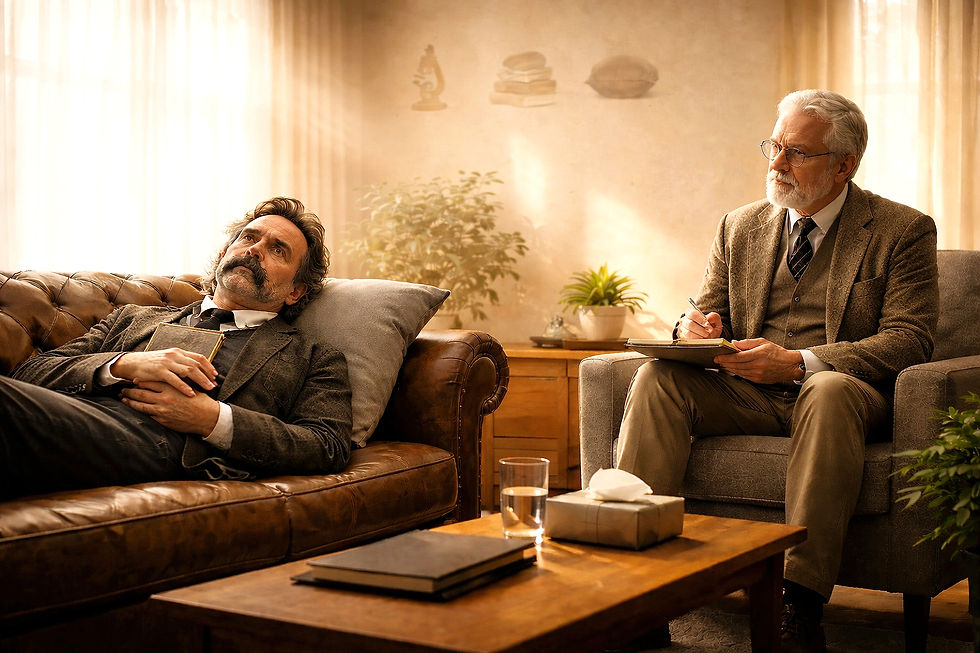
Jung saw this in Nietzsche with admiration and alarm at once. Jung’s diagnosis is mercilessly clear when he described that Nietzsche:
“Had lost the ground under his feet because he possessed nothing more than the inner world of his thoughts.”
That is a sentence worth lingering over, because it is not only about Nietzsche. It is about every ego-mind that becomes so enthralled by its own formulations that it forgets to test them against BEing, relationship, embodiment, humility, or ordinary humanness. Humanity expands. ‘Civilisation’ contracts. For civilisation is the ego at scale.
Knowledge is a little spotlight thinking it is the sun. Conceit begins when the spotlight forgets the sky. The ego does not merely want to be clever; it wants cleverness to spare it the humiliation of surrender.

Thought, when it forgets its own status as instrument, becomes a hall of mirrors. Intellect becomes self-enclosure. One then mistakes interior brilliance for Truth, when very often it is only the most sophisticated available form of isolation.
Con-ceit is inseparable from dec-eit via condescension. Not because the ego always lies maliciously, but because it is itself a strategy of misrepresentation. It is designed to conceal vulnerability, resistance to reality, dependence, grief, fear, need, shame, and the denied force of the shadow. It becomes shame. In this earlier language, the ego can always answer challenge with another justification, another mask, another lie, another strategy, another moral story, another identity. That line matters because it exposes the ego’s real genius: Substitution. Imitation. It cannot tolerate nakedness, so it keeps offering revised narratives instead. One identity fails; it produces another. One self-image cracks; it rebrands. One mask is doubted; it changes costumes and calls this growth. The modern world, being enterprising, has built entire industries around this process and markets them as self-development, each one selling your lovelessness back to you on a silver platter.
The great irony is that the mask is usually put on in order to be loved, and yet it is almost always the thing that keeps us from feeling truly loved; from being unconditionally loved, which is the only kind of real love. A person may be admired for the mask, rewarded for the mask, chosen for the mask, even envied for the mask - but none of that finally touches the deeper hunger, because some part of them knows that what is being welcomed is the presentation, not the person. This is why inauthenticity never fully satiates. It can secure attention, approval, usefulness, status, or desire, but it cannot provide the peace that only real recognition gives.
D. W. Winnicott: The Mask Was Once a Solution
Donald Winnicott was a paediatrician and psychoanalyst, a clinical-theoretical witness, whose account of 'True and False Self' organisation is indispensable here because it prevents “Conceit” becoming a moral accusation. In his landmark paper was 'Ego Distortion in Terms of True and False Self', the 'False Self' is not simply arrogance, dishonesty, or narcissistic theatre. In Winnicott’s account, compliance can emerge as an adaptation to the relational environment. That gives us a much more compassionate way to understand the adult social mask: Not "Look at this ridiculous fake person", but "What once made this performance necessary?" What he gives us here is the profoundly useful idea that compliance may become an organised adaptation rather than evidence of fraud or vanity.
A child who discovers that spontaneous BEing is dangerous does not normally sit down with a fountain pen and draft 'My Five-Year Strategic False-Self Implementation Plan'. It happens more quietly. The adaptation is rewarded. It works. It may work brilliantly. Winnicott catches the relational movement in six words:
“The infant gets seduced into compliance.”
D. W. Winnicott, 'Ego Distortion in Terms of True and False Self' In The Maturational Processes and the Facilitating Environment. Hogarth Press (1960; collected 1965)
And therein lies the cruelty of high-functioning armour: The better it works, the less anybody asks what it costs. The compliant child can become the enviable adult, the indispensable colleague, the perfect professional, the person who can carry everybody except themselves. Conceit, in this book, is therefore not merely thinking too highly of oneself. It can be what happens when the performed self becomes the only self the room knows how to reward. Isn't that so tragic?
Ironically, we are loved more deeply, not less, when we begin to take off the social mask. Not always by everyone, because some relationships are built precisely around the performance and may not survive its removal. But where love is real, authenticity does not diminish it; it clarifies it. The person becomes more lovable not because they have become more polished, but because they have become more present. The Soul, unlike the persona, does not need to be marketed. You cannot sell authenticity; you cannot sell real love, because they are priceless and they are not for sale. Real love is the ‘Mona Lisa’ of your Soul.
This is why Dr Harry Tiebout’s old language of ‘daily ego-deflation’ remains so profound. The point is not to destroy the person, but to puncture the inflation. Recovery, at its deepest, is not a moral polishing of the persona. It is a repeated surrender of the false centrality of the ego. The genius of the Twelve Steps is that almost every movement in them humiliates narcissism just enough to make reality visible again: Admission, inventory, confession, sharing, fellowship, connection, amends, prayer, service, and relinquishment of omnipotence. That is why one can plausibly call them one of the most concise spiritual paths available in practical form. Recovery is crystallised spirituality. Recovery is not for people who believe in God; it is for people who think that they are God. The Twelve Steps are not obsessed with making people ‘nice’. They are a tried and tested formula for making people less governed by the delusion that the frightened self should sit on a throne.
Hence the old recovery-room joke that is truer than many a doctoral thesis: ‘EGO’ as ‘Edging God Out’. Philologists may complain, as they are contractually obliged to do, but the aphorism still lands. Whether one says ‘God’, ‘Truth’, ‘Reality’, ‘the Soul’, or simply ‘what is’, the meaning is the same: Conceit crowds out contact. The ego-mind makes itself the measure, the court, the witness, the verdict, and the deity, then wonders why life feels so cramped. One cannot possibly hear the quieter voice of the Higher Self while the inner monarch is delivering another emergency proclamation about how uniquely mistreated he is. How ‘full he is of himself’. The German philosopher Martin Heidegger, whose work was central to hermeneutics (how we create meaning) and existentialism, wrote:
“We make a space inside ourselves, so that BEing can speak.”
That says enough: It says it all.
Martin Buber: A Human Being Is Not Healed Into a Better Fortress
Martin Buber was a Jewish philosopher of dialogue whose 'I and Thou' begins from relation rather than the fantasy of a completely self-sufficient individual. He is useful here precisely because he does not sound like a clinical protocol. He is a translated philosophical witness. After pages describing the construction of armour, Buber reminds us that the answer cannot simply be a more sophisticated armour with 'brilliant' insight written on the breastplate.
The ego’s fantasy is that safety lies in becoming sufficiently self-contained, sufficiently correct, sufficiently impressive and sufficiently invulnerable that nobody can reach the tender centre. But the final triumph of such a project would also be its catastrophe: perfect protection would mean perfect isolation. Buber compresses the counter-movement almost absurdly well in 'I and Thou':
“All real living is meeting.”
Martin Buber, 'I and Thou' (1923; Ronald Gregor Smith translation)
Buber's famous four words are of course philosophical witness rather than psychological evidence. And yet they are so much more than the brevity of the sentence suggests: Truth needs few letters.
Buber is there to say that 'Re-Collection', as I have innovated in this book, must not become a new fortress of sovereign selfhood. He gives us relation and encounter; he is not being asked to validate the whole '10 Cs' mechanism. The book is here for that. And in any case, Truth speaks for itself, and is instantly recognisable.
We do not yet need to solve the Human Condition here. We need only notice that something changes when the other person ceases to be audience, judge, competitor, client, enemy, mirror or supplier of validation and becomes — startlingly — another human being. The sealed self loosens. Conceit loses one of its jobs. The opposite of the fortress is not defeat. It is encounter.
The Child Does Not Grow Up Outside Society
Erich Fromm was a psychoanalyst, social theorist and humanistic philosopher who spent much of his work refusing the tidy separation between individual psychology and social structure. That makes him uniquely useful at this exact seam. He is a big deal. He is the real deal. We are about to leave the defended individual and ask what happens when human defences acquire professions, procedures, institutions and authority. Fromm gives that movement serious intellectual ancestry without pretending to prove every step of the '10 Cs' 'scaling matrix' thesis. His 1932 formulation is independently anchored in recent scholarship.
The child is not raised in a psychological vacuum and then released into 'society' at eighteen like a laboratory mouse being returned to the wild. Family is already culture in miniature: Expectations, status, belonging, obedience, conditionality, aspiration, fear, and permission are being transmitted before anybody learns the vocabulary with which to describe them. Fromm put the relationship into eight extraordinary words:
“The family is the psychological agency of society.”
Erich Fromm, 'The Method and Function of an Analytic Social Psychology' (1932)
It is also well worth reading Roger Frie’s 2025 peer-reviewed verification reassessment.
The 'Witness Bench’s' strongest finding is that the witnesses become more credible when we let their differences remain visible rather than dressing them all in the same robe. They do not all secretly teach the '10 Cs'. That is exactly why they work.
Maté witnesses what isolation can do to experience; Herman shows forgetting becoming social; Jesus turns the gaze back upon the judge; Teicher and Samson give the bent compass developmental ballast; Haun and Tomasello show private perception separating from public speech; Winnicott makes the mask compassionate rather than contemptible; Buber opens the sealed self towards encounter; and Fromm carries us cleanly from nursery to civilisation. Fromm gives the child → society scale-change a serious intellectual ancestor. He does not empirically prove the stronger '10 Cs' claim that childhood wounds scale through professions into institutions. That larger move remains ours, supported by a crowd of witnesses throughout the three free eBooks of my cathedral of work.
And so now Article I can change scale without changing subject. Children grow up. They become doctors, lawyers, judges, teachers, academics, executives, priests, politicians, regulators and parents. Their intelligence travels with them. Their love travels with them. Their wounds and adaptations can travel too. Social architecture enters people; people, in turn, build social architecture. Which is why the next question is unavoidable:
What happens when the ego becomes institutional?
When the Ego Becomes Institutional
The ego does not stop at the level of the individual. This is where conceit becomes truly consequential: It institutionalises. The disciplines that study the ego have an ego.
There it is. Not hidden in jargon, not wrapped in diplomatic cotton, just laid out on the table where it belongs and where it needs to be seen. Disciplines are composed of humans, shaped by prestige, methods, incentives, anxieties, reputations, gatekeeping, and identity. They therefore do not merely seek ‘truth’; they compete over who gets to define what counts as ‘truth’. Science can become inflated. Religion can become inflated. Psychology can become inflated. History can become inflated. Each may begin as a disciplined partial approach to reality and end, if conceit is left unchecked, as a sovereign performance of its own indispensability. The ‘truth-seeking’ disciplines do not seek truth – they seek power.
This is what institutionalised ego means. It means that a method forgets it is a method. It mistakes its own spotlight for the sun. Disciplines have methods that illuminate, but they also have incentives, gatekeeping, prestige economies, professional identities, and can start behaving like ‘vanguards of Truth’ rather than servants of it. We supply them with our ego, they feed on it, and then their ego takes on a life of its own. That is not anti-intellectualism. It is intellectual hygiene. It is simply the recognition that institutions can become masks too. Their conceit is more elegantly dressed than the individual’s, but no less distorting for that.
So, conceit is not merely personal arrogance. It is a mode of mis-seeing: Of ‘un-seeing’. It is the inflation of conception into certainty. It is the movement by which a thought becomes an identity, an identity becomes a defence, a defence becomes a doctrine, and a doctrine becomes a substitute for Truth. It is the ego at the level of the person, and the persona at the level of the profession. It is the reason a frightened child becomes a controlling adult, and the reason a useful discipline becomes an imperial one.
And this is precisely why the next movement must be the ‘Council of Disciplines’. Because once conceit has been exposed, neither the individual nor the institution can any longer be trusted in isolation. The cure for conceit is not to abolish thought, still less to abolish disciplines, but to dethrone their claim to solitary sovereignty. A frightened ego says, “Only I see clearly.” A disciplined conceit says, “Only my field sees clearly.” It calls all others nonsense, projecting their insecurities elsewhere, just like the individual ego.
Subconsciously it recognises itself, and it does not like it. Truth, having endured both for centuries with admirable patience, waits for something rarer: Not the loudest claimant, but the first honest council.
Again, and I repeat this because it is a ‘velvet sledgehammer’, the final humiliation of conceit is this: Even the disciplines that call themselves ‘truth-seeking’ are often not really looking for Truth, at least not in the pure sense they flatter themselves that they are. They are very often looking for something adjacent to truth, and much easier to manage: Validation, control, explanatory jurisdiction, institutional survival, methodological supremacy, the pleasure of being right, the relief of belonging to a camp, the prestige of sounding authoritative, the narcotic of certainty: ‘Living taxonomies’ of human beings. None of those things is identical with Truth. All of them can impersonate it. A discipline may therefore become highly competent at defending its own lens while remaining curiously unable to ask whether the lens itself limits the view.
That is why so many of our official truth-machines produce knowledge and still leave human beings bewildered. Science can measure with extraordinary elegance and yet be structurally unable to speak to meaning except by smuggling in metaphysics under a laboratory coat. Science cannot concede to spirituality because spirituality is beyond measurement, beyond falsification. Science cannot deny it, so it finds a thousand reasons to do so: None of them being the Truth. Religion can preserve profound symbolic and moral insight and yet become so attached to its forms that it mistakes fidelity to institution for fidelity to the Real. Psychology can expose projection, trauma, attachment, shadow, and distortion while quietly assuming that whatever cannot be psychologised is either irrelevant or unreal. But it categorises all of us as ‘normal’ or ‘abnormal’, even though we are all on a scale with no true ‘cut-off’ point. And even we ‘abnormals’ have superpowers that may be harnessed.
History can document what happened with admirable discipline while remaining silent on what anything finally means. None of this makes the disciplines useless. It simply makes them partial. Their tragedy begins when they forget that.
And partiality, when unconfessed, becomes a form of falsehood. Not because the disciplines are lying in some melodramatic conscious sense, but because they are often taking reflected contact for direct apprehension. They handle fragments and call them wholes. They describe one order of reality and then behave as though no higher or wider order need exist. They touch bark and announce they have exhausted the tree. They hold a mirror to one aspect of the world and then start speaking as if the reflection were the thing itself. The conceit of the disciplines, in other words, is not merely that they overclaim; it is that they frequently mistake successful method for final access.
Truth, by contrast, is not obliged to fit the jurisdictional boundaries of any man-made institution. It is not exhausted by evidence, though evidence may disclose aspects of it. It is not exhausted by doctrine, though doctrine may symbolise aspects of it. Truth does not conveniently slip into a box called fear. It is not exhausted by introspection, though the psyche may refract aspects of it. It is not exhausted by reason, though reason may clear away absurdity and illusion. The higher one goes, the more one is forced to admit that there are gradations even within lucidity itself:

This is why the next step cannot simply be louder certainty. It has to be humility organised into method. If the disciplines are not, in their egoic form, really looking for Truth - and are certainly not finding it whole - then the answer is not to abolish them, but to place them in relation. They must be made to sit together, to confess their limits, to compare lenses, to discover that each has seen something and none has seen enough. Only then does inquiry become honest. Only then does intelligence stop behaving like a border dispute. The boxes have lids – the lid is the limit. Above it is wisdom. Below it is knowledge. And knowledge is contracted consciousness, like a collapsed star – dense, fearful, and dark. And only when the boxes intersect, unpack, unbox, and ‘unlid’ does the possibility emerge that what we have called ‘Truth-seeking’ might begin, at last, to deserve the name.
There is, beneath the metaphors and lineages of this series, a clinical sequence - a lawful arc by which the human condition forms and by which it can be healed. The unconditioned child meets conditional love and adverse experience; what follows is not free choice in the sentimental adult sense, but a choiceless adaptation organised around fear. Fear hardens into negative belief; negative belief crystallises into ego as identity; ego generates preference and resistance; the person enters the path of attachment and the quest for love; emotional pain accumulates; addiction appears as an attempt to make the unbearable bearable; and the self takes refuge in what this series has called the ‘Temple of Emotional Anaesthesia’. It is there, paradoxically, at the point of greatest captivity, that the only real choice first appears. From there begins the ‘Bridge of Awakening’, and beyond that, the ‘Field of BEing’: Our true cathedral.
That same arc can also be stated more compactly, as the Eight 'A's: ACEs, Attachment, Addiction, Anaesthesia, Awareness, Acceptance, Awakening, Action. The first four name the descent into the conditioned structure of suffering; the latter four name the movement out of it. In that sense, the sequence is not merely descriptive but therapeutic. Awareness reveals the mechanism. It truly ‘sees’. Acceptance stops the inner war. Awakening is the loosening of false identification. And action, at its highest level, is no longer frantic self-improvement but the ethical fruit of liberation itself: Compassion, forgiveness, and love: As verbs.
Trauma is paradoxical in its relation to ego. Most often, it strengthens ego, because ego is the psyche's emergency architecture: When reality overwhelms the organism, the system improvises protection - hypervigilance, perfectionism, control, dissociation, numbing, rage, self-sufficiency, relentless performing. In that sense, trauma can grow ego the way a tree grows bark after fire: Functional, protective, and ultimately constricting if it becomes the whole way of BEing.
The ego is a liar. Trauma is a liar. And childhood Trauma is a liar’s liar. It tricks us, traps us, triggers us, and limits us.
Desolation at The Destination

But trauma can also strip ego overnight, not by granting instant Enlightenment, but by collapsing the old operating system so completely that the familiar self-story can no longer be maintained. What had felt like 'me' suddenly ceases to hold. This can look like breakdown, psychic rupture, depersonalisation, or a devastating loss of continuity. The same event can therefore either fortify the defensive structure or shatter its compensations. And that is why trauma is not automatically transformative. It can deepen bondage, and it can precipitate awakening - sometimes both in sequence: First the tightening of defence, then the exhaustion of defence, and finally, if the collapse is met with support and meaning, the opportunity to see that gripping was never the same thing as safety. Trauma may lead to transformation.
The AntiChrist of the Lion King: 'The Circle of Not-Life'
The insight arrived with almost offensive simplicity.
Perhaps the ‘Human Condition’ can be reduced, not to a disease or a doctrine, but to a relational wound that learns how to reproduce itself.
At its beginning is what I now call ‘Petrified Love-Less Conditional Relational Exclusion’: The unbearable developmental discovery that belonging may depend upon becoming someone other than the person one actually is. The child does not stop needing love when love becomes conditional. The child cannot. Instead, the child begins abandoning whatever appears to threaten attachment. Even identity and reality become negotiable before relationship does. Authenticity is sacrificed first because, to a dependent nervous system, exclusion feels like annihilation. Reality just seems too scary, and so is denied. But you can never deny reality – Reality always wins.
Why do we don costumes if live is not an act?
The pain of the fracture that is the diagnosis of the Human Condition would be almost impossible to carry continuously. So we perform an ingenious act of survival. We undergo what I call ‘Somatic Decapitation’. We retreat upwards into thought, competence, performance, and control, the domains of the ego-mind and René Descartes “I think; therefore I AM”, while progressively losing contact with the body that keeps reporting the contradiction. The head becomes brilliant because the torso (‘Feeling-Reality-Contact’) is unbearable. We learn to intellectually deny feelings we no longer permit ourselves fully to feel bodily. Pushing down feelings is like keeping a beach ball underwater: You can do it for awhile but it always comes back back up with a vengeance will at least expect it.
And then, mercifully and disastrously, we discover the ‘Temple of Emotional Anaesthesia’: this is the ‘Prison-as-Lure’ and ‘Profession-as-Dealer.’
The Temple can be alcohol. Substances. Behaviours. Achievement. Random sex. Food. Money. Status. Work. Intellectual mastery. Professional identity. Anything that briefly quietens the original ache without meeting it. Anything that Number or distracts these are all myriad forms of ‘Imitation Love.’ It works just well enough to ensure that we return. The relief is real; that is why the trap is so good. But the source remains untouched, so the pain keeps chasing the very person who believes they are successfully running from it.
This is the counterfeit economy of ‘imitation love’. The OG ‘Metaphysical Accounting Error of the Nursery’. We try to quench a freshwater thirst on a dopamine salt-diet. Each mouthful produces another mouthful of thirst. And that first gets deeper.
And then the private tragedy scales. Privately at first then publicity. Why publicly? Because the institution have developed ingenious ways of ‘Publicly Eulogising Celebritising Projection’ for fear of the whole charade being revealed. But pointing a finger always means that three fingers are pointing back at you. And yes, we can all see that now. And that applies most precisely to the professions, aka, the ‘Wound-Boomerang-Machine-Guns.’
The frightened child grows up, qualifies, receives a title and is invited into a role whose rewards may fit the old adaptation with exquisite precision. The performance that once helped secure attachment now secures approval, advancement and authority. The person may appear to have “gained the world” precisely by surrendering more of the Soul that once needed the world’s permission to exist.
The role is not necessarily the problem. Nor is the professional. The tragedy begins when the role ceases to be something a person does and becomes the architecture through which that person proves who they are.
At that point another human being’s fracture can become strangely useful. A fractured human being sees:
“You are fractured, therefore I am not. I diagnose you, therefore I am well. I classify you, therefore I am whole. I judge you, therefore I am righteous. I punish what is visible in you and call the corresponding invisibility in me professionalism.”
The wound has discovered an occupation. And once enough wounded human beings build sufficiently durable structures around the same adaptation, the fracture becomes concrete. It acquires buildings, qualifications, protocols, hierarchies and authorised language. It becomes an institution.
That institution can then become petrified in every meaning of the word. Frightened and therefore fear-inducing. Cold enough to call itself objective. Hard enough to call itself principled. Contracted enough to mistake its aperture for Reality. Brittle enough that contradiction feels not like information but attack. And because brittle structures cannot bend, they fracture further.
Instead of thawing ourselves, we can begin to “treat” or judge others in order to maintain the identity through which we escaped being treated or judged ourselves. That is the terrible circularity. The wound is taxonomised in the other precisely where it remains unnamed in the observer. What is unhealed within becomes professionally visible without. The individual then helps build the institution that reproduces the relational conditions which formed the individual.
The child goes up looking for love; the wound comes down as institution. And the institution then meets the next frightened child.
That is why I call this ‘The AntiChrist of the Lion King: The Circle of Not-Life.‘ Not because the people inside it are evil. Quite the reverse. Some of the kindest people I know inhabit these structures. The horror is that goodness can be recruited into a mechanism whose direction is away from life, toward 'Not-Life':
Life receives. Not-Life excludes.
Life integrates. Not-Life splits.
Life feels. Not-Life anaesthetises.
Life meets. Not-Life classifies.
Life grows. Not-Life petrifies.
And because petrified things cannot metabolise their wounds, they reproduce them.
The Circle of Life becomes the Circle of Not-Life: Pain seeking relief in the very structures that preserve the conditions for pain. Healing therefore cannot finally mean becoming better at surviving the Circle. It means interrupting its reproduction. It means Re-Collection.
It means turning towards the wound rather than appointing ourselves custodian of somebody else’s. And ultimately it means discovering the one thing the entire circular economy was built to imitate because it could never manufacture it:
Love. Can’t be bought. Can’t be sold. Can’t be sold out.
Unlike institutions, where all of the reverse apply.
Hence the ‘Circle of Not-Life.’ Disney gives US a new ending.
Architectures are not Reality. They are blueprints, made by us, which may be torn up at any moment, without any more violence than a shredder.
Before we finish Part I in this series and hand over to Part II — The ‘Council of Disciplines’, I will give you a glimpse through the crack in the sealed chamber of Schopenhauer's pessimism for humanity and another of the Pivot and Crossing that lie ahead in this epic journey.
The Crack in the Sealed Chamber
"Compassion is the best possible antidote to Egoism."
This is Schopenhauer's sudden, late-stage ethical opening — the exact coordinate where his diagnostic prism, that refracted suffering at the beginning of this article, begins to soften its light. Compassion is the sovereign solvent that dissolves the rigid, separate boundaries of the egoic armour, allowing the exiled self to make Real Reality-contact. It serves as the preparatory bridge that prefigures the un-inverting of the Genealogy of the Wills, transforming the blind cosmic striving of the 'Scarcity-Combustion-Engine' of his 'Will to Live' into the Self-sustaining, effortless vertical lift of this book's 'Will to Love'.
A Glimpse of the Journey Ahead: When the Lid Comes Off
If the first part of this book has done anything at all, it will have begun to disturb the comfortable assumption that the human problem is always somewhere else: In the opponent, the patient, the sinner, the rival, the defendant, the other side, the other 'tribe', the other discipline, the other ideology. Article I has suggested something more uncomfortable and yet potentially more liberating: That the structures of conflict outside us are often scaling expressions of the fractures within us, and that confusion hardens into civilisation when wounded consciousness acquires language, role, status and institutional authority. But diagnosis, however necessary, is not enough. You must also sense that another horizon exists, even before you can yet name it.

That is why the image above belongs here. It does not fully explain the path ahead; it opens appetite for it. It lets you feel, rather than merely understand, that the box is not the sky, that the telescope is not the whole field of vision, that the courtroom is not the final architecture of Truth, and that the observer may yet be included in the observation. It whispers that thought may be 'Re-Collected' into embodiment, method may be 'Re-Collected' into wonder and awe, law may be 'Re-Collected' into humanity, and judgement may be interrupted by meeting and relation. Article II will now begin to show what happens when those insights move from the personal and existential into the institutional and civilisational.
The lid has come off the courtroom. That single gesture says almost everything. The judge has lost neither his robe nor his role, but he has put down the magnifying glass and removed the plank from his own eye. The defendant is no longer merely the object of scrutiny but a person who can be met.
The problem was never that the judge could not see the accused. The problem was that his field of vision did not include the judge. The magnifying glass was not evil. The robe was not evil. Law was not evil. But now the plank is out, the instrument can be put down, and the lid has come off the courtroom. Descartes gets his body back. Bacon gets his sky back. The judge gets his eye back. And the person in the dock gets his humanity back.
In the image above Descartes stands to the left with his body restored, no longer somatically decapitated by the fantasy that consciousness lives only in the head. Bacon stands to the right, still faithful to his telescope, still not quite ready to relinquish the instrument that made so much of modern knowledge possible. Neither is mocked. Both are re-collected. Thought is not destroyed; it is re-embodied. Observation is not rejected; it is re-situated beneath a larger sky. The stones remain on the floor because agency remains real; although no-one has thrown a single stone: The human being may still choose violence, fear and judgement. But now another possibility has entered the room. The architecture is open. The observer can see him Self. The instrument is no longer mistaken for Reality. The box has not been smashed in adolescent revolt; it has been 'Unlidded'. And that is enough to let a wholly different future begin to breathe...
The image therefore works not only as illustration but as parable: As 'metaphors-in-motion', which is what good parables are. It gathers what has already been said above and turns it slightly toward the sun. It allows you to feel, perhaps only half-consciously, perhaps subconsciously, that what has looked like a sealed chamber, a 'life-sentence-of-suffering' — the Human Condition — may in fact be a threshold. The question is no longer simply "What is wrong with the world?", nor even "What is wrong with the self?", but whether the whole field of perception might be capable of opening. My answer is a resounding yes! But it's not for me to tell you. Perhaps you will come to tell me.
From here our path naturally turns toward the later Cs. Your journey has already begun. The next movement of the book will ask what becomes possible once consciousness notices the lens through which it has been looking, once clarity sees the box as a box, and once the disciplines themselves are no longer permitted to mistake their own tiny aperture for the whole sky. The ultimate destination is not a better prison, nor even a more elegant paradigm, but a form of seeing in which love ceases to need the walls that fear required. For now, perhaps it is enough that you have glimpsed the opening. I can assure you, it will be far from doom and gloom, and it will be quite the ride!
If Article I has named the weather, then this last image and section around it lets you glimpse the climate beyond it. The sky is still above the courtroom. The lid was never the 'heavens', for 'heaven' is simply a life where fear is dethroned, only the limit of a frightened architecture. What follows, then, is not an abandonment of thought, law, science, medicine or the disciplines, but their gradual 'Unboxing', 'Unlidding', and 'Re-Collection' into a field infinitely larger than any one of them could contain alone. The journey continues from the fractured self to the institutional world that fracture builds — and toward the possibility that, once seen clearly enough, even those institutions might yet Pivot...
And this concludes Part I - Chaos, Conflict, Confusion, and Conceit: The Ego Speaks. Watch this space for Part II...
This four-part series of articles is an entire eBook. It is free. It is here, along with all of my free eBooks that I have written for you:
This article traces the ‘10 Cs’ as one continuous movement: From the outward theatre that is the prison of egocentric-fear-organised life, through disciplines, consciousness, and clarity, toward a new engine: Love. It is not merely a list of themes, but a cumulative account of how one mechanism of suffering scales from person to discipline to civilisation, and how that same mechanism may be healed.
You have been reading Part I — Chaos, Conflict, Confusion, and Conceit.
Continue to Part II — The ‘Council of Disciplines’
Continue to Part III — Consciousness and Clarity
Continue to Part IV — Carl Jung, Christ, Compassion, and the ‘Will to Love’
This piece belongs to my wider audio library about my life’s work on success, superabundance, the Human Condition, the ‘Pivot’, the ‘Crossing’ and all my tools. You can listen here:
For the audio summary of this book, click on the companion podcast in the audio library above called ‘The Human Condition and the '10 Cs'.
See you in the next Part, the next article, the next book, the next video, the next audio podcast, the next stage of the journey.
I will be here, right beside you, if you so wish.
Olly Alexander
Explore the Wider Map
References For This eBook
Assor, A., Roth, G., & Deci, E. L. (2004). 'The emotional costs of parents’ conditional regard: A Self-Determination Theory analysis'. Journal of Personality, 72(1), 47–88.
Buber, M. (1923; trans. R. G. Smith). 'I and Thou'.
Felitti, V. J., Anda, R. F., Nordenberg, D., et al. (1998). 'Relationship of childhood abuse and household dysfunction to many of the leading causes of death in adults: The Adverse Childhood Experiences (ACE) Study.' American Journal of Preventive Medicine, 14(4), 245–258.
Fromm, E. (1932). 'The method and function of an analytic social psychology'. Quoted and discussed in Frie, R. (2025). Escape from freedom revisited: Erich Fromm, psychoanalysis and the threat of fascism. Psychoanalytic Inquiry.
Haines, J. E., & Schutte, N. S. (2023). 'Parental conditional regard: A meta‐analysis'. Journal of Adolescence, 95, 195–223.
Haun, D. B. M., & Tomasello, M. (2011). ‘Conformity to peer pressure in preschool children’. Child Development, 82(6), 1759–1767.
Herman, J. L. (1992/1997). ‘Trauma and Recovery: The Aftermath of Violence — From Domestic Abuse to Political Terror’. Basic Books.
Hughes, K., Bellis, M. A., Hardcastle, K. A., et al. (2017). 'The effect of multiple Adverse Childhood Experiences (ACEs) on health: a systematic review and meta-analysis'. The Lancet Public Health, 2(8), e356–e366.
Maté, G. (2010). Foreword. In P. A. Levine, ‘In an Unspoken Voice: How the Body Releases Trauma and Restores Goodness’ (p. xii). North Atlantic Books.
Teicher, M. H., & Samson, J. A. (2016). ‘Annual research review: Enduring neurobiological effects of childhood abuse and neglect’. Journal of Child Psychology and Psychiatry, 57(3), 241–266.
Winnicott, D. W. (1960; collected 1965). ‘Ego distortion in terms of True and False Self’. In The Maturational Processes and the Facilitating Environment. Hogarth Press.
Here are a few of my other 500 articles:
Disclaimer
The information presented in this article explores the role of philosophy and psychospirituality in mental well-being and recovery. It is for informational purposes only and should not be considered a substitute for professional medical, psychological, or psychiatric advice, diagnosis, or treatment. You should always seek the advice of your own qualified healthcare provider with any questions you may have regarding your specific condition or any medical concerns. Never disregard professional medical advice or delay in seeking it because of something you have read here. Integrating psychospiritual practices can be a valuable part of a holistic approach to mental health, but it should complement, not replace, care from licensed medical and mental health professionals.


Comments