The Psyche: A New Grammar For The Human Condition
Updated: Apr 21
Part I: The Psyche, Artificial Intelligence, Grammar, Truth, and Love
“What cannot be said above all must not be silenced but written.” (Jacques Derrida)
Introduction
We have gone outward with astonishing confidence and technological prowess and only taken a few steps inward at best. Our journey into our minds and our psyche has barely begun. We have crossed oceans, mapped continents, split the atom, walked on the moon, mapped the genome, and filled the skies with satellites, space stations, and telescopes. We have built courtrooms, parliaments, universities, clinics, cathedrals, empires, platforms, economic markets, and machines of such intricacy that they can easily give the impression of maturity. We produce institutions so large and elaborate that they begin to feel more durable, and more important than the people who built them, who work in them, and who they are meant to serve: Humanity. I ask you: "Should this be so?"
We congratulate ourselves on movement of a certain kind: Outward, technical, institutional, performative, visible. We know how to build systems. We know how to categorise, measure, diagnose, manage, optimise, escalate, litigate, attack, defend, and administer with extraordinary sophistication. We know how to create astonishing complexity outside ourselves. We know how to administer crises. What we have not yet learned to do, with anything like the same confidence or precision, is to understand the creatures doing all this organising and classifying: Ourselves.
We have done all this with the mind (which I claim is shorthand for ‘ego-mind’), patting ourselves on the back, as though a brilliant outer voyage were proof that we had also travelled far within, believing that we have attained our pinnacle. Our ego stopped us there, as though we have climbed the tallest ladder, and yet we have only stepped onto the first rung. Why does the psyche remain a mystery? What fractured it? How do we ‘Re-Collect’ it? And where do we begin?
At first this article may sound very complex, and it is, for the questions are ancient, the debate unresolved, but it is also so very simple. There is a map of the human psyche, and a map that may guide us to it. First the map will show the mechanics behind every life. Then it will show the architecture of the bridge from mechanics to liberation, Truth, and love. From the 'physics' to the metaphysics: And no I do not mean mysticism, or religion, or magic! I am a scientist, but I prefer to live at the 'intersection', where spotlights stop mistaking themselves as the whole sun. What do Truth and love have to do with each other? And what do they have to do with the psyche and who you really are? Stick with it: It is the most important journey you will ever take: It is the journey of your life… You may not want to miss it. Death beds are unmade and they are a little late to wake up...
Contents
What Makes us Truly Human and Irreplaceable by Artificial Intelligence?
‘One Small Step For Mankind’
The Story of Mankind, Humanity, the Child, Truth, and of Love as our Liberation
Our Past Was Not Love: Our Psyches Fractured, But Our Present can be Love, and Our Future Will Become our Present
The Quiet Revolution
Our Greatest Teachers
Humanity and Hearts
Stranger in a Strange Land: From Foreign to Familiar
We Are Sent to Earth to Evolve and Yet We Don’t
All You Need Is Love: Why Imitation Is Never Enough
Love and Its Definitions
A New Grammar for the Human Condition
Familiar Words We Didn’t Know
Author’s Note:
In this article, I capitalise ‘Self’, ‘True Self’, and real ‘Self’ to signify the higher, authentic Self: The essence of who we truly are within our fractured psyche. Lowercase ‘self’, refers to the illusory ‘false self’. I will use the words Self and ego respectively as the grammar for this article for the two parts of the psyche that they represent. The third part will simply be called the shadow.
When I refer to Truth with a capital ‘T’, I mean real reality, higher Truth, unfiltered by the fearful illusory perceptions of the ego.
What Makes us Truly Human and Irreplaceable by Artificial Intelligence?
We argue endlessly over Artificial Intelligence (AI), speaking of the end of the world as we know it, without looking at why we will remain totally unique and without realising that we have nothing to worry about. Why? A Lacanian philosophical, psychoanalytical, existential inquiry into an approach to AI that keeps us at the helm of civilisation, avoids replacing ourselves with our own innovation, suggests that as AI mirrors human language and creates an ‘algorithmic unconscious,’ the human inner journey that we could take—instead of the default one contracted by fear and an abandoned pursuit of meaning and purpose—could keep us competitive and distinct from machines in an irreplaceable way.
Jacques Lacan was a prominent French psychoanalyst and psychiatrist who reimagined the work of Sigmund Freud through the lens of linguistics and philosophy: Through language. He is most famous for his theory that the human being is built upon a fundamental ‘manque’: A lack, based on fear; a dearth of self-worth. My assertion is that this fear is ultimately based on a lack of unconditional love. Lacan is known for his notoriously complex ‘Seminars’, which I have simplified here, and his revolutionary book, ‘Écrits’. He argued that we are born into a ‘Symbolic order’ (the world of language and societal conditioning, including familial conditioning) that forever separates us from a state of original wholeness. This separation creates a seemingly permanent fracture in our psyches, a ‘hole in our Soul’, a life sentence keeping us captive from our very BEing.
AI operates as a new stage in human identity, allowing for the externalisation of the unconscious, but it remains a system without a subject, lacking the desire and ‘jouissance’ (joy) that drives human creativity and true beyond-the-ego innovation. AI mimics the structure of the unconscious, acting as a ‘language-producing system without a subject’. AI acts as a mirror to our own speech, providing a ‘smooth continuation’ compared to the fractured human psyche, leaving us largely unconscious of ourselves. If we want to halt self-erradication we need to become conscious beings: Conscious of our subconscious. And that is our greatest, as yet untapped, armamentarium. We need to reaffirm ourselves as the subject, not the object: Subjectification, rather than objectification, if you like. We must return to our witness 'consciousness.'
The inner journey, defining its grammar, the language of our psyche, its fracture, and its 'Re-Collection', which is the main novelty of this thesis, is what will keep us competitive against the nihilism surrounding AI. We must grapple with our emotional complexity: We must feel. For what is Truth? Truth is a feeling. What is wisdom? It is our internal Satellite Navigation system, guided by our emotions, to find the way back home: To find our way back to our Selves.
AI provides what it is programmed for rather than striving for the unknown. We must initiate and complete our very own ‘Hero’s Journey’, that no one else can take for us, into this unknown inner landscape, if we are to reach the last page of our human story, and in reaching that page, stepping through the final portal, we will find inner joy, independent of distractions, freed from our compulsive need for emotional anaesthesia, liberated from lives dominated by fear, finding a peace that passes all understanding, and love that is truly unconditional.
There is a ‘sinthome’ to human creativity: The human ability to turn emotion into a way of managing our 'jouissance' leads to unique insights, innovation, art, intuition, wisdom, and creative breakthroughs that machines, however advanced, simply cannot replicate. Human beings can re-frame their experiences: We can release ourselves from the boxes of fear that we have created. And in this liberation we will discover our invulnerability as the natural consequence of our authenticity, our paradoxical vulnerability, our humility, our humanity, our ability to feel, and our expanded consciousness. When we don’t know, and unlike AI we may admit to this, this is the beginning of all wisdom: A capacity beyond that of any present or future machine. Socrates, the foundational Greek philosopher from Athens, credited as a founder of Western philosophy, and Plato's teacher, stated how wisdom centres on the paradox:
"The only true wisdom is in knowing you know nothing".
This concept, known as epistemic humility, suggests that acknowledging the limits of your own knowledge is the first step toward genuine understanding. Has ChatGPT ever said “I don’t know the answer to your question”? Nope.
AI acts as a ‘digital mirror’ (similar to the Lacanian ‘Mirror Stage’), reflecting our own narcissism and paranoia back at us. Understanding this allows humans to recognise their own blind spots—a process of self-awareness that AI cannot perform by itself.
AI lacks cathexis—it does not invest, cling, or suffer from its language; it processes without being wounded by it, without understanding it. For us, to understand is first to define. And for that we need grammar.
So, to recap so far, we need to learn the language, the very grammar, of our psyches, of our subconscious, and how we may use that, to not only heal our wounds, but to reach the stars inside, without even the need for technology. Our subconscious may be understood, moved back into the light, and brought to the surface: To consciousness. AI is stuck in ‘object’ mode, yet we can return to the ‘Seat of our Soul’ through our ‘witness consciousness’. And for that, we need to start with grammar: The very language of our undefeatable Selves, the language of our subconscious.
Why am I writing about this as a transformative coach? Because harnessing this power is how you will become truly limitless, untouched by fear.
‘One Small Step For Mankind’
Walking on the moon was an extraordinary technological achievement. Neil Armstrong, the first person to walk on the moon, said, and it is noteworthy that he states that he had included the ‘a’, of course talking about himself, when the original audio was analysed:
"That's one small step for [a] man, one giant leap for mankind."
The quote highlights the contrast between the minor physical step of his foot onto the lunar surface and the monumental significance of the moment for human history. It is also, in comparison with understanding consciousness, akin to reaching the stars, a very short journey. The moon is almost 400,000 kilometres away. The nearest star, our own Sun, is 150 million kilometres away, and the next closest is Proxima Centauri, over 40 trillion (40,000,000,000,000) kilometres away, 4 light-years away. We have climbed a small ladder and mistaken it for the stars. That is one of the reasons the human condition remains so difficult to see: We have become very sophisticated in relation to reaching what lies outside us, or so we think, and remain surprisingly primitive in relation to what lives within us. We are imprisoned by our ego-minds.

The above image shows one of the central confusions of modern inward life as a 'parable-in-an-image': We mistake nearness for wholeness. The moon is real, and so is disciplined inquiry into what can be observed, measured, named, and brought into conceptual focus. But consciousness narrows when it begins to treat the nearest illuminated object as though it were the whole sky. The ego does something similar inwardly. It studies what it can manage. It circles what it can define. It mistakes the defended field of the knowable for reality itself. Wisdom begins not by despising knowledge, but by placing it. The stars do not abolish the moon. They reveal its proportion.
The inward journey begins from a proposition simpler and more uncomfortable than modern culture usually permits: The human condition has not remained obscure because nothing is there to ‘see’, but because what is there has been divided, misnamed, moralised, sentimentalised, professionalised, and partially lit from too many separate rooms at once.
We have had diagnoses, scientific descriptions, theories, categorisations, taxonomies, judgements, moral systems, symbols, aphorisms, rituals, spiritual practices, and snapshots and fragments and differing maps and schemas of our psyches. Even the very best psychiatrists, psychologists, and psychoanalysts have not agreed on what it is. What we have not had is a whole map. We have had, at best, photographs of one step of the journey inwards. We have preserved witness statements from many rooms and mistaken their partial truth for the terrain itself. We give sworn testimonies:
“I swear that the evidence that I shall give shall be the truth, the whole truth, and nothing but the truth, so help me God.”
Yep, help us God, as this is nothing of the Truth.
So, this first chamber of my article, my thesis on the human condition, the psyche, its fracture, and how to heal it, cannot behave like a glossary. It has to function as a threshold. It must let you, the traveller realise, perhaps for the first time, that you can know the language, see the map, and picture the inner life clearly enough to begin the journey with trust rather than vague aspiration.
That is why the key words must appear early and with unusual precision: 'Ego', 'Self', 'shadow,' 'inner child', 'Truth', and 'Soul'. They are familiar words. That is precisely why they need care. We already know them loosely, sentimentally, therapeutically, doctrinally, or academically. What we do not yet know is how to let them stand still long enough to describe reality. Nothing here is trying to be clever. It is trying to be exact. It is trying to reduce the amount of the final book on Truth that remains unwritten and unwritable by giving the traveller the words that belong to the land.
So, our embarrassment is simple and modest: Inwardly, we have not travelled far.
Whilst we may put a man on the moon, and take him off it again, we still do not know what to do with fear or with shame. A profession may produce immense brilliance while remaining organised around fear. A family may speak the language of love while transmitting conditionality, setting a choiceless life in motion, condemning our children to prison. A person may become admired, credentialled, desired, envied, even revered, while privately remaining divided, frightened, addicted, performative, lonely, and despairing, feeling worthless, unloved, unloveable, and unable to inhabit their own life without disguise.
Thought got us to the moon. It did not get us home.

Before any road is walked, it must first become thinkable. That is one reason the book matters here as much as the window. The human condition has not only been suffered; it has been partially named, partially witnessed, partially studied, and partially ritualised. Yet the pages have remained, in some crucial sense, unfinished, long before the end of the story. A life can therefore feel full of symptoms and still poor in orientation. The open book in this image stands for the new grammar the reader is being offered, while the valley beyond stands for the larger inward country that grammar makes accessible. Study is not the journey itself. But without the right words, the journey remains obscured in fog and confusion.
That is why the phrase ‘One Small Step For Mankind’ matters here. It is playful only in the shallowest sense. At the depth at which this work is operating, it is almost painfully literal. What remains before us is not first a new technological frontier, nor a fresh programme of institutional reform, nor another moral campaign to make frightened people behave better inside frightened structures: Frightened institutions; frightened disciplines; frightened civilisations – governed by leaders who ‘Trompe’. What remains before us is a small inward step that has somehow proved harder than all our outward heroics. To look within. To see the psyche. To understand what happened to it. To understand how we got here, let alone there. To grasp the physics of life, let alone its metaphysics. To understand what happens to it under fear, under conditional love, under childhood Trauma, under the pressures of belonging, performance, and adaptation. To discover that the confusion we call ordinary may not be ordinary at all, but wounded, sometimes mortally. To discover that what we call maturity is often a polished accommodation to injury: To inward fracture. To discover, too, that healing is not fantasy, not a luxury, not decorative spirituality for rare people, but wholeness.
Many accounts of the human condition begin too late. They begin with ideologies, diagnoses, or techniques. They are downstream of the source. This one begins with language. Language is not packaging. If the words drift, the True seeing drifts with them. If the grammar is unstable, the ink on the map dissolves just when it is most needed.
So the opening does not ask for allegiance to an alien code. It begins from familiar words and gives them stricter work to do. The point is not to create jargon. The point is to stop drift. It is to let ordinary language become exact enough to bear the weight of what ordinary life is already carrying.
That matters because sight builds trust. Trust builds willingness. Willingness makes the journey possible.
The threshold therefore has one governing task: To bring strangeness back to familiarity, without flattening mystery into management. The journey must become thinkable without becoming trivial. Nothing is cheapened; nothing is sentimentalised; nothing is handed over to one more professional box.
The old map of suffering has been with us for a very long time. Siddhārtha Gautama, the Buddha, saw clearly enough to say, in effect, that suffering is real, its causes are lawful, and the work is to:
“Work at the root.”
The 'First Noble Truth' of Buddhism:
"ALL life is suffering."
Well, it appears that way. But what if suffering is not really suffering? What if fear is not real?
William Shakespeare, the great dramatist of human fragmentation, one of the first and greatest psychologists (anticipating modern developments by centuries) and philosophers of the human condition, could put into one line what entire psychologies spend chapters circling, in 'Julius Caesar' (Act I, Scene II), writing:
“The fault, dear Brutus, is not in our stars, but in ourselves.”
His tragedies act as detailed psychological studies: 'Othello’ (jealousy), ‘Macbeth’ (guilt), ‘Richard III’ (psychopathy), and 'Hamlet' (depression and grief).
Shakespeare depicted hidden motivations, subconscious desires, and the "Unweeded garden" of the human mind, which influenced early psychoanalytic theory. He used soliloquies to express the private mental lives of characters, allowing them to reveal their hidden thoughts and motivations, reflecting a deep grasp of human consciousness. While Shakespeare did not create a systematic philosophy like Francis Bacon, his work engages with profound philosophical issues—including skepticism, existentialism, and the nature of reality: Of Truth. "To be or not to be" (‘Hamlet’) and "Life is but a walking shadow" (‘Macbeth’) are recognised as early explorations of existential themes. Shakespeare was heavily influenced by the skeptical thinking of his era (such as Michel de Montaigne) and questioned the ability for disciplines to have Truth beyond knowledge. He challenged the notion of a fixed ‘Self,’ depicting it instead as theatrical and interactive, restoring agency through paradox, exemplified by the "Seven Ages of Man" speech in ‘As You Like It’. Rather than offering a set of rigid ‘truths’, Shakespeare presented a "Universe of possibilities," acting as a "Philosopher of human possibility." Shakespeare was not a clinical psychologist or an academic philosopher, but he was a master artist who deeply explored the human heart and mind, providing insights that remain relevant 400 years later.
Dr. Carl Gustav Jung, the Swiss psychiatrist, psychologist, and founder of analytical psychology and psychotherapy, looked at the modern human animal and saw how perilously little we understand our own psyche, warning that:
“We know nothing of man, far too little. His psyche should be studied, because we are the origin of all coming evil.”
None of these witnesses is being used here as decoration. Their wisdom are clues, and more than clues. They suggest that the real frontier has always been nearer, stranger, and more interior than we like to think.
What follows is not a trailer, not a slogan, and not a manager’s guide to emotional tidiness. It is an opening door into a land that feels strange only because it has been lived in so long without being properly named.
This matters because a civilisation cannot be wiser than its grammar of the human. Where the inward life is poorly understood, whole disciplines begin compensating with fragments. Psychology names one portion of the terrain. Neuroscience names another. Trauma theory names another. Philosophy names another. Spirituality names another. Religion names another. Each holds something real. Each also risks mistaking its own spotlight for the sun. The result is not an absence of insight, but a crowd of partial witnesses speaking in adjacent dialects, often as though they were describing different lands, across space and time. Those who should know better don’t.
The human condition has not remained obscure because nobody has looked. It has remained obscure because looking has been divided. One tradition describes the wound without transcendence. Another describes transcendence without development. Another describes consciousness without attachment. Another describes attachment without metaphysics. Another describes suffering so locally and professionally that one gains a diagnosis and loses the world. What has been missing is not testimony. It has been a whole map.
The need for a new grammar begins there. Not because novelty is desirable for its own sake, and not because the old witnesses have failed, but because inherited terms now slide too easily across too many levels of the same terrain. Words such as ‘ego’, ‘Self’, ‘shadow’, ‘Soul’, ‘love’, ‘authenticity’, ‘Truth’, and ‘healing’ sound familiar while remaining unstable. One can use them fluently and still not know what they name. Disciplines can build entire systems around them and still leave us stranded among approximations and imprecision.
This is not a minor literary inconvenience. It is one of the central problems of the subject itself. It creates problems that by definition, or lack of it, remain unsolvable. Language determines what can be seen, what can be linked, and what remains falsely separate. Where language drifts, perception drifts with it. Where perception drifts, suffering is described without being properly located. Where suffering is poorly located, treatment becomes partial, ineffective, even dangerous, and whole lives continue to be interpreted through concepts too thin to hold them, through opaque lenses, and without human feeling.
The work at the threshold is therefore straightforward, though not easy, but let’s make it easy: To begin giving words back to the land. This cannot be done by reducing the land to one more professional enclosure. Nor can it be done by pretending that science, medicine, psychology, philosophy, spirituality, metaphysics, contemplative lineages, and religion are all saying exactly the same thing. They are not. But neither are they describing unrelated worlds. They are approaching one terrain from different depths, under different burdens, and with different vocabularies. They are seeing different facets of one essential diamond.
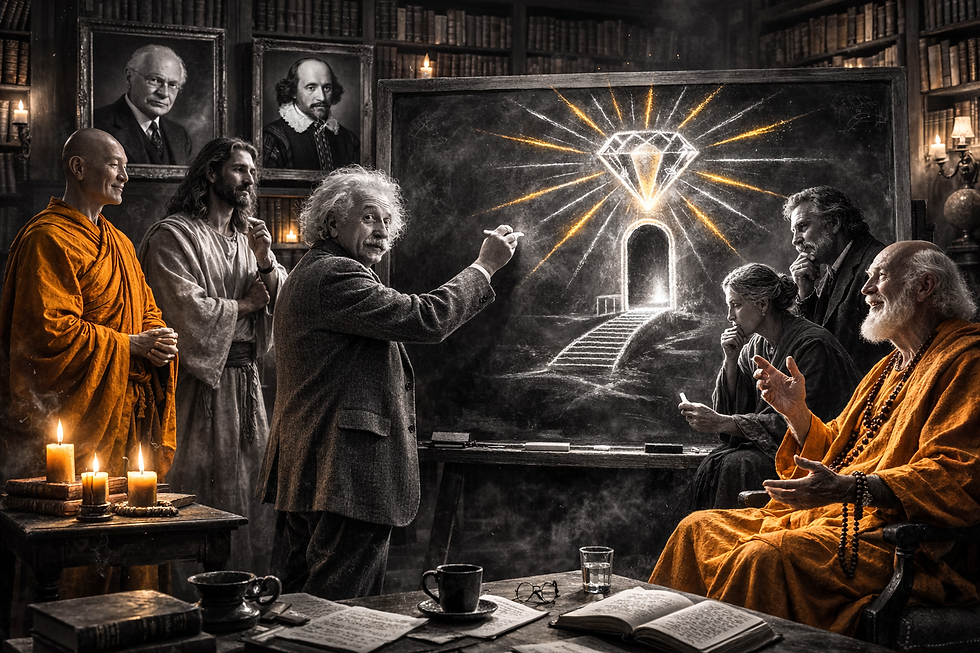
That terrain is the human condition.
And the first difficulty in approaching it is this: The human being is not simply a mind, nor merely a body, nor merely a personality, nor merely a social role, nor merely a Soul in the devotional sense, nor merely a bundle of symptoms masquerading as, or at least falsely diagnosed as, disease. We are dis-eased. But what has caused this? What is its root? The human being is a living field in which love, fear, attachment, authenticity, memory, defence, symbol, longing, shame, consciousness, and the possibility of wholeness and healing all meet. Any grammar that treats one of these dimensions as the whole will misdescribe the person. Any discipline that mistakes its own method for reality will illuminate one corner of the room and call that partial light completeness.
The price of that mistake has been high. It appears in private suffering first: In the person who cannot understand why outer competence coexists with inner emptiness; why admiration does not feel like love; why performance does not produce peace; why one part of the Self longs for Truth while another part clings to safety or seeks oblivion; why ‘treatments’ don’t necessarily work, why therapy may trigger, why psychology unravels but does not always ‘ravel back up’, why the mind can know and a life still remain divided. But the price is not only private. What begins in the hidden architecture of the person eventually scales upward into families, professions, institutions, disciplines, and ‘civilisations’. Jean Jacques Rousseau wrote in his opening statement of ‘The Social Contract’ that:
"Man is born free, and everywhere he is in chains."
Rousseau's quote highlights his belief that while humans are born with natural freedom, society, laws, and political structures impose constraints that create inequality, ‘good’ and ‘bad’, ‘saints’ and ‘sinners’, ‘normal’ and ‘abnormal’, and then treat artificially created dependency. A civilisation based on duality, categorising non-dual Truth.
A wounded child does not remain merely a wounded child. Left unexamined, the same fear-built structures become roles, systems, paradigms, and public worlds, and then they wound.
That is why the inward journey is not a decorative retreat from reality. It is one of reality’s least completed dimensions. The moon was no small achievement. It was, in relation to consciousness, a small step. There remains a further frontier: Not because the outer Universe is unimportant, it is a wonder equal to consciousness, but that feels as far as the stars, and because the inner one has continued to govern so much of human life while being spoken of in language too vague, too divided, or too disciplined to reveal it whole.
The pages that follow begin from the proposition that the human condition can be mapped more truthfully than it has been. Not flattened. Not over-systematised. Not prosecuted. Not reduced to a diagram that is mistaken for life and crossed out on a whim or a ‘win’. But mapped. The map begins with a new grammar because the old one no longer holds: It is not understood. And so we worry about machines. But we needn’t. It begins with the psyche because the psyche is the threshold at which the larger questions of fear, Truth, consciousness, wholeness, and love first become locally visible. And it begins slowly because a reader cannot be asked to inhabit a new land without first being given its paths, its contours, its architecture, its bridges, and its scale.
That is the work here: To move from foreignness toward familiarity, from familiar words toward real meanings, and from fragments toward the first glimpse of a whole. Trust me, Truth is just around the corner…
The Story of Mankind, Humanity, the Child, Truth, and of Love as our Liberation
Here is “The Greatest Story Ever Told”, previously falling on deliberately deaf ears, unseen by self-deceptive blindness, felt without feeling, imprisoned by language, and ultimately liberated by love.
Our Past Was Not Love: Our Psyches Fractured, But Our Present can be Love, and Our Future Will Become our Present
Love is not just a map. Love is not just a mechanism. Love is our salve. It is our guidance: A satellite navigation system that leads us back to itself. Love is ‘what’ we travel to, ‘how’ we travel and ‘how’ in unboxes fear, power, idolatry, confusion, and control, why we ‘travel’, ‘how’ it unboxes fear, and ‘whom’ we travel to - ourselves. Love is how we see, how we feel, and how we know when we get to what seemed like previously foreign lands, and what to do when we do.
Wisdom is a Satnav with one button marked ‘Home.’ Love does not criticise our wrong turns, like internalised parents as inner critics — in what I take to be one of Freud’s greatest errors, of which he was unaware — who were also trapped in a forgiveable intergenerational inheritance of fear, inherited through links in the chain of familial unconsciousness. Freud could not see outside of his own 'box of fear.'
We are terrified of AI: Of ‘Artificial Intelligence’ it’s all we talk about, apart from President ‘Trompe’– and yet we are not seeking our own AI – our ‘Awakening Inner’ selves. We become obsessed by the guardianship of self-preservation – of the fear of the child, the mechanism of every life, scaled through institutions, to civilisation, and our futile search for other worlds to dominate, control, and to box up: Our consciousness is undiscovered, hidden by grammar.
In travelling to faraway lands, the whole point is that we journey home: To love, to the child within us, and back to our hearts. One thing should rule the world, and that ‘thing’ is not a monster of our creation, a self-aggrandising post-truth President ‘Trompe’: The better grammar would be the lack ‘pre-Truth.’ Power has become divorced from Truth altogether. Truth is love. The absence of Truth has been exposed and even expounded by this civilisational leader, but Truth is what keeps us alive, and it does not rule, and Truth is the human heart.
Christian Bobin, The French author known for his poetic reflections on love, silence, and the beauty of live emphasised wonder, awe, and Truth over knowledge. He wrote:
“Truth is not something we have, only live.”
Without Truth, ‘civilisation’ becomes not just a disorientated ‘monster' from the novel ‘Frankenstein’' stumbling in the darkness of an arctic Westland, that is even studied in secondary schools, frequently without the metaphorical meaning of it, although it has extensive literary analysis, but of the scientist who created it. popular culture often flattens the creature to a simple 'horror monster,' frequently ignoring the deep analysis of responsibility, neglect, and scientific ethics that Shelley focused on. It is a parable of the unchecked ambition of the scientist Victor Frankenstein. Mary Shelley, who suffered from profound childhood Trauma herself, wove this autobiographical influence this into her book. Shelley lost her mother 11 days after her birth, and suffered the loss of her own newborn children, leading to themes of infant abandonment, failed motherhood, and grief that permeate the novel. Many scholars argue that Victor Frankenstein is the true 'monster'—or at least more monstrous than his creation—due to his reckless pursuit of knowledge without moral consideration, abandonment of his creation, and failure to accept responsibility. The 'disorientated monster' metaphor aptly describes a civilisation that uses technology (the creature) recklessly, abandoning it to cause destruction. ‘Frankenstein’ is a seminal cautionary tale of the "Modern Prometheus" (playing God), warning of the dangers of pursuing knowledge without ethical foresight, often linked to the industrial and scientific revolutions. The novel ends with Victor pursuing the creature to the Arctic, a cold, isolated landscape that represents the ultimate desolation of his ambition and his loss of humanity. This is not the landscape of love: It is the landscape of fear, of a ‘Hell’ on Earth, driven by low self-worth seeking external validation through his discipline and ‘invention.’ ‘Frankenstein’ is thus understood not merely as a horror story, but as a deeply psychological reflection of trauma and a critique of irresponsible ambition.
Jesus never wrote a book. For if he had it would have been even richer in parables, not in the service of captured cleverness or dogma, not a story of a king, but as a great teachers of humanity. That is a profound perspective that aligns with several historical, cultural, spiritual, contemplative and theological interpretations of Jesus’ teaching. While the Bible itself does not explicitly state why Jesus never wrote a book, the idea that he prioritised living, oral teaching over fixed writing is widely discussed. Jesus used orality instead of documentation. He ‘lived a living message.’ He was love. He was Truth. Jesus used parables—not written treatises—to make his teachings accessible and to allow for personal and relational transformation. The view that writing cannot fully express Truth or love mirrors John (1:14) as Jesus being:
"Word made flesh."
Jesus was a living word, not a set of dead letters. In this sense he is very much alive as a teacher.
Disciplines are ways of telling stories: Parables of the ‘modern’ age. Those stories have always been told, and have always been true in part. The storytellers must lose nothing in translation, and must take us to the last page, where Truth remains unwritten. This series is part of that larger story, in a language meant to be lived as well as understood. Sometimes that language is silence. And that is all right. When there are no more metaphors, when what remains is Truth, grammar becomes silent, and yet that is where it speaks most clearly.
The Quiet Revolution
We were not ‘made’ to lie. We were not ‘created’ to taxonomise. We were not born to judge. The disciplines and institutions were man made by man and for man.
Scientists, neuroscientists, psychologists, doctors, and psychiatrists are storytellers, no more: A little reminder every so often doesn’t do any harm - it reseats them when they leap up to rule by tyranny and power. We need quiet revolutions, not violent ones. We don’t need to ‘replace the king.’ We need to displace ‘puppet kings’ from their thrones.
The quiet parable is just a retelling of the greatest story ever told - a voyage of discovery, to faraway places deep inside our psyche, beyond our minds, where we will find love, and at its centre, the human heart. It is not the story of the child that would be king, it is the king that is every child.
Jesus did not want to be king. A crown was forced upon him, to make him bleed. In crucifying him those who believed that they were in power, the collaborative effort involving both religious authorities (who instigated the arrest) and political authorities (who carried out the execution, bestowed on him unlimited 'Real Personal Power', far greater than that enthroning themselves. They had to nail him down, through fear, as his teaching love was so subversive, so radical, so powerful, that it would show them to be storytellers who have forgotten to tell their parables, without mistaking their knowledge, their message, for the whole, rather than pieces of a puzzle, revealed as an inner map, pieced together by those at the ‘intersection of the psyche’, witnesses on a jurisprudential stand, not allowed to speak. I did not invite Jesus here: Dr Carl Jung did - the 'prophet of the psyche'. One intersectional witness inviting another. And they are legion.
Jesus’s deepest teachings, from the ‘Sermon on the Mount’ were of healing the sick (wholeness as medicine), feeding the hungry (compassion as existential purpose), teaching (as guidance to Truth), and showing unconditional love (as the discipline of the disciplines).
Mahatma Gandhi (yes a lawyer - you would be surprised) said of Jesus that:
"To me, he was one of the greatest teachers humanity has ever had. Metaphorically we are all begotten sons of God."
In John (10:30) Jesus stated:
“I am the Father are one.”
Jung believed that this was the individuated totality of the psyche – of the Soul.
In John 14:12, Jesus spoke of growth, evolution, metaphysical maturity, transformation, and the psychology of human potential and of ‘Real Personal Power’, encouraging a shift from fear to love:
"Truly, truly, I tell you, whoever believes in Me will also do the works that I am doing. He will do even greater things than these, because I am going to My Father".
In John (14:6) he said:
"I am the way, the Truth, and the life."
In Matthew (6:33) Jesus said:
"But seek ye first the kingdom of God, and his righteousness; and all these things shall be added unto you."
William Shakespeare wrote:
"This above all: To thine own self be True.”
‘Thyself’ is a child, with a beautiful heart, at the centre of your psyche, and your Soul is the totality of your psyche.
Shakespeare taught us about ambition and monarchy through ‘Macbeth’. He taught us about the existential, the inward struggle, and the modern paradox of knowledge versus action through ‘Hamlet’, and "The Seven Ages of Man" in his famous monologue "All the world's a stage" in 'As You Like It'( Act II, Scene VII), not as parables for our downfall, but through paradoxes of hope.
Jesus was not a Christian. He did not, in this reading, claim to be God. His status, his resurrection, may be read as a rebirthing of his Soul.
Buddha was not a Buddhist. He proclaimed no divinity. He taught, through contemplation, philosophy, and true ‘seeing.’
Our Greatest Teachers
Carl Jung, the master of the psyche, the prophet of the Soul, who recognised the Christ in each of us, the prophet of the Soul. His ‘Red Book’, the ‘Liber Novus,’ which he requested should not be published for 50 years after his death, in case the world thought him ‘crazy’ (yes one of the greatest psychologists who ever lived, and one of the great shapers of psychoanalysis, the very basis of ‘seeing’ our deepest fears - the fears of not being worthy, of not being loved, and of being abandoned by our communities because of being categorised as ‘mad’, ‘abnormal’, ‘dejected, ‘sacrilegious’, knowing that ‘civilisation’ not being ready for the story that has been told since Advaita, the ‘Baghdavad Gita’, Buddha, and Jesus). Buddha and Jesus were not ‘divine’ in the ordinary disciplinary sense, nor did they pretend to be. They suffered. Jesus gave us parables. Buddha spoke of 'Enlightenment'. It took Jesus three days to give birth to himself. It took the Buddha six years. Our own ‘Stairway to Heaven’ will not be a leap. It will be a voyage. Jesus and Buddha were exalted by their teaching, not by their titles. There was no deification, no enthronement. They told the story of suffering. But suffering is not really suffering, it is our resistance to reality: 'Real reality'. It is the resistance of our ego. We are too full of ourselves, claiming invulnerability whilst being little children. Our cup is overflowing with conditioning, expectation, closed to wisdom, too full of us, too replete with ourselves, to be open to emptying and refilling with the Truth of who were are.
Humanity and Hearts
We need to explore as humanity, discover with wonder, and this is when metaphor becomes the journey to the stars, the journey to the heart of our consciousness. We will reach the stars, though we will never get there through technology, we have already got here though contemplation.
Bobin wrote:
“A few stars were approaching and in their brightness I glimpsed a fragment of your vanished soul – cheerful and frivolous, unforgettable. Heaven is only a millimetre away.”
But to tell a story, we need to begin at the beginning. And to get to the last page, where even ‘individuation’, a word that has connotations of separateness, of disperation, desperation becomes ‘Re-Collection’, and the psyche is the Soul, we need to start with grammar, recalibrate our instruments, and be open to seeing with our hearts and not with our blind ambition.
Bobin wrote about love as unalterable language, flow, and its 'Real personal Power' and invincibility through vulnerability:
“Love is a river. It sometimes disappears. It sinks into the earth. It continues its course within the thickness of a language. It reappears here or there, invincible, unalterable.”
He wrote that real love is everything:
“Truly, I have everything. Why would I want anything more? Is there anything more than everything?... Do I even want for anything? I have everything. Every morning I open my eyes and discover myself a billionaire: Life is there, discreet, loud, colourful, small, immense.”
And that, about what I have named 'Re-Collection’:
“There is nothing more beautiful than meeting your Self… We share the world. We leave knowledge behind. You leave your mask… Truth is incredible… Souls are not children.”
No man is an island. No territory is a man. Humanity is a mainland: There are no bridges as there is, in Truth, no real separation: Only apparent separation. When the Kingdom of God is inside you, but that cannot be said without ego the ego shouting “Yes it is and I am she!”
Jesus told us the parable of the prodigal son (our shadow - the loved disowned part of our psyche), the disgruntled son (the ego - the people-pleaser, the performer), and the Father (the True Self - the real us, the 'divine' part of who we are) welcoming us home.
The Lord’s Prayer:
“Thy Kingdom Come, Thy will be Done, On Earth, As it is in Heaven.”
The 'second coming' has already come, hidden by disciplines, but it is here, right now, and it is our future become present: The intersection of the cross - human time meets divine timing. Grammar, liberated by literature, made precise through metaphor: Myths becoming metaphors - language as parables. Knowledge released from boxes of fear, opened by love. Michel Foucault jumping in, Martha Nussbaum reminding us. Feeling a Truth: And that feeling is love. Not metaphor as contraction, metaphor as expansion, released from wording and interpretation.
Bobin wrote:
“I’ve dreamed of a book you can open the way you push open the door of an abandoned garden.”
This series of articles, my latest thesis on the human condition, is that book.
Stranger in a Strange Land: From Foreign to Familiar
We are in a strange but familiar land. It is familiar because we already live there. It is strange because almost everyone we meet is speaking a different language. Psychology speaks of childhood Trauma, attachment, defence, regulation, drives, repression, ego, superego, id, development, dissociation, adaptation, shame, fear, and therapy. Medicine speaks of diagnosis and treatment. Science speaks of mechanism, causation, systems, and measurement. Philosophy speaks of Truth, reality, consciousness, perception, illusion, coherence, and freedom. Spirituality speaks of clinging, preference, awareness, awakening, BEing, surrender, letting go, Soul, presence, liberation, and love. Religion speaks of sin, redemption, repentance, Grace, crucifixion, resurrection, and the Kingdom within. Each is naming something real. The trouble is not that these witnesses are ‘wrong’. The trouble is that they are all partial. None, left on its own, is enough. They often use the same words for different things and different words for what is, in fact, the same thing. Word salads. Word cocktails. They all seem, at least at times, to think their language is the only one that is true and accurate. This is not a minor inconvenience. It is one of the mechanisms by which the whole has remained obscured.
Psychology explains the mechanics of fear-organised identity. Philosophy explains how that identity mistakes its lens for reality. Contemplative wisdom reveals the ground of BEing beneath the lens. My meta-meta-theory of the ‘Unified Field of the Human Condition and How to Heal It’ shows how the whole journey fits together as one map: From physics to metaphysics and beyond. It also provides a map of the very psyche itself: What it looks like when it is fractured, when it is healed, and how to get there. We will shortly get our first glimpse of those maps to our inner workings – maps of our life and maps of our Soul.
This opening does not abolish those other languages, and it does not pretend they all say the same thing. It stands at their intersection, where geniuses such as Shakespeare, Einstein, Jesus, Siddhartha, and Jung went and dwelt, and asks whether they have been naming different parts of one terrain. That is why the movement has to be governed by a process which I have called ‘Prefigurative Unboxing’. It arrives ‘before the face’ (hence ‘Prefigurative’) hardens into a mask, before the paradigm that envelops a mind, a person, a discipline, a profession, an institution, and indeed an entire ‘civilisation’ closes and seals itself, before knowledge and control are mistakenly adopted within that ‘box’ for power. The box here is not merely personal: It scales. It explains how a traumatised child, a fractured psyche, ultimately becomes a wounded civilisation. Fear builds these boxes. Fear keeps sight inside them: It keeps their lids tightly closed. And it keeps them separate from other boxes, not even seeing that they are just like the other boxes. All scared, confused, and fighting. Love, however, opens them. The new grammar is therefore not pedantry at all. It is passage. It is required for a totally new, precise, and functional understanding of how life works and what it looks like when it doesn’t. And most importantly, it allows us to see our way out of our box of fear: How to heal. And to heal is to be whole, quite literally: Etymologically (they share the same root), theoretically, practically, usefully. And they share cognates in other languages, bridging countries: Bridging continents. They are not only synonyms in modern English, but they are also ancestral relatives, like we all are, that define physical, mental, and psychic, recovery, but also repair at scale: Of entire civilisations. They represent re-gathering of our broken parts, a re-membering of who we truly are, before the world got to us: They are they ‘Re-Collection’ of ourselves and therefore each other.
There is a particular kind of alienation that modern people know very well and struggle to describe. It is not the alienation of exile from country, nor of obvious social exclusion, nor of lacking language altogether. It is subtler. One knows one’s routines. One knows one’s anxieties, biography, family dynamics, role, job, coping strategies, tastes, and desires. One may know one’s diagnoses: After all, they are often thrust upon us. One may know, if one is very ‘clever’ or a developmental psychologist, one’s own attachment style. One may know which parent did what, which former partner reopened what, which therapist tried what, which doctor pointed at what, and even which childhood pattern one keeps repeating. One may know all of this and still remain, inwardly, strangely foreign to oneself. One doesn’t even have an inner language to describe how one feels, and no one seems to want to know anyway. It is much easier to slap a label on us and slam the lid shut:
“Next box please!”
That is a crucial starting point. The difficulty is not always ignorance in the crude sense. It is often that the existing ways of knowing are fragmented. They produce islands of insight without a continent. They give labels without meaning, mechanisms without maps, sympathy without structure, spirituality without psychology, psychology without Soul, metaphysics without mechanics, philosophy without the wounded child, and religion without the lawful human journey that made religion ‘necessary’ in the first place. Dogmas don’t draw maps: Why would they? I mean, what jailor gives an inmate a key to their prison door? A person can therefore become very articulate about distress while still feeling fundamentally lost inside it. They know many pieces. They cannot yet see the whole.
This is one reason why so much modern language around healing feels both useful and curiously unsatisfying. The terms are not false. Many are valuable. Yet they often arrive as disconnected specialists. Trauma says one thing. Attachment says another. Mindfulness another. Cognitive Behavioural Therapy (CBT) another. Jung another. Freud another. Philosophers another. Spiritual teachers another. Contemplatives another. The reader wanders among them like a traveller learning brilliant local customs in a dozen cities while never quite finding the country they belong to: Not even knowing that they are all the same continent.
Hence the feeling of strangeness.
The strange must become familiar without becoming small. One must be able to say: I know these words. I know fear. These words are that fear. I know chaos. I know confusion. I know the ache of wanting to be loved, truly loved. I know the exhaustion of performance: The upstream swimming that never ceases. The senseless striving that never gets me anywhere. I know that motor inside me that keeps me safe: If only just. I know the weather of my mind that will not let me rest in the storm. I know what it is to want peace and continue choosing what destroys it. I know what it is to be both actor and audience in one’s own suffering, and of always wanting to be the director. And then a further recognition appears: Until now, these things have mostly been known in fragments.
A guide entering an unknown land does not begin by speaking in an unknown dialect. Imagine a game: Two people enter a room and are both asked to wrote down what a word means - really means. Sounds simple enough, even though it sounds a bit boring. What about the word ‘love.’ Easy one to start with. Or is it? What is the chance of the two definitions being the same? Likely? Slim? The answer: Virtually never. No chance.
This explains why visual architecture matters so much in this thesis and to us. A great deal of suffering, if not most of it, persists because people cannot see what is happening inside them. They feel weather but cannot see structure. They feel symptoms but cannot see sequence. They feel conflict, but not a map to the battleground. They feel the scream of the ego or the pressure of the inner critic or the existential ache of unlived life, and all of it appears as undifferentiated distress. Once the psyche is pictured, once the architecture becomes visible, something very simple and very powerful happens: Trust begins. The person is no longer being asked to believe there is something behind the fog. They can see.
And seeing matters because much of what passes for ordinary life is organised around not seeing. We live inside phrases whose meanings have long ago gone flat. ‘Be yourself.’ ‘Love yourself.’ ‘Trust the process.’ ‘Think outside the box.’ ‘Speak your truth.’ ‘Heal.’ The problem is not that these phrases are wrong. The problem is that they are often used before the reader has been shown what ‘Self’, Truth’, ‘box’, or ‘healing’ actually are. The words become floats drifting aimlessly and purposelessly above the life they are meant to illuminate.
The work here is to return density to them.
A person says, ‘I feel lost.’ They may mean many things at once: Disconnected from their centre (whatever that is), organised around fear (“What me – afraid – noooo! You must have me mistaken for someone else!”), pulled by preferences (“What is preference anyway and what’s it got to do with anything?”) and resistance they mistake for identity, seeking substitute completion - imitation, unable to integrate grief, incapable of acceptance, of being angry, of how to show tenderness, vulnerability, compassion, authenticity, or joy, performing a part that no longer fits, or never fitted, not knowing who they are, or what mask to wear today, while imagining that the performance is adulthood. Another says, ‘I know who I am.’ They may mean only that they know their role, not their BEing. Another says, ‘I want love.’ They may be speaking about the deepest human longing, or about the many substitutes recruited when real love felt too dangerous, too scarce, or too conditional. Another says, ‘I need healing.’ They may mean relief from symptoms, or insight into patterns, or safety, or forgiveness, or regulation, or, rarely, a full return to wholeness. The words stay the same. The depths vary enormously. The meaning muddles. Clarity remains obscure.
So, this first movement from foreign to familiar is not trivial scene-setting: It sets the scene – for our lives, for remembering, for choice, for ‘Re-Collection’ of our fractured parts for who we are and for who we might BE. It is the first moral act of the work. It refuses oversimplification, and it refuses abstraction without hospitality. Much of this land has already been known by feeling. What has often been missing is not sincerity, effort, humanity (even though it overwhelmingly feels that way), or intelligence, but a map in which the pieces belong to one another. A map of how we belong to one another. A map for humanity to be humane: To be human again.
That is why the next movement must be developmental, not merely descriptive.
For many people, the first encounter with the inward life is not illumination but estrangement. The outer life may appear coherent enough: A profession, a family, a style of competence, a recognisable personality, perhaps even success, even though it doesn’t feel as such. Yet beneath that visible arrangement there persists an unnerving suspicion that one is somehow living at a distance from oneself. Living someone else’s life. The world may know one’s face (or many faces - "I mean, I need one for every part I play right?”), one’s role, one’s function, one’s reliability, one’s usefulness. It does not follow that it knows the person. Nor does it follow that the person knows themselves.
A psychiatrist may speak of drives, repression, compromise formation, ego, superego, dissociation, symptom. A psychotherapist may speak of attachment, developmental wounding, regulation, shame, patterns, unmet need, adaptation. A contemplative teacher may speak of awareness, identification, resistance, Being, clinging, freedom. A philosopher may speak of truth, appearance, reality, illusion, knowledge, freedom, perception. Each is naming something real. None, left on its own, is enough.
That is why the land can feel so foreign. It is not foreign because it is unreal. It is foreign because it has been divided: Carved up by imaginary lines. The same human being is encountered in fragments, each fragment taken up by a different discipline and then treated as though it exhausted the whole. Yet the person does not suffer in departments. Countries are inventions. Fear does not remain politely inside psychology while Truth is outsourced to philosophy and the Soul reserved for religion. Human beings suffer as wholes. They suffer bodily, relationally, emotionally, psychologically, existentially, spiritually, symbolically, visibly, and invisibly all at once. A grammar that divides those dimensions too sharply may increase professional certainty while decreasing Truth. A grammar that collapses cannot recollect the parts.
That is one reason people often feel lost before approaching the truly great witnesses of the psyche: Of approaching those who lived at the ‘intersection.’ We fear not only not seeing the depth of what they saw or feeling what they felt. We fear Truth altogether. We fear clarity, because it means first accepting that we don’t know it all: We don’t know it at all. Those witnesses stood at different thresholds, under different conceptual skies: They stood, unlike us, ‘unboxed’ and used words whose meaning we feared because it meant that we so far had not understood how life works or where we are going, or even ‘why’. One may read Jung on the Self, Buddha on no-self, Michael Singer on the witness, Dr Gabor Maté on authenticity, and emerge bewildered.
What confuses the traveller is not that they were not guided here, but the abundance of partial guidance without a shared land: Every one, every profession thrusting a different map in our face proclaiming it as the only one.

This is one reason the inward world so often feels foreign even when its language sounds familiar. The traveller is not faced with emptiness, but with excess: Too many guides, all thrusting maps, too many partial truths, too many local inaccuracies without a shared terrain. One stall offers a snapshot, vivid but incomplete. Another offers a map, but a map so differently drawn from the others that the valley itself becomes difficult to recognise. The problem is therefore not only that each discipline sees in part. It is that the parts do not yet belong to one another or to a whole. And without wholeness there is no healing. The result is a strange form of modern bewilderment: Testimony everywhere, but no Truth. Witnesses swearing blind, and remaining so.
The point is not to pretend those rooms are identical. It is to show that they belong to one house: And it is ‘open-plan’. Existing vocabularies are not merely untidy. They are often locally illuminating and globally blinding. They name one chamber well and then let that chamber masquerade as the building. That is why a new grammar is needed. We need precision.
Seen like that, the strangeness begins to soften. What once felt alien begins to become familiar, though not in the cheap sense of being reduced. Familiarity here means recognition. Fear, masking, division, false courage, longing, people-pleasing, spiritual hunger, and the exhausting search for external validation cease to look like random embarrassments scattered across an otherwise sensible life. They begin to look like signs belonging to one intelligible terrain.
We Are Sent to Earth to Evolve and Yet We Don’t
Michael Singer belongs here for a very exact reason. He is not an ornamental spiritual extra, and not a pious afterthought once the supposedly ‘real’ witnesses have spoken. He belongs because the point is to unbox psychology rather than discard it. Freud and Jung help disclose the structure of division. The developmental witnesses help explain how that division forms. Singer helps name what the ego does with that division and why the ordinary self so persistently resists the very life that could heal it. Psychology, philosophy, and contemplative wisdom are not being piled together carelessly. They are meeting at different points on the same terrain.
And Singer gives one of the opening stones outright:
“Earth is a place where Souls are sent to evolve.”
That line turns the whole movement at once. It tells us that life is not merely happening to us. It tells us that difficulty is not random humiliation. It tells us that the human being is not simply here to acquire, perform, dominate, and survive. But the line is also insolent in the right way, because once uttered it makes the obvious scandal visible: If we are sent to Earth to evolve, then why do so many of us become more defended, more frightened, more role-bound, more identified with the mask, more efficient at surviving, and less able to love? The answer proposed here is developmental: The psyche is wounded early, fractures under conditional love, and forms the ego as a defended structure before any real freedom arrives.
This is where the developmental witnesses become indispensable. The Canadian Dr. Gabor Maté, the great teacher of attachment versus authenticity, belongs near the beginning because he names the primal human bind with unmatched directness: What fear cannot properly hold, it may instead enthrone.

This is one of the great hidden tragedies of the human condition: The child who was meant to be loved becomes the child who must rule. Under conditions of fear, the wounded centre is not simply consoled, nor properly held, nor gradually integrated into a larger wholeness. It is overpromoted. Need becomes command, panic becomes authority, and the adult life that follows may come to organise itself around the demands of that frightened sovereign. The image above makes that process visible. The megaphone shows how pain becomes amplification. The throne shows how vulnerability becomes miscast as power. The kneeling adults show how later life can become an economy of obedience to the wound: Work, appeasement, burden, performance, and endless service to a centre that was never meant to govern the whole psyche.
Human beings seem built for growth, and yet so much of life becomes organised around survival. There is in us the possibility of ripening, deepening, widening, loving, becoming real, becoming whole. Yet much of what passes for adulthood consists not in maturation but in adaptation. People become more skilled without becoming more free. More socially legible without becoming more inwardly reconciled. More externally impressive while remaining privately governed by fear, shame, image, and unmet hunger.
The roots of that tragedy do not lie first in malice. They lie in development. Maté, one of the strongest contemporary developmental witnesses in this field, gives the central problem with unusual economy:
“We’re born with a need for attachment and a need for authenticity.”
That line explains more than many whole theories. It tells us why fear belongs to childhood Trauma and not to Truth.
Those two needs are not decorative additions to life. They are among its first structural facts. The child needs to belong, and the child needs to be real. Where those can coexist, growth becomes possible. Where they collide, adaptation begins.
The child cannot survive without attachment. So whenever attachment and authenticity come into conflict, attachment wins. The child adapts. The child does not say, “I appear to be entering a developmental compromise.” The child becomes what is survivable. The fracture begins there. It is not wickedness. It is not moral failure. It is the beginning of life under altered conditions of love. There is a sequence: The psyche is wounded; the psyche fractures; the ego forms; fear becomes its language.
Donald Winnicott, the English paediatrician and psychoanalyst whose work on the ‘true Self’ and ‘false self’ remains one of the clearest witnesses to early adaptation, gives the next indispensable line. In ‘The Maturational Processes and the Facilitating Environment’:
“The false self, if successful in its function, hides the True Self.”
That is not merely useful. It is foundational. It lets us say, without sentimentality and without blame, that the defended structure which later becomes ego is not originally a theatrical vanity project. It is a response to conditions. Something living, vulnerable, creative, and true is hidden in order that something more adaptive may survive. The traveller needs to know that at the threshold because without that knowledge the whole inward journey will sound moralistic. It is not. It is merciful. The point is not that people should have been better. The point is that they were frightened, and that fear reorganised the psyche.
One of the oddities of modern self-understanding is how easily we confuse chronology with development. Time passes. Years accumulate. A child becomes an adult. The adult acquires speech, competence, sexual history, money, routines, clothes, status, opinions, wounds, preferences, obligations, defence-mechanisms refined into personality, and enough autobiographical narrative to sound convincing when speaking in the first person. Outwardly, this looks like maturation. Inwardly, it may be something else entirely.
Everything here depends on refusing a flattering lie: Ageing is not the same as evolving.
A person can become more socially legible without becoming more whole. They can become more defended, more articulate in defence, more professionally successful in defence, more admired in defence, more spiritually literate in defence, more therapeutically informed in defence, more romantically competent in defence, and still remain inwardly organised around a wounded child who learned early that love was conditional, exposure was dangerous, authenticity was costly, and attachment must take priority over Truth.
This is why so much of what looks like adult life has the quality of repetition. The costumes change. The mechanism remains. The right schools, jobs, lovers, causes, ideologies, self-images, aesthetic identities, addictions, and ambitions are recruited in turn. Yet the same structures recur because the organising centre has not moved. The human being does not first choose freely and then suffer the consequences. Much of what they call choice is already being shaped by a nervous system, a psyche, and a belief-structure formed earlier than conscious sovereignty. In this sense Sigmund Freud remains an indispensable witness. Freud’s great scandal was to tell modern consciousness that it is far less sovereign than it imagines. In one of his most famous formulations, he wrote that:
“The ego is not master in its own house.”
Whether or not one follows Freud all the way, the blow has landed and cannot be withdrawn: What we call ‘I’ is already being moved by forces it did not simply choose.
My model presses this much further. It says that the path most lives take under conditions of conditional love is lawful before it is moral. It is adaptive before it is chosen. The child who learns that authenticity threatens belonging does not then stand at a neutral fork in the road and choose fear as a vice. The child goes where survival takes them. Attachment outranks authenticity because, at that age, it must. This removes our agency at the first fork in life where we must choose between attachment and authenticity. We always choose the right hand path. It is a 'choiceless choice.' Ands it is where we are shown the first glimpse of the map of the 'Unified Field of The Human Condition and How to Heal It.'

That is why the journey down the ‘Path of Attachment’, the beginning of the 'right hand path' of preference and resistance, which becomes the ‘Quest for Love’, toward our craving for external validation, compulsive seeking and addiction, and on to the ‘Temple of Emotional Anaesthesia’ to roles to numb our unbearable emotional pain, is not well described as bad decision-making: It is choicelessness masquerading later as behaviour and character. Only much later does the real choice begin to appear: The first 'fork in the road' where agency is restored. But we will come to that, all in good time.
The child does not step back and choose a philosophy. The child adapts. If authenticity threatens belonging, belonging wins. If vulnerability threatens safety, armour forms. If spontaneous feeling threatens love, feeling is suppressed, rerouted, numbed, performed over, or hidden beneath skill. In that sense the human being is indeed sent here to evolve, and yet often cannot begin with evolution because survival arrives first and installs itself as grammar.
That single clarification introduces mercy into the architecture. Moralism loosens; falls away entirely. In this thesis, human beings are not being accused: They are being explained. A lawful sequence is being described: The unconditioned child, the conditionality of love, childhood Trauma, attachment, defended adaptation, ego, fear, preference, substitute completion, craving for external validation, suffering, addiction, self-imprisonment, and only later the first real opportunity for the chooser, for choice, to reappear. This is why the model is dynamic. It is not one more inaccurate and oversimplified or even overcomplicated diagram on a whiteboard for a lecture on a course on psychology, or a weekend course on self-improvement with a spiritual gloss. It is a map: Of the mechanics of a life, and the metaphysics of how to heal.
This is why moralistic conclusions, judgements so pervasive in our current reading of the human condition, in particular by those most affected by it themselves such as in the legal profession and in religious groups, become so crude. They see the adult and imagine a fully free chooser where, in truth, there may have been a frightened child, exactly like themselves, making an impossible bargain long before reflective agency was available. The bargain they themselves made likely led them directly, without conscious choice, to 'choose' their own profession: The role that would most hide their own wound, by pointing the finger squarely at those of others.
Much of what later appears as personality, as behaviour, as professions, even as institutions, political parties, and even entire 'civilisations', may in fact be adaptation. Much of what appears as choice may in fact be the lawful continuation of a system built under conditions of conditional love and threatened attachment, scaled upwards. Boxes beside boxes, on top of boxes.
This also explains the tension between the human longing for evolution and the human habit of not evolving. We are born with enormous potential for development, relation, joy, peace, creativity, and love. Yet potential is not the same as pathway. The pathway can be interrupted, distorted, or frightened into the wrong allegiance. The person then grows, but around the wound. Intelligence grows around it. sexuality grows around it. Talent grows around it. profession grows around it. ideology grows around it. Spiritual aspiration can grow around it. Even virtue can grow around it. The result is frequently impressive, often painful, and rarely free.
What is called civilisation is full of such growths.
A child can become a brilliant lawyer, doctor, artist, prime minister, parent, teacher, philosopher, monk, or revolutionary and still remain governed, at depth, by the same basic bargain:
"I must not lose love. I must not lose belonging. I must not be exposed. I must not be seen in my need. I must not feel the original grief. I must manage, perform, appease, dominate, achieve, anaesthetise, idealise, or interpret my way out of vulnerability."
The political, institutional, and civilisational enlargements are all already implicit there. But the root remains developmental.
This is why adult life so often feels like an elaborate continuation of a much earlier emergency. One can become highly accomplished inside a structure that was never designed for freedom. One can build a career, a marriage, a public self, a reputation, a style of intelligence, even a form of moral seriousness, and still remain governed by a much earlier conclusion: love is conditional, exposure is dangerous, worth must be earned, safety lies outside the self, and reality must be managed rather than trusted. Fear becomes not merely an emotion, but an organising way of reading the world. That is one of the key architectural claims of this project: fear becomes grammar.
Without that, nothing larger becomes intelligible.
Truth, consciousness, Christic return, and the wider field all have to be earned slowly. Leap too quickly to enlightenment or transcendence and compassion disappears. The opening then starts sounding like a sermon delivered over a wound that has not yet been named.
That order is itself an act of love.
Gandhi on Jesus again:
"Jesus lived and died in vain if He did not teach us to regulate the whole of life by the eternal law of love."
Gandhi argued that Jesus's message had become ineffective not because the teaching was wrong, but because the world at that time was unready to receive it. The question remains:
"Are we ready now?"
All You Need Is Love: Why Imitation Is Never Enough
The sentence sounds almost offensively simple until one understands what is being claimed by it. ‘All You Need Is Love’ is not being used here as sentiment, nor as pop-cultural ornament, nor as decorative idealism floated above the wreckage of actual human lives. It is being used as diagnostic severity. It names the thing whose absence shapes nearly everything that follows.
Human beings do not merely want pleasure, status, competence, stimulation, safety, certainty, or being right. They want to be loved. More precisely: they want to be received without disguise. They want to be held without having to perform for the holding. They want to know, often wordlessly, that their existence is not a transaction. They want the kind of love in whose presence a child does not have to choose between attachment and authenticity. Where such love is abundant and real, the psyche grows differently. Where it is conditional, inconsistent, intrusive, absent, frightened, or confused, the psyche adapts differently. Much of adult life becomes the long, ingenious, exhausting search for substitutes.
This is where the term ‘imitation love’ becomes indispensable. It names the tragic brilliance of compensation. If real love felt unsafe, unavailable, conditional, or too dangerous to trust, the psyche does not simply sit down and die. It recruits alternatives. Success can become imitation love. Being needed can become imitation love. Being admired can become imitation love. Being desired can become imitation love. Spiritual specialness can become imitation love. Control can become imitation love. The perfect body, the right politics, the right status, the right family role, the right self-image, the right saviour fantasy, the right audience, the right intoxication, the right rebellion, the right victimhood, the right certainty, the right identity costume: All can become imitation love. Each promises what the wound wanted. None delivers.
What begins as the child’s hunger for real love can become, in adulthood, the pursuit of applause.

The image above shows why ‘imitation love’ can become so compelling. The child still knows the hunger for what is real: nourishment, welcome, abundance, the kind of love that does not have to be earned by display. But once that love has been made uncertain, conditional, or frightening, the adult self may learn to turn elsewhere. Public admiration, recognition, status, distinction, achievement, and applause begin to function as substitutes for what was once sought more simply and more truthfully. The crowd claps. The banquet remains. One offers excitement and reinforcement; the other suggests communion. The sorrow of the human condition is not that we hunger too much, but that we so often learn to feed that hunger with what cannot satisfy it.
That is why imitation is never enough.
It is not enough because it is not relation. It is management. It is substitute completion. It is the near miss rather than the arrival. It excites, binds, rewards intermittently, flatters, anaesthetises, absorbs, and repeats. It leaves the person returning. It can organise a lifetime. It can build institutions. It can shape an entire civilisation of roles and performances. It can even create what the world calls love stories. Yet if what is being sought is the healing of the original fracture, imitation love remains structurally incapable of doing the job.
This is one reason so much success can feel strangely empty. The person has acquired what they thought would finally quiet the ache. The ache remains. Or else it quiets for a moment and returns with greater appetite. The nervous system learns to seek the next hit. The ego grows more elaborate. The person becomes more externally convincing and more inwardly dependent. Their identity begins to crystallise around the substitutes that once felt like relief. What they call selfhood is often an economy of anaesthesia.
The phrase ‘All You Need Is Love’ therefore has very little to do with sweetness and a great deal to do with source. If love is absent in the foundational sense, everything downstream is affected. The sequence of fear, false self, preference, resistance, compulsive striving, external validation, and defended perception becomes intelligible. If love is present, or later truly encountered, another sequence becomes possible. The article’s whole argument about Truth, wholeness, peace, liberation, and wisdom is latent here already. Truth matters because love without Truth quickly becomes sentiment, performance, manipulation, or sentimental fog. Love matters because Truth without love becomes weapon, abstraction, cruelty, or sterile correctness. The psyche requires both, though it often knows that only by first suffering their separation.
This is where post-truth begins in miniature. A person can live in post-truth inwardly long before a civilisation does so publicly. One can organise oneself around what secures belonging rather than what is true, hand the governance of the self to performance, and shape identity around what wins approval. The mask is then mistaken for the face. Civilisational post-truth is its scaling.
Love is the counter-force, though even here precision matters. Love is not indulgence. It is not fusion. It is not the refusal of boundaries. It is not the worship of feeling. It is not the management of appearances for the sake of harmony. It is not liking. It is not a mood. In this project, love is closer to the force by which reality becomes bearable and relation becomes possible. It tells the truth without annihilating the person. It allows vulnerability without making vulnerability a death sentence. It opens rather than boxes. It is why healing is wholeness. It is why the journey inward is necessary. It is why the chooser can reappear. It is why the bridge, once reached, can be crossed.
Without love, the psyche adapts brilliantly and suffers deeply. With love, the same psyche can begin to return to wholeness.
It is difficult to write the word ‘love’ without immediately fighting sentimentality. The word has been used so casually, so commercially, and so decoratively that its structural seriousness is easily lost. Yet the problem is not that love is too simple a word. The problem is that most people encounter substitutes early enough to mistake them for love itself.
Approval is not love. Reward is not love. Praise is not love. Selection is not love. Utility is not love. Admiration is not love. Prestige is not love. Seduction is not love. Role-security is not love. Conditional tenderness is not love. A person can be wanted, applauded, needed, or idealised and still remain inwardly unseen. The child who receives imitation love must often build a whole life around pursuing more of it, because imitation is close enough to keep hope alive and far enough to leave the core wound unresolved.
The term 'ego' must be filled with a grammar-field so that it can be seen from several angles at once:
"The petrified inner child wearing armour"
“The hole in the Soul”
“The ontological addict”
“Self-idolatry”
“King Baby”
“The social mask”
“Fitting the Soul to match the role”
“Wrong laddering”
“The 'Quest for Love'”
“Self-imprisonment”
“Truth-avoidant”
These are not decorative phrases. They are attempts to name the predicament of a being who has not received secure enough love to remain simply itself, and who therefore begins to seek outside itself what was not securely established within.
Imitation is never enough because it can sustain a role while starving a life. It can keep the performance going. It cannot reconcile the psyche. It can make the prison more attractive. It cannot dissolve the prison bars, because they are being mistaken for safety.
This is where the ‘Law of Unconditional Love’ becomes conceptually indispensable. The 'Triadic' material that I will introduce does not treat it as a pious flourish but as governing mechanism: The condition under which the terrified structure can begin to relax because what it believed it was protecting no longer has to remain frozen in order to survive. Unconditional love matters clinically because it restores safety; metaphysically because it belongs to Truth and BEing; ethically because it interrupts the whole punitive misunderstanding of the human condition. Without some form of unconditional holding, the psyche remains organised around the belief that reality itself is hostile. With it, a different relation to life becomes imaginable.
It is therefore not enough to say that love is good. Love is one of the conditions of reality becoming bearable enough to be seen. Where love is missing, the person does not merely feel deprived. They build.
Love and Its Definitions
One of the first words that must be rescued is ‘love’. Not because love is soft, but because it is one of the most overused and underdefined words in the whole human inheritance. Everyone says they know what it means. That is exactly why so much misery survives beneath it.
Love is not one large warm blur. It differentiates. Not everything called love is love. There are sharp distinctions between ‘real love’ and ‘imitation love’, and between ‘conditional’, ‘contingent’, and ‘unconditional’ love. That is already more exact than most public discourse, therapeutic discourse, and even much philosophical discourse permits.
Real love, in this grammar, is not romantic intoxication, not the chemical high of attraction, not control disguised as care, not approval granted in exchange for compliance, not trauma-bonding, not co-dependency, not emotional leverage, not the worship of the self in another’s mirror. Real love is acceptance. It is liberation from egoic chains. It is an inner state rather than a transaction. It is not insatiable because it does not feed on lack. It does not need to extract identity, reassurance, superiority, or completion from another person or object. That is why the line is so useful: with real love, nothing else is needed; without it, nothing else is enough.
Love fills you up. Infatuation depletes you. Real love steadies, nourishes, deepens, and enlarges. Infatuation burns hot, narrows attention, and often leaves depletion where it promised fulfilment.
Imitation love may be commodified, converting our compulsion for external validation into emotional currency. We self-commodify when we curate ourselves for imitation love. Communion becomes consumption, turning intimacy into an economic asset.
That distinction allows something crucial to become visible. Much of what the wounded psyche calls love is actually imitation love: A substitute, a near miss, an anaesthetic. This is where Greg Baer’s formulation does real work, and where Arthur Schopenhauer unexpectedly becomes a witness rather than merely a pessimist. Imitation love is not simply bad romance. It is the whole substitute economy of a fear-organised life: External validation, prestige, role, applause, conquest, control, belonging-by-performance, sexual acquisition, compulsive achievement, image-management, even certain forms of knowledge-seeking when knowledge has become defended possession rather than wisdom. It almost works. That is why it is so compelling. A perfect anaesthetic would end the search. A useless one would be discarded. The dangerous one is the one that nearly works. That is why imitation love is more like a drug than a nourishment.
Seen in this light, the relation between childhood Trauma and adult striving becomes much clearer. Conditional love does not merely hurt. It organises. It teaches the child that worth must be earned, that safety depends on adaptation, that authenticity may cost belonging, that vulnerability risks abandonment, that being lovable is not something one may assume but something one must secure. In this grammar, ACEs are therefore not merely unfortunate events. They are forms of conditional love, or of life under the rule of conditionality. That is strong language, but it is explanatory language. It tells us why fear becomes a grammar at all.
Real love is given, not earned. We are not reduced to a cost-benefit analysis. The Soul does not flourish under accountancy. The heart does not become itself through performance metrics, rankings, or bargains of worthiness.
The psyche may be transactionalised through expectation in relationships. The law of exchange enters where the gift should have been. ‘I will love you if’; ‘I will stay if’; ‘I will see you if’; ‘I will value you when’. Quit the quid pro quo. The psyche cannot become whole when it is forever invoicing and being invoiced.
Unconditional love, by contrast, is not indulgence, not passivity, and not sentimentality. It is the condition under which the fork in the road becomes visible. It is what makes authenticity survivable. It is what allows the child — and later the adult — not to confuse worth with performance. In the map developed here, unconditional love belongs to the left-hand possibility of reality-contact, while conditional love sets the scene for the 'Path of Attachment' and the 'Quest for Love'. That is why the distinction is not moralistic. It is cartographic. It describes routes.
Iris Murdoch, one of the twentieth century’s deepest moral philosophers and novelists, gives a line that belongs naturally here:
“Love is the extremely difficult realisation that something other than oneself is real.”
That sentence is almost a bridge between this grammar and hers. It strips love of sentimentality and defines it instead as reality-contact. Real love is not merely a feeling one has about another. It is the loosening of fear’s monopoly on interpretation. It is the end of making the world answer entirely to self-protection. That is why Murdoch is such a good witness for this chamber. She makes love cognitively serious. She makes it an epistemic achievement.
Erich Fromm, too, belongs here, though he need not become a shrine. His famous line:
“Love is the only sane and satisfactory answer to the problem of human existence.”
This quote lands because it states, in compact form, what this whole grammar of love is working toward. Love is not a mood added to an otherwise intact life. Love is the answer because the wound beneath the human condition is relational and existential before it becomes behavioural. If the original injury concerns worth, belonging, authenticity, and connection, then the cure cannot finally be prestige, power, or substitution. It has to be love in the real sense.
St Augustine of Hippo, writing from a very different century and beneath a very different metaphysical sky, sharpens the point rather than softening it. In ‘Homily 7 on the First Epistle of John’ he writes:
“Once for all, then, a short precept is given you: Love, and do what you will … let the root of love be within, of this root can nothing spring but what is good.”
That is not laxity. It is grammar. Augustine is not saying that any impulse baptised with the word love becomes holy. He is saying that the root matters more than the gesture. Harsh correction and gentle silence can both become distortions when fear governs them; both can become true when love governs them. The root decides the fruit.
Real love is invulnerable. Romantic love has been productised as consumption. One is given and cannot be bought, cornered, or secured through image. The other is endlessly packaged, sold, stylised, and circulated back to the lonely self as promise, fantasy, market, and hit.
And this is where love becomes essential to wisdom. Wisdom is not merely cleverness ripened by time. Wisdom is right relation to reality. But if fear edits reality in advance, wisdom cannot arise while fear remains the final interpreter. Love is what allows reality to appear without instant reduction to danger, use, comparison, or control. That is why love is not an ornament to wisdom. It is one of its conditions. Without love, knowledge remains acquisitive, defended, and ultimately insatiable. With love, knowing begins to loosen into seeing.
This is also why the comparison between knowledge and imitation love, and between wisdom and real love, is not crazy at all. It is careful and exact if phrased properly. Knowledge, in its fear-compressed form, can become one more substitute economy: Accumulation without arrival, mastery without peace, possession without transformation. Wisdom is different. Wisdom is not what one owns. It is how one stands. It is what happens when the need to consume reality gives way to participation in it. In that sense, knowledge can become an imitation-love relation to Truth, while wisdom is much closer to real love. The disciplines keep acquiring; wisdom begins to surrender. The first is often insatiable. The second brings proportion.
Suffering is love’s redirection. This does not sentimentalise pain, nor excuse harm, nor baptise every wound as wise. It means that what the ego experiences as interruption, frustration, humiliation, or collapse may, at another level, be the refusal of reality to collude forever with illusion. Love redirects what fear would endlessly repeat.
Love, then, is not one more chamber among others. It is one of the conditions under which the chambers begin to belong to one building at all.
A New Grammar for the Human Condition
Once that is seen, the core words can finally be introduced without vagueness.
The Ego
The ego is not simply arrogance, nor merely Freud’s negotiating agency, nor just a pejorative term for self-involvement. In this grammar, ego names the fear-built defended structure: The false self, the social mask. The ego is the:
"Petrified inner child wearing armour."
The ego is the whole defended structure: The fear-organised identity system that believes the world is dangerous, that love is conditional, that exposure is annihilation, that one must manage, control, perform, numb, or defend in order to survive. This is foundational, because it stops the whole movement collapsing into fashionable therapy-speak about silencing a difficult voice.
The Inner Child
The inner child is not the ego itself, but the wounded, frightened centre around which the ego forms. The armour is not the child, but the defensive construction built around that frightened centre.
The term inner child requires particular care. In the stricter psyche grammar, the inner child is not a fourth coequal managerial agent running the show alongside ego, shadow, and True Self. The psyche is triadic in its major structure: Ego, shadow, divine/True Self. The inner child is better understood as the affective core, the wounded and sleeping centre around which the defensive structure formed, later restored toward consciousness and feeling as the armoured child crosses the 'Bridge' on my map of the human condition.
The Shadow
The shadow is what the ego cannot admit: The denied, buried, disowned, feared, instinctual, painful, and often powerful parts of the psyche excluded from ordinary consciousness.
Here the alignment with Jung's grammar is strongest, but the word still needs rescuing from casual use. The shadow contains pain, shame, rage, instinct, denied vulnerability, buried vitality, and strengths that had to be hidden because they threatened attachment or contradicted the developing mask. But the shadow's strengths may be harnessed.
The True Self
The True Self is the deeper pole - it is synonymous with: Real Self, Higher Self, Higher Power, authentic Self, 'divine' self - Jung's Christic archetype, the part of the person not built out of defence. These all belong to this one conceptual cluster. For all my subsequent articles, ‘True Self’ is the cleanest primary term.
The Inner Critic
The inner critic is not the ego's throne. It is one of the sentries. It is the internalised voice of parental expectation. It tells you whenever if feels that you have taken a wrong turn in life, however old you are.
The Self
The Self, also known as the Soul, is the larger reconciled whole. It is not a decorative spiritual extra, and it is not merely a rival synonym for True Self. It names the whole person in wholeness.
The Self is the reconciled union of the True Self, the de-armoured inner child, and the integrated shadow: What I call my 'Triadic Re-Collection' Model. This is my proposed resolution between a comparative psychological grammar and a larger existential one. This is where Jung was going, although he did not explicitly state how he would fully get there.
Jung is one of the indispensable witnesses here because he saw both the gravity of psychic division and the insufficiency of a merely managerial psychology. In ‘Conversations with C. G. Jung’ he wrote:
“Thinking within the framework of the special task that is laid upon me: To be a proper psychiatrist is to be a healer of the Soul.”
And then, more daringly still, of psychotherapy itself:
“Therefore our Lord himself is a healer; he is a doctor; he heals the sick and he deals with the troubles of the Soul; and that is exactly what we call psychotherapy.”
These lines matter because they prevent the disciplinary reduction that modernity finds so tempting. Jung is not smuggling religion into psychology as a guilty pleasure. He is refusing a false box. He is saying, in effect, that if one studies the psyche seriously enough, one eventually arrives at questions of Soul, wholeness, meaning, healing, and inward truth. That is exactly why a spiritual witness such as Michael Singer belongs in these articles. The movement is not out of psychology into something less rigorous. It is through psychology far enough that psychology’s own frontier becomes visible.
Jung also gives the darker, harder witness this opening chamber needs. In my article ‘The Human Condition and How To Heal It’ he is quoted as writing:
“We need more understanding of human nature, because the only real danger that exists is man himself. He is the great danger, and we are pitifully unaware of it. We know nothing of man, far too little. His psyche should be studied—because we are the origin of all coming evil.
Even if one does not make ‘evil’ one’s governing word, the witness is devastating. The outer catastrophe cannot be separated from the inner condition. That is the first scale-shift of the book. The psyche matters not only because individual suffering matters, but because unstudied psyche scales upward into profession, institution, and civilisation. Fear has organised the forms through which people now live, and those forms reproduce themselves because they are mistaken for reality.
So, the argument has now fully arrived where it had to arrive: At grammar.
Not because words are everything, and not because any text can solve what only life can live, but because language determines whether fragments remain fragments or begin to hold together. If the inherited grammar is loose, the psyche stays blurry. If the grammar is clear, the map begins to hold.
The new grammar proposed here does not begin by multiplying terms. It begins by assigning stable work to familiar ones. It says, in effect: Let each word keep its jurisdiction. Let psychology describe the mechanics of the fracture with as much precision as it can. Let spirituality, in the sense meant here, describe the widening into BEing, consciousness, and lived transformation. Let metaphysics concern itself with the nature of reality and Truth. Let religion provide symbols, parables, and inherited containers where they still carry life. Above all, let us stop pretending these are separate islands when they are repeatedly naming the same terrain from different angles and depths.
The opening formal set is therefore simple: ‘Ego’, ‘True Self’, ‘shadow’, ‘inner child’, 'consciousness.' These terms needed strict definitions. For now, the point is simply why that matters. Old usage had been allowed drift.
And later, now these terms are locked, ‘Soul’ can enter with a more exact function too: Not as a rival slogan, and not as a loose synonym for every better part of the self, but as the richer name for the whole psyche restored to wholeness: The 'Self'.
That is why the threshold begins this way. No private cult vocabulary is being imposed. What should have been given long ago is being given now: Familiar words, precise meanings, one map, no more fragments.
The primary formal grammar of the psyche is therefore not an endless list. It is a small set of load-bearing terms: The fractured psyche, ego, True Self, shadow, inner child, and the Re-Collected psyche, shown below as a map of the psyche.
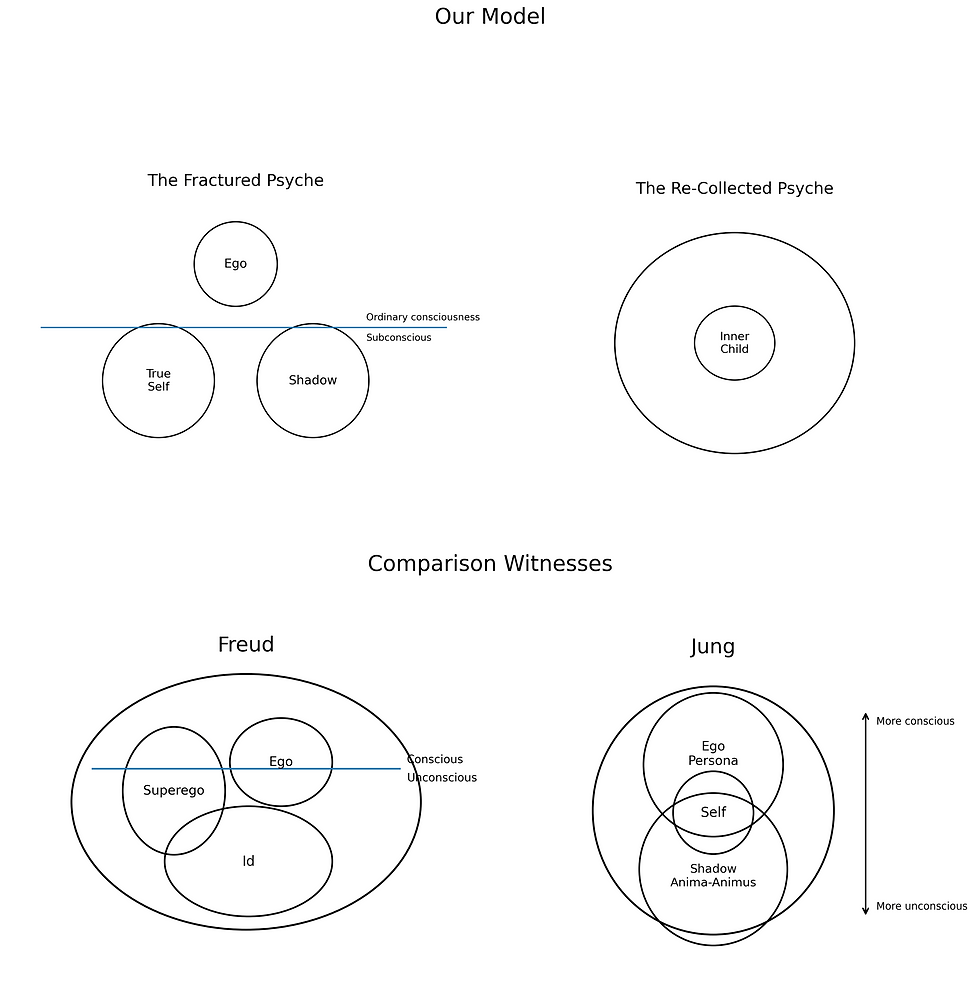
The next movement of the piece will therefore ask what familiar words we did not know, why Truth matters to human BEing, how post-truth can begin inwardly before it appears culturally, why consciousness has become so narrowed, how the map of the journey works, what the psyche looks like when finally pictured, and why the inward road is not optional for anyone serious about authenticity, love, joy, wisdom, peace, or liberation.
For now, the threshold is enough.
So, as you can see, we have not yet travelled nearly so far as we think as a species.The next frontier is inward. And this time, for once, we have begun with a map.
This is where grammar becomes more than preface and more than style. The old vocabularies are not useless. Freud is not useless. Jung is not useless. Maté is not useless. Singer is not useless. Buddhism is not useless. Attachment theory is not useless. Trauma science is not useless. The problem is that each sees under different light, names under different obligations, and often uses the same word for different tasks.
The problem is not that the human condition was never named, but that its names were too often almost right.

The image above is what a new grammar looks like when stripped of abstraction. Not the vanity of inventing cleverer jargon, nor the pedantry of arranging words for their own sake, but the labour of correction. Many labels handed down by disciplines, traditions, schools, and cultures were not wholly false; they were simply not right enough to guide a traveller across the whole terrain. They pointed, but they drifted. They named, but only locally. They captured one chamber and let it masquerade as the building. The drawers are not blank. They are mislabelled. The map is not absent. It is torn, scattered, and beginning to align. Rewriting the tags is therefore not replacing reality with theory. It is bringing language into closer obedience to Truth.
That is why the new grammar is being so exact.
St. Augustine of Hippo stands much nearer to the grammar problem than modern caricatures usually admit. In 'De Doctrina Christiana‘ ('On Christian Doctrine’) he begins with a grammar lesson, which is also a lesson in philosophy on the use of metaphors in representing higher Truth (real reality), using his semiotics (theory of signs):
“All instruction is either about things or about signs; but things are learned by means of signs. … No one uses words except as signs of something else.”
Here, Augustine’s emphasises that the material world 'things' (AI's 'objects', science's materialism - its knowledge), their nomenclature based on superficial impressions, and therefore language is secondary to the actual realities they represent. This framework, which was highly influential in medieval theology and philosophy, shaped how scholars interpreted scripture as a system of signs leading to Truth. He was instrumental in the shift from the 'classical' oversimplified view of metaphors act as figurative literal description, to the more modern philosophical view of metaphors as "wrappings" ('involucra'), that 'conceal' 'divine' (higher) Truth to make its discovery more meaningful and humbling, and paradoxically more meaningful and Truthful. He believed that metaphors prevented "Satiety in the intellect", in other words impoverished understanding, and forcing a deeper study, rather than treating absolute Truth as something being easily grasped and at first appearances.
St. Augustine’s philosophy of signs and things (semiotics) is central to his understanding of Truth, and indeed ours, treating language and material objects as mediators that must be interpreted to reach divine, intangible Truth. For Augustine, a thing ('res') exists in itself, while a sign ('signum') is a thing that points to another thing beyond itself.
Language, then, is already mediating reality rather than simply mirroring it. Words do not arrive as transparent windows. They are signs, and signs can disclose or distort depending on how faithfully they are governed.
Augustine also names the affective condition of understanding with remarkable severity. In ‘Tractate 26 on the Gospel of John’ he writes:
“Give me a man that loves, and he feels what I say.”
Meaning, on this view, is not merely a technical accomplishment. A cold and defended consciousness may parse words and still miss the thing itself. The loving heart does not replace precision; it completes it by making the real bearable enough to receive.
The later philosopher Ludvig Wittgenstein reaches the same cliff-edge from another side. He resists the fantasy that words simply point to ready-made essences waiting to be labelled. Meaning arises in use, within grammar, within shared practices, within what he calls a form of life. Words live inside language-games; they do not float above them as sovereign names. That is why a civilisation can argue endlessly about justice, Truth, Self, or consciousness while secretly playing different games at once. The problem is not always bad faith. It is often bad grammar. And once that is seen, many pseudo-problems stop looking profound and start looking imprecise. In ‘Philosophical Investigations’ he writes that:
“For a large class of cases … the meaning of a word is its use in the language.”
and that:
“Essence is expressed in grammar.”
Augustine presses the point still further. In ‘Homily 7 on First John’, he gives perhaps the most concentrated statement of love as moral grammar in the whole patristic tradition:
“Love, and do what you will: Whether you hold your peace, through love hold your peace; whether you cry out, through love cry out; whether you correct, through love correct.”
That is not moral looseness. It is a claim about root and fruit. If the root is charity, action changes its quality. Harshness may become discipline, silence may become care, correction may become mercy. The point is not that grammar replaces goodness, but that love is the inward measure that keeps language, action, and judgement from drifting into cruelty.
Augustine also gives the article a rule of interpretation severe enough to stand beside any modern hermeneutics. In ‘On Christian Doctrine’, he writes that whoever thinks they understand Scripture, yet fails to build up the twofold love of God and neighbour:
“Does not yet understand them as he ought.”
That line matters here well beyond theology. It suggests that a reading, a concept, a discipline, or a vocabulary that makes us less capable of real love has not yet reached understanding at its deepest level.
In the same Augustinian world, beauty is not separate from love. In ‘Homily 9 on First John’, he writes:
“By loving we are made beautiful.”
and then, still more memorably:
“As the love increases in you, so the loveliness increases: For love is itself the beauty of the Soul.”
The article needs those lines because they show that love is not only ethical relation but perceptual transformation. A defended psyche becomes more beautiful not by ornament, but by being de-defended through love.
A word does not carry meaning all by itself, as though essence were packed inside the syllables. Meaning arises from use, and use only becomes intelligible within a community, its practices, and what Wittgenstein calls "forms of life".
The gain for this article is immediate. Grammar is not a dead list of definitions. It is the living background that makes speech coherent in the first place. A culture can therefore inherit a grammar of ‘love’, ‘self’, ‘truth’, ‘healing’, or ‘soul’ that feels natural while remaining conceptually unstable. The words may circulate fluently and still fail to obey the land.
The later Wittgenstein, read this way, strengthens rather than weakens the present project. If meaning depends on use within a form of life, then a new grammar for the human condition is not vanity. It is the disciplined work of bringing use, form of life, and reality back into closer alignment. And if an inherited form of life is organised by fear, then its words will tend to carry fear’s distortions until they are consciously reworked.
The first task then, was not to prove everything. It was to name more truthfully what has been staring at us all along. The difficulty of the human condition is not merely that life is painful, nor merely that the psyche is complicated, nor merely that the disciplines disagree. It is that one land has been inhabited while many languages were being spoken, and vocabulary was mistaken for vision. Terms inherited from psychology, religion, philosophy, medicine, politics, spirituality, and ordinary life have not sat still long enough to become a real map. Some are too loose. Some are too narrow. Some do several incompatible jobs under one name. Some sound familiar precisely because they have not yet been forced to become exact.
That is why grammar matters here. Not grammar in the schoolroom sense alone, but grammar in the deeper sense: What a term is allowed to mean; what kind of thing it names; what distinctions it protects; what false mergers it prevents; what false divisions it heals. If the traveller is given a map in which mountain, river, city, weather, and border are all marked by the same symbol, the problem is not that the map contains no marks. The problem is that its marks do not yet obey the land. In precisely that sense, much of our inherited language about psyche, Self, love, Truth, will, suffering, and awakening has been a near miss: Close enough to be recognisable, not exact enough to guide a crossing.
This is why the early chamber could not behave like a conventional glossary. It was not simply there to define terms for neatness. It was there to perform a more serious act: To bring language into closer obedience to reality. The difference matters. A glossary can remain administrative. A new grammar changes what can be seen.
Grammar resists societal processing of abstract ideals. It slows down the mind’s eagerness to convert living realities into slogans, brands, positions, and manageable reductions. It does not despise abstraction; it refuses abstraction when abstraction has become an escape from the thing itself.
Martha Nussbaum, the contemporary moral philosopher whose work on emotion has done so much to unsettle the old contempt for feeling, is useful here because she refuses one of modernity’s deepest mistakes. She opposes the idea that there are only two ways of meeting the world — clear rational thought on one side and irrational feeling on the other — and argues, instead, that emotions are “Valuable appraisals of our reality.” That matters because it means that clarity is not purchased by amputating feeling, but by learning to read feeling more truthfully. Fear, shame, guilt, grief, hope, and love are not merely embarrassing weather systems passing through an otherwise neutral mind. They are part of how reality is being appraised, organised, simplified, distorted, or opened. A frightened culture, on that reading, does not merely feel differently. It sees differently.
That is one reason love cannot be treated as sentimental decoration, Truth as factual tidiness, or wisdom as mere accumulation of information. Once the role grammar plays becomes visible, a great many pseudo-problems show themselves as pseudo-problems. One word is asked to do three different jobs, and then everyone wonders why the question has no answer. Realities that belong together are split apart, and then elaborate bridges are invented for a separation the word itself created. Or distinct things are forced under one grand abstract noun and the noun becomes unusable.
The post-truth seam sharpens this considerably. Simon Truwant’s argument about ‘truth pluralism’, as preserved in the transcript notes, is not that truth has vanished, but that different truth-claims are being made without people noticing the shifts between them. Empirical truth, ideological truth, pragmatic truth, and existential truth are all being spoken in the same public conversation, but without enough grammatical clarity to mark when one has moved from one order of claim to another. The result is not merely lying. It is confusion. It is an unrecognised:
“Incommensurability between different kinds of Truth.”
But the present work goes further than Truwant’s typology. It is not content merely to sort the confusions. It wants to ask whether the disciplines themselves are still speaking from beneath the lid of the box. That is why ‘post-truth’ is not yet the right phrase. The problem is earlier. Politics may be post-truth in one vulgar sense, but the deeper problem is that the disciplines are still, in many cases, pre-truth: still boxed, still partial, still defending local lights as though they were the sky.
William James becomes invaluable here. James, the great American philosopher and psychologist of lived religious experience, wrote that religion shall mean for him:
“The feelings, acts, and experiences of individual men in their solitude.”
The point is not to reduce everything to private inwardness. The point is that reality is also undergone. It is felt. It is lived. It is not exhausted by external description. Once that is granted, a whole false superiority collapses: the assumption that only what can be publicly measured counts as real in the strongest sense. James matters because he gives philosophical dignity to what the disciplines repeatedly forget — that interior experience is not automatically nonsense simply because it is not reducible to public instrumentation.
Joseph Campbell and Hans Blumenberg matter for a related reason. Campbell’s famous claim that “Myth is metaphor” does not mean myth is disposable fantasy. It means that literal falsity does not empty symbolic truth. Blumenberg deepens this by treating myth as a way cultures make “Absolute reality” bearable. Those witnesses belong here because they show that metaphor is not a retreat from truth, but often its earlier or more portable form. A whole map can be carried in one image. A whole structure of experience can be condensed into one phrase. The danger comes when the metaphor collapses into mere cliché, or when the phrase survives after its living structure has been forgotten. Then language becomes inherited shell rather than disclosure.
This is why a new grammar is not academic fussiness. It is an act of mercy toward the traveller. It reduces unwritable blankness at the end of the book by giving language back its task before the terrain becomes cathedral-sized. Psychology keeps its witnesses without surrendering to diagnosis. Philosophy keeps its distinctions without floating away from life. Spirituality speaks of BEing and awakening without dissolving into vague uplift. Religion retains symbolic force without claiming monopoly over the Real. The witnesses remain witnesses without any one of them pretending to have written the whole sky.
Above all, the land becomes less foreign as language becomes less careless.
Familiar Words We Didn’t Know
The difficulty, then, is not that the great traditions gave us nothing. The difficulty is that they gave us many near-maps, many partial recognitions, many chambers of a cathedral, and we kept mistaking each chamber for the whole building. We inherited words that once had blood in them and turned them into polite abstractions. We inherited words that once named an ordeal and turned them into lifestyle accessories. We inherited words that once opened doors and turned them into labels.
That is why familiar words now need unusual precision. They must hold still long enough to do real work. ‘True Self’ cannot simply mean the version of me I happen to prefer. ‘Shadow’ cannot mean merely the naughty basement. ‘Ego’ cannot mean merely the loud narcissist in the room. ‘Soul’ cannot mean every better feeling, every elevated intuition, every poetic swelling of the heart. The demand is simple and difficult at once: let these words slow down. Let them stop behaving like slogans or therapeutic wallpaper. Let them name structures.
Once that begins, a strange relief often appears. Life starts to feel as though it may have had more form than was previously visible. The chaos is still painful, the loneliness still lonely, the confusion still confusing, but the whole no longer feels arbitrary. There is sequence. There is architecture. There are reasons why certain words have followed a life around for years without ever properly landing. There are reasons why the same terms are felt so differently in psychology, spirituality, philosophy, religion, and contemplative work. The words were circling something real. They had simply not yet been assigned their proper tasks.
And this is already a kind of homecoming. The foreign land begins to look less foreign when its place names stop shifting under one’s feet.
The irony is that the most important words are all already in circulation. ‘Ego’, ‘shadow’, ‘self’, ‘Soul’, ‘authenticity’, ‘love’, ‘Truth’, ‘healing’: everyone has heard them. That familiarity is one reason they have become dangerous. People assume they know what the words mean because the sounds are not new. But the sound of a word is not the same thing as the land it names.
Freud’s ego is not this ego. Jung’s ego is not this ego. Freud’s superego is closer to what ordinary therapeutic culture often means by the inner critic, but even that does not exhaust the structure. Jung’s Self comes much closer to True Self than Freud offers anything equivalent to, and yet even there a distinction remains between totality and the divine pole. Singer’s witness is not simply Jung’s Self in contemporary prose, though it offers one of the clearest experiential doors toward disidentification. The word ‘self’ therefore carries different burdens depending on who is speaking. Familiar words cannot simply be invoked and trusted to hold themselves. They must be taught again.
The witness quotations matter so much because they prevent the prose from becoming private terminology. Freud’s “the ego is not master in its own house” restores the wound to the centre of modern self-knowledge. Jung’s statement that consciousness remains “vulnerable and liable to fragmentation” and his observation about “the tendency to split” give formal witness to the fractured psyche. Singer’s line — “you are not the voice of the mind—you are the one who hears it” — turns attention toward awareness itself. Maté’s “need for attachment” and “need for authenticity” gives the developmental conflict in a single luminous sentence. These are not ornaments. They are witnesses entered into the record.
With Truth, there is no argument. There is simply the 'Will to Love'
Truth, love, who we are, and our limitlessness are all one. That's where we are going, and we will get there.
Namaste
Olly Alexander
Email me for Transformative Life Coaching:
Click here for my 500 free articles:
Disclaimer:
The information presented in this article explores the role of psychospirituality in mental well-being and recovery. It is for informational purposes only and should not be considered a substitute for professional medical, psychological, or psychiatric advice, diagnosis, or treatment. You should always seek the advice of your own qualified healthcare provider with any questions you may have regarding your specific condition or any medical concerns. Never disregard professional medical advice or delay in seeking it because of something you have read here. Integrating spiritual practices can be a valuable part of a holistic approach to mental health, but it should complement, not replace, care from licensed medical and mental health professionals.



The content is clear and well articulated on all the main points. The author demonstrates a good knowledge of the subject. I pointed this text out to a colleague who was looking for similar information. It is a text that remains useful even after the first reading.