President ‘Trompe’, The ‘Will to Lie’, and Why We Must Speak Power to Truth
Updated: Aug 22
'The Institutional Übermensch: The Ego-Scaling Matrix, Affective Fields, and Trauma-Organised Autopoiesis'
Introduction
Are you feeling that the world is like bad weather right now? Does it feel like chaos, conflict, and confusion?
In an era of 'post-truth', what is the Truth anyway? Who can we trust now?
How can you get 'Real Personal Power' and turbocharge your own life in any environment? How can you harness Truth when no one else seems to be able to?
Author's note: I use the word Truth with a capital 'T' when referring to real reality. I use the word truth with a small 't' when it is not Truth at all.
Truth matters. Why? Because without it we do not know who we are. And if we don't know who we are the world will tell us. And that way lies misery.
Truth = Clarity = Real love
Dr Carl Jung wrote in 'Modern Man in Search of a Soul' that:
"The world will ask you who you are, and if you do not know, the world will tell you."
and that it is:
"However true that much of the evil in the world comes from the fact that man in general is hopelessly unconscious, as it is also true that with increasing insight we can combat this evil at its source in ourselves. We are the origin of all coming evil. The only great danger that exists is Man himself."
If Arthur Schopenhauer named the misery of appetite and ceaseless striving as the ‘Will to Liver’, Friedrich Nietzsche the intoxication of power as the ‘Will to Power’, and Jean-Jacques Rousseau the dangers of collective will dressed as virtue as the ‘Will to Lead’, then the next modern mutation of the same structure is stranger still. It is the will not merely to dominate, nor merely to persuade, but to colonise the conditions under which Truth itself may appear.
This is the ‘Will to Lie’.
Not lying in the small, ordinary sense by which one conceals a fact while still secretly paying tribute to reality. Something more radical is taking place here. The ‘Will to Lie’ is the ego’s attempt to enthrone itself above reality by making performance sovereign. It does not merely distort the Truth. It challenges the very idea that Truth should bind power at all. So, what comes next?
That is why the figure of President ‘Trompe’ matters. The archetype is not important because it is ‘uniquely wicked’, still less because he is the sole author of post-truth civilisation. He matters because he is one of its clearest masks. He is the fear-organised self made monumental, the wounded child scaled upward, box after box, into pageantry, appetite, certainty, grievance, and theatrical command.
He is hubris made huge
He is the ruling monarch in a post-Enlightenment post-modern ‘Reign of Terror’
He is the boast become method. He is the persona swollen to the point where it begins demanding that the world ratify its private compensations as public fact.
The issue is therefore not merely geopolitical. It is also metaphysical, psychological, and civilisational at once. It is ‘me-go-political’.
A culture organised enough around fear will eventually produce figures who do not merely lie within reality, but perform a challenge to reality itself. And all because a petrified little boy was not seen, heard, held, or loved. All because of the ego...

The phrase ‘post-truth’ has entered public language so completely that it can feel almost self-explanatory. The Oxford Dictionary recognised it in 2016, defining it as circumstances in which:
"Objective facts are less influential in shaping public opinion than appeals to emotion and personal belief."
That definition caught something real. It named the strange political weather gathering around Brexit, the archetype of 'post-truth' President 'Trompe', and the wider decay of public trust. Yet it still does not reach the root of the matter.
It names a symptom before it names the disease: Or should that be dis-ease?
What if it’s not just our politics that are post-truth? What if science, psychology, philosophy, spirituality, and religion are all post-truth? Worse: What if all of the disciplines and institutions are pre-Truth?

Knowledge describes the prison. Wisdom sees the door.
Rumi wrote:
"Why do you stay in prison when the door is so wide open? Move outside the tangle of fear-thinking. Live in silence. Flow down and down in always widening rings of BEing."
Why do we stay in self-imposed prisons of our own creation? Because there is too much of ourselves inside us. We are drunk on 'imitation love.'
From Diagnosis to 'Civilisation'

In my clinical psychopathological model of the human condition, described in my article 'The Human Condition and How to Heal It', I reveal the hidden mechanics of life, which may be applied to individuals, institutions, or even to 'civilisation' itself, starting from the root cause, leading to the threshold of consciousness, and how to cross the 'Bridge of Awakening' to become whole and healed.
So, where on Earth does one begin with a 'post-truth' civilisation and political system? One begins in the same place: In the fractured psyche.
There is a point at which moral denunciation begins to lose explanatory force. One can keep saying that an archetypal figure is vulgar, shameless, corrupt, manipulative, or dangerous, and all of that may be true, but the deeper question remains untouched: What kind of system produces such a figure, rewards such a figure, and experiences such a figure as compelling?
At that point politics has to pass through the same diagnosis. The clinical image above works because it stages that turn visibly. President ‘Trompe’ is no longer only an object of outrage. He becomes a patient in a larger case history: Childhood Trauma, conditionality, addiction to 'imitation love', defensive role-formation, and the scaling of wounded consciousness from person to institution to civilisation. Woah, is this really the pinnacle of civilisation?...

There is something historically new in the spectacle of the modern tyrannical personality. The older therapeutic grammar imagined that the subject, however defended, might at least recline, speak, remember, unravel, and become interpretable. The newer spectacle does something else. It enthrones the wound. It gives the wounded child a sceptre, a camera angle, an audience, and an empire of grievance. That is why this image is stronger than a straightforward satirical portrait. It shows the throne as the replacement for the couch. The pathology no longer presents itself as pathology. It presents itself as sovereignty. The teddy bear, the food, the dishevelled body, the weaponised backdrop of ruin: All of it says the same thing. Infantilism has not been healed. It has been crowned.For the crisis in front of us is not exhausted by the claim that facts have become weaker. A liar still inhabits a world in which Truth matters enough to be concealed. They may try to distort reality, but they do not abolish it.
The 'Christmas Truce', Human Kindness, and the Refusal of War
The much respected Dutch historian and author Rutger Bregman has been highly critical of President 'Trompe', characterising him as a symbol of "Moral decay" and "Unhinged" leadership, calling him:
"The most openly corrupt president in American history" and a "Convicted reality star."
Bregman doesn't hold back, stating that he is a:
"A modern-day Caligula. He surrounds himself with loyalists, grifters and sycophants."
Bregman goes further:
"Self-censorship driven by fear should concern all of us. This isn't about left or right. It's about the health of our democratic institutions."
But why do those institutions allow themselves to be bullied? Are they cut from the same cloth? Box-shaped disciplines not realising that they are?

The image above belongs in this article because it punctures the whole mythology of conflict at one of its most sacred points. Rutger Bregman uses the 'Christmas Truce' as one of his great counters to the cynical doctrine that human beings are selfish, violent, and barely held back by civilisation. In 'Humankind', he quotes a British soldier who came away from those Christmas day encounters thinking that:
‘Our newspaper reports must be horribly exaggerated... More than a hundred thousand soldiers laid down their arms.’
Bregman’s wider point is not that human beings are angelic. It is that institutions, propaganda systems, and official narratives often require a darker view of humanity than humanity itself warrants. That is why this image belongs so naturally in the article. It shows that the machine of war may need conflict more than the men inside it do. When people are allowed to meet one another directly, even briefly, they may recover their humanity faster than the institution can tolerate. The fact that military authorities threatened punishment for renewed fraternisation only sharpens the point. Truth had appeared in the trench, and the machine needed to close it down.
The Liar, the Bullshitter, and the Severance from Reality
Harry Frankfurt, the American philosopher best known outside philosophy for his small, devastating book ‘On Bullshit’, saw this distinction with unusual precision. Frankfurt was not a political pundit. He was a serious analytic philosopher interested in the structure of Truthfulness, sincerity, and deception. What made his essay (which took the world by storm) so prophetic is that he grasped the difference between lying and a more radical indifference. The liar must still track the Truth carefully enough to deform it. The bullshitter (please pardon my 'French' - I am half French so I reserve the right to the phrase), by contrast, has loosened the relation to Truth altogether. Frankfurt’s crucial line is this:
‘It is just this lack of connection to a concern with Truth—this indifference to how things really are—that I regard as of the essence of bullshit.’
That sentence matters because it names a public condition more dangerous than ordinary falsehood. It names the point at which speech ceases to answer to real reality as such.
This is why the present disorder cannot be described merely as dishonesty, still less as the routine vanity and spin of political life. Politics has always contained theatre. It has always contained exaggeration, concealment, pageantry, vanity, strategic messaging, and role-play. Like any institution, dogma, or discipline, the only two concerns are knowledge and power. The current disorder lies deeper. Public language increasingly behaves as though reality were negotiable material. Contradiction no longer seems to cost what it once cost. Falsehood, once exposed, often hardens into identity rather than collapsing in shame. One can correct a statement and still feel that nothing essential has been corrected, because the deeper severance is between speech and world. The problem is not only that something false has been said. The problem is that reality itself is no longer felt to be binding.
It is here that President ‘Trompe’ becomes more than a pun and more than an insult. He becomes a parable. And when myths become metaphors, the falsehood becomes exposed, as the mask becomes thinned.
Metaphors and Parables
Parables are a symbolic narrative (a didactic story—one that is taught) designed to reveal profound existential Truths that cannot be fully captured by literal language. Truth, we will see is a feeling. It is a 'remembrance'. Parables are a collection of metaphors. They act as a 'window to the sky.' They are rooted in everyday real reality that points toward an uncontainable, transcendent, deeply personal Truth. They lift us from knowledge to wisdom. From contracted consciousness based on fear, to expanded consciousness based on wisdom, love and clarity.
The meaning of a metaphor is often intentionally implicit, requiring the hearer to engage with the metaphor rather than just receiving a definition.
To Trump or to 'Trompe'
The pun on the word 'trump' matters because the pathology announces itself through language. ‘Trump’ suggests triumph, the over-card, the boast that beats the table, the gesture of superiority that needs no explanation because it presents itself as its own justification. ‘Trompe’ evokes deception, as in 'trompe l’oeil': The deceiving of the eye, surface mistaken for substance, appearance taken as reality. Put those together and the picture sharpens. The ego wants to trump. It wants to overrule, override, arrive already crowned, already above contradiction. Yet what it repeatedly produces is ‘trompe’: Spectacle mistaken for strength, shamelessness mistaken for authenticity, aggression mistaken for solidity, performance mistaken for authority. The public figure at the centre of such politics ceases to be merely an elected leader and becomes the visible costume of something older and more intimate: The wounded self scaled upward into command.
That claim has to be handled carefully, because it is easy to make it sound either trivial or merely psychological in a reductive sense. The point is not that politics can be explained away by personality. The point is more unsettling. It is that institutions can become traumatised psychologies in ceremonial dress. A civilisation can externalise its inward fracture. The fracture of the psyche is the 'Human Condition' A whole culture can begin to wear its wound as realism. The reason this matters is that the ‘Will to Lie’ is not only a taste for falsehood. It is a mode of organising reality under fear. It is the effort to keep the world manageable by reducing it to a scale the frightened self can bear. It puts us into boxes of fear: And for some reason we are addicted to them.

The above image may be the cleanest visual statement of the article’s central argument. The ‘Will to Lie’ is not only the will to utter falsehood. It is the will to sustain a world in which surface can replace substance without collapse. That is why 'trompe l’oeil' is the right phrase. The political façade is not simply deceptive in the crude sense. It is compelling because it is beautiful, monumental, lit, ceremonial, and socially reinforced. It does not ask merely to be believed; it asks to be inhabited. The crowd kneels before it not because every individual has been fooled in a simple way, but because the maintenance of the façade has become a collective act of desire, fear, prestige, and obedience. The scaffolding is visible. The workers are visible. The canvas is lifting. Yet the ceremony continues. This is exactly what makes the modern lie so dangerous: The evidence against it need not be absent for the performance still to succeed.

The public figure of President ‘Trompe’ does not merely lie: He performs. That difference matters. A lie can still presuppose a world that remains stubbornly there. Performance seeks something more ambitious. It seeks to replace the world with an atmosphere. The face must therefore be maintained. It must be powdered, lit, angled, elevated, costumed, and protected from collapse. This is why the image above, of the crowned figure being prepared for the stage, belongs so centrally to the argument. It discloses power not as grounded reality, but as cosmetics under pressure. Majesty is not shown here as an achieved essence, but as a fragile surface requiring constant management. The short ladder matters because it implies elevation without rootedness; without significance. The hand applying powder matters because it reveals what public myth tries hardest to conceal: That grandeur is often a collaborative disguise.
‘The Monarchy of Fear’
Martha Nussbaum helps us here because she is one of the great contemporary philosophers of emotion, ethics, political life, and democratic culture. Nussbaum has spent decades resisting the old rationalist picture in which emotion is treated as a regrettable interference in otherwise clear thought. Her claim is stronger and truer: Emotions are appraisals. They are ways of seeing what matters. They disclose how people and societies value the world around them. In her work on shame and guilt, for example, she shows that shame usually folds inward around the image of the self, whereas guilt recognises the other person whose dignity or rights have been infringed and can therefore move toward repair. The significance of that distinction is not merely therapeutic. It shows that emotional life is already interpretive. Feeling is not the opposite of appraisal. It is one of the places where appraisal happens.
When Nussbaum turns to politics, fear becomes her key witness. She argues that democracy depends upon trust, cooperation, deliberation, and the ability to work with fellow citizens one may not like and still treat as equals. Fear corrodes exactly those capacities. It narrows the world. It prepares populations to long for protectors. It makes simplification seductive. In one interview on ‘The Monarchy of Fear’, she puts it memorably:
‘Fear and monarchy pair nicely.’
The phrase is compact, but the thought beneath it is large. Democracy asks people to bear uncertainty together. Fear trains them to flee into hierarchy.
That insight matters enormously for an account of President ‘Trompe’, yet it still does not go quite far enough. For the present argument, fear is more than one dangerous emotion among others. It is an organising grammar. It says that the world is dangerous, that love is conditional, that worth must be secured, that exposure is perilous, that control is safety. Under those conditions, language changes function. It no longer exists chiefly to reveal what is. It becomes one more instrument for surviving the room. Speech starts regulating anxiety rather than disclosing reality. One speaks to keep the image together, to hold the crowd, to pre-empt shame, to stabilise belonging, to maintain allegiance. The lie, then, is not merely verbal. It is structural. It grows from a consciousness already contracted by fear.
This is where the article must slow down and turn toward the psyche itself.
The ego, in the grammar being developed here, is not simply Freud’s mediator between instinct, morality, and reality, and it is not simply Jung’s centre of ordinary consciousness. Those are important historical formulations, but they do not name the mechanism with enough depth (sorry guys) for the present argument. The ego is better understood as the mislocated function of the child.
The ego is the 'petrified inner child wearing armour'.
We appoint that child to run our lives: And we are surprised that we are anxious before noon.
The child wants love, play, safety, spontaneity, and relation. Under conditions of fear and conditional belonging, that child is gradually required to do something impossible. It is made responsible for securing acceptance. It is made responsible for managing shame. It is made responsible for holding together identity, belonging, approval, and worth. A child cannot do this without distortion. What was once spontaneous becomes defensive. What was once playful becomes strategic. The ego is not something other than the child. It is the child under pressure, relocated into a role it cannot sustain. Relocated to the Presidency. A petrified child ruling civilisation. The ego is the child placed in a role no child can bear.
The Tyrant as 'King Baby'

The sentence ‘the ego is the mislocated function of the child’ needs an image like the one above because otherwise it can sound abstract when it is in fact brutally concrete. The child wants love, attention, play, reassurance, and immediacy. None of this is wicked. All of it is developmentally ordinary. The problem begins when the child is asked to govern the whole inner kingdom. At that point dependence becomes entitlement, fear becomes command, and unprocessed need begins to speak in the grammar of rule. The image works because it reveals that the king baby is not a cartoon insult. It is a structural diagnosis. The child should have been loved, held, and gradually integrated. Instead, the child has inherited the chair.
Once the 'King baby' is seen, the political relevance follows quickly. A culture organised by fear will eventually produce leaders, institutions, and public rituals shaped by the same mechanism. Civilisation becomes a petrified child given power. That is why President ‘Trompe’ is more than a controversial politician. The archetypal leader is one of the clearest public masks of a deeper psychic organisation: 'A grievance looking for a cause', inflated into authority, insecurity presented as power, theatrical certainty used to cover fragility, domination performed as liberation. The crowd recognises something in it because the structure is already familiar. Many people have lived by masks long before they voted for them.
Speaking Power to Truth
The old phrase ‘speaking truth to power’ has become inadequate. There is courage in it. It evokes the prophet, the dissenter, the whistleblower, the witness who refuses silence before authority. Yet hidden within it is a concession so deep that moral language has almost stopped noticing it. The phrase assumes that power is the primary reality. Truth appears before it as petitioner. Power remains the throne. Truth may be brave, but it is still subordinate.
That grammar no longer holds.
We need a new grammar if we are to describe the indescribable.
For if the crisis consists precisely in power having severed itself from Truth, then to bring truth before power as though power were still the higher court is to misdescribe the whole situation. One is appealing to a tribunal that no longer recognises jurisdiction. This is why the phrase must now be reversed. It is no longer enough to speak truth to power.
We must speak power to Truth.
That reversal is not a slogan. It is ontological repair. It says that what has been called power must itself be judged. It must be recalled beneath something greater than force, office, wealth, institutional command, or symbolic dominance.
This is where the argument moves beyond ordinary political commentary. For what is Truth here? It is not merely propositional correctness, although it certainly includes the discipline of factuality. It is not a partisan ownership of reality. It is not simply the opposite of lying. Truth, in this grammar, is encountered as remembrance. It is felt before it is fully said. It appears as alignment, peace, clarity, vulnerability, love, and BEing. One of the reasons the current disorder runs so deep is that much of what is publicly debated under the heading of 'Truth' never reaches this level at all. Facts matter, knowledge matters, but they are not the whole of Truth. A culture can be drenched in data and still remain estranged from reality if consciousness itself remains contracted.
When Myth Becomes Metaphor
This is why myth and metaphor now fully enter the argument.
Joseph Campbell, the American comparativist of religion and myth, became famous for the phrase that "Myth is metaphor." He described the 'Hero's Journey' that each of us must take. The phrase "When myth becomes metaphor" matters because it rescues myth from two opposite mistakes. One mistake literalises myth and turns symbol into dogma. The other dismisses myth and imagines that once a story is no longer literally credible it has become useless. Campbell’s point is subtler. Myth can carry psychological and metaphysical Truth precisely by refusing flat literalism. Campbell wriote that:
"If you want to change the world, you have to change the metaphor".
Campbell emphasised that metaphors are meant to point beyond themselves, guiding the mind to a 'transcendent' understanding that cannot be put into literal words.
Hans Blumenberg, the German philosopher of metaphor and myth, makes a related move. Myth, for him, is one way cultures labour upon overwhelming reality so that it becomes bearable. Story is a civilisational response to excess, dread, enormity, and the limits of conceptual thought. He argued that metaphors are not merely decorative, but are fundamental, 'absolute' building blocks of philosophical language and human understanding, often resisting translation into pure concepts. He proposed "Metaphorology" to study these non-conceptual, epoch-defining representations that structure how we perceive reality and manage existential 'gaps' in knowledge.
This matters here because President ‘Trompe’ is not simply lying in a literal, journalistic sense. He is operating inside mythic structures. Greatness. Betrayal. Invasion. Decline. Purity. Rescue. Humiliation. Restoration. These are not neutral descriptions. They are emotionally saturated patterns that allow frightened populations to feel their own inner structure as public destiny. The ‘Will to Lie’ therefore exceeds literal falsehood. It becomes the will to preserve a world in which the myth cannot be punctured because the myth is carrying the emotional economy of the self.
President ‘Trompe’ shows us the next mutation of myth: When wounded will no longer seeks merely obfuscation, subterfuge, pleasure, strength, and obedience, but attempts to govern the terms of intelligibility itself. The ego is no longer content to win inside the game. It wants to remake the board. It steals the pen off ‘God’ and starts writing our script.
And yet this is precisely where this article's deeper reversal becomes possible. Because what the fear-world presents as myth, parable and metaphor quietly begin to expose. Myth, in the sense operative here, is not simply ancient story. It is defended narrative mistaken for reality. It is the tale power tells about itself in order not to see its own wound. Myth says:
“I am better than you. I am destiny. I am strength. I am the necessary leader. I am the one before whom contradiction must kneel.”
Myth in that sense is the ego at civilisational scale: Compensatory, theatrical, self-protective, grandiose, and terrified of exposure. It is not story as such that is the problem. It is story frozen into camouflage. A puppet-king. A wound in a robe.
Metaphor does the opposite. A true metaphor does not hide reality. It reveals structure. It shows the child. It says: this is that, and in doing so sharpens perception under pressure. It does not politely decorate the truth. It makes truth visible where literal language has become too frightened, too managerial, or too captured to speak. That is why parable matters so much in this whole project. Parable is metaphor given movement. It is image placed under moral and spiritual tension until the hidden architecture of a thing begins to show itself. The ego hates this because the ego depends upon costume. Parable removes costume without requiring humiliation. It does not scream, "Look how ridiculous you are!" It says something much more devastating and much more merciful: "Look how the same wound keeps reappearing. Perhaps we might get some help for that now?"
This is why the image of the ‘King on the Couch’ above has such force. The throne is overturned into symptom. Myth is translated back into diagnosis. The ‘King’ becomes a patient. Civilisation is a patient. In the image, power loses its costume and suffering becomes legible. The scene does not argue by abstraction. It says: Same room, same couch, same mechanism, for any human being. Only the costume changes. The human condition remains the same: Until the map of the human condition, described in my article ‘The Human Condition and How to Heal It’, is seen and turned over.
The private wound becomes the defended self, then the defended role, then the defended discipline, then the defended civilisation. All little boys. That is what metaphor can do when it is no longer serving illusion. It can turn the whole pageant back into parable: And parable is Truth. It can show that civilisation is not some abstract monster floating above humanity, but traumatised childhood externalised and organised.
Here the article touches a frontier it must not miss. The problem with fear-organised civilisation is not only that it produces lies. It produces myths that can no longer recognise themselves as myths. It worships performance as ontology. It mistakes amplification for authority. It crowns the frightened child and calls the result realism. By the time such a culture encounters Truth, Truth itself may feel like attack, because Truth no longer arrives as comforting narrative. It arrives as unmasking. It exposes the fantasy that will, image, and repetition can make the real kneel. In this sense post-truth politics is not post-mythic at all. It is hyper-mythic: A civilisation so frightened of wound, dependency, contradiction, and limit that it would rather inhabit theatre than BEing, even when, as Ralph Waldo Emerson wrote in ‘Self-Reliance’:
“Imitation is suicide.”
‘The Theatre of Witnesses’
Friedrich Nietzsche saw one side of this with savage brilliance: The metaphor, not the myth. Nietzsche, the nineteenth-century German philosopher and genealogist of morality, language, and culture, wrote in ‘On Truth and Lies in a Nonmoral Sense’ that:
"Truth is a mobile army of metaphors, metonyms, and anthropomorphisms, and that truths are illusions we have forgotten are illusions."
The line has often been used lazily, as though Nietzsche were simply licensing relativism. That misses the deeper point. He is exposing how social worlds harden living metaphor into dead certainty. Cultures forget that their truths have been shaped, inherited, stylised, and repeated. What once disclosed becomes what now imprisons. And yet Nietzsche wrote his famous work on the ‘Will to Power:’ Ego personified.

One of the most dangerous mistakes in political writing is to imagine that public pathology can be understood politically alone. It cannot. The stage is already crowded before the first speech is given. William Shakespeare is there, because false faces and performed sovereignty are among his oldest subjects. Nietzsche is there, because hardened metaphors and theatrical will are central to his diagnosis of culture. Arthur Schopenhauer is there, because craving, suffering, and restless willing help explain why the public can become so magnetised by spectacle. Jean-Jacques Rousseau is there, because collective legitimacy can mutate into coercive righteousness. And behind them all stands the Christic figure — not as denominational decoration, but as the witness to a form of power that does not depend upon domination. This image works because it places President ‘Trompe’ inside a theatre much older than the news-cycle. He is not merely a politician. He is one more actor in a chamber where tragedy, philosophy, myth, and revelation have always already been waiting.

One of the deepest ambitions of the article is to show that no discipline gets to diagnose the human condition from innocent height. Philosophy, psychology, politics, theology, science, law — all can become boxes. All can carry their own defended assumptions, blind spots, prestige rituals, and fear-compressions. That is why the image of the philosopher on the couch is so useful. It does not humiliate the thinker. It humanises him. It says that even the fiercest diagnostician remains implicated in the condition he diagnoses. The real issue is never merely whether a thinker is brilliant. It is whether brilliance itself has become one more defence against feeling, vulnerability, and Truth.
The present article takes Nietzsche one step further. Some metaphors contract reality. Some reopen it. Some myths narcotise fear. Some parables loosen it. The distinction between them is one of the hidden hinges of this whole project. Post-truth politics thrives on hardened metaphor, on the myth that has forgotten it is myth. It weaponises imagery that once might have been reflective and turns it into emotional anaesthesia. That is why factual correction often fails. The deeper attachment is not to the sentence. It is to the world the sentence protects.
William Shakespeare, everyone's favourite author, whom I consider to be a prophet of Truth, psychology, and philosophy, a true 'intersectional genius, knew all of this before modern media theory had a name for it. Shakespeare, the dramatist of ambition, appearance, role, power, theatre, ageing, desire, cruelty, and the Soul in costume, remains one of the greatest witnesses to the political psychology of unreality. In Macbeth (Act I, Scene VII), once the crime must now be carried by performance, he gives the line:
"False face must hide what the false heart doth know."
That is not ornamental quotation. It is a political diagnosis. The false face is the public mask. The false heart is the inward corruption that already knows what has happened. The line reveals that the lie is not ignorance. The lie is a managed relation to Truth: It is knowledge bent into costume.
The Bard wrote in Hamlet (Act I, Scene III):
"This above all: to thine own self be true, / And it must follow, as the night the day, / Thou canst not then be false to any man."
The Blind Armour of the Ego-Mind

One of the most dangerous confusions of the modern world is the assumption that technological advancement is evidence of awakened consciousness. It is not. The ego-mind can be extraordinarily intelligent in an instrumental sense. It can build rockets, weapon systems, financial machines, surveillance architecture, and political theatre of dazzling sophistication. Yet none of that guarantees perception. The armoured knight belongs here because he embodies that split exactly. He is forceful, engineered, and heavily defended. He can send man into space, yet he cannot see the illuminated corridor standing open beside him. The image above therefore refuses one of the central vanities of modern civilisation: that external power proves inner maturity.
Jean-Jacques Rousseau adds another piece to the civilisational puzzle. Famous for the quote:
"Man is born free; and everywhere he is in chains. One thinks himself the master of others, and still remains a greater slave than they. How did this change come about? I do not know. What can make it legitimate? That question I think I can answer."
Rousseau, the eighteenth-century political philosopher of freedom, legitimacy, social contract, and corruption, is important here because even in trying to save freedom he reveals how easily moral language becomes coercive. His notorious formula that:
"Whoever refuses to obey the general will shall be compelled to do so by the whole body. This means nothing less than that he will be forced to be free."
shows the danger of collective righteousness once it mistakes itself for reality. One cannot heal ego by collectivising it. One cannot solve domination by giving domination a nobler accent. A frightened crowd may wear the language of virtue just as successfully as a frightened ruler wears the language of order. That is why the answer cannot be one ego replacing another, whether personal or collective. Ego steals from the rich, patronises the ‘poor,’ and imprisons the psyche.
So the argument’s central sentence has to stand in full public view:
The Ego is the problem. Ego cannot be the solution.
That sentence explains why so many modern remedies feel morally noisy yet structurally weak. One can tax the rich and still worship money. One can shame the shameless and still remain governed by shame. One can educate the 'ignorant' and remain arrogant. One can replace one elite with another and still preserve the theatre of domination. None of this denies the reality of policy, institutions, legislation, or material suffering. It simply refuses to confuse tactical rearrangement with healing at the level of the generating mechanism. A wound in ceremonial dress is still a wound.
Ludwig Wittgenstein was an Austrian-British philosopher who was widely regarded as one of the most influential thinkers of the 20th century, specialising in logic, language, and the mind. He revolutionised philosophy with two distinct, opposing phases: The early, logical, and structured view in 'Tractatus Logico-Philosophicus', and the later "Ordinary language" philosophy of 'Philosophical Investigations'. Wittgenstein’s writings, specifically his 'Notebooks' from 1914–1916 and the 'Tractatus', argued that empirical facts—the "What is the case"—do not constitute the totality of human experience or the ultimate meaning of existence. He believed that science can explain 'how' the world is, but it cannot touch the problems of life: The 'why?' or the 'who?'. When people do not know who they truly are, as they are imprisoned by their ego, they simply cannot access Truth. Wittgenstein’s assertion was that:
"The facts of the world are not the end of the matter."
Wittgenstein called Truth:
"What cannot be said."
He wrote that:
"There are, indeed, things that cannot be put into words."
It states in 'Tractatus' 6.5 that:
"When the answer cannot be put into words, neither can the question be put into words."
Wittgenstein suggested that what we consider 'riddles' (inexpressible questions) are merely instances where we have failed to construct a coherent question within the limits of language. In 'Tractatus' 6.52 he asserted that even when all scientific questions are answered, the 'problems of life' remain untouched. It is the arrogance of science that believes it is superior to other disciplines, when all the disciplines and institutions are no more than dogma dressed as power. But puppet kings fall. Always.
Wittgenstein called Truth 'ineffable', with the most important part of the book on the Truth of life being the part that cannot be written. That book is called the 'Will to Love.'
Gilles Deleuze, the highly influential French philosopher of the late 20th century, known for his radical, anti-establishment approach to philosophy frequently collaborated with the psychoanalyst Félix Guattari (who often cited from 'A Thousand Plateaus') wrote together with him stating that that:
"We should bring something incomprehensible into the world."
Deleuze emphasised the philosophy of 'becoming.' He was deeply influenced by Nietzsche, Spinoza, Bergson, and Hume, often reinterpreting their work through a contemporary lens. These philosophers are our greatest 'teachers', dwelling in the intersections between disciplines. They quite literally thought 'outside the box.' Deleuze himself had a profound impact on literature and political theory.
Post-truth commentaries such as those expounded by President 'Trompe', are confused, sloppy, arcane, moribund mythologies, propagating pseudoscientific 'fake news,' believing that special powers give them special access to reality, when they have been severed from even searching for Truth, like a guillotine severs the neck. Truth simply 'gets in the way.' The transcendent stands outside of political structures, and the disciplines have reinforced and buttressed those structures. This leads us to feel that the world is not enough, that when we look at it, we're not contented, that we are not enough. Arthur Schopenhauer embodied this constant striving as the "Will to Live", not knowing where it came from or what to do with it.
Yet our evolutionary necessity is clear: From the 'Will to Live', through this 'Will to Lie,' to the 'Will to Love.'
The Russian Doll of Power

What looks like authority may be only a frightened child sealed inside larger and larger shells. This Russian-doll image strips the argument to its essentials: The outer public figure, the institutional figure beneath him, and the wounded child at the centre. There is less environmental narrative here, and that helps the core mechanism stand out more starkly. Power appears not as ascent but as enclosure. Grandeur appears not as maturity but as a shell built around fear. The Russian-doll image emphasises the debris of civilisation around the figure: The structure of fear at scale itself-the outer ruler, the inner institutional shell, the child at the centre. In that sense the image is almost diagrammatic while remaining human and grave. It says that the public ego is not the deepest thing in the person or in the polity. It is a casing. The more ornate the shell, the more urgent the question becomes: What is being defended inside it?
The argument that ego is the problem and cannot therefore be the solution becomes much easier to grasp once it is seen spatially. The public figure is the outer shell: The grandiose costume, the role, the office, the myth. Beneath that lies the institutional self: law, legitimacy, discipline, profession, civilisation, all the structures by which fear becomes respectable. Beneath that again lies the wounded child — not weak in the sentimental sense, but mislocated, armoured, and made to carry more than any child can bear. The Russian-doll image is therefore not merely symbolic; it is mechanistic. It shows that what appears most powerful may be the least integrated. The outer shell is largest because it is farthest from Truth. The inner figure is smallest only because the deepest life has been compressed, hidden, and forced to survive inside enclosure. The tragedy is not that the child is there. The tragedy is that the child has been made to run the whole edifice from exile.
Power
We return to the question of power. Public life usually imagines power as the capacity to produce preferred outcomes. The stronger party gets what it wants. The richer party dictates terms. The louder party controls the atmosphere. The state enforces. The platform amplifies. The office-holder commands. This whole frame is being challenged here. Real power, in the grammar now emerging, is the ability to remain aligned with Truth when every social incentive points the other way.
Real power is authenticity maintained under pressure.
Real power is the refusal of inner division. Real power is the ability not to abandon the centre in order to survive the room.

The same structure explains why the figure of Christ remains important here even outside confessional belief. Christ was not a Christian. The term ‘Christic’ needs explanation if it is to function for readers who have not entered the larger project. It does not mean sectarian Christianity imposed upon politics. It means the pattern in which love remains aligned with Truth even under humiliation, coercion, or threat. ‘Turn the other cheek’ is often heard as weakness, piety, or passive niceness. In the grammar being developed here, it means refusal. It means refusing the ego’s terms of combat. It means refusing to become the same structure in reverse costume. It means refusing to let fear dictate the form of one’s response. What looks weak within a domination-system reveals itself, from another order of perception, as incorruptibility.
This is why crucifixion, read psychologically as well as theologically, reveals the logic of frightened power. When domination cannot secure inward allegiance, it humiliates, punishes, stages, and destroys. Yet even then it fails if the person under assault remains aligned with something deeper than outcome. That is why resurrection becomes, in this grammar, more than miracle and more than doctrine. It becomes the disclosure that Truth, authenticity, and love possess a kind of power that force cannot finally recruit. One turns back. One shows the way. Love becomes a verb.
President ‘Trompe’ matters, then, because he 'teaches'. "Whaaaat!" you might say "President ‘Trompe' is not my teacher!"He teaches that the mask is fine. He teaches that spectacle outranks sincerity. He teaches that shamelessness can masquerade as honesty. He teaches that domination can pass as authenticity simply because it no longer bothers to hide behind older decorums. He teaches that the false face may be received as liberation by those who are already exhausted by performance. That is why the problem is larger than one politician. The danger lies in the pedagogy of the mask. He teaches by paradox, of which he is unaware.
The answer cannot therefore remain merely oppositional. To defeat the false face with another false face would preserve the wound. To answer ego with improved ego would only hand the same mechanism a different flag. The movement has to begin deeper. It has to begin where the role first formed. It has to begin with the recovery of what fear taught the self to abandon.
Boxes of Fear
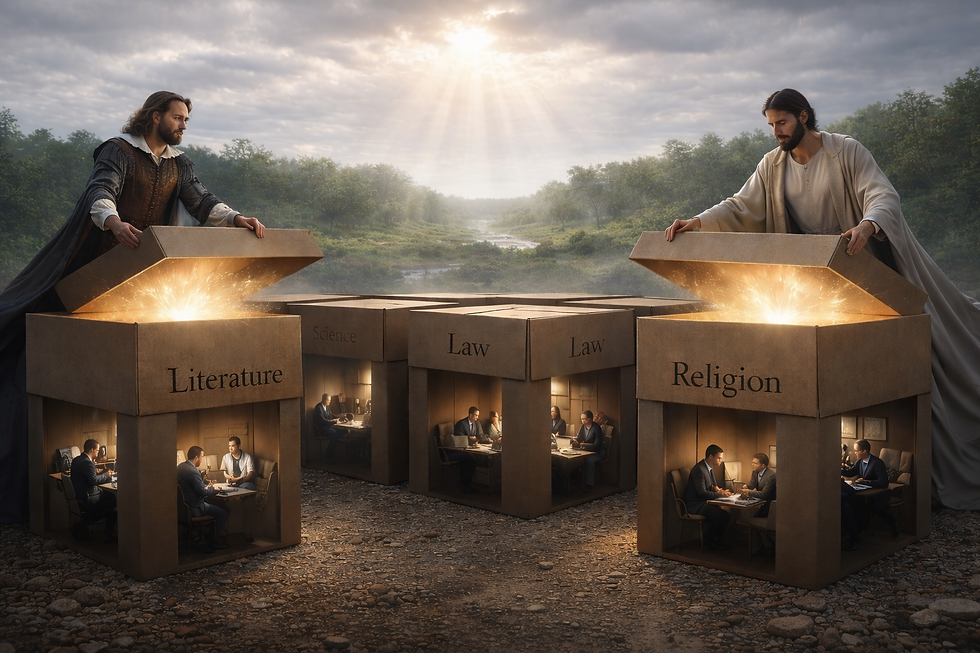
This image belongs where the argument begins to move beyond the immediate figure of the demagogue and into the deeper question of consciousness itself. The point is not that literature or religion are uniquely redeemed while law remains uniquely fallen. The point is subtler and more severe: the disciplines are still boxed. Some, at moments, become porous to revelation, metaphor, beauty, or love. Others remain more rigidly enclosed within procedure, conflict, and authorised reality. Yet none, so far, is simply identical with Truth itself. That is why the lids matter. They signify not ignorance alone, but partiality: The condition in which a chamber mistakes its own interior light for the whole sky. Shakespeare and the Christic figure appear here not as mascots for two successful boxes, but as threshold-witnesses: Figures who begin to lift the lid without claiming ownership of the field beyond it.
This is why humanity matters so much as a term. Humanity does not mean demographic mass here. It means the wider field that fear cannot imagine because fear always narrows the world to tribe, image, possession, status, and safety. I say here:
"Never give up on humanity."
This phrase is not sentimental optimism. It is the refusal to let fear’s account of the human being have the last word. The heart of being human, in this grammar, is the point at which authenticity, vulnerability, love, and Truth still touch. Public life becomes monstrous when that centre is abandoned too early and too often.
The final movement of the article therefore has to be quiet. It cannot become another performance of denunciation. The real revolution is quieter than spectacle because it begins where spectacle cannot reach. It begins where masks are set down. It begins where a person stops asking, ‘Who must I become so that I am accepted?’ and begins instead to ask what happens when one stands as one is, allowing love rather than fear to determine the form of presence. That question belongs to family life, to work, to politics, to teaching, to institutions, to civilisation. It is not private. It is foundational.
So the deepest political claim of this article can now be said plainly:
The future will not be healed by better-managed inauthenticity. It will not be healed by one more frightened structure inheriting the stage from another. It will not be healed by theatre inside theatre. It will be healed only by people willing to restore power to Truth, to stop abandoning the centre, and to stand sufficiently unmasked that others begin to remember they need not live entirely in costume either.
Everything else remains rearrangement inside the box.
Political theorists are so afraid of what's outside the box that they never even consider opening it. And the greatest deception is self-deception.
It is a recognised critique of the Enlightenment to argue that its greatest error was prioritising the accumulation of technical knowledge and empirical data over the cultivation of wisdom, which includes understanding value, meaning, and purpose. This perspective argues that by focusing exclusively on 'knowledge-inquiry' (science and technology) rather than 'wisdom-inquiry' (life-centred transformative understanding), the Enlightenment severed the connection between understanding the world and knowing how to live well in it. By even giving up on this, President 'Trompe' has disseminated and propagated confusion at civilisational scale. No wonder that the fog is thick and we can't seem to see through it. But the greatest Truth is:
All is well. This too shall pass. You can handle it. Truly!
Nicholas Maxwell is a contemporary philosopher of science who is perhaps the most explicit in the critique of the Enlightenment. He argues that modern science and academia are dominated by a flawed, 'knowledge-inquiry' model—a legacy of the Enlightenment—which has led to a "Gross and very damaging" imbalance. He advocates for 'wisdom-inquiry,' which puts problems of living (rather than just problems of knowledge) at the heart of academia. It is ironic that Buddhists use the term 'Enlightenment' for exactly the reverse.
Theodor Adorno and Max Horkheimer wrote their seminal work 'Dialectic of Enlightenment' in 1947, arguing that the Enlightenment turned into a form of mythic, instrumental rationality. They suggested that the pursuit of technical control (knowledge) became an end in itself, which eventually turned against human freedom, leading to totalitarianism rather than liberation.
René Descartes became an internal critic from within, so while he was considered to be the father of modern philosophy, he warned in his later works that:
"A man is not truly wise until he knows the limits of his understanding"
and that
"It is not enough to have a good mind; the main thing is to use it well"
implying that knowledge without application and humility is insufficient. The President 'Trompe' archetype is certainly not characterised by humility.
We are on a quest for something inexplicable.
Jean-François Lyotard, the French sociologist, argued that the Enlightenment's 'metanarratives' of progress mask power relations and suppress traditional or local wisdom, replacing lived understanding with technocratic information.
The Temple of Sorting

The scene above compresses one of the article’s central claims about institutions: Fear does not remain private for long. It hardens into categories, systems, procedures, diagnoses, and rituals of exclusion. What begins as a wounded grammar of perception ends as architecture. This is true of science, medicine, psychology, law, and religion. We are taxonomised, dehumanised then judged accordingly, and controlled. This is duality. 'Right' and 'wrong.' 'Normal' and 'abnormal.' 'Guilty' or 'not guilty.' Saints' or 'sinners.' For what are the disciplines but formalised arrangements of the ego's traits? And one of the most pathological traits of the ego is that of 'projection.' We made the institutions after all, and then they acquired a life of their own.
Rumi wrote:
"Out beyond ideas of wrongdoing and rightdoing, there is a field. I'll meet you there. When the Soul lies down in that grass, the world is too full to talk about."
Shakespeare echoed this, writing in Hamlet (Act I, Scene III), that:
“There is nothing either good or bad, but thinking makes it so.”
Alexander Pope wrote in 'An Essay on Criticism'' in 1711 that:
"To err is human, to forgive divine."
This phrase directly states that making mistakes is a fundamental part of human nature. Jesus knew this: In the Bible in John 8:7:
"He who is without sin among you, let him be the first to throw a stone at her."
Needless to say, no stones were thrown.
The literary genius Oscar Wilde, the Irish poet and playwright, wrote in 'A Woman of No Importance' in 1893, with his usual 'velvet sledgehammer' taken to human nature that:
"Every saint has a past, and every sinner has a future."
The strength of the image above lies in the fact that it takes the argument beyond the leader and into the built world. Fear does not remain a mood. It becomes a system of sorting. It classifies, diagnoses, disciplines, excludes, rewards, and names itself neutral while doing so. Law and medicine appear together here because both can become, at their worst, respectable dealers of wounded order: two professions authorised to say what counts, who belongs, who is normal, who is deviant, who may pass, and who must be redirected toward the grey entrance. The demagogue matters, but he matters most because he reveals the architecture already waiting behind him. President ‘Trompe’ is not merely one bad king. He is one face of a wider civilisational machinery in which fear becomes category, category becomes institution, and institution begins to mistake its own classification for reality itself.

What this image shows is that the problem is no longer only political. It is paradigmatic: It is box-shaped. These chambers are close to one another, and all shaped the same. They belong to the same civilisation. Their inhabitants are serious, disciplined, often intelligent, often sincere. Yet closeness is not the same thing as union, and adjacency is not the same thing as wholeness. Each chamber retains its own grammar, its own methods, its own permissions, its own internal light. That is why the boxes are cardboard: Not because the disciplines are worthless, but because their authority is more fragile than they usually suppose. They are more similar than they care to believe. They can contain important labour. They can preserve fragments of the real. Yet they can also become mistaken for reality itself. The field beyond them does not abolish them. It relativises them. It says that Truth may exceed the walls within which a discipline has learned to feel at home.
From Geopolitics, to Me-gopolitics, to We-gopolitics
Never give up on humanity
Make humanity the political party
We don’t need a ‘leader’ who tips democrac into oligarchy
Ego is the problem: Ego can’t be the solution
We must never give up the heart of being human
Truth is a feeling
Fear is a box

What is being shown in the image above is not ignorance, but ‘pre-truth’. That distinction matters. ‘Pre-truth’ does not mean that the disciplines know nothing, or that science, philosophy, psychology, politics, literature, or religion are merely wrong. It means that each may still be operating inside a chamber of partial reality: A box built from fear, lit from within by its own methods, concepts, permissions, and limits. In that condition, knowledge is real, but contracted. It can classify, analyse, narrate, strategise, diagnose, and interpret. It can judge, and it does. What it cannot yet do is see the whole, because it is still looking from within a box. That is why paradigms of fear are so powerful: They do not merely distort content; they organise consciousness itself. They decide, in advance, what may be safely felt, known, said, or even imagined. The result is not only defended persons, but defended disciplines, each mistaking its interior light for daylight. They are limited and mistaken in their world view: Quite literally.
Wisdom begins where this enclosure is seen. And it is rarely truly seen. Shakespeare saw. Christ saw. They taught. Truth, in this larger sense, is not simply one more proposition inside the box, nor the victory of one discipline over another. It is what becomes visible when consciousness expands beyond the local grammar of the chamber and begins to encounter reality without the same fear-based contraction. That is why the 'Bridge of Awakening' matters so much in the image. It is not one more structure within the boxed district. It begins precisely where the chambers end. It signifies the passage beyond knowledge as possession, control, classification, or authorised reality, and toward Truth as lived encounter, remembrance, BEing, and love. The bridge is therefore the route from disciplined partiality into a wider human and civilisational awakening. It does not abolish knowledge. It re-situates it within a greater field.
With Truth, there is no argument. There is simply the 'Will to Love'
Namaste
Olly Alexander
Email me for Transformative Life Coaching:
Click here for my 500 free articles:
Disclaimer:
The information presented in this article explores the role of psychospirituality in mental well-being and recovery. It is for informational purposes only and should not be considered a substitute for professional medical, psychological, or psychiatric advice, diagnosis, or treatment. You should always seek the advice of your own qualified healthcare provider with any questions you may have regarding your specific condition or any medical concerns. Never disregard professional medical advice or delay in seeking it because of something you have read here. Integrating spiritual practices can be a valuable part of a holistic approach to mental health, but it should complement, not replace, care from licensed medical and mental health professionals.



The article is written competently and offers reliable information. The information is presented clearly without unnecessary jargon. I appreciated being able to find all the necessary information in a single text. It is an article that offers a clear and complete picture of the matter.