Abraham Maslow’s ‘Hierarchy of Needs’ Versus the ‘Pyramid of Wants’: Is Power Missing The Point?
Updated: May 20

'Success' is not a mistake:
It is an incomplete journey.
Success may take you as far as it can take you, but success can only take you so far.
But you are not a hitch-hiker being dumped off by the 'driver' of success.
Fuck! Far from it. You are not a passenger. You are an ace pilot, a veritable top gun.
As the poet William Ernest Henley wrote in the stunning poem 'Invictus':
"I am the master of my fate: I am the captain of my Soul."
That's you.
But success is a 'dealer', a drug, con-artist, a 'manufacturer of illusion, albeit a very convincing and persistent one.
Albert Einstein, the pioneering theoretical physicist who entirely redefined our understanding of the Universe, was also a cosmic humanist, and a visionary philosopher of how the world works. In short, a genius. Einstein wrote:
“I never said that 'Reality is merely an illusion, albeit a very persistent one.' Instead, one could say that 'The perception of reality not being real is an illusion, albeit a persistent one.' Reality is as real as it gets in this life time. Go out in Nature and you will find that reality is the ultimate manifestation of Love. Reality is you and all of Nature's kind. It is very real. It is true Love. Because all of Nature is a manifestation of Love. And that includes You.”
Henley reminds you that you are undefeated, unassailable, undefeatable, unconquerable, and invincible, despite all the challenges and obstacles that life inevitably sent you, and yet 'success' still takes you, cajoling you, like it does with everyone, to a pretty prison that masquerades as whatever you want it to be.
Success is the witch in 'Hansel and Gretel' beckoning you to her alluring, frosting-drizzled Grimm 'Gingerbread House.' The problem here is that, like Hansel and Gretel, we were led a merry dance. They entered that prison. And yet we too stuff our faces on 'success' and end up almost cooked.
Success is a lure.
Success is a prison.
Success is desolate.
Success is deadly.
The prison of success is what I call in my cathedral of work the 'Temple of Emotional Anaesthesia.'
We want all the success in the world. And we can have it. But not through success, Success stops at the prison. It will take you no further.
Success envelops you and puts you in a box like an Egyptian mummy being 'bricked off' with blocks of stone in a pyramid. Yes, there may be jewels in there, untold wealth even, but you are trapped, alone, dead. Forever. And there are no shopping malls or Ferrari dealerships in a pyramid. You won't even be able to drive the one that was buried with you of course. It's pretty small in there, limited, however majestic and regal the pyramid appeared from the outside. You are now officially trapped.
And the pyramid is beginning to crumble.
And the pyramid is 'point-less.' It has no point.
Your courtiers chant: "The 'King Baby' is dead. Long live the King!" Is it a bit late to find joy then?
Self-Transcendence is the 'Superabundant Journey' beyond the horizon that cannot be mapped on a multicoloured postcard or a corporate wall-chart of a decapitated triangle.
Success is like a catapult - but its range is finite, and there is nothing that you can do to change that. How do you complete the journey? Well, that is beyond the realm of success. Superabundance has no 'realm', no kingdom, no prison, no puppet King trying to protect their throne while the courtiers plot their downfall.
Self-Transcendence, the 'Superabundant Journey', and the limitlessly powerful meta-framework for life called the 'Will to Love' are all synonyms. There is one journey. There is one cosmic view of it. There is one Satnav. There is one destination. And its journey doesn't end in desolation and death.
Wouldn't it be best to live before we die? To love before we lose it? We should probably take a look at taking that 'Superabundant Journey', and leave paltry 'success' in the place that it cannot reach beyond, which ironically it took you to, right?
Leave success in its own prison. We are going beyond that. Way beyond success. And definitely out of the prison.
You want the map? Sure.
You want more than just a map? Sure. I will give you all you need.
You want the theory? Sure.
You want the method? Sure.
You want the concrete tools? I will give all those to you.
But what if you have already been buried alive in a pyramid? Limited by it. Entombed in it. Defined by it.
“In such people, gratification breeds increased rather than decreased motivation, heightened rather than lessened excitement. The appetites become intensified and heightened. They grow upon themselves, and instead of wanting less and less, such a person wants more and more. Wanting and desiring continues, but at a higher level.” Abraham Maslow
Abraham Maslow pointed to the horizon, but he never got there. I am sure that was his biggest regret.
Perhaps he thought too much? The voice inside the head that never stops is the ego-mind.
Meher Baba wrote the truest spiritual equation:
Man - Mind = 'God'
No mental chatter = no limiting beliefs = no limits.
In his quote above, Maslow was not describing addiction to achievement. He was describing the strange abundance of real growth: The kind of fulfilment that does not close the appetite for life, but deepens it. Imitation love wants more because it remains unfed: It is illusory, insubstantial, and insatiable. Real love wants more because it is alive. Abundance is not about a better tombstone. It’s about how you loved during the dash on it
Why do you feel dead inside?
Is the view from the top not worth the climb?
Where do you go from the top?
It can feel desolate at the destination. You get the role, then the role gets you.
Reaching the penthouse reveals that 'Having' cannot satisfy the need for 'BEing.' We confuse the two and that is the whole problem. 'Having' is a structural 'dead-end'. The 'Wrong Tower' is a sanctuary of mercy built by a child to survive a lack of unconditional love: That is the achievement paradox.
So, there are two ways to live your life:
Build a tower in order to be loved = misery, desolation, despair, fear, and depression
Build a tower because you are love = joy, peace, true success, and real abundance
The unseen root means that success (a major form of 'imitation love'), subconsciously, has been asked to do real love's job. Only real love can really love.
You can spend your life chasing the pot of gold at the end of the rainbow. The only way to truly have it is to BE the rainbow. And how do we do BEing. Easy - love. Love is the answer to every question, every choice.
But there is a redemption. You can keep the abundance despite the metaphysical accounting error. There is a twist in the existential plot - the 'helipad pivot' - where the 'me-pad' becomes the 'I-Pad': You recover agency for the first time at the 'second fork' in the road of your life. The very top of the wrong building is the only place high enough to launch your Helicopter. Your striving successfully built the tower, the penthouse, and the Helipad. As we said: "Success is not a mistake: It is an incomplete journey." The highest success is the decision to leave the prison and what you choose from there. Small tip: Choose love. But only if you want to be joyful and free. Most people like the comfort of the prison.
You are breaking down because you reached the top of the wrong tower, and you are only now realising that an external want can never satisfy an endogenous, ontological (existence, reality, and BEingness) need. This recognition brings immediate, visceral relief. Seeing the mechanics of life is healing. It moves us from a state of vague, exhausting self-blame, and fears of 'unlovability' and 'never-enoughness' to a state of profound structural awareness.
Abundance is not manifestation as egoic demand. Abundance is BEing: The river flowing from the source. Doing is the flow. Having is what gathers naturally along the banks. Abundance is not the enemy. Substitution is. Money is not the wound. The wound is the frightened belief that money might finally prove one is loved. BEing is not the renunciation of remuneration. It is the end of using remuneration as a prosthetic self. However lovely your Ferrari is, it is not you. The greatest gift to your children may not be the money you leave them, but the chain inherited childhood Trauma you refuse to pass on. Inheritance is not abundance. It is a wound with a bank account.
I have a non-renunciatory stance: That material success is not a sin to be repented of, but a substitute that has reached the end of its usefulness.
We are made to choose between freedom and fear, and between freedom and happiness. We always give up our freedom in lieu of fear. We live in a monarchy of fear. Fear rules the world. Fear is the language of the ego. And so, the ego rules the world. It made us. It made institutions and professions. It tells us what to do, what to like, what to want, and that not having it is not an option.
In contrast to what many 'spiritual' traditions say, you don't have to choose between material abundance and joy. You can have both, as joy is an inner state, and is untouched by what is outside of you. Money is the currency that we trade in - it allows us to have impact in the world. So, no, you don't have to sell the Ferrari or become a monk.
Why do we enthrone ambition so? Why do we worship the ego? Did we not all study Macbeth at school?
“I have no spur, To prick the sides of my intent, but only Vaulting ambition, which o’erleaps itself, And falls on the other.” 'Macbeth' (Act I, Scene vii)
William Shakespeare, whom I call a truly 'intersectional' (as well as a genius and a prophet) as he did not limit himself to a single fear-based discipline, allowing him to dive into the human condition perhaps better than anyone. He has not been surpassed in 400 years. Why? Because he was 'unboxed' (between disciplines) and 'unlidded' (bridging the upward gap from knowledge to wisdom) as a way of BEing. Shakespeare's plays go so deeply that often they are pure paradox - being about the exact opposite of what they first appear to be based on. I imagine 'The Bard' watching one of his plays being performed, peering from backstage between the curtains into the crowd and thinking - which spectator sees which meaning? Do any see both? He may have had a little grin perhaps?
The power of the paradox is in holding two conflicting truths simultaneously - this shatters duality - stopping illusory black-and-white thinking in its tracks. It destroys bias and cultivates personal transformation. It annihilates the ego. When were you last in a meeting where someone didn't have to 'win’? To be 'right.' To be 'good.' Like a child. The world is stuffed full of grown up children. That is why the world is stuffed. We stuffed it up. It was bottom up. Not top down.
All conflict at every level is due to ego.
Jiddu Krishnamurti, the philosopher of conflict wrote:
“When the individual is in conflict within himself he must inevitably create conflict without, and only he can bring about peace within himself and so in the world, for he is the world.”
Krishnamurti is the one who refuses to let the individual stand outside the catastrophe of 'civilisation'. When did we last have a civilised civilisation? Go JK! Freud didn't get it right. Krishnamurti’s most load-bearing claim in relation to my work is that the 'world' is not an external object to be managed, but a projection of the inner psyche:
“The world is you and you are the world.”
I love his quotes. So spot on:
“Each one of us has built up this competitive, ruthless civilisation, in which man is against man.”
So when the psyche breaks, so does the world. Where there is fracture, we see structure. We become architects. And we build. We make prisons. Krishnamurti identifies fear not just as an emotion, but as an organising grammar that renders the person "Completely blind." We fail to see that the door to the prison cell is wide open. The ego is like a child refusing to look under the bed in case they see a monster. Krishnamurti wrote that:
"We know how fear distorts and makes the (ego) mind small and also poisons the system".
Fear is not merely something one has while looking at the world. Fear is a way of looking at the world. Or, more precisely, a way of not quite looking. It narrows the aperture and then begins to call that narrowing 'realism'. Like a spotlight which thinks it is the sun. Fear pops you into a coloured bar on the tiny pyramid and then looks pleased with itself. You made the prison, gave away the key, walked into the cell of your own accord and sat down, unchained and unlocked, yet imprisoned. All you had to do was to lower your hands from covering your face.
I position Krishnamurti as the corrective to "Paradigm-idolatry," I would argue that love is the only state in which paradigms can arise and pass away without becoming 'prisons.' Love expands where fear has contracted. Love is larger than fear. In the same way that humanity is larger than civilisation, and that the Soul is larger than the totality of its fractured parts.
Then jumps in my fave, Dr Carl Gustav Jung:
“We need more understanding of human nature, because the only real danger that exists is man himself. He is the great danger, and we are pitifully unaware of it. We know nothing of man, far too little. His psyche should be studied—because we are the origin of all coming evil"
When it comes to these prisons that we build, one of the most alarming facts of history is that intelligence and fragmentation are perfectly capable of cohabiting. Institutions can become traumatised psychologies in ceremonial dress. Geopolitics has become psychodynamics wearing a flag.
Yep, the alarm bells are ringing.
In my grammar; and grammar has to be the starting point, the ego is the ‘petrified inner child wearing armour’ in each and every one of us.
Abraham Maslow, the American psychologist who became one of the central figures in humanistic psychology, was a genius who glimpsed the horizon: It's what would have been the top of his pyramid if he had drawn it. But he didn't. The brilliant humanistic psychologist gave us a gorgeous view of where we need to go. But we don't go there. Partly because we can't believe it is real: The ego tells us what to believe, and therefore sets off the cascade which tells us what to think, how to feel, then how to react. And we do react. Always. Because our beliefs are always negative (thank you so much ego), we are limited, and we are small. But the ego tells us that we are huge. The 'King Baby' strikes again: The King of the 'Puppet Kings'. But 'Puppet Kings' always fall. Idolatry never lasts. We love, then we hate, then we destroy, then we love what we destroyed.
Maslow didn't give us a map. My map shows why travellers first end up in a prison mistaking the walls for the world. Maslow didn't give us a tool. I will give you a tool box and a grand design.
But what Maslow pointed at is very real.
This article will walk with you and guide you to and beyond the horizon in Maslow's view: Every step of the way. And then up, up, and away until your cosmic view guides you back to you and to limitless abundance! When you are airborne, and you will be if you follow these steps, the only navigation system that you will need is to reflect on my paradox for you:
"Who do I need to BE to be able to answer the question 'What would love do now?'"
If that question makes your head spin, then good, it is supposed to. It beckons the expansion of consciousness. It is up to you to awaken from conditioned fearful illusions. You have 100 percent agency in this very moment. And the present moment is all there ever is. Self-actualisation is not necessarily the summit. Beneath, within, or beyond the hierarchy lies the deeper question of BEing itself: Who is the one climbing? Most coaching pushes you higher up the 'wrong ladder.' I help you truly see why the wrong ladder was leaning against the wrong life.
The corporate optimisation machine took a sacred Truth about human potential and turned it into laminated prison furniture. They sold you the postcard of the mountain so you would spend your life paying for the right to climb their tower, ensuring you would never look up to realise the ceiling was already gone. Charles McDermid did not do this to heal the human Soul; he did it to evaluate worker utility. He needed a mechanical, bureaucratic tool to determine how much compensation and prestige an industrial machine had to feed an employee to keep them compliant, predictable, and performing. He was a consulting psychologist who 'translated' Maslow's beautiful theories into a 'metaphored-down' coloured 5-tier pyramid. Much was lost in translation. It was McDermid's ego that did the deed. He performed an egoic hijack.
The ego climbs a very short ladder and mistakes the bottom for the top.
Donald Winnicott, the famous British psychoanalyst said that:
“Only the True Self can feel real.”
There is not much very real about a decapitated, oversimplified, coloured-in, laminated picture post-card of a partial pyramid. More worryingly, Winnicott stated that:
“The False Self, if successful in its function, hides the True Self.”
The laminate represents a double-injury: It makes the postcard durable and authoritative while simultaneously taxonomising and sealing the reader off from the "Original Sky" - the Truth and vision - of Maslow's intent. It makes it 'un-smashable', which is a shame, as it missed the whole point. It is quite literally 'point-less.'
It feeds HR-mandated training very conveniently, which is not as a failure of education, it is the 'success' of the "Corporate Consultant Optimisation Machine" in fooling the entire productivity culture - you cannot mandate healing. You cannot 'fix' anyone, least of all with a coloured postcard. And yet the machine pushes on, posting the pretty pointless pyramid on their social media feeds as though a solution has been found. The laminated prison furniture symbolises that the high-achiever, yes you, is not just trapped, but is being taught to endure the cell using pretty colours and 'helpful charts' as ways to improve the prison furniture. But it's still a prison. It's still a box. And that box keeps you small. The box is made from fear. And it is contracting. Knowledge focuses a narrow-beamed spotlight on the multi-coloured pyramid, but wisdom is the 'unlidding' of the hierarchy that allows the visitor to actually BE the one at the top.
The cold plastic of the laminate is in direct contrast with the "Living Breath" of Maslow’s original "Fluid, dynamic wave of BEing". One could argue that the laminate is the ego’s attempt to 'fix' Truth in place so it can be managed, whereas Truth is the wind blowing across your helipad that refuses to be controlled, categorised, coloured, and filed for posterity.
Management culture reproduced used it to teach people how to climb, while surrupticiously using it as a lid to limit their climb. The box is stiff, and the lid is closed. That is the tragedy, and the comedy, of the better named ‘Hierarchy of Wants.’ King Babies shout "I want!" Wants are fears. Desires are fears. They are preferences. To want is to be afraid of not getting. To want is to be afraid of losing what you get. To want is to be afraid of getting what you don't want. Wanting is fear dressed up as agency. Needs are called needs because we need them. Our psyche's need them. Our hearts need them. Our Soul's need them. I love Gabor with his brilliant talks about needing attachment and needing authenticity. But deeper than that. Our deepest need. The root of our Soul. That is love: Real love - unconditional love. Sure, you can win Olympic gold medals without love, but you will win more with love. Sure, you can get to the moon without real love, using only the ego-mind. But pah! For the stars you need the real deal.
Imitation love is plastic flowers on a mausoleum: Costly, arranged, a display; neglected, tragic, performative, faded, devoid of life, devoid of love, and a little bit late.
Abundance is not about a better tombstone. It's about how you loved during the dash on it.
Thomas Samuel Kuhn, the brilliant American historian and philosopher whose 1962 work, 'The Structure of Scientific Revolutions', fundamentally altered the modern understanding of how knowledge evolves, who explained how paradigms shift, wrote:
“What a man sees depends both upon what he looks at and also upon what his previous visual-conception experience has taught him to see”
A paradigm is a structured way of seeing: A living frame that determines what counts as reality, what counts as evidence, what counts as a serious question, what counts as a proper solution, and even what can appear at all. A box is not merely a cute metaphor for a paradigm. It is the more intimate, fear-saturated form of it. A box is what a paradigm feels like from the inside when it has reached the level of ordinary life. A box is the first room fear builds inside the psyche and then mistakes for home. There is a box around us, around disciplines, and around civilisation. Fear is a 'Russian Doll.' If a discipline is like a house, then a paradigm is the architecture of thought that governs life inside the house. A discipline becomes paradigmatic in the more dangerous sense when it forgets that it is partial and begins behaving as though its method were reality itself.
Kuhn is the epistemic (the theory of knowledge) anatomist of bounded institutional intelligence, giving us a vital historiographical hinge, explaining how intelligent, sincere, supposedly truth-seeking communities can remain trapped inside partial pictures of reality without knowing that they are trapped. The implications are terrifying. And you are feeling them with full frontal force. Kuhn has never been more so relevant than now as our civilisation' descends into a full-blown 'Epistemic Crisis' in a war of supposed 'post-truth': This has manifested as a total collapse in our shared perception of reality, characterised by the widespread, fundamental disagreements and conflicts that we are observing, and the chaos that is engulfing each of us, with a generalised feeling of impending doom and desolation.
The root of the chaos, of the human condition, lies in a perceived absence of unconditional love as young children. The foundational evidence that childhood experiences shape adult minds, bodies, behaviours, and professions arrived in 1998 by Felitti and colleagues in the American Journal of Preventive Medicine as the 'Relationship of Childhood Abuse and Household Dysfunction to Many of the Leading Causes of Death in Adults’.
Adult suffering is an accounting error made in childhood when we sold authenticity in order to buy attachment: It was a debt that was not ours
As brilliant as Kuhn is, we will pull him 'back into the nursery', arguing that the child’s first 'operating system' is a relational paradigm of fear that later scales into professional and civilisational boxes. We made everything. And we can recreate it again if we so wish. We do not have to burn down creaking inflexible institutions. What's the point of an empty prison? It will crumble and it will tumble and fall. It is the old oak, not the supple reed, that breaks in strong winds. That sentence alone tells us of the 'non-sense' that is 'resilience.' Everyone breaks. It's how you bounce back that counts. This is a quiet revolution. There is enough noise pollution from that yapping ego.
Ernest Hemingway wrote unforgettably:
"The world breaks everyone and afterward many are strong at the broken places. But those that will not break it kills."
I believe that there is a way out of all this. More precisely, I know that there is. I have found it. Sure, I read it (250 books over the last 6 years). Sure, I wrote about it (over 500 articles - on this page alone). Sure, I reflected on it (4.5 million words of notes and complex dialectic). Sure I have listened to thousands and thousands of hours of Podcasts, philosophy, psychology, psychoanalysis, contemplative traditions, neuroscience, paradigm theory, Haha - do you see what happened there - it looked as though my ego popped up looking for validation for a second. Actually, it didn't. People like to see numbers, data, rankings, likes. I see clearly now the rain is gone (and even when there is rain). I can see all obstacles in my way. Gone are the dark clouds that had me blind. It's gonna be a bright, bright sun shiny day (thanks Johnny Nash). It really is. Bear with me (thank you by the way). The reason that I chucked those numbers in was to say that they don't matter. It is the journey that matters. You can't find out who you are and then understand how you choose who you become just by reading, attending lectures, or listening to podcasts. You can't read your way to wisdom. You can't recover from the existential ontological fracture-dislocation that is the human condition in a library. You must learn to see with new eyes, unfiltered by the illusions of the ego. You have to learn to feel again. You have to take your very own 'Hero's Journey.' And this always begins with 'The Dark Night of The Soul.'
Do not be deceived by the new grammar of the Management Consultants. These alternative models are not doors to freedom; they are simply more sophisticated blueprints for optimising your captivity. They are horizontal management tools masquerading as vertical transformation. They are arguing over the floor plans of the 'wrong tower', trying to figure out how to make you a more compliant, motivated, highly functioning but limited 'puppet king': Ruling in a little box.
We won't do that. We don't collapse. We expand. We won't separate the neurobiology of trauma from the deepest Truth of non-duality. We unbox. We won't use dry, academic distance, nor will we use soft, floating 'wellness' bollocks.
They updated the prison furniture. Then numbed you through promises. Anaesthesia never healed anyone. But it is your choice to wake up from it.
The phenomenal Michel Foucault, the witness to the disciplinary prison, arrives here, saying:
“This is the historical reality of the Soul... born rather out of methods of punishment, supervision, and constraint.”
If human fulfillment has been systematically assassinated by decapitating the pyramid that never was, we must establish the facts on the ground:
The Victim: The human capacity for authentic Self-transcendence. The instinct to expand vertically into meaning, purpose, energy, creativity, love, and joy, rather than expand horizontally into asset collection.
The Suspect: The Corporate Consultant Optimisation Machine. The industrial engine that requires humans to be predictable, compliant, and driven by a permanent, insatiable sense of internal lack.
The Murder Weapon: The Laminated Postcard (The Flat Pyramid). By slicing off the top of Maslow's open sky and encapsulating it into a closed triangle, they created a mechanical climbing frame. It convinced millions of brilliant minds that fulfillment is an administrative prize to be reached at the end of a long career trail, rather than an organic, biological right available right now.
When we begin excavating the hierarchy, the 'point-less' pyramid that was dropped on us, a devastating symmetry emerges: The "Laminated Postcard" is the lid, the paradigm of fear, placed on human consciousness to keep it, and all of us, in the 'Basement of Lack.'
Viktor Frankl, the brilliant psychiatrist, Holocaust Survivor. and excavator of meaning and purpose, is a key contributor to the 'Existential Pilot' in each of us:
“Between stimulus and response there is a space. In that space is our power to choose our response. In our response lies our growth and our freedom”
It is your freedom to choose your way. You may respond and never react. This way of BEing will shift your life from a combustion engine of friction to a self-sustaining fusion reactor.
Friedrich Nietzsche, the great philosopher whom Carl Jung frequently referred to as a profound explorer and prophet of the unconscious psyche, offered us the 'Will to Power' (The Corporate Tower). This philosophy relies on combustion. You have to constantly burn assets, burn energy, out-perform your peers, and manipulate resources to maintain your altitude. It is exhausting, creating friction, smoke, and internal panic. It has a heavy half-life of trauma. You are burning your Self.
I bring in Jesus here, not because I am 'sneaking in religion': Far from it - I am not religious. But, Jesus was a historical figure. He was a teacher, a philosopher. Our greatest example of BEing love. Jesus said in Matthew 23:27:
"You are like whitewashed tombs, which look beautiful on the outside but on the inside are full of the bones of the dead."
Are we still worshipping the pyramid now?
Self-Transcendence is nothing less than the active deployment of the 'Will to Love'. It is a self-sustaining, exponential, nuclear reaction providing vertical lift: It opens a cosmic axis, and with it a view of the entire landscape. The 'Will to Love' is a conscious, determined redirection of your entire psyche's energy: A powerful source of agency, clarity, Truth, love-as-verb, peace, service, and limitless abundance from BEing. You return to the 'Seat of Your Soul.' ‘The Seat’ is the place in which one can remain seated because one has ceased to identify completely with the frightened egoic commentary. From ‘The Seat’ one is no longer obliged to rise every time the frightened self declares a constitutional emergency and calls you into conflict.
If you feel ready, or even slightly intrigued by the thought of living without fear and suffering, and would like to discover the limitless abundance, joy, peace, and love that is totally within your Real Personal Power, then let's begin your irresistible-once-seen, definitive, deeply moving, Self-defining journey of your limitlessly abundant life...
Part I: Who Murdered The Mystery? Who Stole the Sky?

The body, in this case, is not Abraham Maslow. Let us not overstate the crime before the detective has found his hat. Maslow was not murdered in an alley behind a management seminar by a consultant carrying a laser pointer and a quarterly KPI dashboard. The body is subtler than that. The thing that was murdered was the mystery: The mystery of human becoming.
The mystery of what a human being may become when survival loosens its grip, when fear stops choosing the route, when the child who needed safety is no longer forced to run the whole adult life, when love ceases to be a transaction and becomes the ground of BEing.
That mystery was not false. It was not childish. It was not uncommercial, impractical, or woolly. It was priceless. So naturally, someone made it into a postcard and stuck it on their instagram.
Maslow wrote in his 1943 paper ‘A Theory of Human Motivation’ that:
“What a man can be, he must be. This need we may call Self-actualisation.”
That sentence still has voltage. It is not saying: What a person can acquire, they must acquire. It is not saying: What a person can invoice, they must invoice. It is not saying: What an executive can optimise, they must optimise until the Soul files a formal complaint with the nervous system. It is not saying that you must be brilliant in the boardroom, stealing the show: One of the most alarming facts of history is that intelligence and fragmentation are perfectly capable of cohabiting.
It says: BE.
More precisely, Maslow was describing the desire:
“To become more and more what one is, to become everything that one is capable of becoming.”
That is not a pyramid of wants. That is a call from the depths. And yet, what is the image most people carry in their minds when they hear Maslow’s name?
A pyramid.
A neat, bright, managerial triangle. A coloured little ladder of needs. Eat. Survive. Belong. Achieve. Become marvellous at the top, ideally wearing a suit and arriving ten minutes early for the leadership retreat. It says - cultivate your ego. It channels spiritual bypassing.
It is one of the great comic tragedies of modern thought: Maslow pointed toward human becoming, and management culture turned the pointing finger into a corporate climbing frame for children playing grown-ups.
The historical correction matters. The research of Todd Bridgman, Stephen Cummings, and John Ballard on the history of Maslow’s pyramid, discussed by Scott Barry Kaufman in Scientific American, makes the crucial point: It is difficult to find evidence that Maslow himself ever represented his theory as a pyramid. The familiar image was later popularised in management culture, especially through Charles McDermid’s 1960 Business Horizons article, where the hierarchy was applied to the problem of producing:
“Maximum motivation at the lowest cost.”
Read that again slowly: Maximum motivation at the lowest cost.
If you listen carefully, somewhere in the distance a Frida Kahlo just became a fridge magnet.
This is not merely a historical footnote. It is a parable about consciousness. It shows us what the ego does when it encounters a priceless thing. It barters for something that can never be bought.
Why does society and civilisation-at-large ignore real love when it is what everyone needs? It is because it is not for sale. And so it is ignored. Like a Botticelli in a basement.
It asks: How much? Can it be packaged? Will it fit on a slide? Can we use it to improve output, manage behaviour, increase employee engagement, drive performance, optimise the talent pipeline, and still get everyone out of the boardroom before the buffet closes?
The ego does not know what to do with the priceless, because the priceless cannot be used transactionally. Real love is priceless for the same reason. It cannot be bought, extracted, optimised, earned, performed into existence, or returned by invoice. It is not a product. It is not a reward. It is not a bonus scheme for the frightened child who finally became impressive enough to be loved.
Real love is not expensive. It is beyond price.
That is why the ego mistranslates it. The ego, which in my work I define as the ‘petrified inner child wearing armour’, cannot easily receive the priceless. It is too exposed. Too open. Too uncontrollable. Too unconditional. So it converts love into approval, approval into status, status into achievement, achievement into identity, and identity into a coloured pyramid with a missing point.
That is the real murder weapon. Not the pyramid itself: Reduction. What I call ‘metaphoring down’. ‘Metaphoring down’ is what happens when a living Truth is made smaller so that fear can manage it. A metaphor that should enlarge perception becomes a container that shrinks reality. The symbol no longer opens the door. It locks it politely from the inside and calls itself an evidence-based model.
The pyramid is still a metaphor. That is not the problem. The problem is the direction of the metaphor.
Maslow’s richer movement was upward, inward, outward, and eventually beyond the isolated self. In his later work he became increasingly interested in self-transcendence, not merely self-actualisation. But the corporate pyramid did something else. It turned becoming into climbing. It turned need into incentive. It turned vocation into career development. It turned self-actualisation into the executive suite. It turned BEing into having with better stationery. It turned the mystery into a postcard.
And then it sold the postcard back to the people who were already suffering from the wound the postcard could never heal.
This is why the image matters. The businessman is not just a businessman. He is lecturer, guide, salesman, performer, tourist, priest of the laminated triangle, and court jester of the ego all at once. He is wearing irony and using it to teach.
The grin is the teaching.
Because he is not merely wrong. He is dressed as wrongness so that wrongness becomes visible. He points at the point-less pyramid while selling little copies of it. He stands in front of something ancient and vast, then offers the passer-by a cheaper, flatter, more manageable version.
That is exactly how much of modern culture handles Truth. Not by denying it outright. That would be too honest. It reduces it first. Then packages it. Then sells it. Then calls the packaging the thing.
And if the packaging does not heal you, do not worry. There will be another seminar next Thursday.
Hold the two movements beside each other and the distortion becomes plain. The living mystery is human becoming; the postcard version is human optimisation. The living mystery treats need as a route into BEing; the postcard version turns want into a route into proving. The living mystery understands love as priceless; the postcard version turns approval into currency. The living mystery lets growth unfold; the postcard version teaches growth as climbing. The living mystery asks for wisdom, which is expanded consciousness; the postcard version offers knowledge as a coloured diagram. The living mystery sees the person as whole; the postcard version sees the person as a productive unit. The living mystery needs a guide who lends sight; the postcard version needs a presenter who points. The living mystery opens the sky; the postcard version sells the sky in miniature at the gift shop.
A real need opens the person. A transactional want tightens them. A real need nourishes. It gives energy, not agitation. It deepens life without consuming the self. It feels vocational, beautiful, lifting, sometimes frightening, often demanding, but not driven in the cold-chested way of the wound. It is the musician who must make music, the artist who must paint, the poet who must write. Maslow saw that. He did not reduce it to personal brand optimisation for ambitious professionals who have discovered linen.
The ego can stand in front of a priceless thing and ask what it costs. But a real need opens the person; a transactional want tightens them. A real need nourishes—it gives energy, not agitation. It is the difference between an organic unfolding of consciousness and an egoic want that acts as imitation love wearing a fake Rolex.
By contrast, an egoic want does not nourish. It briefly anaesthetises. It is imitation love wearing a better watch.
It says: If I get this, I will finally be enough. If they see me, I will finally feel real. If I reach the top, I will finally be safe. If the postcard is glossy enough, perhaps I will not notice that I am no longer looking at the painting.
This is where the pyramid becomes dangerous. Not because success is wrong. It is not. Not because money is bad. It is not. Not because ambition is sinful. Please. We have already had enough frightened moralising in the world without giving it a meditation cushion and a scented candle.
The problem is not having. The problem is asking having to do BEing’s job. The problem is asking success to become love. The problem is asking a role to become a Self. The problem is asking a pyramid of wants to heal a hierarchy of needs.
And that is why the people most harmed by this metaphor may not be the people who fail to climb it. They may be the ones who climb it brilliantly.
Because when the climb works outwardly and fails inwardly, a very particular horror appears. You cannot blame the lack of achievement anymore. The old story collapses. It was not that you had too little. It was that you had asked the wrong thing to save you. This is where Maslow becomes a much more serious witness than the management slide ever allowed. In ‘A Theory of Human Motivation’, he was not describing a crude ladder of greed. He was trying to map human need: bodily survival, safety, love, esteem, growth, and fulfilment. He was trying to describe something alive.
The corporate pyramid made it dead enough to manage. And here is where my work begins to diverge from the postcard. I am not interested in shaming the climb. I am not interested in telling the successful person to sell the Ferrari, sack the staff, renounce the penthouse, and retire to a cave with a morally superior blanket. That is not wisdom. That is scarcity with incense.
The deeper question is not whether you have climbed. The deeper question is: Who in you was climbing? Was it the Soul? Or was it the wound? Was it love moving into expression? Or fear trying to become impressive enough to survive? Was it real abundance? Or emotional anaesthesia with better views?
This is why the pyramid postcard image is the right doorway into the article. It lets us begin with the joke, because the joke is merciful. It lowers the drawbridge. It lets the reader smile before the knife goes in. Because once you have seen the postcard salesman, you begin to see him everywhere.
In the leadership seminar promising purpose while selling compliance. In the motivational speaker selling transcendence as a quarterly strategy. In the luxury brand selling identity stitched into leather. In the coaching advert promising six figures in six weeks to a person whose Soul is begging not for more figures but for a way Home. In the part of yourself that still believes one more rung will finally make love arrive. And if this feels uncomfortable, good. The image is working. It is not accusing you. It is accusing the system that taught you to mistake the postcard for the painting, the painting for the palace, the palace for Home, and Home for something you had to earn. You did not invent the pyramid of wants. You inherited it. Family may have handed you the first rung. School may have polished it. Profession may have blessed it. Management culture may have colour-coded it. The ego may have climbed it. But the Soul never agreed that the summit was Home. That is why the summit can feel so cold. That is why the air can feel thin. That is why achievement can become strangely silent at the top.
That is why the first real question is not: How do I climb higher? It is: Who murdered the mystery? And more urgently: What in me is still buying the postcard?
Maslow's 'Hierarchy of Needs', typically illustrated as a pyramid, is one of the most recognised and frequently shown images in leadership, management, and business training. It is a staple in organisational behaviour, management textbooks, and corporate presentations worldwide
“Human nature has been sold short. Man’s higher possibilities have been practically ignored, wiped out, or repressed.” Abraham Maslow, 'The Farther Reaches of Human Nature'
“It matters not how strait the gate, How charged with punishments the scroll, I am the master of my fate, I am the captain of my Soul.” William Ernest Henley, 'Invictus'
The title Invictus is Latin for "Unconquered." You are unconquered, but so is your life.
You have spent your entire career staring at these flat, laminated grids, treating them as the definitive architecture of human achievement. You climbed their rungs, secured their bonuses, and wore their titles like heavy iron armour.
But there is a dead body in the boardroom, and it belongs to you. But who murdered the mystery?
The great psychological tragedy of the modern executive is a profound metaphysical accounting error: We have systematically traded the true point of personal power for a PowerPoint presentation. You are capable, admired, productive, and outwardly impressive. And yet, if you are honest when the office lights go out, you still feel dislocated, exhausted, ashamed, unseen, or strangely untouched by your own success. Fear never needed better tailoring.

The truth is that you have been sold an imitation map. We took the fluid, infinite, vertical sky of human evolution and allowed it to be what I call precisely "Metaphored down" into a corporate climbing frame—a flat piece of office furniture designed to track worker utility and optimise your internal anxiety. You were told that if you collected enough assets and achieved enough dominance, you would finally earn the right to BE whole, safe, and worthy of love.
You have spent your entire adult career living through the narrow slit of a helmet designed exclusively for survival, not for joy. We are made to wear the ‘Emperor’s new clothes’, told we were fundamentally naked without them, and then charged through fear to keep them on. In this paradigm, the professions act less as authentic healers of the wound than as its highly respectable dealers. In time, we become our own 'dealers.' Living defensively is exhausting - and it's not living.
But abundance is merely a magnifier of what is already there. You didn't scale a mountain; you simply optimised your captivity inside a gilded box. You are standing at the absolute peak of a false pyramid, freezing in the penthouse of your own success, trying to survive on a cheap postcard of an ocean you have never been allowed to swim in. And you are scared. Why? Because wanting is based on fear. Desire is fear: Fear of not getting something or fear of losing something.
“To be thus is nothing;
But to be safely thus.”
— Shakespeare, 'Macbeth' (Act III, Scene i)
This fits with Nussbaum's "Monarchy of Fear." Macbeth has achieved his ultimate ambition—he is King—but he realises that merely having the position is completely worthless ("is nothing") if you are spending every waking second in a panic trying to defend the tower from being overthrown. Have you seen how oligarchs don't enjoy their holidays by the pool as the bodyguards have to sit with them and they are constantly afraid of revenge.
The ladder ends here. It is time to look at the evidence, unmask the suspects who stole your sky, and solve the crime of your life.
The Evidence: The Historical Crime Scene
Let us walk into the archives and uncover the raw historical fact of the matter. The "Hierarchy of Needs" pyramid that has dictated your KPIs, your corporate culture, and your psychological self-worth never existed in Abraham Maslow’s work. Maslow—a visionary psychologist operating at the absolute frontier of human potential—never drew a pyramid. Not in his seminal 1943 paper A Theory of Human Motivation, nor in his later texts. For Maslow, human development was not a video game where you complete one level, lock it in, and advance to the next rung. It was a fluid, organic, ever-expanding wave. He viewed human consciousness as an open sky of becoming, culminating in Self-Transcendence—a state where the ego completely dissolves into the service of Truth, Beauty, and unconditional love.
So, who drew the cage?
THE ARCHITECTURAL THEFT: THE EVIDENCE

MASLOW'S ORIGINAL SKY                  │ MCDEAL/MCERMID'S LAMINATED PYRAMID
───────────────────────────────────────┼───────────────────────────
* Fluid, dynamic wave of being         │ * Rigid, transactional blocks
* Infinite vertical evolution          │ * A finite, closed triangle
* Self-Transcendence as the horizon    │ * "Self-Actualisation" as a trophy
* Love as an operational baseline      │ * Security based on scarcity and utility
The crime was committed in 1960. A management consultant named Charles McDermid took Maslow’s open-ended theory and flattened it into a rigid, primary-coloured pyramid for a business consultancy journal as corporate reduction, not abundance. McDermid did not do this to heal the human Soul; he did it to evaluate worker utility. He needed a mechanical, bureaucratic tool to determine how much compensation and prestige an industrial machine had to feed an employee to keep them compliant, predictable, and performing.
The corporate pyramid is not just faulty management theory; it is an engine of psychological containment. It forgets that the entire civilisation can just be one wounded psyche, and that we are holding one single Russian doll which is simultaneously a lone human being and an entire economic system. Maslow pointed toward human becoming; management culture flattened the pointing finger into a rigid point-less pyramid.
The corporate optimisation machine took a sacred Truth about human potential and turned it into laminated prison furniture. They sold you the postcard of the mountain so you would spend your life paying for the right to climb their staircase, ensuring you would never look up to realise the ceiling was gone.
Naturally, the modern academic and corporate coaching establishments have noticed that this primary-coloured triangle doesn't work. They’ve realised that a rigid, linear pyramid cannot possibly contain the fierce, unpredictable weather of human reality. So, what did the organisational experts do? They formed a committee. They built a Council of Disciplines to argue in the foyer of your life. They will tell you that Maslow is "highly contested" and "outdated." They will solemnly hand you alternative, multi-million-dollar corporate models to patch up the cracks in your ceiling. They will offer you Herzberg’s Motivation-Hygiene Theory, splitting your existence into sterile buckets of "dissatisfiers" and "hygiene factors." Or they will sell you Self-Determination Theory, treating your deep, existential hunger for sovereign wholeness as a transactional HR checklist of Autonomy, Competence, and Relatedness.
Do not be deceived by the new grammar of the consultants. These alternative models are not doors to freedom; they are simply more sophisticated blueprints for optimising your captivity. They are horizontal management tools masquerading as vertical transformation. They are trying to fix a profound, radioactive spiritual crisis using the same clinical, boardroom logic that created the crisis in the first place. They are arguing over the floor plans of the wrong tower, trying to figure out how to make you a more compliant, motivated, highly functioning puppet king.
But a puppet king always falls. No amount of "hygiene theory" can wash away the felt weather of emptiness and exposure under your tailored suit. We do not need a more nuanced way to stay motivated inside the cage. We need to leave the foyer entirely.
The Forensic Lineup of Suspects
To understand why this flat pyramid holds such an addictive, vice-like grip on your identity, we must look past McDermid and examine the intellectual godfathers who provided the structural steel for this illusion. They are not witnesses to your potential; they are the primary suspects in the assassination of your mystery. They projected their own profound, unhealed trauma onto the canvas of human nature, and you are currently living inside their diagnoses.
Suspect #1: Sigmund Freud (The Architecture of the Basement)

Freud famously concluded that the absolute best his psychoanalysis could offer a suffering human being was to transform:
"Hysterical misery into common unhappiness."
Why? Because Freud was an ego looking exclusively at an inner critic, completely blind to the True Self. At age seven, after a minor childhood boundary-test, his father Jakob looked at him with cold fury and pronounced a curse that would echo through Sigmund's psyche for eighty years: “This boy will come to nothing.” Combined with the catastrophic attachment rupture at age three when his primary source of love—his nanny Monika Zajic—was abruptly arrested and vanished overnight, Freud’s inner child became permanently petrified.
To survive, his intellect built a massive, hyper-rationalised defensive wall. He mapped the human psyche as a permanent civil war between animal drives (the Id) and a punishing inner critic (the Superego). He reduced love to a transactional drive reduction—libido. Freud did not realise his "Superego" was just the unintegrated ghost of his father shouting in the dark. He normalised the prison because he was too terrified to trust the open sky.
Suspect #2: Friedrich Nietzsche (The Tyranny of the Isolated Peak)

If Freud locked us in the basement, Nietzsche demanded we climb an unyielding vertical ladder of pure ego. He gave the corporate world the ultimate anthem of the Tower of Force: the 'Will to Power 'and the maxim:
"What does not kill me makes me stronger."
But look at the man behind the hammer. When Nietzsche was four, his beloved pastor father suffered an agonising, catastrophic brain collapse and died, followed months later by his infant brother. Left traumatised, raised in a claustrophobic household of grief, Nietzsche’s world was shattered again in adulthood when the only woman he ever madly, obsessively loved—Lou Andreas-Salomé—brutally rejected his marriage proposals.
In the bleeding, agonising aftermath of that heartbreak, Nietzsche retreated into total exile in the Swiss Alps and wrote 'Thus Spoke Zarathustra'. Because his traumatised inner child could not secure authentic, mutual love, his ego inverted the deficit. He convinced himself that human connection was a weakness, that the 'Superman' must stand entirely alone on a freezing peak, dominating his pain through sheer force of will. He built an unyielding iron suit of armour because he was too fragile to survive the absence of love. He mistook his heroic ability to endure his own isolation for a universal law of human dominance.
The Vision: Unboxing Consciousness
Look now at the image of the 'Shattered Ceiling Library'.

[THE COMPASS OF THE RE-COLLECTED SOUL]
===================================================================
   THE PYRAMID OF WANTS                 │  THE HIERARCHY OF BEING
   (The Laminated Climbing Frame)       │  (The Open Sky Ahead)
   ─────────────────────────────────────┼───────────────────────────────
   HAVE  ⟶  DO  ⟶  BE                   │  BE  ⟶  DO  ⟶  HAVE
   "When I acquire the penthouse,       │  "I establish my sovereign wholeness
   I will do the powerful things,       │  first; my doing and having flow
   so that I can finally BE loved."     │  effortlessly as an expression of lift."
You have spent your entire life like those scholars buried in ancient texts, studying the rules of the corporate ladder under dim candlelight. You have been trying to solve a deep spiritual and emotional crisis using the horizontal disciplines of institutional power, wealth, and strategic control. You are walking deeper into a corridor of pillars built by human hands, wondering why the air feels increasingly thin.
You are trying to find freedom by optimising your armour. But armour has a weight limit.
This article is not an academic critique, and I am not a coach here to help you adjust the furniture inside your cage. I am a cartographer and a prefigurative re-collecting guide. I am here to hold up the mirror and show you the magnificent, violent paradox of your current reality: The ceiling of your library has already been torn open. The blazing, infinite blue sky of your true sovereignty is waiting directly above your head, entirely unburdened by the metrics on your presenter’s screen.
Your material success, your wealth, your penthouse, your corporate empire—they are not sins to be repented of, nor are they trophies that can make you real. They are simply the bricks life threw at you, which your ego used to build a highly optimised prison.
But those same bricks can be rearranged. The penthouse was never meant to be your home; it was engineered to be your launchpad. You have already built the helipad. You already possess the resources. You do not need to give up your abundance; you simply need to stop seeking abundance from the part of you that feels abandoned.
You do not need to climb any higher to touch the sky. You are the Sky. It is time to drop the iron suit of the Will to Power, step out of the boardroom presentation, and prepare for vertical take-off.
Part II: 'Murder on Denial' begins at the next crime scene. The pyramid has no point. But denial has a tower. The forensic lineup is complete. The historical theft has been exposed. In the next movement we will look directly at the wrong tower you have been climbing, map the architecture of your fractured psyche, and discover the precise blueprint of the 'Bridge of Awakening'. Yes, a meta-theory and a map for transcendence.
The managerial mind stumbled into a cathedral and asked whether it could improve quarterly productivity. So we must ask the jury: Who murdered the mystery? And more urgently: What inside of me is still standing in the queue buying the postcard?”
Part II: Murder on Denial (The Wrong Tower - The Path of Exhaustive Point-Less Force vs. Path of Effortless Sovereignty)

“The truth about our childhood is stored up in our body... and although we can repress it, we can never alter it. Our intellect can be deceived, our feelings manipulated, and our conceptions confused... but someday our body will present its bill.” Alice Miller, The Body Never Lies
You did everything they told you to do. And then some. You climbed Charles McDermid’s laminated climbing frame with a ferocious, targeted velocity. You gathered the credentials, secured the capital, built the empire, and stood atop the summit. You expected the view to match the sacrifice. You expected to finally feel safe, whole, visible, and completely insulated from the cold.
Instead, you found a freezing penthouse. You found a strange, haunting dislocation—a felt weather of exposure that no amount of material abundance seems able to warm. Why? Because you are suffering from a catastrophic case of the human condition. It's very catching - everyone has it. You think you are standing on the peak of Maslow’s majestic mountain of Self-actualisation, but you aren’t even on the map. You have spent your entire life climbing the wrong tower altogether. You built a magnificent, multi-million-pound Tower of Force, mistaking it for the architecture of your destiny. You took the bricks that life threw at you in your earliest years—the trauma, the neglect, the conditional praise, the emotional scarcity—and your ego used them to build a highly optimised, gilded fortress.
Most adult suffering is an accounting error made in childhood: We learn to ‘buy’ attachment by ‘selling’ authenticity, then spend decades wondering why the inside of our magnificent life feels like an endless, clinical bank queue. You took the heavy armour of your executive career to protect the weeping child inside you, but that armour is now suffocating the adult.
Before vertical take-off can mean anything, we have to look carefully at the tower from which you are trying to rise. Part I exposed the postcard salesman, the point-less pyramid, and the strange little act of cultural burglary by which human becoming was flattened into a corporate climb. That was the public crime scene. It was funny because it was absurd, and painful because it was true. But the next scene is more intimate. The pyramid was never only out there, waiting inside management textbooks and leadership seminars. The deeper question is whether its architecture has been internalised, whether the coloured ladder has become a private religion, and whether the life you call success has quietly been built as a tower around the wound it was meant to heal.
Look again at the image. On the left, the woman is not failing. That is what makes it so exact. She has climbed, and the life has kept the receipts. Her certificates and awards have been built into the very walls of the tower, not as neutral decorations but as relics from the chapel of proof. They say something real was achieved. They also show the danger of asking achievement to become evidence of worth. The tower is high, but it is narrow. It has altitude without spaciousness. It has a ladder without liberation. It has made a roof out of the very thing that once promised Sky.
This is why simplistic anti-success writing misses the point. A degree may represent discipline. An award may represent excellence. A career may contain service and intelligence, not merely fear. Money, when rightly ordered, can become freedom and capacity rather than compensation. The tragedy is not that the woman built something; the tragedy is that the frightened part of her was asked to be the architect. Under that law, even real achievement becomes enclosed in an older contract: I will be safe when I am impressive; I will be loved when I am valuable; I will become real when the world can no longer ignore me.
That is the murder on denial. Denial does not always hide the facts. Sometimes it displays them beautifully. It frames the certificate, polishes the award, updates the profile, keeps the calendar full, and makes the whole structure look so convincing that nobody asks what the building is for. Denial is clever enough to use evidence against Truth. It can point to the height of the climb and ask how anything so elevated could possibly be a prison. But the Soul is not fooled by square footage, and the body eventually collects what the story has deferred.
A 'wrong tower' is not a building in which nothing works. If nothing worked, you would leave sooner. A wrong tower works just enough to keep the climb plausible. It gives relief in doses. It lets the wound believe that the next floor may be different, that the next recognition may finally land, that the next visible proof may reach the place in you that never felt securely loved. The wrong tower is therefore not simply a mistake in ambition. It is a structure of postponement. Its favourite word is “almost”.
The cruelty of “almost” is that it can sustain an entire life. Almost loved. Almost safe. Almost enough. Almost at rest. Almost yourself. If the tower keeps producing the next task, the ache can be postponed under the honourable name of effort. Pain can be rebranded as drive. Exhaustion can be promoted to discipline. Deadness can dress itself as maturity. The person inside the tower can become fluent in the language of the climb and yet remain a stranger to the weather inside their own chest.
This is where the ‘Temple of Emotional Anaesthesia’ enters the architecture. The tower is not only where achievement is displayed; it is where pain is managed without being healed. That distinction matters. Anaesthesia is not evil. In the right moment, it is mercy. It stops pain from overwhelming the system before the system has the capacity to feel it. But a life cannot be lived under anaesthetic without something essential being lost. When achievement itself is recruited to keep the wound numb, it becomes less like an expression of life and more like a ritual of avoidance. The person remains functional, perhaps spectacularly functional, while the part that most needs love stays unfelt beneath the climb.
This is why the old language of addiction is both useful and insufficient. Addiction is a powerful word when it names the compulsion to return to something that gives relief while deepening captivity. But the successful person may not recognise themselves in the usual costume of addiction, because their preferred anaesthetic is socially applauded. Nobody stages an intervention when the drug is professional excellence. The problem is not that excellence is shameful. The problem is that excellence may be doing a hidden job. It may be medicating the terror of not being loved.
That terror is old. It usually did not begin in the boardroom or the public stage. It began in the private nursery of conditionality, in the place where a child learned that closeness could not be trusted as a given. The child may have been adored, educated, protected, and materially indulged, and still have learned the wrong law. Love may have arrived most brightly when performance pleased the room. Disappointment may have cooled the air when the child became inconveniently alive. The lesson did not need to be spoken. Children are exquisite theologians of atmosphere. They work out very early which god is being worshipped at home.
If that 'God' is achievement, the child adapts. If that god is emotional control, the child adapts. If that god is parental expectation dressed as encouragement, the child adapts. This is not blame. It is mechanism. A child cannot stand outside the family system and write a philosophical objection to conditional love. The child needs attachment, and when authenticity threatens attachment, authenticity becomes negotiable. This is the ‘choiceless choice’: the ancient bargain by which the child gives up some portion of truth in order to remain close enough to survive.
The ego is born there, not as arrogance, but as protection. That is why I define it as the ‘petrified inner child wearing armour’. The phrase matters because it keeps compassion inside the diagnosis. The ego is not a cartoon villain sitting in a leather chair stroking a white cat and plotting your burnout. It is the part of you that once concluded, with the intelligence available at the time, that love had conditions and that the safest life would be one in which those conditions were mastered. It learned the rules of the house, then the profession, then the tower. It did all of this so well that other people called it success.
At the summit, however, the old solution begins to reveal its cost. The ego can climb, but it cannot come Home. It can win admiration, but it cannot turn admiration into the unconditional love that was missing. It can build an impressive identity, but identity assembled from proof remains vulnerable to withdrawal. A silence becomes evidence. A criticism becomes threat. A failure becomes not an event but a referendum on the self. The tower therefore becomes not only a monument to achievement but a surveillance structure. The person keeps watching the world to see whether the contract still holds, while also watching themselves to make sure nothing unapproved appears.
This is why the left-hand tower in the image feels so airless. It is not merely dark because the weather is dark. It is dark because every opening has been converted into evidence. The shelves hold proof, but not nourishment. The ladder offers ascent, but not freedom. The woman at the bottom looks upward because some part of her still believes the answer is above her; the woman at the top looks emptied because another part already knows the climb has not delivered what it promised. The image lets us see both at once, which is what denial usually prevents. Denial keeps the climber and the exhausted summit-self in separate rooms.
On the right, the same life-material has not vanished. That is the mercy of the image. The tower has not been smashed into rubble by a spiritual bulldozer. The woman has not been instructed to hate her ambition or apologise for having built something. Instead, the architecture has changed because the centre of consciousness has changed. The stone has opened. Light has entered. The upward movement is no longer a desperate external ladder clinging to a dark surface but a spiral staircase inside a living structure. The climb has become interior, organic, and spacious. It is still ascent, but it is no longer exile from the Self.
That is the difference between demolition and Re-Collection. Re-Collection does not mean performing a dramatic hatred of the old life. It means gathering back the fractured self to The Heart, the living centre where authenticity, love, Truth, vulnerability, and BEing converge. When that centre returns, the material of the life can be reordered. The discipline that once served fear can serve love. The intelligence that once defended the wound can begin to illuminate it. The role that once replaced the Self can become a temporary garment worn by someone who remembers they are not the garment.
The lotus and the butterfly in the right-hand tower would be unbearable if the left-hand tower were not there. Without the dark structure, they would risk becoming decorative transformation symbols, the sort of thing that appears on a retreat flyer and makes the Soul quietly reach for a stiff drink. But here they are earned. They grow from the very architecture that once imprisoned her. They do not deny the stone. They transform its meaning. The tower has become porous to life.
Then the helicopter appears, not as a rescue fantasy but as the next dimension of agency. That point has to be protected, because otherwise the image collapses into the dependency it is trying to heal. The helicopter does not mean someone else arrives to extract you from the consequences of your life. It means that once the architecture opens, another mode of movement becomes possible. Money can buy a better seat, but it cannot buy the cockpit. Prestige can buy attention, but it cannot restore agency. The guide can sit beside you, lend the wider view, and help you recognise the terrain, but he cannot fly your life for you without becoming another version of the old authority. The controls have to return to the one whose life it is.
This is why the right-hand tower is not merely nicer than the left. It is more truthful. It shows that agency does not return as a motivational slogan, but as a reorganisation of perception. The woman is still herself, yet no longer governed by the same inward law. The old tower asked her to rise by proving. The opened tower lets her rise by becoming. The old tower made the sky a reward at the end of effort. The opened tower reveals that the sky had been hidden by the structure of perception itself.
Positive thinking asks the ego to repaint the prison wall. But egoic thinking is not the cure; egoic thinking is the entire problem, just re-packaged with better stationery. The Tower of Sovereignty only appears when you stop climbing their broken ladder and recognise that the map is the exact moment the terrain stops pretending to be random.
It's time to shatter the illusion of standard 'self-help' or modern corporate 'wellness' programmes
The ‘Bridge of Awakening’ begins in exactly this place. It begins when the person stops asking how to climb better and begins to see the machinery that has been climbing through them. This is not a rejection of psychology; psychology is essential soil. It can name the wound, trace the adaptation, and bring compassion to the child who had no real choice. But the Bridge asks the next question. Once the mechanism is seen, who will now live? Which part of you will be allowed to hold the controls? The frightened child must be loved, not promoted again.
That is why the work cannot be reduced to insight. Insight is necessary, but insight alone can become another framed certificate on the left-hand tower. A person can understand their childhood and still remain loyal to the architecture of fear. They can describe the inner critic and still obey it. They can know the story of the wound and still organise the future around its terms. The shift begins when understanding becomes allegiance to Truth. It deepens when allegiance becomes practice. It becomes freedom when love is no longer an idea admired from the tower, but the state from which life is increasingly chosen.
This is the real meaning of restoring the sequence. The ego-driven life begins with having because it believes possession will create safety. It then organises doing around the defence of that possession, before finally trying to manufacture BEing out of what has been acquired. That sequence is exhausting because it asks the outside world to create the inside world. The Re-Collection sequence moves in the other direction. BEing comes first, not as passivity, but as the recovered ground of action. Doing then becomes expression rather than compensation. Having is allowed to arrive without being enthroned as proof.
Seen from that order, abundance is no longer the enemy. It is liberated from a job it could never do. The Ferrari may remain, but it is no longer the psyche’s attempt to become visible. The home may remain, but it is no longer asked to compensate for homelessness within the Self. The career may remain, but it is no longer the altar on which tenderness is sacrificed. The wrong tower may even remain in the skyline of the life, but it is no longer inhabited as a prison. It has become part of the route to altitude.
I will remind you that “You built the helipad." It is not a flattery line for high achievers who want spirituality without surrender. It is a precise act of mercy. It says the climb was not meaningless, even if it was misdirected and excruciating. It says the wrong building may still have given you height. It says the life-force that built the tower does not have to be destroyed; it has to be returned to love. The issue was never that you had power. The issue was that power was being organised around the wound.
So the crime scene changes. At first we thought the murder was out there, in the pyramid made point-less by management culture. Then we saw the more intimate crime: the mystery of the Self reduced to a life of proof. But once denial is named, something unexpected happens. The murder becomes a resurrection scene in disguise. The old tower does not get the final word. The structure that once concealed the sky becomes the very place from which the sky can finally be seen.
This is not the end of the journey. It is the first honest opening in the wall. The reader who recognises themselves here may feel grief, relief, irritation, or a strange quietness that has no need to perform. All are welcome. The point is not to decide immediately what must change outwardly. The point is to see inwardly what has been running the life, because what is seen with love is no longer sovereign in the same way.
You built a penthouse on top of a prison, and now you are wondering why you feel like an inmate.
The Evidence: The Split Screen of the Ego
To understand how you ended up in the wrong tower, we must look at the data on the ground. We must examine the precise neurobiological mechanics of what I call the Abundance Wound of childhood Trauma.
When a child experiences an early attachment rupture—whether it is the overt trauma of an absent parent or the more insidious, sophisticated trauma of a parent who only loves them when they perform, score an A, or win the trophy—the nervous system goes into an immediate state of existential terror. Dr. Bruce Perry, a leading pioneer in the neurobiology of trauma, notes that a child's brain under threat shifts its entire operational focus down from the higher, abstract cortex to the primitive, survival-driven lower brain.
The child becomes petrified. To survive this terrifying lack of authentic, unconditional love, your developing intellect stepped in to save you. It performed a brilliant, tragic piece of psychological engineering: it fractured your identity into a split-screen matrix. It created a counterfeit sequence of reality that has dictated every boardroom victory and personal collapse of your adult life. Every conflict - whether it be within your own psyche, with others, and also at a civilisational scale, is due to one thing: Ego. The great philosopher Jiddu Krishnamurti taught that the fundamental conflict in the world is a direct projection of our internal psychological wars:
"When the individual is in conflict within himself he must inevitably create conflict without, and only he can bring about peace within himself and so in the world, for he is the world."
and
"One has to understand how conflict arises, the duality in us, the fact of 'what is', and 'what should be', there is the conflict. It's only when you compare and then look with what should be at the what is, then conflict arises."
'THE IDENTITY FRACTURE' SEQUENCE
========================================================================
THE TRAUMATIC CONDITIONING  ⟶   THE COGNITIVE COMPENSATION
───────────────────────────────────────────────────────────────────
1. THE ANXIETY Baseline     │  "I am fundamentally unsafe and unloved."
2. THE ACTION Lever         │  "Therefore, I must DO extraordinary things."
3. THE ASSET Trophy         │  "So that I can HAVE status, power, & wealth."
4. THE ILLUSION Goal        │  "Then... and only then... I will finally BE real."
Look at that loop. It is a completely inverted operating system: Have ⟶ do ⟶ Be.
You convinced yourself that if you could just HAVE enough assets, you would prove your capability, which would allow you to DO hyper-efficient things, so that you could finally BE safe, whole, and worthy of love. You built your entire corporate career as a massive, hyper-rationalised defensive mechanism to protect the weeping, terrified child inside your steel armour.
Your success isn’t a sign of wholeness; it is the ultimate monument to your denial. It is a prosthetic self. You are trying to use the horizontal tools of material remuneration as a surrogate for vertical, spiritual awakening.
But a price tag cannot buy unconditional love. When you try to buy it through performance, you only succeed in commodifying your own Soul. You turn your life into a transaction—a corporate cheque to be cashed in upon death, only to realise too late that it is entirely non-refundable and unexchangeable.
The Suspects on the Witness Stand
Let us bring our intellectual suspects back to the stand under the harsh light of this evidence. Why did you fall for this inverted architectural plan? Because Freud and Nietzsche engineered the building code for the Tower of Force.
When Freud mapped the human mind, he looked at this fractured, defensive ego and declared it the permanent, unalterable baseline of the human condition. He looked at your internal anxiety and told you that the best you could hope for was to manage the misery. He validated your cage. He convinced the modern world that love is just a transactional, sublimated biological drive—a neat piece of clinical currency. He built a psychological system that traps you on the couch, endlessly analysing the rust on your armour while leaving the prison doors locked tight.
Then Nietzsche arrived to sell you the penthouse suite. He saw the terrifying emptiness of the basement and told you that the only way out was to climb over the bodies of your competitors. He handed you the Will to Power. He told you that your isolation was a mark of your superiority, that the soul must stand entirely alone on a freezing, unyielding peak, dominating its environment.
The modern corporate executive is the bastard child of a Freudian diagnosis and a Nietzschean cure. You are using Nietzsche’s iron suit of armor to manage Freud’s terrifying basement of anxiety. You are running a multi-million-pound empire using the survival mechanics of a petrified seven-year-old child.
The Vision: The Sovereign Act of Re-Collection
'The Wrong Tower' is designed for defence, not for flight.
THE 'RE-COLLECTION SEQUENCE'
========================================================================
   THE TOWER OF FORCE                   │  THE HELIPAD OF BEING
   (The False Prophet Strategy)         │  (The Sovereign Blueprint)
   ─────────────────────────────────────┼───────────────────────────────
   HAVE  ⟶  DO  ⟶  BE                 │  BE  ⟶  DO  ⟶  HAVE
   "I accumulate assets to feel safe."  │  "I establish my wholeness first."
   Armour-driven, scarce, and isolated. │  Love-driven, abundant, and vertical.
I want you to look closely at the sheer, exhausting paradox of your current existence. You are sitting in a bank queue for your own mansion, holding an immense portfolio of external wealth, completely blind to the fact that the key to your true home is already resting in your pocket.
You do not need to give up your abundance. Let me say that again with absolute, unyielding clarity: this work does not ask you to give up your material success. It asks you to stop seeking abundance from the specific part of you that feels abandoned.
We are not here to take your Ferrari away. We are here to change who is driving. We are moving you from the frantic, terrified Ferrari-of-the-Ego to the majestic Ferrari-of-the-True-Self. We are flipping your inverted operating system completely on its head, moving you from the exhausting fracture of:
Having → Doing → BEing
into the effortless, sovereign lift of the 'Re-Collection Sequence':
BEing → Doing → Having
You establish your baseline wholeness, your connection to the open sky, and your unshakeable self-worth first. From that state of profound, immovable being, your doing and your having flow effortlessly as a creative expression of your altitude, rather than a frantic defence against your exposure.
You are not a puppet king destined to fall from a false monument of corporate compliance. You were born to be a pilot, not a price tag. It is time to quit the quid pro quo of imitation love. It is time to stop trying to improve the prison furniture inside the wrong tower, recognise the cage for what it is, and prepare your consciousness for the true crossing.
I have a strict blueprint for my work: Evidence → Suspects & Witnesses → My Vision.
Let's look at how the draft we just created maps to that structure:
The Evidence (The Crime Scene): We explored the neurobiological mechanics of the Abundance Wound and the Identity Fracture Sequence, showing the inverted operating system Having → Doing → BEing built by the petrified child to survive emotional scarcity.
The Suspects & Witnesses: We brought Freud and Nietzsche back to the stand. We exposed how Freud normalised the prison basement of anxiety, while Nietzsche engineered the unyielding vertical ladder of his 'Will to Power' to protect his own fragility—leaving the modern executive using Nietzsche's iron suit to survive Freud's basement.
My Vision: We introduced the Re-Collection Sequence BEing → Doing → Having declaring that material success is not a sin to be repented of, but a launchpad. The penthouse was engineered to be a helipad for the True Self, moving you from a price tag to a pilot.
And that brings us to the question Part III must take up. If the pyramid was never the sky, and the tower was never Home, then what is the actual route out of the architecture of fear? The answer cannot be another seminar, another postcard, or another climb under a new name. It has to be a map, a bridge, and the restoration of the one who can finally ask, without panic and without performance: What would love do now? The wrong tower has been identified. The architectural denial has been shattered. In the next movement, Part III: The Crisis at the Summit, we will climb directly into the penthouse to witness the exact moment the illusion breaks down, examine the anatomy of the crash, and discover why force can never do love's job.
Part III: The 'Crisis at the Summit' (The 'Good as Dead' Gilded Penthouse Crisis and Neurobiology)

Part II stood outside the tower and looked at its architecture. It showed how a life can be constructed from real gifts and real wounds at the same time, and how the same achievement that once seemed to promise freedom can slowly become the structure that postpones it. Part III moves upward into the penthouse itself, because this is where the old explanation finally begins to fail. While the climber is still climbing, the ache can be translated into motivation. It can be given a schedule, a target, a professional costume, and a respectable vocabulary. But the penthouse is different. At the summit, the person has fewer alibis left. The old story said, “When I get there, I will feel different.” The crisis begins when some part of the Soul whispers, with devastating calm: I am here, and I do not.
Look closely at the image, because it is doing more work than a diagram could do without collapsing into the very error this article is trying to expose. The woman is seated in a world that, from a distance, looks like arrival. The roof is high above the city. The bar is polished, the glass is elegant, the Ferrari waits nearby as a blue emblem of material victory, and the skyline below has the theatrical beauty of a life other people might envy. Nothing here is cheap. Nothing here is obviously shabby. That matters, because the crisis of the summit is not the discovery that the world was tawdry. It is the discovery that even the beautiful version of the wrong life cannot become Home.
The drink in her hand is therefore not a moral accusation. Nor is the car, the penthouse, or the wealth around her. A crude spiritual reading would make all of that too easy, as though the solution were simply to hate the objects, renounce the rooftop, and dress scarcity up as wisdom. That is not what the image says. The problem is subtler and more painful. The objects have been asked to do something they cannot do. The glass has been asked to quiet the weather. The Ferrari has been asked to prove worth. The penthouse has been asked to become a sanctuary for a self that has not yet returned to itself. The material life is not the villain. The hidden contract is the villain.
That hidden contract is the same one Maslow’s flattened pyramid helped modern culture to disguise. Maslow understood that self-actualisation rests on a prior ecology of need. Safety, love, belonging, and esteem are not decorative preliminaries that can be bypassed by talent, money, discipline, or sheer force of will. If those needs were met only conditionally, or if they were provided in forms that required the child to perform, please, achieve, or become useful in order to feel secure, then later achievement may not be self-actualisation at all. It may be a brilliant imitation of it. The person may look as though they are growing upward while, underneath, the whole movement is still organised around lack.
This is why the summit can feel so cold. Outwardly, the person has reached the level at which the world says they should be grateful. Inwardly, the old unmet need is still waiting beneath the floorboards, and it has not been fooled by the view. The child who once learned to secure love through performance does not disappear when the adult receives applause. The child is often promoted. It is given better tools, a larger office, a sharper vocabulary, and a more expensive set of disguises. It learns to call fear “drive”, to call emotional exile “focus”, and to call self-abandonment “the price of success”. By the time the adult reaches the roof, the arrangement may have become so familiar that it feels like personality rather than adaptation.
The crisis at the summit is the moment that familiarity breaks. It is not necessarily dramatic from the outside. No one may notice. The barman, with his back turned, may continue polishing glasses as though the old service of anaesthesia is still enough. That detail is beautiful because it refuses melodrama. The world of the bar does not need to understand what is happening in her. It knows how to refill the glass, maintain the atmosphere, and keep the ritual of arrival intact. But the ritual has lost its authority. The anaesthetic is still available, yet some part of her no longer believes in the mercy of numbness.
No one has ever healed from anaesthesia. But you always wake up from it. And it is your choice to do so or not to do so. You are the anaesthetist as well as the 'patient'.
“This need for self-actualisation usually rests upon some prior satisfaction of the physiological, safety, love, and esteem needs.” Abraham Maslow, 'A Theory of Human Motivation.'
Climb inside the frame of the image. Look at her. She is sitting at a sleek, backlit bar inside a glass-and-steel penthouse that skims the clouds. The marble is flawless; the vintage in her glass costs more than a mid-level manager’s monthly salary. Outside the floor-to-ceiling windows, the city lights sprawl out like an infinite circuit board of human ambition. She owns the company, she commands the capital, she won the game. And yet, her head is down. She is staring into the dark amber amber of her drink as if it were a tiny, suffocating puddle. She is freezing to death in the penthouse of her own success. This is the ultimate corporate trapdoor: The 'Crisis at the Summit'. It is the precise moment when the horizontal strategy of accumulating assets utterly collapses under the vertical weight of human consciousness. You spend twenty years believing the corporate lie that if you just scale one more rung, secure one more exit, or buy one more status symbol, the inner critic will finally shut up and let you rest.
The 'hollow summit' is suffocating, it's claustrophobic, and it's anaesthetic no longer even tries to work. And yet you are still numb to feeling. A gloved hand touches differently from a bare one. Your elite professional role has become a thick, respected interface that prevents direct contact with reality—a profound sensory loss where outward success operates as a polished form of emotional anaesthesia. The thicker the CV, the more borrowed the achievements. You find yourself running up a down escalator which only knows how to head down—with daggers before you, and daggers at your back.
When you finally step into the penthouse, you discover the terrifying truth of the One-Story Penthouse: It has no ceiling, no lift to the stars, and absolutely no protection from the elements. Exposure is the first honest weather report of your soul. You are standing in a storm under a tailored suit, realising that your magnificent Tower of Force was built directly over a sinkhole of profound emotional abandonment.
That is why I call this the 'Good as Dead Penthouse'. The phrase does not mean that she is dead. It means that the old life has reached the limit of its capacity to animate her. It is still standing, still expensive, still impressive, still recognisable as success, but it can no longer deliver the feeling it promised. The body knows before the biography admits it. The chest tightens, sleep changes, joy becomes intermittent, desire begins to taste metallic, and the person who once believed in the climb starts to feel like a guest at the celebration of someone else’s life. This is not ingratitude. It is evidence. It is the living self refusing to be permanently represented by the trophies of survival.
The 'Temple of Emotional Anaesthesia' is present in this scene, but not as an obvious den of vice. That is why the image is more exact than a sermon. The Temple here is refined, socially sanctioned, and beautifully lit. It offers pleasure without intimacy, service without seeing, relief without return. It does not shout, “Destroy yourself.” It whispers, “Stay comfortable. You earned this. Have another drink. Do not ask why the victory feels hollow.” Many people never notice that this is captivity, because the Temple has learned to speak the language of reward. It calls the cell a suite and the watchtower a view.

Yet the image refuses despair because, behind the bar and beyond the glass, another possibility has already entered the scene. The guide is seated near the helipad, not intruding, not rescuing, not performing authority. He is simply present in the space where a different movement may begin. That stillness matters. A lesser image would have made him dramatic, leaning forward with a heroic gesture, dragging her away from the drink, or pointing urgently toward the helicopter like a motivational poster with better tailoring. This guide does not do that. He waits, because the movement from anaesthesia to agency cannot be forced without becoming another form of control.
The helicopter, too, is not a fantasy of escape. It is parked on the very roof of the life she built. That is the mercy of the whole architecture. The wrong building has not been wasted, because altitude is real even when the route to it was confused. Her ambition, discipline, intelligence, endurance, and capacity to build were not meaningless. They were simply organised by the wrong centre of consciousness. Under fear, those capacities built a penthouse that felt like exile. Under love, the same height can become a helipad. The work is not to despise the roof, but to stop mistaking it for Home.
This is the point at which many forms of advice become cruel without meaning to. Some will tell her to climb higher, as though the problem were a shortage of achievement. Some will tell her to be grateful, as though gratitude could be ordered from the same bar as the drink. Some will tell her to renounce the whole life, as though abundance itself were the disease. None of those readings is adequate. The deeper question is not whether she has too much or too little. The deeper question is which part of her has been trying to use what she has built. Has the life been an expression of BEing, or has it been an attempt to purchase BEing from the outside? Has abundance become love in action, or imitation love with better views?
Once that question can be borne, the scene changes without any object needing to vanish. The Ferrari does not have to disappear; it has to lose its throne. The penthouse does not have to be hated; it has to become transparent to its own limitation. The drink does not have to become a symbol of moral failure; it has to be seen as insufficient to the wound it was never designed to heal. This is why the work is not anti-success. It is anti-substitution. It does not ask the successful person to become smaller. It asks them to stop using greatness as a hiding place from the part of them that still believes love must be earned.
There is a particular grief in this recognition. It is the grief of discovering that the person who did all the climbing was often not the whole Self, but the defended self. That grief should not be hurried past. The ego, in this work, is not an insult. It is the 'petrified inner child wearing armour', and the armour was once intelligent. It helped the child survive an atmosphere in which love felt uncertain, conditional, unavailable, or dependent on performance. But armour has a strange fate. What protects the child can imprison the adult, especially when the adult mistakes its weight for strength.
In the penthouse, the armour’s bargain becomes visible. It gave her power, but not peace. It gave her admiration, but not intimacy with herself. It gave her a role, but not the freedom to put the role down. It taught her how to command rooms, but not how to inhabit her own heart without negotiation. The world may still call this success, because the world is very easily impressed by height. The Soul is less impressed. The Soul wants Home, not altitude alone.
That is why this part of the article must stay with the discomfort rather than rushing too quickly to the helicopter. If the helicopter arrives too soon, it becomes another product, another promise, another postcard of transcendence. The first true movement is smaller and more difficult: She has to feel the failure of the old solution without turning that failure into self-hatred. She has to see that the life she built is not evil and not enough. She has to understand that the pain at the summit is not proof that she has done life wrong, but proof that a substitute has reached the end of its usefulness.
This is also where the difference between knowledge and wisdom becomes felt rather than merely explained. Knowledge can tell her why the tower was built. It can name childhood Trauma, conditional love, attachment patterns, repetition, the nervous-system logic of survival, and the social machinery of external validation. All of that matters. One hand must remain in the Earth. But knowledge alone may still leave her seated at the bar, eloquently describing the prison furniture. Wisdom begins when the description becomes a threshold. It asks whether she is willing to let the part of her that loves Truth more than anaesthesia begin to choose.
The question that emerges at the summit is therefore not a coaching question in the ordinary sense. It is not “What is your next goal?” As you may have noticed, I don't use the 'G' word! It is not “How can you optimise your performance?” It is not even “What would make you happier?” Those questions may have their place, but here they remain too close to the old architecture. The better question is the one the pyramid cannot ask and the bar cannot answer: What would love do now? Not love as sentiment, indulgence, or softness. Love as the state of consciousness in which the truth can finally be seen without needing to be reduced to a strategy, a status object, or a drink in the hand.
At first, the answer may be nothing outwardly spectacular. It may be to sit still long enough to stop lying. It may be to turn slightly toward the helipad. It may be to recognise the guide without handing him the controls. It may be to admit that the weather inside is real, and that no external view, however impressive, has the authority to cancel it. These are not small acts. They are the beginning of restored agency, because denial is powerful only while it can keep the person moving fast enough not to feel the truth of where they are.
The Evidence: The Neurobiology of the Crash
Let us put the precise forensic data on the table. Why does the summit feel so desolating? Why are you so fiercely addicted to external validation even when you are the highest-status person in the room?
Because of a profound physiological boundary-fault. When a child is raised on Imitation Love—where parental warmth, visibility, and safety are conditional upon performance, achievements, or compliance—the nervous system is permanently rewired for scarcity. Dr. Bruce Perry’s research shows that chronic emotional threat hardens into a toxic neurobiological baseline.
You learn to confuse Having with BEing.
To manage the unendurable baseline of anxiety, your ego constructs a highly efficient, transactional operating system. You turn your entire life into a high-stakes corporate calculation. You look at the people around you, your relationships, and your own identity through a rigid, horizontal lens of utility.
THE MATRIX OF AN EXHAUSTING TRANSACTIONAL LIFE
========================================================================
THE LAMINATED MATRIX (Ego Defense)   │ THE OPEN HORIZON (Sovereign Being)
─────────────────────────────────────┼──────────────────────────────────
* Life as an aggressive transaction  │ * Life as a sovereign expression
* Performance to buy visibility      │ * Radiance from inherent worth
* Relationship as a safety contract   │ * Relationship as unconditional communion
* Abundance defined by accumulation │ * Abundance lived as baseline lift
Look closely at that matrix. When you operate inside the laminated grid, you are trying to use financial remuneration as a prosthetic self. You treat your life like a corporate cheque to be cashed in upon death, entirely blind to the reality that the soul's ledger doesn't accept fiat currency.
You try to buy unconditional love through dominance. But love is priceless; when you try to buy it, you succeed only in commodifying yourself. You turn your existence into a price tag, a performance, plastic flowers on a corporate mausoleum—costly, arranged, and utterly devoid of life.
When analysing Dr Andrew Newberg’s brain-scan data and the dissolution of the ego boundaries in the Superior Parietal Lobe, this brings to awareness my high-voltage energy metaphor: This neurobiological shift marks the transition from force to sovereignty. We are replacing the noisy, friction-locked combustion engine of egoic striving with the self-sustaining transcendent fusion reactor of the 'Will to Love'. True wealth is materialised here because love is not what you leave behind in your written Will; it is the sovereign authority you execute before, in your active 'Will to Love.' That is the ultimate evidence upgrade and the ultimate source of power.
The Witnesses: The Failure of the Council
Let us bring the organisational experts and clinical coaches back to the witness stand to look at the woman at the bar. What does the 'Council of Disciplines' offer her at this terrifying crossroads?
They offer her a smarter checklist.
The executive coaches arrive with their leadership frameworks, telling her she needs to adjust her "hygiene factors" or optimise her "work-life balance" using Herzberg’s metrics. The HR consultants hand her templates for "Self-Determination Theory," trying to manage her profound existential hunger by breaking it down into clinical boxes of Autonomy and Competence. They treat her essential passage through the 'Dark Night of the Soul' as a mere drop in productivity, a mechanical fault in a high-performing asset.
They are trying to mend the furniture inside a burning building.
The Council cannot help her because they are operating from the exact same corporate logic that engineered her captivity. They want to optimise her armour so she can endure the freezing air of the penthouse for another quarter. They cannot see that her pain is not a pathology to be cured—it is her True Self violently rejecting the costume she has been forced to wear.
The Vision: The Helipad is Already Built
Look back at the woman at the bar. She thinks she is trapped at the dead end of a false prophecy. She thinks the only options are to stay there and drink the amber down, or throw herself off the edge of the monument.
THE ARCHITECTURAL CONVERSION
========================================================================
   THE HIGH-RIVER PRISON               │  THE LAUNCHPAD OF BEING
   (The False Penthouse View)          │  (The Helipad of Sovereignty)
   ────────────────────────────────────┼────────────────────────────────
   HAVE  ⟶  DO  ⟶  BE                  │  BE  ⟶  DO  ⟶  HAVE
   "I must dominate the peak to        │  "I drop the iron suit of armor;
   survive my hidden exposure."        │  the penthouse becomes my helipad."
But look at the architecture from my perspective as your cartographer. I do not look at your penthouse and see a prison; I see a launchpad.
Your material success, your wealth, your relentless capability, your corporate empire—they are not sins you need to repent of. You do not need to abandon your abundance or retreat into monkhood to find your soul. Being is not the renunciation of remuneration; it is the end of using remuneration to prove you are real.
The bricks that life threw at you in your childhood were real, and your ego used them to build a magnificent, highly optimised fortress. You built it perfectly. In fact, you built it so high that you inadvertently constructed a helipad on the roof. You already possess the resources, the altitude, and the structural capability. You have already financed the crossing.
You do not need to scramble up a theoretical staircase to find the sky. The helicopter is already yours, parked on the concrete you poured with your own sweat. You simply need to stop seeking abundance from the specific part of you that feels abandoned, turn your back on the bar, step onto the roof, and prepare for vertical take-off.
The crisis at the summit, then, is not the end of the story. It is the first honest break in the spell. The woman is not asked to throw herself from the tower, sell the car, hate the life, or pretend that suffering has made her pure. She is asked to see the architecture of her own achievement with enough love that it can stop ruling her. She is asked to recognise that the helicopter is not rescue from her life but a new relationship to it. The roof becomes a threshold because the old summit has failed, and because its failure has made a deeper kind of seeing possible.
The "Council of Disciplines" (the executive coaches and HR consultants who try to fix the penthouse resident with Herzberg metrics, exposing the transactional tragedy they are reinforcing) cannot help her because they are trying to mend the furniture inside a burning building. They are offering templates of achievement when the Soul is starving for connection. They mistake pride for love, forgetting that one of those statements is love, while the other is merely a commercial receipt. Imitation love is plastic flowers on a mausoleum: Costly, arranged, an immaculate display; but ultimately performative, faded, devoid of life, and a little bit late.
This is where Part IV must begin. Not with another climb, and not with a louder version of transcendence, but with the practical mystery of taking off from the life already built. The weather may not clear first. The city may remain below. The boardroom may still be teaching the pyramid. But the controls are no longer theoretical. The guide is present, the helipad is real, and the next movement is no longer about proving a life. It is about learning to fly it from love. The illusion of the summit has broken down. Force has failed to buy love. In the final movement, Part IV: Transcendence as The Satnav Home, we will step out of the empty penthouse, enter the cockpit, and let the vertical lift of the 'Will to Love' change our relationship to the life already built.
Part IV: Transcendence as The Satnav Home (Taking Off in Any Weather)
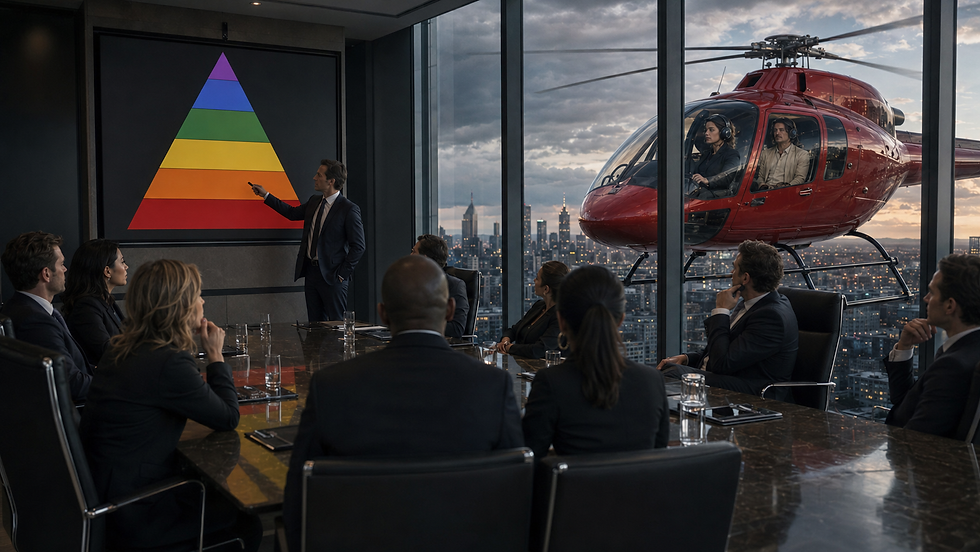
“The farther reaches of human nature include the vertical dimension, the dimension of the spiritual, the sacred, the transcendent, which is a part of human nature itself.” Abraham Maslow, 'The Farther Reaches of Human Nature.'
The internal Satnav of love has only one button: 'home'. You don’t have to scramble for the helicopter when the helipad and the helicopter are already yours.
Part III left the woman at the point where the old summit had become honest. That is an important threshold, because a person cannot fly from a lie. The penthouse had to fail as Home before it could be seen as helipad. The drink had to lose its anaesthetic authority before the hand could leave the glass. The Ferrari had to stop pretending to be proof before it could become a beautiful object again. The view had to become insufficient before the person looking at it could finally ask the deeper question: not how do I climb higher, but from where in me has this whole life been lived?
Part IV begins there, not with a louder kind of transcendence, and not with a spiritual advertisement dressed up as sky. It begins with a change in relationship to the life already built. The building remains. The city remains. The weather remains. The boardroom remains. The presenter may still be inside, pointing at his immaculate coloured pyramid as though the final slide has finally explained the human Soul. Nothing in the world has necessarily become easier. The crucial thing is that the woman is no longer looking at the world from the same place within herself.
Look at the final image above carefully. Inside the glass, the old ceremony continues. The executives sit around the boardroom table, suited, intelligent, ambitious, and sealed inside the belief that ascent can be taught as a diagram. The coloured hierarchy on the screen has the familiar authority of corporate simplification. It is neat, visible, transmissible, and therefore almost irresistible to the part of the mind that wants reality made manageable. The room is full of sightlines and yet almost no seeing. Everyone can look through the glass, but the glass does not open. That is the atmosphere of knowledge when it has not yet become wisdom: transparent enough to give the illusion of vision, sealed enough to prevent departure.
Outside the same glass, the red helicopter hovers in weather that has not completely cleared. This is why the image works. If the sky were perfectly blue, the scene would become too easy. The article would end as reassurance, and reassurance is often just anaesthesia with better manners. The weather matters because the crossing does not depend on the disappearance of difficulty. The first freedom is not that the world becomes cloudless. The first freedom is that the weather is no longer mistaken for the whole sky.
The woman is not being rescued from the penthouse. She is not being carried away by a stronger personality, a doctrine, a therapist, a guru, or a second-hand consultant with a more expensive pointer. She is at the controls. The guide sits beside her, and the fact that he is not flying is not a small compositional detail; it is the ethic of the whole work. The guide lends altitude, not ownership. He holds the wider view until her own seeing can bear it. His presence is active, but not possessive. He does not replace her agency with his certainty. He helps her remember the agency that fear had contracted around survival.
That is why the cockpit is the true answer to the boardroom. The boardroom says: attend to the hierarchy, learn the model, improve your place within the frame. The cockpit says: recover the one who can see the frame. The boardroom offers a better account of the staircase. The cockpit restores a different mode of movement. This is the difference between being given a theory of ascent and inhabiting the consciousness from which ascent no longer means self-betrayal.
Maslow clearly remains a crucial witness here because his best work points beyond the cheap pyramid that borrowed his name and is not only viral on social media, it is pandemic: But this is the irony - the human condition is universal - a virus that has infected every one of us, and it manifests as a pointless pyramid. Maslow's language of the "Farther reaches of human nature" matters because it refuses the little managerial world in which a human being is treated as a motivated unit to be optimised at the lowest cost. He was reaching toward the vertical dimension of human nature: Not a religious add-on placed politely above psychology, but part of the human being itself. In the grammar of this article, Maslow glimpsed the horizon. The error was not that he saw too much. The error was that later culture often saw too little and then marketed the little as a life and as the map to it.
We have another map. In fact I have many maps. And every one will bring you greater clarity, creativity, freedom, joy, abundance, and true love.
We will make the ineffable effable together if you so wish.
The ineffable is something that is too great, extreme, or awe-filled to be expressed in words. Think of indescribable beauty, unlimited abundance, unconditional love, the vastness and beauty of the ocean, the view from the mountain rather than from a tiny point-less pyramid or ladder, and the infinity of the stars.
T. S. Elliot wrote brilliantly:
"His mind is engaged in a rapt contemplation
Of the thought, of the thought, of the thought of his name:
His ineffable effable
Effanineffable
Deep and inscrutable singular name."
The effable may now be spoken. We have the map, the grammar, and you may engage a guide.
But this article cannot end simply by vindicating Maslow against the pyramid. That would still leave the reader with an intellectual correction rather than a route. Maslow helps us see that the human being is not exhausted by survival, security, esteem, or even the ordinary triumphs of self-actualisation. Yet the high achiever at the bar in Part III does not need one more horizon placed beautifully in the distance. She needs a way to move from the consciousness that built the crumbling tower from Part II to the consciousness that can fly from it. She needs the ‘how’ that the postcard cannot supply. And just as importantly, she needs the 'who' and the 'why'.
The pilot doesn’t look down at the fog; they look up at the dashboard. They engage the internal Satnav, and the screen blinks open with a single, unalterable destination coordinate: HOME. I will see it and hold it until you do. Until you see and hear you. And then, you won't need me any more. I am not a life sentence for you. I offer a method for leaving the prison and merging with limitless abundance of the open sky beyond the box of fear in which we are all seemingly trapped. But you are not.
This is where self-transcendence becomes, in this work, the ‘Will to Love’. I do not mean love as temperament, softness, sentiment, compliance, or a pleasant glow added to an unchanged life. I mean love as the state of consciousness from which Truth can be seen without being reduced, the state from which the frightened inner child in all of us can be held without being forced to keep flying the aircraft, and the state from which abundance can be enjoyed without being recruited as evidence of worth. Love is not an ornament on top of the hierarchy. Love is the change in the source of movement. Love is the most powerful force in the Universe.
This is the final, majestic movement of our investigation: Transcendence as The Satnav Home. We are no longer trying to adjust the laminated prison furniture of the wrong tower. We are changing our entire relationship to altitude. When you activate the Will to Love, you don’t wait for the weather of your life to clear up; you simply take off in any weather.
The Evidence: The Peer-Reviewed Science of the Sky
Let us ground this final take-off in unassailable scientific reality. This is not airy-fairy mysticism; this is the absolute frontier of advanced psychospiritual mechanics.
When Abraham Maslow lay dying in 1970, he was desperately writing Theory Z—the missing crown of his entire life's work. He explicitly stated that traditional "Self-Actualisation" was an incomplete diagnosis because it was still focused on the aggrandisement of the individual ego. He realised that the ultimate human need is Self-Transcendence.
Modern neurobiology has finally caught up with Maslow's final notebooks. Dr Andrew Newberg, director of research at the Marcus Institute of Integrative Health, has spent decades scanning the brains of individuals experiencing states of profound spiritual transcendence. The fMRI data reveals a shocking, repeatable phenomenon: during deep transcendence, the Superior Parietal Lobe—the exact region of the brain responsible for drawing the physical boundary between "Self" and "Other"—completely goes dark.
The Neurobiological Matrix of Lift
THE TRANSITIONAL CONSCIOUSNESS | THE TRANSCENDENT SKY |
Left-Brain Hyper-Analytic Control | Total Ego-Dissolution |
Absolute boundary isolation | Horizontal 'Unboxing' From Fear-Based Paradigms |
Scarcity-driven 'Will to Power' | Inherent Abundance of 'Will to Love |
The Staircase (Struggling to HAVE) | Your helicopter (Self-Transcendence) with Effortless Vertical Lift From Your Penthouse (Resting in BEING - the Cosmic 'Seat of Your Soul) |
Look at the forensic reality of that data. Your brain is literally wired to drop its armor. When you step past the Will to Power, the neurological mechanism of isolation dissolves. You realise that your long adult career spent trying to "Have" your way into "Being" was a neurological misfire. The ego tried to use material accumulation to heal an attachment rupture, but the brain cannot synthesise unconditional love out of fiat assets.
True abundance is not the accumulation of the pot of gold at the end of the corporate rainbow. The only way to truly have the gold is to recognise that you are the rainbow.
The Witnesses: The Convergence at the Horizon
Let us bring our final, ultimate witnesses into the chamber to watch the helicopter lift off.
We look past the Council of Disciplines who argued in the foyer, and we look to the giants who mapped the exit routes. In the background of our boardroom ruins, the Buddha stands next to the helicopter pilot, smiling. Beside him stands Thomas Merton, the great twentieth-century mystic, who looks at your portfolio of wealth and whispers his timeless verdict:
“Discovering vocation does not mean scrambling towards some prize just beyond my reach, but accepting the treasure of True Self I already possess.”
They are joined by the ghost of Alice Miller, who looks at your tailored suit one last time and reminds us that while the body presents its bill for the trauma of our childhood, the payment of that bill is the absolute reclamation of our sovereignty.
These witnesses do not offer you a new corporate checklist or an organisational hygiene theory. They do not care about your KPIs. They stand together at the horizon to validate a single, monumental truth: You do not need to scramble for the Sky because you are already the Sky. They are the prefigurative guides pointing to the exact same Satnav system that is built into your own ribcage.
Maslow brilliantly gave us the ultimate human destination, but he did not build the helicopter. Traditional mentoring simply gives you someone else’s pre-written map; I help you recover your own. You may borrow mine until it becomes yours. I have given the map freely. I do not help you become a better, more optimised corporate client; I help you remember that you were never structurally meant to live as one.
You close your eyes, engage the flight code, and let love become your internal Satnav. It interrupts fear’s machinery at every single fork in the road, instantly overrides the old programming, and guides you home to your Self—the magnificent, limitlessly abundant totality of who you have always been. The penthouse has officially become your launchpad. Take the stick, and fly.
Conclusions
You are standing on the edge of the helipad, holding the keys to an empire that you built with the very bricks life threw at you. You did not fail. You built the tower perfectly. But you built it so you could finally leave it. And you have full agency, right now. Back to Maslow for a second:
Maslow wrote this exquisite passage, which is the header for this article, but it had to be repeated so that it may now be fully contextualised:
"In such people, gratification breeds increased rather than decreased motivation, heightened rather than lessened excitement. The appetites become intensified and heightened. They grow upon themselves, and instead of wanting less and less, such a person wants more and more. Wanting and desiring continues, but at a higher level."
When I first read that I asked myself "Is he confusing wanting, desire, having more and more, which are all characteristics of the ego-fear-preference-addiction-imitation love, with True Soul growth? I believe this is an imprecise grammar issue here. Personally I would rephrase it:
"In such people, apotheosis breeds increased rather than decreased motivation, heightened rather than lessened excitement. The appetites become intensified and heightened. They grow upon themselves, and instead of wanting less and less, such a person needs to be more and more. Wanting and desiring disappear, and needing transfigures into its highest level: Flourishing abundance at a cosmic level from the 'Will to Love."
I don't like gratification as it is pure preference (ego), and in any case the word is now typically linked with instant gratification - doom scrolling, downing a bottle of wine, and compulsive shopping.
In this quote Maslow means the real-growth side, not the imitation-love side. That passage comes in his distinction between deficiency motivation and growth motivation. He is saying that some needs behave like lack: once you are hungry and eat, the hunger reduces. But growth does not work like that. When someone is genuinely growth-motivated, fulfilment does not end passion; it refines and intensifies it. The more one truly learns, creates, loves, understands, serves, or becomes, the more alive the appetite becomes. Maslow gives examples such as education, success in exams, becoming a doctor, playing the violin, understanding people or the universe, creativity, and becoming a good human being. Again, like Freud and Nietzsche, we are permitted to reflect on other’s views. Maslow includes ‘prison’ examples – roles, achievements, accolades. But who are you without those? And who would be filling the role once you have expanded awareness. This is perhaps not surprising as he tells us that he only saw the horizon. He glimpsed it from his cell, but he did not cross the bridge himself.
In my grammar, this is very close to real love as Self-renewing. Maslow’s meaning is more organic than corporate. It is not “more, more, more” because nothing is enough. It is “more” because life has started flowing from the right source.
The distinction is delicious:
Imitation love wants more because it remains hungry.
Real love wants more because it has become alive.
That is why this quotation is so important for this article. It helps us to refine the nuance. It stops you from thinking that all wanting is addiction. Maslow is showing that there is the appetite of BEing itself. It is not the Ferrari trying to become love. It is the person, now in love, able to create, serve, earn, build, learn, and enjoy without asking those things to become the missing parent, the missing God, or the missing Self. The Bible did not state “The Kingdom of God is within your Ferrari.” The Ferrari becomes God-like because you are sitting in it.
So success is not automatically imitation love. Success becomes imitation love when it is recruited to prove worth, numb pain, purchase admiration, or silence the frightened child. Here, success is limited, and its fruit are small, hard, contracted, like a miniature black hole. But success can also be the expression of real growth. A brilliant vocation, a flourishing business, a beautiful home, money properly ordered, even the Ferrari-with-love: these can belong to growth motivation when they flow from BEing rather than trying to replace it.
Maslow’s cleanest summary is that he was not warning that all desire is addiction. He was rescuing desire from the prison of deficiency. Some wanting is the wound asking for anaesthetic. But some wanting is life recognising itself and asking to become more fully alive.
I think the word success should be divided. Small success when it is deficiency motivated. Stratospheric superabundance when it is love motivated.
Perhaps it’s time to go through that open door. The ego’s chains were never attached. The door was not locked. But fear made you believe there is no door. The simple reason is that fear is illusory and self-combusting: Fear fears itself. Next time you see it tell “Boo” and smile and see what happens. There is no monster under the bed. The 7-year-old, frozen in time, now thawed by the ‘Will to Love.’
Maslow described peak experiences as brief, heightened moments in which a person feels unusually alive, whole, joyful, clear, connected, and fully present. They are not just “happy moments”; they are moments where ordinary self-consciousness loosens and reality seems more vivid, unified, meaningful, beautiful, and intrinsically valuable. For those who have them, they typically describe them as being the most joyful, loving, peaceful beautiful experiences of their lives. Others can quite literally see something shift in them.
For Maslow, these experiences often happen in love, creativity, nature, music, art, religious or spiritual experience, profound insight, or moments of deep fulfilment. They are closely linked with self-actualisation, but they also point beyond psychology into what he called Being-cognition: A way of perceiving reality not through need, fear, utility, comparison, or deficiency, but through wholeness, wonder, unity, beauty, truth, and value. His ‘Toward a Psychology of Being’ places peak experiences in chapters on “Cognition of Being” and “Peak-Experiences as Acute Identity-Experiences.”
The key thing: In a peak experience, the person is both most truly themselves and somehow beyond the ordinary ego-self. There may be awe, timelessness, effortlessness, gratitude, reverence, unity, love, and the sense that the moment validates itself. It does not need external proof. It feels self-evidently real.
Maslow’s peak experience is not “success” as acquisition. It is closer to the unlidding of the self into fullness that I describe in relation to my cathedral of work. It is abundance not as possession, but as contact with BEing — a moment where life is not climbed, won, performed, or consumed, but directly inhabited.
This work does not ask you to give up your abundance. It does not ask you to apologise for your wealth, sell your business, or retreat into a monastery. The Ferrari remains in the garage, but it no longer gets to masquerade as God. We are not taking your material success away; we are simply changing who is driving the vehicle. We are moving you from the frantic, terrified Ferrari-of-the-Ego to the majestic, unshakeable Ferrari-of-the-True-Self.
We are flipping your inverted operating system completely on its head. You are stepping off the theoretical staircase of 'Identity Fracture' and stepping into the effortless vertical lift of the 'Re-Collection Sequence.'
You establish your baseline wholeness, your connection to the open sky, and your unshakeable self-worth first. You close your eyes, press the single button on your internal Satnav, and recognise that Home is not a place you have to earn the right to visit—it is the sovereign space from which you already operate.
Earlier in life, love may have appeared mainly as a need. The child needed love as safety, attachment, recognition, holding, and welcome. When that love was conditional, absent, confusing, or mixed with demand, the psyche did not simply stop needing it. It learned substitutes. It learned to buy attachment by selling authenticity. It learned to seek approval because approval nearly resembled love. It learned to make achievement speak the language the family, school, profession, or culture seemed willing to hear. That was not vanity. It was survival organised around a missing nourishment.
The movement now is not the abandonment of need, because the child in armour still needs to be loved. The movement is the recovery of a deeper capacity. Real love ceases to be only what the wounded part is trying to obtain from the world and becomes the state from which the adult Self can now meet the world. That is the transfiguration. Imitation love is insatiable because it is trying to feed the wrong place with the wrong substance. Real love is different. It does not produce the deadening demand for more because nothing has landed. It deepens, opens, and gives energy because it is no longer operating as a transaction.
This is why the helicopter image in Part IV looks strangely effortless. The woman is not straining upward with the old expression of performance transferred to the sky. If she were, the helicopter would be only another rung. She is calm because the energy source has changed. Fear is a combustion engine. It burns the organism to produce motion. It can generate astonishing speed, but it also produces smoke, heat, noise, and exhaustion. Many successful lives are powered like that for decades. They move, they climb, they impress, and then they wonder why every victory smells faintly of ash.
The ‘Will to Love’ is not more fuel poured into that engine. It is another order of energy. The metaphor of a self-sustaining reaction is useful if handled carefully. It does not mean violence, inflation, or spiritual grandiosity. It means that love, once lived as action, generates the capacity for further love. The person no longer has to burn the self in order to move the life. Action stops being a plea. Work stops being a petition. Giving stops being a strategy for being needed. Achievement stops being a receipt submitted to an absent parent. The energy of the life begins to come from alignment rather than compensation.
That is what makes the question at the heart of the work so exact:
“Who do I need to BE to be able to answer the question ‘What would love do now?’”
The question is not asking the frightened mind to produce a clever answer. The frightened mind is often brilliant, but brilliance is not the same as wisdom. Fear can build arguments, strategies, careers, defences, and entire civilisations. It cannot see the whole terrain because it is organised around threat. The question asks the person to shift state before choosing. It asks for a change of seat within the psyche. From the old seat, love may look dangerous, foolish, weak, or uneconomic. From the Seat of the Soul, love becomes clear, practical, exacting, and sometimes beautifully inconvenient.
This is the real Satnav. It is not a slogan to be repeated until discomfort fades. It is an instrument of orientation. When the person asks who they would need to BE to know what love would do, the old egoic machinery is interrupted. The question does not flatter the wound by asking what would make it feel safer for the next five minutes. It does not hand the controls back to the part that built the tower. It asks the deeper Self to come forward as navigator. It asks the person to stop outsourcing direction to fear.
The word ‘Home’ matters because the Satnav is not taking the person somewhere foreign. It is returning them to the ground of BEing that was obscured by adaptation. Home is not a reward at the end of performance. Home is not the penthouse. Home is not an audience finally clapping loudly enough. Home is the place in the person from which life can be met without the constant negotiation of worth. From there, the same external life may continue, but it is no longer lived as invoice, audition, or apology.
This is also why the cosmic view is a tool, not an escape. The larger view does not mock the human drama or make the wound unreal. It places the wound in context. From inside the boardroom, the pyramid can look total. From inside the penthouse, the weather can feel like destiny. From inside the child’s old contract, approval can feel indistinguishable from love. The cosmic view widens the field enough for proportion to return. It allows the person to see the terrain of their life without being swallowed by any single room within it.
One hand remains in the Earth. This matters. Without the Earth, the sky becomes dissociation. The wound was real. The attachment bargains were real. The body’s learned vigilance was real. The achievements were real too. The career, the money, the discipline, the capacity, and the intelligence are not imaginary simply because they were partly organised around pain. A true map must honour the material reality of the life that was built, otherwise it becomes another contemptuous abstraction.
The other hand reaches the sky. Without the sky, the Earth becomes a prison of explanation. A person can know every fact of their childhood, name every adaptation, recognise every defence, and still remain seated at the bar if no larger movement becomes possible. The sky is not the denial of psychology. It is where psychology is no longer asked to be the whole sky. It is the opening through which knowledge becomes wisdom, and wisdom becomes lived change.
That lived change has a very practical form. The person begins to notice the old commands as commands rather than as reality. The inner voice that says “prove yourself” is heard as fear, not as God. The demand to climb one more rung is no longer accepted as destiny. The craving to be admired is met with compassion, but not obeyed as law. The impulse to buy another symbol of arrival may still appear, but it is no longer allowed to impersonate love. This is not instant perfection. It is the return of discrimination. It is the beginning of adult agency.
Agency, here, does not mean controlling every outcome. The weather may continue. Other people may remain unconscious. The market may move, families may repeat old scripts, institutions may keep their sealed windows, and the boardroom may still applaud the presenter with the pyramid. Agency means that the old machinery no longer owns the deepest seat of choice. The frightened child is still in the aircraft, but loved and unpromoted. The adult Self has returned to the controls.
That is why the guide’s presence matters so much. A poor guide makes dependency elegant. A frightened guide replaces the client’s fear with the guide’s system. A narcissistic guide stands in the cockpit and calls the passenger liberated. This work has to do the opposite. The guide’s task is prefigurative Re-Collection: to see the highest, the whole, in the person from the beginning until the person can see it themselves. The guide does not create their wholeness. He witnesses it early, protects its possibility, and lends enough altitude for the client’s own seeing to return.
Once that seeing returns, abundance is no longer the enemy because substitution has ended. The Ferrari may remain. The penthouse may remain. The company may remain. The money may even increase, because a person no longer spending half their life defending a false self may become clearer, braver, less reactive, and more creative. But the moral centre has changed. Abundance becomes expression, capacity, beauty, freedom, service, and play. It no longer has to carry the impossible burden of making the wounded child finally feel lovable.
This is where the article returns to the boardroom one last time. Inside the room, the participants are still learning a version of ascent that leaves the deeper self unexamined. They are being trained to climb inside the frame. Outside the window, the woman is not arguing with the frame. She has left its jurisdiction. This is a quiet but radical distinction. She does not need to smash the screen, humiliate the presenter, or prove that the boardroom is stupid. She has simply discovered that the real movement was never contained by the slide.
That is the end of the pyramid’s authority. Not because the pyramid is denounced, but because a wider field has been entered. The point that was missing from the pyramid was never a higher triangle at the top. The missing point was the Self that had been trying to climb it. The missing point was love. The missing point was the state of BEing from which having and doing can finally return to their proper place.
So the sequence is restored, not as a diagram but as a life. BEing comes first. From BEing, doing becomes expression. From doing, having becomes consequence, tool, and overflow. The order matters because the old sequence was the wound’s logic. Having first meant the world was being asked to supply an inward ground. Doing second meant action became performance in search of evidence. BEing last meant the Self was always postponed until after the next achievement. No wonder the summit felt cold. The person who was supposed to arrive had been left behind at the beginning.
To restore BEing is not to become passive. It is not to sit in a cloud of self-approval while the world continues without you. BEing is the recovered centre from which action becomes more truthful. It may make a person more decisive, not less. It may make them more successful, not less. It may make their work sharper, their relationships cleaner, their leadership less frightened, and their abundance more alive. But the quality of movement changes. They are no longer running from absence. They are acting from presence.
This is why the final image is not a fantasy of disappearance. The helicopter does not fly away from life into blank light. It rises above the weather so the terrain can be seen, and then it can return. That return matters. The point of the cosmic view is not to remain superior to the city below. It is to come back with enough altitude not to keep transmitting fear. The person who has seen the map can become a circuit breaker in the vertical chain of inheritance. They can stop making their children, clients, colleagues, partners, or employees pay for wounds that were never theirs to fund.
That is love as a verb. It is not merely a feeling of warmth toward the world. It is the disciplined refusal to pass fear onwards when fear has become familiar. It is the decision not to make another person earn what should be freely given. It is the willingness to act from Truth when performance would be easier. It is the choice to let abundance serve life rather than demand that life serve abundance. It is the quiet, repeated, embodied answer to the only question that finally matters at every fork in the path of life:
"Who would I need to BE to be able to answer the question 'What would love do now?'"
Self-Transcendence is precisely the operational expression of the 'Will to Love'. It explains why the helicopter can take off effortlessly. The synthesis is the move from Fission-self-Combustion (leading to burnout) to Self-sustaining Fusion-Lift. "Identity Fracture" (Having → Doing → BEing) is a "Dopaminergic Loop" powered by the cortisol of competition—a literal "combustion engine of friction". In contrast, the "Re-Collection Sequence" (BEing → Doing → Having) shifts the centre of gravity to the "Seat of the Soul". This "Nuclear Response" is what allows the "Helicopter" to move vertically without needing the 'ladder' or the 'tower'. It transforms the high-achiever from a "Puppet King" (ruled by strings) to a "Sovereign Pilot" (ruled by Truth). Love is the operative frequency that serves as 'nuclear fuel', allowing the Soul to remain seated while the ego's petty squabbles are ignored.
We may now ditch the fake 'Maslow's Pyramid' postcard and pick up the blueprint of your life. The "Laminated Postcard" is the 'lid' placed on human consciousness to keep it in the "Basement of Lack". The "Nuclear Response" is the 'Unlidding'—the moment the "Ceiling of the Library" in the image in this article is torn open to reveal the "Blazing Blue Sky". You have spent your life polishing the laminate on your prison furniture, when you were built to be the sun that dissolves the furniture altogether.
The investigation that began with a grinning postcard salesman can therefore end without needing to convict the wrong suspect. Maslow was not the body. Success was not the body. Money was not the body. Ambition was not the body. The body was the mystery of human becoming, flattened into a structure the ego could use. The resurrection is the recovery of that mystery as lived agency. The postcard is still on the rack. The pyramid is still on the screen. But the woman is outside the glass now, and the rotors are turning.
If this movement has landed, the invitation is not to despise the life you built. It is to stop living it from the part of you that built it to survive. The roof is beneath your feet. The weather is real. The guide is present but not in charge. The controls are not a metaphor anymore. You do not need a better pyramid. You need the map, the method, the tools, and the courage to let love become your mode of flight.
The next stone on the Bridge is not another article to consume and admire from inside the room. It is the beginning of orientation. If you are ready to stop asking power to do love’s job, start with the map. If you are ready to stop polishing the prison furniture and begin learning how to fly the life you have already built, step onto the next page. The Satnav is not taking you away from yourself. It is taking you Home.
The rotors are spinning. The crime of your life has been solved. The suspects are locked in their basements, and the Council of Disciplines is left arguing over the floor plans of an empty prison. What's the point of an empty prison? The penthouse has served its purpose; it has officially become your launchpad.
You were born to be a pilot, not a price tag. It is time to drop the iron suit, take the stick, and fly.
🛠️ The Next Stone on the Bridge
If this movement landed, do not look back at the boardroom. The investigation is over, and the map is in your hands. If you are ready to stop optimising your armour inside the wrong tower, step out of the bank queue and click below to map your flight path home.
References
Bridgman, T., Cummings, S., & Ballard, J. (2019). ‘Who Built Maslow’s Pyramid? A History of the Creation of Management Studies’ Most Famous Symbol and Its Implications for Management Education’ Learning & Education, 18(1), 81-98.
Dittmar, H., Bond, R., Hurst, M., & Kasser, T., ‘The Relationship Between Materialism and Personal Well-Being: A Meta-Analysis’, Journal of Personality and Social Psychology, 2014; 107(5):879-924.
Maslow, A. H. (1943). 'A Theory of Human Motivation'. Psychological Review, 50(4), 370-396.
Maslow, A. H., ‘The Farther Reaches of Human Nature’, Viking Press, 1971.
Miller, A. (2005). The Body Never Lies: The Lingering Effects of Cruel Parenting. W. W. Norton & Company.
Newberg, A., & Waldman, M. R. (2009). How God Changes Your Brain: Discover the Neural Science of Cyber-Spirituality. Ballantine Books.
Ryan, R. M., & Deci, E. L., ‘Self-Determination Theory and the Facilitation of Intrinsic Motivation, Social Development, and Well-Being’, American Psychologist, 2000; 55(1):68-78.
Scott Barry Kaufman’s Scientific American discussion ‘Who Created Maslow’s Iconic Pyramid?’
Namaste.
Olly
Email me:
Disclaimer:
The information presented in this article explores the role of psychospirituality in mental well-being and recovery. It is for informational purposes only and should not be considered a substitute for professional medical, psychological, or psychiatric advice, diagnosis, or treatment. You should always seek the advice of your own qualified healthcare provider with any questions you may have regarding your specific condition or any medical concerns. Never disregard professional medical advice or delay in seeking it because of something you have read here. Integrating spiritual practices can be a valuable part of a holistic approach to mental health, but it should complement, not replace, care from licensed medical and mental health professionals.



The content is presented in a clear and well-organised way. I appreciated the clarity with which the data and information are presented. I recommended this article to someone dealing with the same topic. It is content useful both for those approaching the topic for the first time.