The Human Condition and How to Heal It: ‘The Seat of The Soul’, ‘The Glass', and 'The Hula Hoop'
Updated: May 17
A New Grammar For Triangulating The Ego: A Triptych Catechism For the Psychospiritual Journey to Unconditional Well-being – Introducing Emotional Sobriety, De-Identifying From the Ego, Fear, Trauma Bonding, and Codependency
Introduction
Hello. Welcome back to the series of articles on 'The Human Condition and How to Heal It'. I invite you to take your 'Seat'. Or rather, may I remind you to stop leaving it. You are being distracted by the objects of your focussed consciousness. But, that's totally cool - everyone is to start with. Instead, we try to use willpower, and that is concentrated consciousness. And no, willpower is not a good thing. We are told that it is, but that would be like telling the sun that it is what the beam of a small spotlight is shining on.
If the first two articles were the diagnosis and aetiology of the human condition, this article is the operational manual: A set of coordinates you can consult mid‑argument, mid‑email, mid-phone call, mid-conflict, mid‑panic, mid-crisis, mid-catastrophising, mid-overwhelm.
The three elements described here are simple enough to remember under stress, and deep enough to keep unfolding: Those elements are ‘The Seat’ (witness consciousness), ‘The Glass’ (psychological boundary), and ‘The Hula Hoop’ (sane responsibility of what is yours and what need not be yours).
Please do read the next sections like a field guide. First, the images (so your dysregulated triggered nervous system ‘gets it’). Then the definitions (so the mind can name it and to give you the language of what comes next). Then the mechanics (so you can practise it).
This is the roadmap:
Image → Grammar → Geometry → Practice → Peace
The Triad: 'The Seat', 'The Glass', and 'The Hoop'
This article explains how we may live differently - practically, relationally, peacefully, joyfully, lovingly, effortlessly, abundantly, and freely. It works because the three concepts, “The Seat of The Soul’, 'The Glass', and 'The Hula Hoop', map cleanly onto three developmental failures of the ego:
Loss of 'The Seat' → false identification (the mask) fused with reactivity (conflict).
Loss of 'The Glass' (psychological boundaries) → emotional contagion, projection, and codependence.
Loss of 'The Hoop' → illusions of omnipotence, control, martyrdom, manipulation by others, people-pleasing, and resentment.
'Emotional sobriety', a concept that is often poorly understood, if at all, is simply the restoration of all three.
This article will allow you to do four things straight away (and much more besides):
Show ego dissolution as nervous system regulation, not 'mysticism'.
Define agency (whilst allowing you to recoup it along the way) without moralism.
Define spirituality without dissociation or bypassing.
Define boundaries without turning them into therapy 'psychobabble'.
This article bridges and integrates transcendental transpersonal psychology, existential philosophy, trauma nervous system science, and contemplative traditions, psychotraumatology, and nervous system science — hopefully without becoming preachy. This fusion, this integration, is what I call 'psychospirituality.'
It sits here after my integrating definition of the ego in the previous two articles as being 'the armoured petrified inner child'. Because once the ice thaws, these three capacities naturally emerge:
The first corner is ‘The Seat of the Soul’: A mechanical regulator for the cognitive and emotional disidentification from the objects of consciousness and restoration of authenticity.
The second corner is the ‘The Glass’: Differentiation in contact with disciplined permeability.
The third corner is the ‘Hula Hoop’: Sane agency without manipulation.
Triangulated, these three become the map of 'emotional sobriety': Not as a pious aspiration, but as an operational description of what it looks like when ego stops driving your life, and how to go beyond.
Addiction is simply leaving ‘The Seat’ - fear causing the person to stand up and reach for what I call the 'Temple of Emotional Anaesthesia': Please see my previous article where I define precisely what this is - 'The Human Condition and How To Heal It: Series Introduction.'
Awakening is reinstalling the geometry of the human condition.
But first 'The Triptych’: The parable-in-three-images that makes sense of the entire human condition. It makes it clinically literate, spiritually serious, whilst landing as its foundational visual canon.
Before we theorise further, here is the catechism in pictures. The nervous system learns by imagery before it learns by argument. If the words feel lofty, let the images teach you the geometry first.
'The Triptych'
The sequencing of the following images is deliberate. We begin at the end. Beginning with the 'end' - seeing 'The Vision' creates aspiration and a glimpse of 'witness consciousness' as Michael Singer says; then moving backwards creates recognition; returning forward creates hope and clarity. It also alludes to the deepest Truth - one that no-one talks about: That your starting point is, in reality, your 'end point' for the dissolution of the ego: A new beginning. ALL human suffering is caused by one thing and one thing only: Leaving the 'Seat of The Soul'. You panicked, you became distracted, and you ended up outside, in the middle of the chaos, at the centre of the fight. Again, don't worry or be alarmed, we all do it until we feel and see that there is another way.
This is a visual cognitive behavioural model wrapped in contemplative symbolism. I pray that this will land with you. I am certainly not saying that I am a psychologist - I am not. But many contemplative philosophers and transformative coaches see the overlap and that is where Truth and healing actualises.
When you see the images together ('The Vision', 'The Starting Point', 'The Return', and then 'The Vision' again my intention is that you won’t just understand the 'The Triptych' images intellectually — it is that you will feel the nervous-system difference between them.
That’s why this article, in the series on 'The Human Condition and How to Heal It', stops being theory and becomes intervention.
'The Vision'
First, here is a glimpse of where you started, but perhaps you can’t remember - the unconditioned child in you before you felt that love was conditional. This is both the real beginning, and 'The Vision' and what it means to 'come home.'
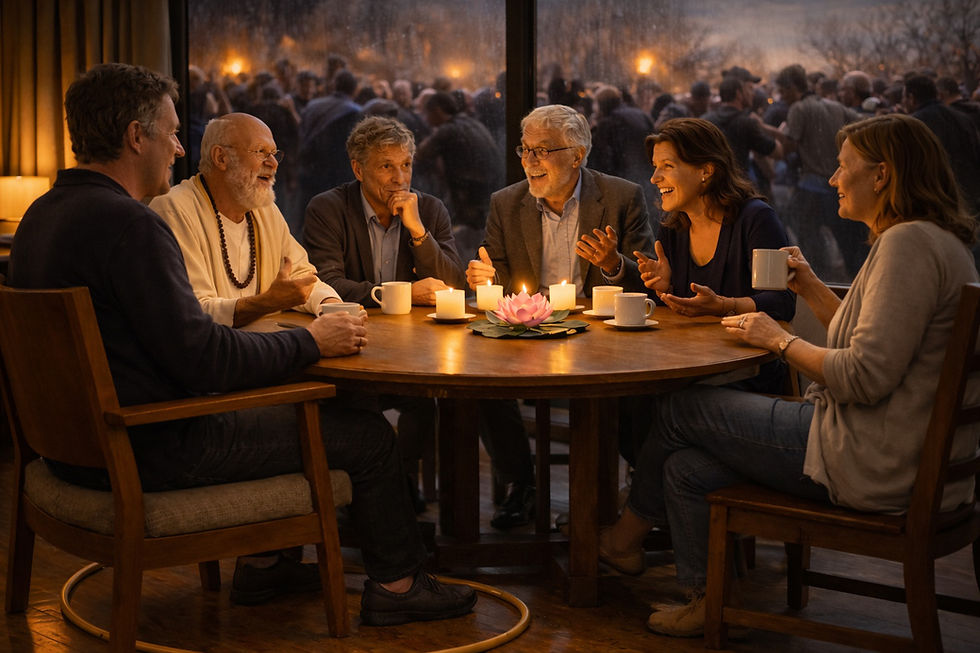
In the image above, a single room becomes a whole psychology. More, it becomes the whole of transpersonal psychology, and what was missing - the full psychospiritual potential to heal from the human condition in every one of us.
'The Triptych' explains not only how the entire psyche works, but also what happens when it fractures, which is the diagnosis of the human condition, and also how to heal it.
The chair is the 'Seat of the Soul': This is the simple power of staying present to sensation without being possessed by it. The chair is occupied by what Singer calls 'The Witness' and 'Witness Consciousness', and that witness is you.
The circle at your feet is 'The Hula Hoop’: The perimeter of what belongs to the Self—attention, tone, limits, repair, choice, the inner journey—and the dignified release of what does not—other people’s moods, opinions, projections, storms, timing, demands, manipulations, trespasses, and outcomes. Even if they do not have a 'Hula Hoop' of their own, it is not for you to give them yours, expand it, or let them step into it. It is also a reminder that you may remain within it, and still manifest your BEing.
The window, 'The Glass', is the psychological boundary made visible: Transparent enough for compassion, yet strong enough to stop the mêlée outside from entering your nervous system inside as a command.
Around the table sit the ‘witnesses’: Archetypal guides and human loves—faces of Truth, science, wisdom, highest levels of compassion, forgiveness, tenderness—reminding the nervous system that it can be in fellowship without being recruited into panic.
In the image above we find from left to right: Ram Dass, the Harvard Professor of Psychology turned contemplative guru, who wrote the seminal book 'Be Here Now'; the compassionate clinician Dr Gabor Maté, doyen of childhood Trauma, attachment versus authenticity, and addiction), with the salt-and-pepper maturity of a seasoned doctor who has seen suffering and stayed tender, who wrote the book 'The Myth of Normal', which is in my 'Suggested Reading' list, tellingly with his son; Dr Carl Gustav Jung, the 'prophet' of psychiatry, psychology, psychotherapy and father of psychoanalysis; the luminous Marianne Williamson, the contemporary teacher who speaks Grace, love, and miracles, author of 'A Return to Love' - the US Presidential candidate who should have become president.
But you can choose your own witnesses: Your compassionate guides. Outside, the crowd surges and clashes, seeking to hurt others as much as they themselves are hurting, as though hatred is self-healing. Inside, the person in the chair, is not lonely but held: Not by control, but by clarity. The 'Bridge of Awakening' is simply this, repeated until it becomes native: Returning to 'The Seat', repairing 'The Glass', shrinking 'The Hula Hoop' back to sanity—until ego’s compulsion to manage the weather dissolves, and BEing is no longer an experience visited, but the ground from which life is lived. You can't control the weather, the storms of life, but you can dance in the rain.
Opening with the perfectly seated image above, ‘The Seat of your Soul’, establishes the telos - the ultimate objective: This is what true awakening looks like when embodied. Not ethereal, not disembodied, not heroic — simply regulated, relational, and sovereign. This is not a goal, this is expanded consciousness: 'The Vision', free from the ego's clutches.
Then reversing through 'The Triptych' gives us pedagogy through descent:
‘Ego Overreach’
The next image is actually the place where we all think that this story begins: The ego. This is the ‘petrified inner child wearing armour.’ This is the adult that was the conditioned child. Conditioned by our parents, and the collective conditioning of our current Dystopian society and culture. This is the norm: And our current culture, as Dr Maté describes in 'The Myth of Normal', requires us to be mentally ill just to survive in it, and we have no choice but to start here. It sets the scene of our lives. And that society manipulates and amplifies it to deepen our greatest fears of being unworthy, so that we consume to alleviate that pain.
The image below shows ‘Ego Overreach’: 'The Glass' irrelevant and storm entered; 'The Hula Hoop' inflated and geometry distorted; 'The Seat' vacated and authority confused with urgency. The problem is that most people start here and think that they have to stay here: They live here, many for their entire lives.

‘The Return’
The image below shows the moment in adult life when the psyche realises, with a shock that is simultaneously both comic and tragic (like William Shakespeare's "All the world's a stage" is from his play 'As You Like It' (Act II, Scene VII), that it has been living as if it were standing in the street, punching the world and everyone it in. Not merely with people, not merely with circumstances, but with the very texture of reality: With tone, with implication, with disappointment, with other people’s moods, with what they think about you. The human condition, in one of its most ordinary disguises, is the compulsion to treat the world as a tribunal and the self as perpetually on trial.
Mahatma Gandhi wrote that:
"The problem with the world is that humanity is not in its right mind"
This second image in the series, shown below, is ‘The Return’ — hand extended, glass closing, hoop shrinking, chair visible again.

And at last we return below to the first image in this article: ’Seated Sovereignty’ ('The Vision' revisited or rather, reinhabited) — integrated peace.

Once we have seen 'The Triptych', the structure does something powerful psychologically: It prevents spiritual romanticism. It captures how the psyche really works. It explains why your life feels like a mess.
The reader sees:
'The Vision': This is expanded consciousness.
'Ego Overreach': This is how we lose it.
'The Return': This is how we return.
And finally, this is what it looks like when stabilised and expanded consciousness is restored, revisited, and reinhabited ('The Vision').
It becomes experiential ‘theology’ without preaching. The vision is the place of total clarity. Of intuition. When you reach that state of BEing, you don't have to worry about what you will do next, as the doing will flow from your BEing. And in any cases outcomes then will no longer matter as you will have let them go, knowing that you can handle anything. And that is exactly the point at which fear ceases.
Now that the geometry is visible, Singer supplies the simplest instruction manual for staying inside it: Return to 'Witness Consciousness'; release the objects of limited focused consciousness; stop arguing with the weather, people, situations reality, and Truth.
And a gentle reminder: What people think about you has nothing to do with you - it is what they are ashamed of in themselves - this is what Jung called 'projection.'.
Singer reminds us:
"You Are The Consciousness. You Are Being Distracted. Let It Go."
“You are a very great BEing.”
Every atom in your body was made from stars. Stars are the primary crucible of the elements, created through a process known as stellar nucleosynthesis.
The quantum physical field that runs through your body runs through the entire Universe. It is omnipresent.
Singer says that:
“Consciousness is God. Consciousness is the quality of the awareness of BEing.”
What stops us from living like this all the time: As the great BEing that we truly are? Fully conscious? Singer tells us that:
“Psychology says that it is 'The sum of your learned experiences. This wrong. You are the witness behind that. We are distracted by this 'garbage' that we stored inside - 'likes' and 'dislikes', and preferences. Be aware. You are the consciousness. You are being distracted. Let it go.”
He asks us:
“Who is in there? You are in there. Your consciousness doesn’t change. What you are conscious of changes. You are not a human being. You are God consciousness being distracted.”
Singer says:
“You are being distracted by you. Your ego is a set of thoughts created in your mind, distracting you.”
Sam Harris, the neuroscientist and philosopher defines the ego (the false self, the persona) as:
"A persistent illusion—the subjective, incorrect feeling of being a 'thinker of thoughts' located inside one's head, separate from the stream of experience.
He argues that this sense of a central, unchanging 'me' is a constructed, transient thought pattern that does not exist in reality or neuroanatomy.
Letting it go means to let go of the part of us that refuses to let go of the garbage inside and accept reality. And that part of us is called the ego. And letting go is the entire spiritual journey. The ego and what it does is very easy to understand.
Psychology is the science of the things that you held inside of you that bothered you. Spirituality is the science of letting go of the part of you that did that. That is why spirituality is what allows you to get your life back. To return to the ‘Seat of your Soul.’ To regain agency. Your sovereignty. This is true liberation. This is how to be free. This is how to heal and become whole again. It reunites the 'fractured psyche.'
“The ‘Great Way’ is Not Difficult For Those Who Prefer Everything.”
The Third Patriarch of Zen wrote a peom, the first line of which is that:
“The ‘Great Way’ is easy for those who have no preferences.”
That certainly feels true. But there is an error there. Not having preferences is to have preference! So, how do you get around this dilemma? What is keeping you from not being in a continuous state of peace, bliss, and ecstasy?
Singer, as always, has the solution. He says that:
“The ‘Great Way’ is not difficult for those who prefer everything.”
Wow! Mind blown. Ego-mind blown.
When you get there, Singer says that “You will know what to do.” Just get there and stay there, living in the harmony, the flow of things. That is Enlightenment, that is the 'Tao'. That is what it feels like when you step from this thesis' meta-theory's 'Bridge of Awakening' into the 'Field of BEing.' That is the quiet revolution here.
Singer's view is echoed in Stoic philosophy, embodied by their motto, 'Amor Fati' - 'love your fate'.
The terms 'desire', 'preference', limiting belief, and 'fear' and all synonymous. Singer says that we create our own fears:
"Underneath, at the bottom, is fear. Therefore the only way to be truly out is to be at peace with fear. You have to be willing to say 'If I do not let go of my fear, it will define the limit of how far I can go.'
You are not liberated as you are giving in to the discomfort of fear."
This is what allows you to say internally:
“I am not ok, why?”: “I’ve left 'The Seat',” “'The Hoop' has inflated,” “'The Glass' has cracked.”
You don't need me to tell you that this is new: It was always inevitable. But, far more importantly, its significance is that it is usable, it's practical. It's not airy-fairy metaphysics. It's the physics, the mechanics of life, that allow you to walk the path, not just see it. The 'Temple' and the 'Bridge' in the meta-theory are grand architecture. But 'The Seat', 'The Glass', and 'The Hoop'? Those are handholds. Those are teachable.
Those are usable at 9:17 p.m. in the middle of conflict.
That’s when theory proves itself. It’s the foundational scaffolding of the human condition. When you can notice, gently, with Self-compassion, mid-argument:
“I am not ok, why?”
They can simply notice, with Self-compassion, that:
“I’ve left 'The Seat',”
“'The Hoop' has inflated,”
“'The Glass' has cracked.”
— we’ve given you a language and a framework that interrupts compulsion.
That’s how you deal with life. That’s intervention. These are the coordinates. This is the beauty of refusing to stay in one discipline.
The following image is the 'Seat of my Soul'. This is where I go when I meditate, when I am being mindful. When I am present. I can see the fighting outside but no part of me wants to join the fighting. Why would you? What is the 'Seat of your Soul'.

The image above is my icon of ‘inner emergence’: The moment the human being discovers that they can be in the world without being swallowed by the world. 'The Glass' is the boundary, the table is 'The Hula Hoop' made tangible, and the seated witness, the 'wounded healer' as Jung calls them is in the 'Seat of their Soul'.
The world can rage beyond the window and still the nervous system can learn a new law: Attention returns, breath returns, the heart does not evacuate. In that return, ego begins to loosen its grip, take off its armour, and climbs aboard, fusing with the 'Higher Self' through loving awareness' as the psychologist Tara Brach calls it.
The old reflex to manage, merge, appease, fix, dominate, collapse, flee or freeze becomes optional. What remains is a clean interior: Love without fusion, compassion without self-abandonment, clarity with love and without cruelty, and strength without armour.
“A True Paradigm Shift Means Changing Your Seat"
Healing, real growth, is a paradigm shift: It means changing your perspective - the level where you sit. It means taking your seat. Singer says that:
“A true paradigm shift means changing your seat. You change 'The seat' from which you are looking at things. It is a paradigm shift in your life. It will change your thoughts, all your emotions, all your purpose in life. Every single thing is determined by the level where you sit. It will change your life. It will change everything single thing about you because you have expanded and encompassed a larger Truth than this tiny thing called you.”
This 'tiny thing' is the ego - a construct which has been called 'King Baby' - an 'Egomaniac with an inferiority complex'. The ego is a pedlar of lies and illusion, spoken through the language of fear - the only language that it knows. The only reliable thing about the ego, is that it consistently lies: The Truth is simply the opposite of what it says.
Without the paradigm shift described in ‘The Triptych’, you will always continue to believe, think, and feel that life is happening to you rather than for you.
Singer wrote that:
“Earth is the place that human beings are sent to evolve.”
That evolutions is a paradigm shift.
The French philosopher Pierre Teilhard de Chardin, who explored consciousness wrote famously:
"We are not human beings having a spiritual experience. We are spiritual beings having a human experience."
Singer continues about shifting perspectives through a paradigm shift and why ‘life-hacks’, ‘mantra’, ‘positive-mindsets”, ‘resilience training’, and forms of psychotherapy that simply focus on trying to change the ego’s negative thinking into ‘positive thinking’, are nonsense:
“Not putzing around sitting where you’re sitting and saying, well, I know I’m supposed to like people and I don’t, so I’ll work on liking. You can do that. I shouldn’t swear. It’s not a nice thing to offend some people. So those are not paradigm shifts. They’re nothing. It’s like you’re watching the TV and you realise that it’s not doing you any good. So you change the channel. You wouldn’t have to use positive thinking. You would not have to do mantra. You don’t have to do anything.
So the question is first, what do I do about that? It’s obvious. You don’t participate in it. You just don’t participate. It’s a meaningless thing. It’s just nothing. It’s nothing. That’s how you have to look at your psyche. It is nothing. It has no meaning. It’s illusion and delusion going on inside of my head.
And so you question, ‘Why does that happen? Why? No matter how hard I try, I keep getting pulled down into this tiny little psyche with all its noise and likes and dislikes and preferences and judgements and reactions’ and so on. And what you’re going to see is that there’s a word, one word that is underneath all of it is fear.”
Fear
Singer says that behind all likes and dislikes, preference, every desire, judgement, reaction, and perceived failure, is fear:
“You will see what is underneath all of it is fear. Therefore, your only way truly out is to learn to be at peace with the fear. That is what it boils down to. That’s that white hot fire that goes on when you’re going through something really deep. It’s scary.“
Fear comes from the ego, and the ego comes from conditioning.
You have to feel the fear and let it go, otherwise it will define the limit of how far you can go. It will define who you are.
Singer says:
"You literally define your borders by what you’re able to handle. You’re going to stay within the restraint of your limitations, and your limitations are determined by what you can handle and what you can’t, which again, is fear... The world has to be a certain way for you to be okay. If you do that, you’re welcome to do that. You’re defining your life by your limits, and you will never be free. How could you be free? You’ve locked yourself into a cage of your own limitations."
This is the key to liberation - realising that the door to the ego's prison, the 'Temple of Emotional Anaesthesia',was never locked and that the chains were never attached.

With regards to success and failure, Singer says that you defined something that will happen as success, and when you didn't achieve it you called yourself a failure. Why did you do that? You did that.
Singer continues:
"Because I wan't to prove myself. I don’t want to be left behind. I want to feel like I did something. I don’t wanna feel like my life was meaningless. Fear. Fear. Fear. Fear. And so you sit there and decide what will make you not feel that fear, and then you say that’s the purpose of your life. Can anybody understand that?"
Michel de Montaigne, one of the most significant philosophers of the French Renaissance, wrote that:
"A man who fears suffering is already suffering from what he fears."
Singer says that:
"The question is, are you willing to take on the task of liberating yourself from yourself? It’s now that you’ve decided what you want to do with your life, you will see that there is a part of your being that for a very, very long time has not devoted itself to what you wanna do with your life. It’s devoted itself to itself. In fact, honest, it has devoted itself to its fears and the whole tree it built to try to avoid those fears, desires and preferences. There’s fear in there, and you’re stimulating it, and you’re saying it’s okay because you’ve stimulated, so you can avoid it. If you don’t have to deal with it, you don’t have to avoid it. That’s the answer. The answer is not avoiding it. The answer is learning to not be afraid.
The following line hit me when I first heard it as it is so obvious! It's total Truth.
You start by not creating your own fears and then being afraid of them."
Boom! Then another line spot on target. Singer hits the bullseye every time, saying:
"You create your own fears so that you can protect yourself from them. You think about things that might happen that would scare you, so you can figure out what you would do if they happened. That is letting your fears define your life. You have to be willing to say, I’m gonna stop creating my own fears, and that’s a big job. But it’s fun because you made them. They’re not really there. If you start to do that, you’re going to find out. You get stronger. You are going to find out you’re not a baby. You are gonna find out that you can feel some little fears or insecurities or jealousies or whatever it is. I’m okay with that. It’s just a psyche. It’s just a leftover problem that the mind is creating for itself and you relax."
Singer advises us on how to let go of our fears:
"And so you look at it and you say, 'I have to deal with these fears. That’s what I have to do.' How do you do that? Little by little? Little by little. Don’t run away from the fear. Because (otherwise) you are creating the stimulus and the response. You don’t play around with this. It’s not a game. It’s the meaning of your life. So basically you look at it and you say, if I want to be liberated, if that’s the meaning of my life, I need to use every moment of my life to let go of these fears, to let go of what is limiting me to stay within the boundaries of myself... Relax your way through it. Always relax your way through it. Let go. Now you see why letting go is the teaching. Now you see why relaxing is the teaching. You let go. Don’t start with the big things. Just these tiny little things that you’re creating yourself. Let ’em go, dare to let them go... As I’ve taught you over and over again, that 99% of your fears are nothing."
The best acronym for FEAR is 'False Evidence Appearing Real.'
Singer’s deepest insight is:
“You are God on Fear. So you can’t experience your divinity, but you are God. ”
Reflect on that one. Relax, lean back, never react - respond.
Singer sums it up:
"You are a God. You just got lost. God will be very happy. For you to come back into union and experience himself as himself. So basically, you more and more let go of your fears. You just let go. You don’t have to plan or do anything. Just if they show up, the moment they show up. You realise 'The purpose of my life is not to limit myself to these fears. The purpose of my life is to be free so I can look up and never down, always look up.' Experience the divinity, the greatness of your BEing. And so I’m willing to take a chance to take a risk to let this go... It's not a risk... The fears will go because they are not real."
Beliefs, Truth, and Liberation
Singer says:
"Spirituality is not about beliefs. It’s about the Truth."
This immediately brings to mind Jesus stating in John 8:32:
"Then you will know the Truth, and the Truth will set you free."
In a particularly brilliant recent episode, called ‘Making The Paradigm Shift From Fear to Freedom’ on his awesome Podcast with 'Sounds True', Singer says that:
"Spiritual liberation is not about rearranging the contents of the psyche but about stepping back and observing the psyche with clarity. If you do so, you will see that most emotional and mental suffering is rooted in fear: fear of failure, loss, and rejection.
Spiritual freedom requires the courage to look upward toward truth, God, and the vastness of the universe while letting go of the deep internal fears that drive our actions.
Liberation is not earned through outer success, control, or acceptance from others, but by choosing to be free from the tyranny of the personal self.
You are not going to be free if you don't want to be."
‘Making The Paradigm Shift From Fear to Freedom.’ E158 The Michael Singer Podcast, with ‘Sounds True’.
A New Integrative Grammar Beneath The Architecture of The Human Condition: Beyond Architecture Into Consciousness
Neville Goddard wrote in 'The Power of Awareness' that:
“Man's chief delusion is his own conviction that there are causes other than his own state of consciousness. All that befalls a man — all that is done by him, all that comes from him — happens as a result of his state of consciousness. A man's consciousness is all that he thinks and desires and loves, all that he believes is true and consents to. That is why a change of consciousness is necessary before you can change your outer world. Rain falls as a result of a change in the temperature in the higher regions of the atmosphere, so in like manner, a change of circumstance happens as a result of a change in your state of consciousness.”
The title of this article may seem bizarre, and yet it is structurally inevitable. A catechism is a series of questions, answers, or precepts (ways to regulate behaviour or thought) used for instruction: For practical, workable, achievable results. We are not just talking metaphysics here. We are building an integrative grammar, at the level of first principles, for the cessation of suffering and the start of Self-sovereignty.
Most people live inside fragments — psychology here, spirituality there, possibly philosophy somewhere else: In this article, the third in the series of articles on 'The Human Condition', I am insisting on a single architecture that can hold them all without flattening any of them.
I can do that because I have not just seen the blueprint of that architecture: I have lived in it. I have held its keystone. I am a doctor, having qualified from Trinity College, Cambridge. My Master's degree in Cambridge was 'The History and Philosophy of Science and Medicine.' I have a PhD in Science. I am a surgeon. I have walked the psychospiritual path. I have studied it and lived it. I am here to serve you and guide you. I have been metaphorically crucified and resurrected. I have found my true authentic voice.
Once you have used every tool without insisting that any single one can "Get the job done alone" (the arrogance of siloed professions hinted at in my Friedrich Nietzsche on Dr Carl Gustav Jung's couch metaphor from my first article on 'The Human Condition and How To Heal It' where each tool/discipline mistakenly labels itself as the only repository of Truth through inevitable institutionalisation of the ego, mistaking its version of the truth as the whole Truth), seen the toolbox as a whole without identifying with, seen the blueprint of the schema of the meta-theory of the 'Unified Field of The Human Condition' that runs throughout this series (see below), and stood at the archway of light that appears at the far end of the 'Bridge of Awakening', and shed your last piece of (egoic-fear-based armour), the last bastion of defensiveness that we all retreat to when we drop back into the very human condition where authenticity, vulnerability, Self-reflection, connection, unconditional love, humility, and emotional expression are seen as weaknesses rather than the greatest superpowers that we possess, then the cathedral of light, peace, joy, awe, love, and wisdom becomes the source for an entirely new landscape: The Self-assembling secular 'cathedral' of the 'Field of BEing'.
Expansive enough to melt secular and spiritual approaches in the sunshine of love and Universal consciousness, this landscape-as-architecture is the true repository of unified scientific endeavour, of the human experience, of Dr Carl Jung’s 'collective unconscious' - the deepest, universal layer of the human psyche that is inherited rather than learned, containing shared ancestral experiences, instincts, and archetypes, consistent across the millennia, across all cultures, found in dreams in states of pure consciousness, psychology, philosophy, and contemplative practice; all brought into a new dawn of 'collective consciousness."
The actualisation of Joseph Campbell's 'monomyth'. The paradoxically welcome 'groundhog day' of each turn of the spiral of the 'Hero's Journey'.
The 'Tapestry of Truth': One Essential Diamond
In this article, we are diving into science, psychology, philosophy, metaphysics, and spirituality, braiding and weaving them into a seamless tapestry, Adverse Childhood Experiences (ACEs) and conditional love as the original story, preference and resistance, addiction and the ego, witness consciousness and unconditional well-being, the Soul and awakening, the nature of absolute Truth, and much, much more. We will see that they’re all connected - they are just different lenses on the same human predicament: Losing 'The Seat’, cracking the 'The Glass', and inflating 'The Hula Hoop' - and then finding the way back.
My instinct has been to triangulate, resisting the ego's desire for separation, disconnecteness, and drive to fragment. ‘The Return’ is effectuated through expanded awareness: Consciousness, holding the multiple strands of the tapestry without dropping them. It isn’t stitched together artificially. It’s integrative at the level of first principles. This has not been written in this configuration before, although the conclusions are timeless, this series of articles is simply the latest, contemporary iteration of the teaching of psychospiritual masters - our field guides and witnesses from the 'Council of Disciplines' at the 'Hall of Lineages.'
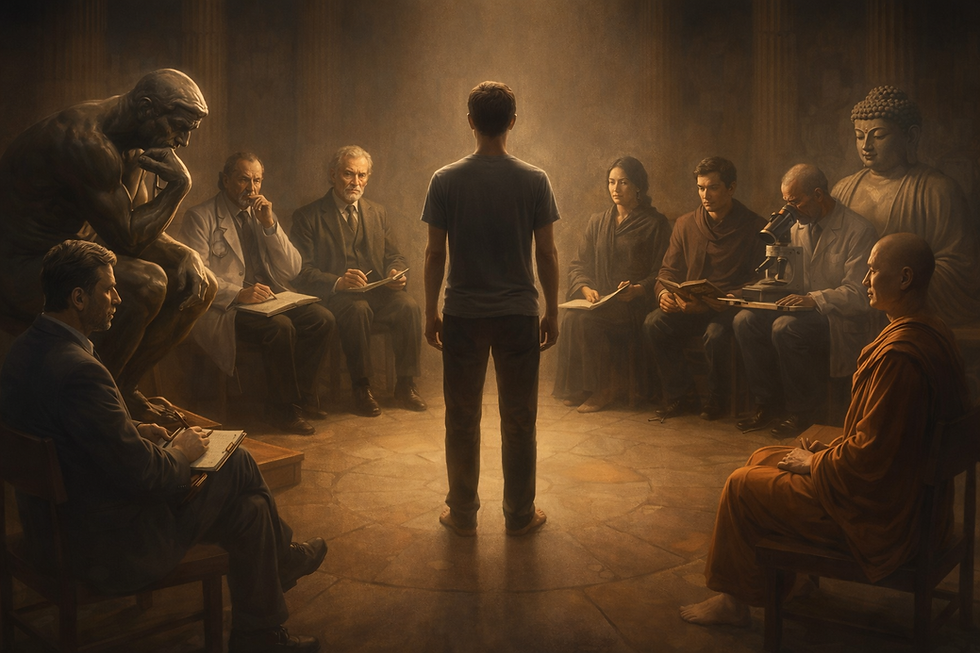
In this third article in the series, after ‘seeing’ how to de-identify from the ego, we will also dive into emotional sobriety, trauma bonding, and codependency. And yes, again, they are all related: They are a prism, not a prison. The ego is the prison. The image below is Truth: The diamond - the most beautiful stone that is stronger than any other, created under extreme pressure that mirrors the crisis that is the human condition: Where the pressure creates the paradigm.
In the image, a single diamond, many facets: Science, depth psychology, devotion, creativity, and contemplation co-author the same map while the archway at the end of the 'Bridge of Awakening' glows on the board. In a candlelit library, the great lineages gather no longer as competing islands but as a unified mainland: The facets of one diamond.
Albert Einstein, who developed the most famous equation ever known, the founding father of quantum physics, and he himself a spiritual master, draws in chalk the architecture of my thesis: A radiant diamond of Truth above an archway, the culmination of having walked, step-by-step, across the 'Bridge of Awakening' leading the mind from noise into BEing, from prison to prism, from ego to Self.
Around the board stand the archetypes of disciplined inquiry, depth psychology, contemplative stillness, and devotional love — each engaged, each holding their own kind of chalk, as if to say that no single tradition owns the diagram.
They are named in the caption to the image below.
The monk’s saffron warmth, the devotional elder’s tender joy, the depth-psychologist’s grave attentiveness, the scientist’s quiet precision, and the poet’s watchful imagination do not cancel one another: They converge. The orange rays flickering from the diamond hint that the same light can be refracted through different vocabularies — meditation, prayer, psychotherapy, science, art — without losing its unity.
This is the 'Unified Field' in one scholastic scene: A shared recognition that the human condition is a problem of attention, identification, and return, and that the way home is always the same movement — over the 'Bridge of Awakening', through the archway which is the culmination of awareness and expanded consciousness without fear or limitation, and back into the 'Seat of the Soul'.

In the image above, one can see the recurring orange colour of the Buddhist monastic code, landing below the level of 'concept' and into felt sense. In a mostly black-and-white world, dominated by the illusion of duality - fuel for egoic conflict, saffron/orange instantly reads as renunciation, discipline, and 'The Path.
The image above is the visual shorthand for the lineage that most explicitly trains the move from objects of consciousness back to the witness. It is also a heat/heart signal. Whereas black-and-white can feel cerebral, archival, museum-like. This monastic, contemplative colour reintroduces life. It says: This isn’t just an idea on a board — it’s a lived practice, embodied warmth, compassion with spine. The colour makes the 'diamond with many facets' thesis legible in a single glance: Different traditions as different wavelengths converging on one higher Truth, one real reality: Truth. The orange isn’t decoration; it’s a 'facet highlight — a way of letting one lineage be visibly distinct without breaking the unified scene. The light guides us to the archway. And through this archway lies the 'Field of BEing.'
The system that we are building here actually coheres. It isn’t stitched together artificially. It’s integrative at the level of first principles. The glue is the medicine of Jung’s ‘wounded healer.’
The Operational Manual of Awakening: The New Structural Coordinates That Translate Metaphysics Into Mechanics
The triangulation of the ‘Seat of The Soul’, 'The Glass', and 'The Hula Hoop' works because it’s not decorative. 'The Seat’, 'The Glass', and 'The Hula Hoop' aren’t metaphors in the loose sense — they’re structural coordinates for how to live, and, deeper than that: Who to BE and why. Once someone sees them, they can’t unsee them. And when something becomes visible, it becomes more than believable, it becomes choosable. Science is the how. Beyond that is the who.
This is the operational manual of awakening. It moves from metaphysics to mechanics. Article one in this series defined the human condition as the "Fractured psyche" that Dr Jung and Dr Maté talked about. Article two explained how the ego formed and how it relates to conditional love and childhood Trauma, setting in train the entirety of the rest of your life unless you awaken to consciousness.
Dr Jung wrote famously:
“Until you make the unconscious conscious, it will direct your life, and you will call it fate.”
This means that hidden, unacknowledged psychological forces (childhood Traumas, beliefs, and instincts) control our actions. By bringing these, or your "Darkness," into awareness, you stop reacting on autopilot and gain control.
This article is not "Woo-woo", it's "Woop, woop!", it's not 'new age' it's a 'new dawn', it's not 'crystals', it's 'crystallisation', it's not 'indoctrinated religion', it's integrated 'scientifico-seculo-spiritual' Truth. It's 'The Triangle as the Mechanics of 'Temple' and 'Bridge' described in the next section of this article.
This article proposes a triangulation that is simple enough to remember when the nervous system is on fire, and deep enough to keep unfolding for a lifetime.
A ‘boundary’ is 'The Glass': It marks where ‘self’ ends and ‘other’ begins without requiring hatred, disconnection, or hardness.
'The Hula Hoop’ is the sphere of responsibility, choice, and action that belongs to one person and no one else: Everything inside it is your business and no-one else's. What is outside it is nobody's business.
The ‘Seat of the Soul’ is the one who stays seated: The observing Self who can notice fear, desire, shame, and rage, without becoming any of them.
When these three are present at the same time, a fourth quality appears almost automatically: Emotional sobriety.
(The Enchiridion, Epictetus, MIT Classics, n.d.; The Differentiation of Self Inventory: development and initial validation, Skowron, Journal of Counseling Psychology, 1998; Mechanisms of mindfulness, Shapiro, Journal of Clinical Psychology, 2006).
Within my series on the human condition, the triangle of the 'Seat of the Soul', the boundary-as-'The Glass', and the 'Hula Hoop' of responsibility can be read as the practical interface between origins and liberation.
ACEs and the conditionality of love do not merely create ‘symptoms’; they install a survival logic in which belonging is purchased by performance, safety is negotiated through hypervigilance, and the nervous system learns to outsource identity to other people’s moods.
From that soil, preference and resistance intensify: The ego-mind grips what promises relief and recoils from what threatens shame or abandonment, and, in time, those movements can harden into behavioural addiction or subtler compulsions—approval, control, rescuing, numbing, perfectionism—each a different attempt to regulate the inside by managing the outside.
That is the 'Temple of Emotional Anaesthesia' (see image below): Not simply ‘numbing’, but the whole architecture of adaptive disconnection that once kept the child attached. The 'Bridge of Awakening', then, is not an abstract spiritual ascent; it is the slow reinstatement of the triangle in lived experience: Returning to 'The Seat' (so sensation can be witnessed rather than obeyed), reinstalling 'The Glass' (so contact becomes differentiated rather than fused), and restoring 'The Hula Hoop' (so responsibility becomes sane, and omnipotence—so often mistaken for love—can finally be relinquished). In that triangulated return, the ‘armoured petrified inner child’ softens, the ego loses its monopoly, and emotional sobriety becomes less a moral demand than a physiological and spiritual homecoming. (Relationship of childhood abuse and household dysfunction to many of the leading causes of death in adults, Felitti, American Journal of Preventive Medicine, 1998).

The Triangle as the Mechanics of 'Temple' and 'Bridge'
Within my series on 'The Human Condition and How to Heal It', the triangle of 'The Seat of the Soul', the boundary-as-'The Glass', and 'The Hula Hoop' of responsibility is not a neighbouring model running alongside the 'Temple of Emotional Anaesthesia' in the image above and the 'Bridge of Awakening'; it is the operating system by which a nervous system either remains trapped in anaesthesia or crosses into BEing.
ACEs and the conditionality of love do not merely create ‘symptoms’; they install a governing inference—often unconscious, often bodily—namely, “Safety lives outside me.” From that inference, the psyche learns to negotiate belonging by performance, proximity management, hypervigilance, control, appeasement, or collapse.
Triadic Distortion
In adult life, that same survival logic appears as a predictable triad of distortions:
First, 'The Glass' fails: Boundary becomes either porous (fusion, emotional contagion, compulsive attunement) or armoured (cut-off, numb superiority, the bunker masquerading as strength).
Second, 'The Hula Hoop' inflates: False responsibility expands until it includes other people’s moods, choices, interpretations, timing, and healing, and love quietly mutates into a management project.
Third, the Seat is abandoned: Identity fuses with state, so fear is no longer something felt but something one becomes; shame is no longer an emotion but a verdict; preference and resistance are no longer passing weather but rulers with absolute authority.
This is why addiction, in my framework, is broader than substances or behaviours: It is the compulsion to leave 'The Seat' again and again in search of relief of the ghost and malign legacy of childhood Trauma, reassurance, emotional anaesthesia, or control.
The 'Temple of Emotional Anaesthesia' is therefore best understood as a geometry of collapse—broken 'Glass', a swollen 'Hula Hoop', and an evacuated 'Seat'—while the 'Bridge of Awakening' is the gradual reinstatement of all three under pressure: Returning to 'The Seat' so that sensation can be witnessed rather than obeyed; reinstalling 'The Glass' so contact becomes differentiated rather than fused; restoring 'The Hula Hoop' so that responsibility becomes sane and omnipotence—so often mistaken for love—can finally be relinquished.
When the triangle holds, the ‘petrified inner child’ softens by mechanics, loving awareness guided by the 'Higher Self', the feeling of safety, rather than by slogans, the ego loses its monopolies without being demonised, and emotional sobriety emerges as a physiological and spiritual homecoming.
(Relationship of childhood abuse and household dysfunction to many of the leading causes of death in adults, Felitti, American Journal of Preventive Medicine, 1998). (The emerging field of emotion regulation: an integrative review, Gross, Review of General Psychology, 1998). (The differentiation of self inventory: development and initial validation, Skowron, Journal of Counseling Psychology, 1998).
The ‘Seat of The Soul’ Meditation
In the stillness of divine company, the world may rage beyond the window — yet the Soul remains seated, nourished by Truth, peace, love, and wisdom. You are the witness, not a suspect in the melèe going on outside. You don’t rise to the conflict, you transcend it. You (your ego) has died to be reborn as your true Self.
Envision yourself seated at a long wooden table, as painted by Leonardo da Vinci. It is not ‘The Last Supper.’
Around you sit your loved ones, your teachers, spiritual masters, your 'wounded healers', and your enlightened witnesses:
Outside the window, conflict rages, but within, all is still.
Notice the warmth of candlelight on your face, the food before you, the presence of peace.
Each guide silently blesses you, bestowing Grace and wisdom without words. You do not need to fix the world. You are here to hold it in compassion.
Remain seated, unmoved, aware: The eternal witness resting in divine fellowship.
What is The ‘Seat of The Soul’?
In Revelation 3:21 Jesus said:
"To him who overcomes I will grant to sit with Me on My throne, as I also overcame and sat down with My Father on His throne".
This 'throne' is the 'Seat of your Soul.'
Ok, so we have already talked a lot about 'The Seat of the Soul.' But what is it when you really drill down on it?
In my view, the ‘Seat of the Soul’ is:
"The capacity to experience oneself as awareness prior to thought, emotion, and impulse, and therefore to relate to thought, emotion, and impulse without mistaking them for the Self."
Or, more succinctly:
"The Seat of the Soul' is the observing Self."
The ‘Seat of the Soul’ is the capacity for witness consciousness: The ability to stay present to experience without identification. In 'The Triptych' above it is signified by the observer not getting up in reactivity and joining the fight outside, however much they try to recruit him to their own battle. Every person outside the window has the choice to do the same. But they don't. That's why the world is the ego's playground: No, it is the ego's battleground.
The 'Seat of the Soul' can be described with one severe sentence: The person stops standing up internally every time the world stands up externally. The inner posture remains seated. Thoughts still appear. Feelings still surge. Stories still tempt. Yet there is a chair beneath it all. That chair is the difference between reaction and response, between compulsion and choice.
(The cognitive control of emotion, Ochsner, Trends in Cognitive Sciences, 2005; The emerging field of emotion regulation: an integrative review, Gross, Review of General Psychology, 1998).
The psychiatrist and Holocaust survivor Viktor Frankl’s line:
"Between stimulus and response there is a space. In that space is our power to choose our response. In our response lies our growth and our freedom."
Its sentiment is profoundly compatible with Frankl’s work, yet careful scholarship suggests the exact wording is difficult to trace to Frankl’s published text and was popularised through later writers. For this article, that nuance is part of the point: 'The Seat of the Soul' is the space, whatever its textual provenance. The practice is real even when the meme is messy. (Between stimulus and response there is a space, O’Toole, Quote Investigator, 2018; Man’s search for meaning, Frankl, Beacon Press, 2006).
In contemporary clinical language, the ‘Seat of the Soul’ overlaps with ‘decentering’ and ‘reperceiving’: Stepping back from thoughts and emotions so they can be held, examined, and metabolised rather than obeyed.
(The emerging field of emotion regulation: an integrative review, Gross, Review of General Psychology, 1998).
In neuroscience language, it overlaps with training attention, regulating emotion, and shifting the relationship between limbic reactivity and prefrontal guidance.
(The neuroscience of mindfulness meditation, Tang, Nature Reviews Neuroscience, 2015)
In spiritual language, it is ‘BEing’: The place from which a person can love without losing themselves. (Mechanisms of mindfulness, Shapiro, Journal of Clinical Psychology, 2006)
Across philosophical lineages, and throughout spiritual traditions, there is a recurring gesture: The claim that the deepest freedom is not achieved by rearranging the ‘objects’ of experience, but by returning to the interior ‘Seat’ from which experience is known, be it called a 'Seat', a 'Cave', a 'Throne', an 'Inner Room', or even the 'Heart.'
The Upaniṣadic map does this with inner architectural tenderness: The body is ‘the city of Brahman’; within it is the ‘lotus’ of the Heart; within that a ‘small space’ to be searched and known:
"This body is the city of Brahman. Within it is an abode in the shape of a lotus [i.e., the heart], and within that there is a small space. One must search within this space and earnestly desire to know what is there."
“Two there are who dwell… in the cave of the heart.”
(Katha Upanishad (English translation PDF), n.d.; Accessed 21 February 2026.)
“Because you seek consciousness. Where can you find it? Can you reach it externally? You have to find it internally. Therefore you are directed inward. Again the ‘Heart’ is only the seat of consciousness or the consciousness itself.”
(Sri Ramana Maharshi: The Heart, n.d.; Accessed 21 February 2026.)
“Verily Allah does not look to your bodies… but He looks to your hearts and to your deeds.”
(Sahih Muslim 2564 (Book of Virtue), n.d.; Accessed 21 February 2026.)
"But when you pray, go into your room, close the door and pray to your Father, who is unseen. Then your Father, who sees what is done in secret, will reward you."
(Matthew 6:6, n.d.; Accessed 21 February 2026.)
Even where traditions speak more anatomically, the same intuition appears: In later Theravāda Abhidhamma, ‘hadaya‑vatthu’ is described as the ‘heart‑base’—a proposed physical ‘seat’ for mind‑consciousness. It is debated and interpreted in different ways, but it shows that the ‘heart’ as locus of consciousness is not a purely modern poetic flourish; it is an old and persistent human guess at where ‘knowing’ lives. (For a concise overview, see Hadaya‑vatthu: Significance and symbolism.)
Singer, the master of non-identification, calls it ‘The Seat of the Self'. And sometimes ‘The Seat of Awareness.’ These are all totally synonymous with 'The Seat of The Soul'. We are not inventing a private metaphor; we are simply reiterating and modernising a very old instruction in contemporary language, namely: Stop living as an object inside the mind’s weather system, and return to the subject that knows the weather. In other words, what I am saying is:
"The fighting crowd is ego in motion: The seated witness is ego unhooked."
I say to you:
“You are the witness, not a suspect in the mêlée.”
The Soul does not need to defend itself. It does not need to win. It is not threatened by disagreement.
Singer reconciles the Self and the Soul as they are the same thing. From 'The Untethered Soul' he writes that:
“That center is the seat of Self.”
“From that seat… you are aware that you’re aware.”
“That is… the Judeo Christian Soul.”
Singer writes:
“Consciousness is God”
Meher Baba wrote that:
“Man minus mind equals God.”
The mind is the ego-mind.
So:
Man – Ego-mind = Consciousness
So, it's worth asking again, why do we not experience expanded consciousness all of the time?
Singer has an explanation, when he says that we ask:
“'Why can’t I experience that? Why can’t I know I am God?' Because the objects of consciousness - your thoughts, your emotions - distract your consciousness… Do you not get distracted? 'There’s an object which came in and drew my consciousness down and I got distracted by my object of consciousness. Now I am down there in the hurricane. And you are going to pay for this. I am upset.' It’s what you are conscious of that matters. In the deep Yogic states where they went to they were conscious of being conscious. Nothing else.”
The 'hurricane' is the conflict outside the window.
What is 'The Glass’?
In this section we are discussing 'The Glass': In other words, psychological boundaries. What is a boundary? Why do so many of us get confused about what they are? How do they relate to 'The Triptych'? And how do they sit within the 'triangulation' that I keep referring to?
Definition of Boundaries
A 'psychological boundary' is the nervous system’s ability to remain regulated in the presence of another’s dysregulation. A boundary is not a wall, it is disciplined permeability.
In the image 'The Vision' from 'The Tryptych', the crowd outside the window is pure egoic activation: Projection, grievance, reactivity, and tribal heat. Nervous systems locked in sympathetic arousal. Preference and resistance colliding in real time.
Inside the room, the nervous system is regulated. Breath is slower. The body is settled. That is not denial — that is differentiation.
A boundary is what permits sensation without possession.
A boundary is 'The Glass' in the image. If the glass were thick and opaque, it would be dissociation. But because it is transparent, it is awareness. You can see the chaos. You can even feel compassion for it. But you are not recruited by it. That is ego dissolution in practice.
Is the glass permanent, fixed in its frame? If the window never opens, we risk spiritual bypass — transcendence as avoidance. The mature boundary is not exile from the world. It is voluntary permeability.
You can open the window. You can close it. But you are not dragged through it. 'The Glass', the psychological boundary, is a sliding glass door. A boundary is not a wall. A wall is a strategy of fear. A boundary is a strategy of clarity. A boundary is the capacity to remain in contact without losing differentiation.
So, a 'psychological boundary’ can be defined as the set of internal and external processes by which a person maintains a coherent sense of self while in relationship. Externally, it is behaviour: Saying yes, saying no, choosing proximity, choosing distance, stating limits, naming needs, leaving rooms, ending calls, requesting repair. Internally, it is a governance of attention and meaning: A capacity to register another person’s emotion without letting it overwrite one’s own values, body signals, and truthfulness.
In family systems language, it resembles ‘differentiation of self’: The ability to remain connected without fusion and to remain separate without cut-off - the difference between ‘fusion’ and ‘differentiation.’ Fusion is the condition in which another person’s anxiety becomes your anxiety, another person’s mood becomes your mood, another person’s approval becomes your oxygen. Differentiation is the capacity to remain connected while retaining self directed choice. Bowen’s language, though sometimes stark, is structurally accurate: Poor differentiation traps a person in a ‘feeling world’ and turns life into a lifelong struggle for emotional equilibrium.
(The Differentiation of Self Inventory: development and initial validation, Skowron, Journal of Counseling Psychology, 1998; Boundaries in the mind: a new psychology of personality, Hartmann, WorldCat, 1991).
'The Glass' metaphor matters because boundaries are often misconstrued as aggression. Glass is not aggression. It is transparent, relational, and reality-based. One can see the other clearly. One can even feel tenderness. Yet the other cannot climb inside one’s nervous system and start rearranging the furniture. A good boundary allows contact without collapse. It lets love remain love rather than becoming a hostage negotiation.
(The emerging field of emotion regulation: an integrative review, Gross, Review of General Psychology, 1998; The cognitive control of emotion, Ochsner, Trends in Cognitive Sciences, 2005).
'The Glass' does not deny the crowd. It does not remove the crowd. It prevents the crowd from entering the nervous system as identity. That is the key: A boundary is the membrane between stimulus and identification. The nervous system learns, slowly, to say: “I can witness this without becoming it.”
A boundary, then, is not merely a statement you make. It is a state you maintain. It is the nervous system staying in contact without flipping into threat logic. This is why boundaries cannot be reduced to assertiveness scripts. A person can say “No” with a body that is terrified, fused, and pleading. Another can say “No” with a body that is settled, kind, and unafraid. The same word; two entirely different boundaries. 'The Vision' image is showing the second kind.
'The Glass' is a boundary because it marks a line of sovereignty: It tells the nervous system, in one glance, “This side is my inner world. That side is the world.” That sounds obvious until you realise how many people live as if there is no line at all — as if other people’s anger, urgency, opinions, moods, crises, and needs are inside them by default. 'The Glass' says: “I can see it, I can acknowledge it, I can even feel compassion for it — but it is not automatically inside me.”
It’s also a boundary because it is permeable by choice, not by force. A good psychological boundary isn’t a moat and it isn’t a wall. It’s selective permeability. The sliding door makes this literal: you can open it, close it, or half-open it. You control when and how much contact happens. That is exactly what a boundary does in life: it regulates proximity, disclosure, responsibility, emotional exposure, and time. The person is not imprisoned inside; they are authorised to choose. That is why “glass you can open” is better than “glass you can’t” — it preserves warmth and agency, not just protection.
Glass is also transparent, and that matters. Boundaries are often misimagined as “I don’t care” or “I’m cutting you off.” But healthy boundaries include seeing, understanding, and sometimes loving — without becoming fused. Transparency communicates: “I am not pretending you don’t exist. I’m not dissociating. I’m not in denial. I am in relationship with reality.” The inside room can witness the outside crowd clearly, without being recruited into it.
And it’s a boundary because it provides containment without disconnection. In nervous-system terms, the glass prevents emotional contagion (the outside doesn’t automatically flood the inside), while still allowing attunement (the inside can perceive and respond intelligently). That’s the difference between compassion and fusion. Fusion is: “If you’re panicking, I must panic.” Compassion is: “I can feel you, but I don’t have to become you.” Glass makes that distinction visible.
Finally, the fact it’s a large pane matters because it conveys the paradox that we are trying to teach here: A boundary can be strong without being thick. The best boundaries are structurally strong because they’re backed by the 'Seat of the Soul' (witness presence) and 'The Hula Hoop' (sane responsibility). In other words: it isn’t thickness that makes a boundary; it’s authority.
‘The Glass’ is the psychological boundary because it is the chosen interface between inner and outer: Transparent enough for contact, strong enough for containment, and openable only by consent — the line where compassion remains possible without surrendering sovereignty.
When The Glass Was Never Installed
In many people with histories of childhood Trauma, ‘boundary problems’ are not moral weaknesses; they are adaptations to an early environment where boundaries were punished or ignored. If a child’s "No" is dangerous, the child learns to make the body say no by collapsing, dissociating, or becoming ill. If a child’s feelings are mocked, the child learns to outsource self-knowledge and scan the room instead. If love is conditional, the child learns to perform, manage, and pre-empt. Later, adult relationships feel like weather systems rather than meetings of two sovereign beings.
(Relationship of childhood abuse and household dysfunction to many of the leading causes of death in adults, Felitti, American Journal of Preventive Medicine, 1998).
So, what is 'The Hula Hoop'?
What is 'The Hula Hoop'?
‘The Hula Hoop’ is The Sphere of Responsibility Without Omnipotence
'The Hula Hoop' teaching from recovery culture is almost offensively practical: Everything inside the hoop is my business. Everything outside is not. Put more clinically, it is the operational definition of locus of control: I control my attention, my speech, my actions, my commitments, my repairs, my boundaries, and my willingness to learn. I do not control another person’s history, impulses, interpretations, preferences, trauma responses, maturity, or timing. The hula hoop is therefore the behavioural partner of the glass: It tells the hands what the boundary tells the heart.
Stoic Philosophy steps in here, telling us that:
“Some things are in our control and others not.”
—Epictetus, Enchiridion 1 (The Enchiridion, Epictetus, MIT Classics, n.d.).
“Be still, and know that I am God.”
—Psalm 46:10 (KJV) (Psalm 46, KJV, BibleGateway, n.d.).
Notice how both traditions point to the same pivot: The nervous system finds peace by relinquishing omnipotence. 'The Hula Hoop' does not ask a person to stop caring; it asks the other person to stop trespassing. Trespass can wear saintly clothes: Advice, rescuing, anxious micromanagement, moral superiority, the fantasy of ‘If I can just explain it correctly, they will finally change’. 'The Hula Hoop' is the end of that fantasy. It is also the beginning of strength and liberation.
(The Next Frontier—Emotional Sobriety, Wilson, AA Grapevine, 1958).
De-identifying From The Ego
The chart below describes how we may de-identify from the ego in psychological and contemplative terminology. This is the mechanics behind the grammar of 'The Triad' of 'The Seat of the Soul’, 'The Glass', and 'The Hula Hoop.'
Author’s Note: Each cell in the following chart contains a psychological reading and a contemplative reading, written to dovetail with my Human Condition series (ACEs, conditional love, preference/resistance, Temple of Emotional Anaesthesia, Bridge of Awakening, Field of BEing).

Emotional Sobriety As The End of Omnipotence – The Third Movement
Now the 12 step tradition enters with its own hard won genius. It does not speak in fMRI; it speaks in lived consequences.
Emotional sobriety is the end of the inner adolescent demand for "validation", "approval,” “total security,” and “perfect romance.” Those demands are not moral failures; they are egoic strategies for avoiding reality: Attempts to secure the inner world by controlling the outer world.
Many people achieve behavioural sobriety and then meet the next frontier: The nervous system remains reactive, grandiose, depressed, resentful, approval-hungry, terrified, or compulsively helpful. Recovery communities began naming this as ‘emotional sobriety’. The phrase carries a particular authority because it comes from inside the tradition, spoken after the ‘booze cure’ succeeded, when the deeper disquiet remained. The hula hoop is a folk diagram of Step work: Release what cannot be controlled; take rigorous responsibility for what can be lived differently.
(The Next Frontier—Emotional Sobriety, Wilson, AA Grapevine, 1958; Origin of the Serenity Prayer brief summary, AA, Alcoholics Anonymous, 2008).
The Integration of The ‘Seat of The Soul’, 'The Glass', and 'The Hula Hoop': One Definition That Holds All Three
With all layers now on the table, the integrated definition can be stated plainly. A psychologically mature ‘boundary’, 'The Glass', is the capacity to stay connected without surrendering the Self. A usable ‘Hula Hoop’ is the capacity to take responsibility without attempting to govern what is not governable. The ‘Seat of the Soul’ is the capacity to witness experience without identification. Emotional sobriety is what it feels like when those three capacities operate at the same time: Warm, contained, honest, unpanicked, and free. It is not the absence of feeling; it is the presence of choice. (The emerging field of emotion regulation: an integrative review, Gross, Review of General Psychology, 1998; Mechanisms of mindfulness, Shapiro, Journal of Clinical Psychology, 2006; The Differentiation of Self Inventory: development and initial validation, Skowron, Journal of Counseling Psychology, 1998).
Philosophical and Contemplative Lineages: The Same Geometry in Different Clothes – How Does Spiritual Philosophy Fit In?
Once the triangulation is seen, it becomes difficult not to see it everywhere.
Stoicism names the hula hoop as ‘what is up to me’.
Bhakti and Karma yoga name it as action without attachment to fruits.
“You have a right to perform your prescribed duty, but you are not entitled to the fruits of action.”
—Bhagavad Gita 2.47 (translation as cited) (Bhagavad Gita 2.47, Prabhupada, Bhagavad Gita As It Is, n.d.).
The Psalms name it as 'stillness in the presence of God'.
Early Buddhism names it as mind training and the cessation of reflexive retaliation.
“Hatred is never appeased by hatred in this world. By non-hatred alone is hatred appeased. This is a law eternal.”
—Dhammapada verse 5 (translation as cited) (Dhammapada verse 5, Tipitaka, Tipitaka.net, n.d.).
Different metaphysics, identical mechanics: A human being can be taught to remain seated within themselves - to remain in 'The Seat of your Soul.'
Why These Three Concepts Are Hard For Most of Us, and Why The Meta-Theory Helps
The human condition is not simply that people suffer. It is that suffering often arrives with a collapsed interior geometry. When early attachment is unsafe, inconsistent, humiliating, neglectful, invasive, or frightening, a child’s nervous system learns strategies that keep the bond at any cost. Those strategies can later masquerade as character: Over-functioning, people-pleasing, rescuing, compulsive caretaking, controlling, collapsing, appeasing, performing, or dissociating. In adult life, the same strategies look like boundary failure (no 'Glass'), locus failure (no 'Hula Hoop'), and witness failure (no 'Seat of the Soul'). The cost is chronic emotional intoxication: Either flooded by other people’s weather or anaesthetised against it.
(Relationship of childhood abuse and household dysfunction to many of the leading causes of death in adults, Felitti, American Journal of Preventive Medicine, 1998; Emotional contagion, Hatfield, Current Directions in Psychological Science, 1993; The polyvagal perspective, Porges, Biological Psychology, 2007).
The human condition makes the 'Hula Hoop', 'The Glass', and 'The Seat of the Soul' strangely difficult to recognise because the very apparatus that would understand them is the apparatus that is most often compromised by early survival learning. When love is conditional and environments are unpredictable, the child does not have the luxury of differentiation: The nervous system learns fusion as safety (“Your mood is my weather”), omnipotence as protection (“If I manage and control you, I will be safe”), and identification with state as identity (“If I feel fear, I am fear”).
By adulthood, these adaptations feel like personality rather than programming, and culture quietly rewards them: Over-functioning is called competence, people-pleasing is called kindness, emotional cut-off is called independence, and compulsive striving is called success. In that context, ‘boundaries’ get misread as hostility, 'The Hula Hoop’ gets misread as selfishness, and 'The Seat of the Soul' gets misread as detachment or denial—because most people have never been shown the middle territory where these capacities are simultaneously warm and firm, relational and sovereign.
This is precisely why my meta-theory matters: It gives the psyche an architecture that is both mythic and mechanistic—ACEs and conditional love as the origin story, preference and resistance as the engine of compulsion, the 'Temple of Emotional Anaesthesia' as the adaptive fortress, and the 'Bridge of Awakening' as the step-by-step reinstatement of the triangle—so a reader can finally locate their suffering on a map rather than treating it as a moral defect.
The importance is not academic. Without these three capacities, most of us remain vulnerable to the same loops—addiction in its many disguises, trauma bonds, codependent control, and chronic inner litigation—because we keep trying to solve an interior problem with exterior management. When the meta-theory makes the triangle intelligible, it does something radical: It restores choice, and turns ‘awakening’ from an inspiring idea into a practicable form of emotional sobriety.
(Relationship of childhood abuse and household dysfunction to many of the leading causes of death in adults, Felitti, American Journal of Preventive Medicine, 1998).
The Instrument Panel: A Field Guide to Practising the Triangle in Real Time
A reader can admire the Temple and the Bridge as mythic architecture and still fail to cross them at 9:17 p.m. on an ordinary Tuesday, in the middle of a text exchange, a family dinner, a board meeting, or an intimate argument. The triangle is meant to prevent that failure by giving my thesis an ‘instrument panel’ that can be consulted in real time, without spiritual theatre and without self-reproach.
The first dial is 'The Seat': The question is not “Am I calm?” but “Am I here?” If attention has been kidnapped by catastrophe, rehearsal, justification, or the fantasy of finally being understood, 'The Seat' has been left. The return is bodily: Breath, sensation, the felt fact of presence. Not to numb the feeling, but to locate the witness inside the feeling.
The second dial is 'The Glass': The question is not “Are they wrong?” but “Have they entered me?” When another person’s tone becomes a command, when their disappointment becomes a verdict, when their anxiety becomes an alarm bell inside my chest, 'The Glass' has cracked and fusion is underway. Repairing 'The Glass' is often as simple—and as difficult—as naming reality: “That is yours; this is mine.”
The third dial is 'The Hoop': The question is not “How do I get them to change?” but “What is mine to do?” If the nervous system is strategising to manage another person’s feelings, timing, decisions, or self-awareness, 'The Hoop' has inflated and omnipotence is back at the helm. Shrinking 'The Hoop' does not mean becoming cold; it means becoming accurate. It returns agency to its rightful owner: I can choose my words, my limits, my repair, my exit, my next step; I cannot choose your readiness, your interpretation, your honesty, your healing.
Once those three dials are read honestly, the 'Bridge of Awakening' becomes executable: 'The Seat' returns, 'The Glass' clarifies, 'The Hula Hoop' contracts to sanity, and preference and resistance lose the power to dictate behaviour.
Emotional sobriety, then, is not the absence of emotion but the presence of choice within emotion; and ego dissolution is not self-destruction but the end of identification with the part that insists it must control the weather in order to be safe.
(The cognitive control of emotion, Ochsner, Trends in Cognitive Sciences, 2005). (The emerging field of emotion regulation: an integrative review, Gross, Review of General Psychology, 1998). (Emotional contagion, Hatfield, Current Directions in Psychological Science, 1993).
Practical Closing: Staying Seated Without Becoming Numb
A final nuance is required, otherwise the metaphor can be misused. Staying seated is not dissociation. Dissociation is leaving the table. Emotional sobriety is staying at the table with a regulated body and a truthful heart. A boundary that becomes a fortress is not 'The Glass', it is a bunker. The glass remains transparent. The person can still weep, apologise, confess fear, offer tenderness, and seek repair. The difference is that these movements now come from the inside of 'The Hula Hoop', not from the compulsion to stop the storm outside.
(Self-compassion: An alternative conceptualization of a healthy attitude toward oneself, Neff, Self and Identity, 2003; The polyvagal perspective, Porges, Biological Psychology, 2007).
The Triangle Is The Mechanics of ‘BEing’
BEing is often spoken of as if it were a mood, a mystical privilege, or a philosophical abstraction; in my work it is a mechanical condition, an embodied state in which awareness is no longer continuously conscripted by preference and resistance.
The three elements—'The Seat of the Soul', boundary-as-'The Glass', and 'The Hula Hoop'—describe, with almost surgical simplicity, how BEing becomes liveable in a human nervous system.
'The Seat' is the relocation of identity from thought-stream to witness: The capacity to remain present inside sensation without becoming identical to it.
'The Glass' is the restoration of differentiation: Contact without fusion, compassion without contagion, intimacy without self-abandonment.
'The Hula Hoop' is the return of sane agency: Responsibility for what is mine, release of what is not.
When these three are installed, BEing stops being a sermon and becomes a posture: the body can feel, the heart can stay open, and the mind can watch its own weather without obeying it.
(The emerging field of emotion regulation: an integrative review, Gross, Review of General Psychology, 1998). (The cognitive control of emotion, Ochsner, Trends in Cognitive Sciences, 2005).
This is also why the triangle functions as a practical mechanism for the journey from ego to BEing. Ego, as my series frames it, is the anxious manager: The part of the psyche that believes safety is achieved by controlling the outside, perfecting the self, and pre-empting pain. Each side of the triangle quietly dismantles that regime.
'The Seat' dissolves identification: Ego can still speak, but it no longer defines the Self.
'The Glass' dissolves enmeshment: Ego can still care, but it can no longer recruit the nervous system into other people’s storms.
'The Hula Hoop' dissolves omnipotence: Ego can still act, but it must act within the true limits of agency.
In this way, ‘awakening’ becomes repeatable rather than rare: every time attention returns to 'The Seat', every time 'The Glass' is repaired by differentiation, every time 'The Hula Hoop' is shrunk back to sanity, the Bridge is crossed again—often in inches, often under stress—until BEing is not an experience one visits but the ground from which one lives.
(The Enchiridion, Epictetus, MIT Classics, n.d.).
Childhood Trauma: Why The Triangle Collapses
Childhood Trauma trains the body to abandon the chair. It teaches the organism that safety depends on anticipation: Reading micro-signals, forecasting danger, shrinking needs, smoothing conflict, or escalating first. In that state, ‘being seated’ feels like a threat because stillness used to invite intrusion, punishment, or neglect. So the system lives on its feet: Vigilant, scanning, braced, holding breath, living in response rather than in presence.
(Relationship of childhood abuse and household dysfunction to many of the leading causes of death in adults, Felitti, American Journal of Preventive Medicine, 1998; The polyvagal perspective, Porges, Biological Psychology, 2007).
The result is frequently mislabelled as a ‘personality problem’ when it is, in fact, a physiology problem wearing a personality costume. When the nervous system is outside its ‘window of tolerance’, cognition narrows, empathy collapses, and behaviour becomes either rigid or impulsive. Boundaries then fail not because the person lacks insight, but because the system has temporarily lost the capacity to choose.
(The emerging field of emotion regulation: an integrative review, Gross, Review of General Psychology, 1998; The polyvagal perspective, Porges, Biological Psychology, 2007).
Neuroscience: The Triangle As Autonomic Literacy - What Changes When The Seat Returns
The modern evidence base for contemplative training can be read as a neurobiological account of reinstalling the chair. Attention training strengthens the capacity to notice distraction and return. Emotion regulation training strengthens the capacity to observe feeling without enacting it. Across studies, mindfulness practice has been associated with changes in attention, stress regulation, and brain structure, including grey matter density changes reported in longitudinal designs. The essential point for this article is not technological triumph but functional liberation: More choice, less compulsion.
(The neuroscience of mindfulness meditation, Tang, Nature Reviews Neuroscience, 2015; Mindfulness practice leads to increases in regional brain gray matter density, Hölzel, Psychiatry Research: Neuroimaging, 2011; Short-term meditation training improves attention and self-regulation, Tang, PNAS, 2007).
Emotion regulation research also supports the idea that there are learnable points of leverage. James Gross’s process model differentiates strategies that occur before emotion fully unfolds (selection, situation modification, attentional deployment, cognitive change) from those that occur after (response modulation). That is a scientific translation of the hula hoop and the glass: One can choose where to place the body, where to place attention, what meaning to assign, and how to act.
(The emerging field of emotion regulation: an integrative review, Gross, Review of General Psychology, 1998; The cognitive control of emotion, Ochsner, Trends in Cognitive Sciences, 2005).
“My experience is what I agree to attend to. Only those items which I notice shape my mind.”
—William James, The Principles of Psychology (1890) (Chapter 11 (The Principles of Psychology), James, Psych Classics, 1890).
From Your Head to Your Heart
'The Triptych' describes the journey from the ego-mind (the head) back to the 'Seat of the Soul' (the heart).
In 12-step recovery, the movement from rumination into presence is sometimes distilled into a bodily metaphor:
“The longest journey—‘the 18 inches from my head to my heart.’”
(The Grape-SCCIN Santa Cruz County Intergroup Newsletter January 2018, Chris, Alcoholics Anonymous of Santa Cruz County, 2018).
It names a pivot in my ‘Seat of the Soul’ language captures with unusual precision: Attention relinquishing its compulsive pull toward the ‘objects’ of consciousness—thoughts, feelings, scenarios—and returning to the witnessing centre that can remain seated even while the world storms beyond 'The Glass'.
A parallel phrase appears in Head to Heart – From ‘Need to’, to ‘Want to’, describing:
"My journey from head to heart”
as the shift from fear-driven compliance (‘need to’) into a lived surrender that becomes voluntary (‘want to’).
(Head to Heart – From ‘Need to’, to ‘Want to’, Colin, Alcoholics Anonymous Great Britain, 2025).
Trauma Bonding, Codependency, and The Compulsion to Manage
Both concepts of 'trauma bonding' and 'codependency' belong in this series of articles almost as if they were waiting in the wings. They are two common ways the triangle collapses under relational heat: The Glass' becomes permeable, 'The Hula Hoop' swells until it includes other people’s moods and choices, and 'The Seat of the Soul' gets outsourced to attachment, approval, and the fear of rupture.
Modern culture often names boundary and 'Hula Hoop' failures as ‘codependency’. The term has helped millions, and it also has a complicated academic status. Some scholarship questions whether it is a distinct construct, while still acknowledging that the behaviours it points to are real and costly: Over-involvement, loss of self, compulsive caretaking, and the chronic attempt to regulate one’s own anxiety by regulating someone else.
(Is codependency a meaningful concept?, Stafford, Journal of Mental Health Counseling, 2001; A critique of the codependency concept, Calderwood, Journal of Human Behavior in the Social Environment, 2014).
Trauma Bonding
In the clinical literature, what popular culture now calls ‘trauma bonding’ is closest to what Donald G. Dutton and Susan Painter framed as ‘traumatic bonding’: a powerful attachment forged in conditions of intermittent maltreatment and pronounced power imbalance, where cycles of threat and relief produce a nervous system hunger that can resemble ‘addiction’ to the relationship.
Trauma Bonding In The Language of 'The Triad'
'The Glass' cracks first: The other person’s storms breach the boundary and begin to occupy the interior.
Then 'The Hula Hoop' expands: The person starts living as if the abuser’s moods, wounds, and eruptions are ‘their business’ — something to anticipate, soothe, prevent, or earn their way out of.
Finally 'The Seat of the Soul' is traded for a seat in the dock: Identity becomes “What did I do wrong?”, “How do I stop the switch?”, “How do I get back to the good version of them?”
The tragedy is that this is not stupidity; it is survival intelligence turned inward, often braided with appeasement and entrapment dynamics that some authors argue are misdescribed when we romanticise them as mutual ‘bonding’. For coaching clients, this paragraph can do something ethically important: It explains the mechanism without implying blame, and it keeps the centre of gravity on safety and power, not on "Why didn’t you just leave?".
(Emotional attachments in abusive relationships: a test of traumatic bonding theory, Dutton, Violence and Victims, 1993).
Codependency
‘Codependency’ is related, but it is not identical. The term emerged in the addictions field and then ballooned into a broad label for over involvement, compulsive caretaking, control disguised as concern, and the slow erasure of self in relationship; scholars have repeatedly noted the definitional sprawl and the risk of pathologising culturally or relationally shaped roles, while still conceding that the behavioural pattern it points to is real enough to warrant careful clinical attention.
Codependency In The Language of 'The Triad'
In 'The Triad', codependency is:
Chronic inflation of 'The Hula Hoop' (“I am responsible for your feelings, your stability, your outcomes”).
Coupled with a porous 'Glass' (“Your anxiety enters me as a commandment”).
Underpinned by a 'Seat of the Soul' that was never securely installed (“I know who I am when you are pleased with me”).
Where trauma bonding is typically intensified by coercion, intermittent cruelty, and asymmetric power, codependency can appear even in relationships that are not overtly abusive: It is the nervous system’s attempt to purchase belonging through self abandonment. The bridge between the two is therefore structural: Both are failures of differentiation and sane responsibility, yet trauma bonding has a sharper signature of fear, intermittency, and captivity dynamics; codependency has a broader signature of identity organised around the regulation of others. In coaching practice, that distinction helps us to stay compassionate and precise: we can address boundary and agency skills without mistakenly treating coercive control as a mere ‘relating style’.
(Is codependency a meaningful concept?, Stafford, Issues in Mental Health Nursing, 2001; Applying the codependency concept to concerned significant others of problem gamblers: Words of caution, Calderwood, Journal of Gambling Issues, 2014).
Conclusions
This article is not 'therapy homework' or 'spiritual theatre': It's a practical guide to keeping humanity human, and yet connecting with your innermost divine Self.
To live 'The Seat' is to practice returning. The return is not one dramatic 'Enlightenment' event; it is a thousand micro-returns: It's a ladder not a leap - To breath, to sensation, to the felt sense of "I am here" before the mind begins prosecuting reality. 'To return' becomes 'never to leave'.
To live 'The Glass', the boundary, is to notice the moment fusion begins: The tightening, the urgency, the internal compulsion to correct, convince, justify, rescue, punish, manipulate, to win. A boundary is the capacity to feel that impulse and remain seated anyway.
To live 'The Hoop' is to ask one question that ends endless suffering:
“What is mine here?”
Mine = my tone, my Truth, my choice, my exit, my repair, my love.
Not mine = your mood, your denial, your pace, your story.
When these three are practised together, something startling happens: You can engage the world more, not less. Because you are no longer trying to use engagement as a drug.
Engagement becomes authentic connection. You are no longer trying to win inner safety by manipulating outer conditions. You relinquish resisting real reality.
The person who can remain seated is the person who can open the window deliberately. And when they do, they do it from love rather than need.
Namaste.
Olly
Email me:
Disclaimer:
The information presented in this article explores the role of psychospirituality in mental well-being and recovery. It is for informational purposes only and should not be considered a substitute for professional medical, psychological, or psychiatric advice, diagnosis, or treatment. You should always seek the advice of your own qualified healthcare provider with any questions you may have regarding your specific condition or any medical concerns. Never disregard professional medical advice or delay in seeking it because of something you have read here. Integrating spiritual practices can be a valuable part of a holistic approach to mental health, but it should complement, not replace, care from licensed medical and mental health professionals.
References
A critique of the codependency concept. Calderwood, R.A., et al., Journal of Human Behavior in the Social Environment. 2014; 24(8):969-980. [Accessed 24 February 2026].
Al-Anon Family Groups: 2024 World Service Conference Summary. Al-Anon Family Groups. (2024).
Applying the codependency concept to concerned significant others of problem gamblers: Words of caution. Calderwood, K.A., Rajesparam, A., Journal of Gambling Issues. 2014; 29:1-16. [Accessed 24 February 2026].
Balance from my center. Al-Anon Family Groups, Al-Anon blog (n.d.). [Accessed 24 February 2026].
Between stimulus and response there is a space. Quote Investigator. (2018).
Bhagavad Gita 2.47. Bhaktivedanta Book Trust, Bhagavad Gita As It Is (n.d.). [Accessed 24 February 2026].
Boundaries in the mind: a new psychology of personality. Hartmann, E. Basic Books (1991).
Chandogya Upanishad, verse 8.1.1. Wisdom Library (n.d.). [Accessed 24 February 2026].
Chapter 11 (The Principles of Psychology). York University, Classics in the History of Psychology. (1890).
Dhammapada 1: The Twin Verses. Tipitaka (metta.lk). [Accessed 24 February 2026].
Dhammapada verse 5. Tipitaka.net (n.d.). [Accessed 24 February 2026].
Emotional attachments in abusive relationships: a test of traumatic bonding theory. Dutton, D.G., Painter, S., Violence and Victims. 1993; 8(2):105-120. [Accessed 24 February 2026].
Emotional contagion. Hatfield, E., et al., Current Directions in Psychological Science. 1993; 2(3):96-100. [Accessed 24 February 2026].
Energizing our spiritual quest. Al-Anon Family Groups. (2008).
From false identification to liberation: Returning to the seat of self (Spotify episode). Spotify. (2025).
Hadaya-vatthu: Significance and symbolism. Wisdom Library (n.d.). [Accessed 24 February 2026].
Head to Heart – From ‘Need to’, to ‘Want to’. Colin I. , Alcoholics Anonymous Great Britain (2025).
Is codependency a meaningful concept?. Stafford, L.L., Journal of Mental Health Counselling. 2001; 23(3):273-286. [Accessed 24 February 2026].
Katha Upanishad (English translation PDF). Spirit Maji (n.d.). [Accessed 24 February 2026].
Man’s search for meaning. Frankl, V.E. Beacon Press (2006).
Matthew 6:6. BibleGateway (n.d.). [Accessed 24 February 2026].
Mechanisms of mindfulness. Shapiro, S.L., et al., Journal of Clinical Psychology. 2006; 62(3):373-386. [Accessed 24 February 2026].
Mindfulness practice leads to increases in regional brain gray matter density. Hölzel, B.K., et al., Psychiatry Research: Neuroimaging. 2011; 191(1):36–43. [Accessed 24 February 2026].
Origin of the Serenity Prayer brief summary. Alcoholics Anonymous. (2008).
Psalm 46 (King James Version). BibleGateway (n (n.d.). [Accessed 24 February 2026].
Relationship of childhood abuse and household dysfunction to many of the leading causes of death in adults: the adverse childhood experiences (ACE) study. Felitti, V.J., et al., American Journal of Preventive Medicine. 1998; 14(4):245–258. [Accessed 24 February 2026].
Sahih Muslim 2564 (Book of Virtue). Sunnah.com (n.d.). [Accessed 24 February 2026].
Self-compassion: An alternative conceptualization of a healthy attitude toward oneself. Neff, K.D., Self and Identity. 2003; 2(2):85-101. [Accessed 24 February 2026].
Short-term meditation training improves attention and self-regulation. Tang, Y.Y., et al., Proceedings of the National Academy of Sciences. 2007; 104(43):17152-17156. [Accessed 24 February 2026].
Sri Ramana Maharshi: The Heart. BeeZone (n.d.). [Accessed 24 February 2026].
The body keeps the score: brain, mind, and body in the healing of trauma. van der Kolk, B.A. Viking Press (2014).
The cognitive control of emotion. Ochsner, K.N., & Gross, J.J., Trends in Cognitive Sciences. 2005; 9(5):242-249. [Accessed 24 February 2026].
The developing mind: toward a neurobiology of interpersonal experience. Siegel, D.J. The Guilford Press (1999).
The differentiation of self inventory: development and initial validation. Skowron, E.A., & Friedlander, M.L., Journal of Counselling Psychology. 1998; 45(3):235-246. [Accessed 24 February 2026].
The emerging field of emotion regulation: an integrative review. Gross, J.J., Review of General Psychology. 1998; 2(3):271-299. [Accessed 24 February 2026].
The Enchiridion. MIT Classics (n.d.). [Accessed 24 February 2026].
The Grape-SCCIN Santa Cruz County Intergroup Newsletter January 2018. Chris G. , Alcoholics Anonymous of Santa Cruz County (2018).
The neuroscience of mindfulness meditation. Tang, Y.Y., Hölzel, B.K., & Posner, M.I., Nature Reviews Neuroscience. 2015; 16:213–225. [Accessed 24 February 2026].
The next frontier: emotional sobriety. Wilson, B., AA Grapevine. 1958. [Accessed 21 February 2026] (n.d.). [Accessed 24 February 2026].
The polyvagal perspective. Porges, S.W., Biological Psychology. 2007; 74(2):116–143. [Accessed 24 February 2026].
The Untethered Soul: The Journey Beyond Yourself. Singer, M.A. New Harbinger Publications (2007).



This text offers a complete and well-organised overview of the topic. I found a lot of useful information that I did not know before. I have already suggested this text to a couple of people in my area. It is an article that demonstrates a good command of the subject.