The Human Condition and How To Heal It: Series Introduction
Updated: Aug 22
This article is the first in a series of articles, a 'thesis' if you like. It is the culmination of hundreds of hours of research: But also a lived experience and a journey into awareness, distilled in my service to you. Let's dive in with no more ado shall we?
Series Introduction: A Map Out of The Human Condition
"I am not what happened to me, I am what I choose to become." Carl Gustav Jung
Contents
· What is the Human Condition?
· What Has This Got to Do With You?
· We Are ALL Guilty of BEing Human
· Definitions and Novelties
· Why Am I Writing About The Human Condition?
· My Vow to You
· Aphorisms For The Spiritual Journey
· Why We Need A Meta-Theory
o An Entirely New Paradigm – Thoman S. Kuhn Steps Forward
o Michel Foucault Steps Forward
o Albert Einstein Sums it Up So Far in One Sentence
· The ‘Council of Disciplines’
· The What, The How, and the Why of The Human Condition
· The Clinical Psychopathological Model of The Human Condition
· The ‘Four Noble Truths’ Model of The Human Condition
· Psychology Mapped Onto The Meta-theory
· Childhood Trauma and Conditional Love
· The 'Law of Unconditional Love
· Neurobiology Of ‘Unconditional Love’ And 'The Right-Hand Route'
· Triangulating conditional love, preference, and the ‘one choice’
· The Fractured Psyche
· The Ego
· Preference and Suffering
· Spiritual Equations on Pain, Resistance, Reality, Acceptance, Suffering, Surrender, Truth, and Meaning
· The Meta-Theory of ‘The Unified Field of The Human Condition’
· The Eight ‘A’s: ACEs, Attachment, Addiction, Anaesthesia, Awareness, Acceptance, Awakening, Action
· The Twelve ‘C’s: Conditional love, Childhood Trauma, Conditioning, Conflict Between Attachment and Authenticity, Choice is Illusory, Craving, Clinging, Compulsions, Captivity, Choice, Consciousness, Clarity, Compassion
· Addiction and The ‘Temple of Emotional Anaesthesia’
· Choice
· Seeing The Mechanism is Healing
· Healing is to Become FREE
· The Tools of Psychospirituality and The Human Condition
· Neuroplasticity After Childhood Trauma (ACEs) and Lack of Unconditional Love: Evidence for Change and Reversibility
· The Seven ‘R’s: Reality, Relax, Release, Relinquish Resistance, Return to Presence, Respond, and Rise
· The Seat of The Soul
· The Institutional Übermensch: The Ego-Scaling Matrix, Affective Fields, and Trauma-Organised Autopoiesis
· References and Suggested Reading
· Disclaimer
What is the Human Condition?
Dr Carl Gustav Jung, the psychiatrist, psychologist, founder of psychoanalysis, philosopher, and metaphysician, wrote on the human condition and the pressing need to understanding it in our chaotic, dystopian world:
“We need more understanding of human nature, because the only real danger that exists is man himself. He is the great danger, and we are pitifully unaware of it. We know nothing of man, far too little. His psyche should be studied—because we are the origin of all coming evil."
What Has This Got to Do With You?
BEing Is Not Monkhood: It Is The Operating System
Many people hear the language of 'BEing' and immediately imagine withdrawal: A monk’s life, a cloistered spirituality, a kind of moral ascent away from the ordinary world. In that misunderstanding, BEing becomes a place you go to, and the proof that you have arrived is that you no longer want money, ambition, organisation, systems, That’s a seductive picture—partly because it flatters the ego while it avoids the arena where the ego is most threatened. But in the logic of this thesis, BEing is not a location, and it is not an aesthetic. It is an operating system. It is the difference between a life organised around fear-organised identity and a life organised around love, Truth, service, and the deeper intention of the Soul.
This matters because it reframes what most people call procrastination, self-sabotage. In the mechanism view, these are rarely moral failures. They are almost always misalignment plus threat perception. The ego avoids what feels like exposure: rejection, failure, being seen, being judged, ad not being enough. If “business generation,” “selling,” or “making money” is unconsciously coded as the arena in which one might be exposed as unworthy, the nervous system will resist—sometimes with astonishing ingenuity—while the mind produces respectable reasons: “I’m spiritual,” “I’m not interested in money,” “I’m not like those people,” “It shouldn’t be about wealth. ”Underneath, it is still the armour’s ancient job: prevent the petrified inner child from feeling the terror of not being loved.
Here the thesis makes its first practical incision: The same action can feel like poison under the ego and like light under BEing, not because the action has changed, but because the centre of gravity has changed. When the motive is fear-organised identity—prove worth, secure approval, outrun shame—ordinary tasks become heavy, avoidable, and endlessly postponed, because each task is secretly a referendum on the 'Self'. But when the motive is authentic service—love, responsibility, Truth—the motivational geometry re-codes. The nervous system relaxes because the action is no longer a theatre of worth. It becomes an expression of values. An expression of authenticity: Our BEing - An expression of love. The armour loosens.
This is why the 'money' question is then not a deviation from spirituality but one of its most revealing tests. In this framework, money is neither idolised nor demonised; it is understood as impact. It can be recruited as status (ego) or as service (BEing). When money is unconsciously worshipped as proof of self-worth, it drives the 'right-hand path' into the 'Temple of Emotional Behaviour becomes love-in-action rather than fear-in-disguise. The task stops being contaminating. It becomes coherent. What felt loathsome can become almost addictive in the healthiest sense, because the energy source has changed: It is no longer ego fuel; it is meaning. And that fuel is veritably nuclear.
Viktor Frankl wrote that:
"If life has meaning, so does suffering. Suffering is an ineradicable part of life.”
His metaphysical equation is then:
Despair = Suffering - Meaning
This is where Viktor Frankl’s equation becomes not a quotation but a diagnostic tool: Despair is suffering minus meaning. The cousin of despair is avoidance. Restore meaning, and the same labour becomes bearable, even joyful. Alignment, in this vocabulary, is simply the 'Sacred Sequence' restored. The Sacred Sequence is:
BEing → Doing → Having
The 'Ego-Driven Reverse Sequence' of Having → Doing → BEing says: Get the outcome (have the 'stuff' or the role), prove yourself by doing what you need to do to get it, and then finally you define yourself by what you own or what role you are in. That road is endless, it's insatiable, and it is quietly violent. By contrast, the Sacred sequence does not forbid having; it subordinates having to BEing. It says: Act from what is true especially what is true to you; let action be an embodiment of values, with doing flowing from the BEing; allow outcomes to follow as a by-product rather than as a substitute for self-worth. The astonishing result is that 'spirituality' stops being an escape from life and becomes the art of living it without armour and with abundance.
This also clarifies the professional paradox that appears everywhere: People enter professions or roles—caregiving, healing, teaching, service, leadership—because something in them is still intact, still oriented toward relieving suffering. But without seeing the mechanism that led them there, that original impulse gets colonised by worth-proving. The role becomes a theatre in which the ego tries to settle an ancient account based on fear: "Now I will be good enough.” The vocation remains present but no longer governing. Practice becomes defended instead of human. In the 'map' that I will present in this thesis, the cure is not necessarily changing the profession; it is changing the organising centre. It is returning to the pre-conditioned intention—the original love—and letting that love govern the way that you do the work. Then the same work that once served the 'Temple of Emotional Anaesthesia', where external validation is used to numb the emotional pain of not feeling loved becomes 'Bridge of Awakening'-work: Aligned, authentic, awake, and infused with real Personal Power.
And this is why this thesis insists that 'BEing' cannot remain a lofty concept reserved for meditation cushions or cold, far-away sage's caves. If it does, it becomes yet another strategy of avoidance. BEing must govern the things we least want to do: The uncomfortable conversation, the invoice, the marketing email, the boundary, the disciplined routine, the delayed gratification, the repeated attempt. The test is simple: Does the action arise from fear-organised identity or from love? If it arises from fear, it will tend to drain and distort. If it arises from love, it will tend to energise and clarify, even when it is difficult. You will feel joy when it comes from a higher place.
So the thesis’s promise here is not merely relief from suffering. It is the restoration of right relationship to reality: To work, money, responsibility, family, impact, ambition. They are real first. Then they build. Then they have.
In plain terms: BEing doesn’t mean becoming a monk. It means doing the same life from a different place inside. When the motive shifts from proving worth (ego) to serving love (Higher Self), the resistance drops, the procrastination ceases, the self-sabotage disappears, the energy returns, and the work that once felt impossible becomes straightforward—because it is no longer a fight with reality. It is reality, lived awake.
We Are All Guilty of BEing Human

We are all guilty of being human. Fortunately, the Universe gives us an infinite number of chances of getting it right.
Definitions and Novelties
This section on definitions and novelties is like a legend on a map. They tell you how to read the map: What the labels mean; showing and how the views have changed. The map of the human condition and how to heal from it is what I call the ‘Unified Field of The Human Condition.’
This ‘thesis’, or series of articles, uses a number of terms and refers to many concepts that may be unfamiliar to you, as they were to me at the start of my journey. inwards into healing from the human condition that affects us all.
This thesis also integrates viewpoints, theories and disciplines that may have previously seemed disparate and use differing terminologies that have been adopted by the disciplines using them. These orienting integrations are presented and clarified briefly here and in greater depth during this series of articles, as conceptual ‘harmonisations’, in part to restore peace to what has seemed like intra-disciplinary and inter-disciplinary ‘warfare.’ This warfare is, ironically, typically the result of ego. The orienting integrations are also to show that many of the competing theories are simply entrenched views of the different facets of one essential diamond. This is the hidden truth behind why they are called viewpoints. The Truth is always the same. That diamond may be called ‘real reality’, Higher Truth, or simply ‘Truth’.
This thesis also introduces four completely novel concepts, that will hopefully bring clarity to you as they did for me when I had those lightbulb ‘aha’ moments, that I guess Darwin had when he saw the differences in the finches in the Galapagos Islands and realised what those differences were pointing to, that I now cherish as part of my journey. This journey is one of personal and spiritual evolution, akin to the process of natural selection in the ‘Theory of Evolution.’ This thesis could be called ‘On the Origin of the Soul’, inspired by Darwin’s 1959 paper ‘On the Origin of Species’ which also showed that life isn’t fixed but changes over time. In this thesis, I argue that life changes at a single focal point, the ‘Fork in the Road. When understood as the ultimate source of heritable variation that natural selection acts upon. While Darwin knew traits were heritable, he did not know the molecular mechanism; today, we recognise that mutations in DNA provide the new, stable variants that allow species to evolve. The parallel of gene mutation in this thesis is taking the path at the ‘Fork in the road’ that reunites your psyche, which becomes the true origin of your Soul, and of your healing from the human condition through BEing.
Definitions
These are extremely important as authors within, and between disciplines, use many different terms and many of them have very different meanings. For accuracy, consistency, and also precision in how I believe that these concepts have evolved and are evolving, I define all the relevant terms used in this thesis here.
The Soul
I define the Soul as a ‘triadic’ concept that merges the unconditionally loved inner child, the Higher Self and the shadow. I capitalise the ‘S’ to denote the Soul, as opposed to the small ‘s’ of the the ego.
I use the terms Soul, Self, True Self, and real Self interchangeably. This is the authentic Self that does not mould themselves according to the baying of the crowd. It is your essence, although I do incorporate existential philosophical views that you can recreate your Self through the choices you make.
The fractured psyche is the result of childhood Trauma. The Soul is the reintegration of these fractured parts of the psyche. Healing then is a return to wholeness: The word healing has its etymological origins in the word ‘wholeness’. This returning to wholeness is also called ‘Individuation’, a term used by Jung.
Ego
Ego is defined in this thesis as ‘The petrified inner child’. The ego is more precisely defined here as ‘The armoured petrified inner child, adorned to both protect itself and to be externally approved of.’ For simplicity, I will use the term ego synonymously with the term ‘armoured petrified inner child’ throughout the series of articles for brevity. The ego has both features of the petrified inner child such as fear and the armour such as conflict-seeking. The ego is also known as the persona, false self, or social mask that we wear to satisfy our addiction to external validation. The ego screams incessantly at you, telling you lies about how it sees reality and what to do about it out of fear and conditioning.

The armour is finally cast off when the inner child finally feels loved unconditionally by the Higher Self. This casting off allows the merging of the triadic elements of the True Self.
The armour prevents us from experiencing the world as it truly is and that feels called to fight with reality, with people, and against situations.
The ego resides in the conscious but is asleep, too terrified to wake up from its nightmares, not realising that waking up brings an end to the nightmares.
Higher Self
This is also known as the ‘Divine Self’, and is the sacred, intuitive part of you that is unchanging. It is the unconditioned seat of awareness.
The Higher Self lives in the unconscious and wakes up when it is invited back into the conscious.
The Shadow
The shadow is then the denied part of the psyche.
The Ego-Shadow Conflict
There is a constant raging inner battle between the ego and the shadow. This has deep implications for our perception of reality. The conflict ends at the second fork of the ‘Fork in The Road' Model’ in the ‘Triadic Reintegration Model’.

This is why the inner war of the human condition feels timeless. The content changes—different lovers, bosses, addictions, beliefs, ideologies, diagnoses, disciplines—but the structure repeats: Something real is trying to return; but the protective identity tightens; pressure builds; eruption of the full force of the buried powerful subconscious shadow (signified by the volcano); temporary relief; then the next layer. And that’s the crucial point that this image expounds: The ego and the shadow cannot finally resolve their conflict by fighting. The shadow cannot complete the work by brute force because the ego can always respond with another iteration of defence. Likewise, the ego cannot ‘defeat’ the shadow because the shadow is not an enemy—it is buried reality—and reality cannot be killed . You cannot kill Truth. So, the war continues, timelessly, generation after generation, until something enters the field that is not playing the same game, that breaks the chain of inheritance of the shared childhood Trauma. It enters the field at the ‘Fork in the road'.
That ‘something’ that appears on the battleground is the Higher Self: The unconditioned presence that does not need to fight, like a warrior with a sword that they never take out of their scabbard. The Higher Self is Truth. It is pure consciousness. It is connected to the infinite. Only that presence can step between the combatants without becoming a third combatant. Only that presence can say, in effect: “Enough. Neither of you is wrong for existing. This war is not proof of your evil; it is proof of your pain. We are that home and our home is called the ‘Soul.' When that intervention occurs, at the second fork in the road in the ‘Two Forks One Choice Model’ through the ‘Triadic Reintegration Model’ the petrified inner child no longer has to keep donning stronger armour as the inner child is no longer alone and no longer feels afraid. And the shadow no longer has to erupt like a volcano in manifest subconscious ways in order to appear, because it is no longer denied. The battle ends not by conquest, but by integration—by a love strong enough to bring back together what fear has divided through childhood Trauma fracturing the psyche: That integration is the Soul.
Truth
When I refer to Truth with a capital ‘T’ I mean real reality, ‘Higher Truth’, unfiltered by the fearful and illusory perceptions of the ego.
BEing and doing
These are meant to written this way as our Soul relates to our BEingness. We are human BEings not human doings, in that our source is our BEing, and doing stems from who we are, as an acorn grows into an oak, or a river flows from its source.
Spirituality
Spirituality is not in any way a religious term. Spirituality simply means ‘waking up’ to awareness. Eighty percent of people in the world describe themselves as being ‘spiritual.’ One hundred percent of people are on a spiritual journey, they just don’t all know that they are. Dr Carl Jung believed that we have a Soul, and in a spiritual world beyond the physical world: Not doing so is a limitation of science, not of spirituality.
Psychospirituality
This is not a ‘woo-woo’ term: It is the powerful combination of positive psychology, philosophy, spirituality, science, the humanities, and other disciplines that relate to the human condition. Psychospirituality provides many with a source of strength and a pathway to healing and unconditional well-BEing. Buddhists, for example, have no ‘God’ or deity, yet their tradition is rich in psychological concepts, philosophical inquiry, and spirituality and has practical falsifiable application similarly to science, and is increasingly influencing the Western world. Buddhist teachings focus on the human experience, the nature of suffering, and a path to liberation and healing from ALL suffering .
Childhood Trauma
This will be defined precisely later on, but the term is here to denote the capital ‘T’ being used as it is major trauma, in comparison to adult ‘trauma’, which is largely adult stress that may or may not trigger the symptoms of childhood Trauma.
Meta-Theories, Frameworks, Schemas, and Maps?
Meta-Theory
A theory aims to explain specific observable phenomena. A meta-theory is fundamentally a theory whose subject matter is a collection of other theories within a discipline. It is a theory about theories. It addresses the foundational philosophical assumptions such as ontology (the nature of reality), epistemology (knowledge), etc. that underpin the formulation of those theories. Meta-theories provide the philosophical underpinning for research and theories. I use the term meta-meta theory for the ‘Unified Field’ as it subsumes all the theories (meta) from all the different disciplines (meta-meta). Meta-theories are no less than the lens. A broad worldview. A meta-meta theory is to view the entire world as a single congruent fully integrated continent. Its function is to guide inquiry.
Framework
This meta-theory has allowed us to produce our entirely new meta-framework, which is a focussed explicit external conceptual formal structural guide, ‘scaffolding’ if you prefer, that we have used to clarify, organise, analyse, and generate our other new theories. The meta-framework is a practical tool for structuring our theories and we have used it to integrate all the other relevant theories and perspectives from every discipline, however disparate, into a working model. The structured representation may be in the form of a diagram that is intended to be shared, as in my meta-meta theory.
Schemas
Schemas are a cognitive internal mental structure stored in memory that helps individuals organise and interpret information. Schemas are developed through experience and allow for quick, often automatic, processing of new information. Their purpose is to make sense of the world and guide interpretation.
Maps
Maps are a visual representation of interrelationships between things within a conceptual space. In this article we have produced a map of the ‘Unified Field’ and a flowchart map of the implications of the meta-meta theory in 'the one choice'.
Novelties
This work is not claiming to have invented each component idea from nothing; it is claiming a new synthesis: An rchitecture that places previously disparate disciplines into one coherent mechanism of suffering and liberation. In other words: The novelty is integration with arbitration—showing why each discipline is partially true, where each becomes harmful when absolutised, and how they converge when read through consciousness. This thesis invites you to undergo the journey that would manifest the very shift it describes.
The Novelties in This Thesis Are:
1. The Clinical Psychopathological Model of The Human Condition
The clinical psychopathological model is applied to both the description and treatment of the human condition.
2. The 'Clinical Psychopathological Model of The Human Condition' is Mapped Onto The Buddhist 'Four Noble Truths.'
Together these two systems form the foundational interdisciplinary organising 'arc' as the spine of my thesis.
3. Integration as a ‘Meta-meta-theory’.
This thesis does not merely ‘include’ many disciplines; it orders them. It tells the reader which tool belongs to which stage of the human condition, why single‑tool thinking fails, and how apparent contradictions between disciplines resolve when each is placed within the human mechanism.
This thesis is the integration of all the concepts and theories from all the disciplines that relate to the human condition in a unified, fully evidence-based way. It also integrates across the disciplines. It is represented here by this schema/map. I will use the word ‘map’ interchangeably with the word ‘schema’ for convenience, although map is a simplification of the term schema, which is a visual representation of a framework or theory. Here is the map. I will show it more than once, as, like a map, it will orient you, especially as it covers new ground, and like all maps, you look at it until it becomes your satnav.

4. The ‘Two Forks One Choice Model’ orn 'The Fork in The Road
For academic readers, this is the mechanism in one clause: Early conditionality and threat‑wiring through fear and attachment installing preference and resistance before reflective agency is online, so the first ‘fork’ is choiceless; Only when the anaesthetic strategy becomes consciously intolerable does agency reappear, making the second fork the first moment of true choice.
There are only two forks in the road of life and only one real choice. Let me explain.
This is the key lynchpin of this thesis. This includes the following three elements:
I. The ‘choiceless choice’ at the fork near to the beginning of life, after conditioning and childhood Trauma (also called ‘Adverse Childhood Experiences’ or simply ACEs) has occurred to the unconditioned child, is the first of the two forks in the journey of life, where one direction at the fork is the ‘Path of Attachment’ and the other is the ‘Path of Authenticity’ (inspired by the work of Dr Gabor Maté). Childhood Trauma sets the child on the ‘Path of Attachment’, which the child, subconsciously, has no choice but to take. Authenticity is not available to it.
II. The path from the ‘choiceless choice’ continues directly all the way through the right-hand side of the map of the journey of your life all the up to the second fork in the road.
III. The real fork in the road, the second one, is the very first and only real point in life where there is a real conscious choice to BE different, which is the pre-requisite to DOing and behaving differently. It is a turning point, where a decision can be made between being ruled by the ego, or guided by the Soul. It is the point at which the fractured psyche is reunited. It is the choice point after which ALL suffering comes to an end.
5. The ‘Triadic Reintegration Model’.
This is my model for healing the fractured psyche and therefore the human condition.
The three main protagonists who have been on the scene with the most powerful and relevant theories in relation to healing the human condition are the psychiatrists and founding fathers of psychoanalysis Dr Sigmund Freud and Dr Carl Gustav Jung, and the contemporary philosopher and spiritual teacher Michael Singer. While each of these doyens in their fields each provide parts of the treatment; this thesis provides the convergent structure and the path-function beneath those parts through the precision in its assembly. The triad is a harmonisation layer: It translates their insights into a single operational picture (inner child as fear/need; ego‑armour as defence/identity; shadow as exiled vitality/reality; Higher Self as non‑fearful awareness) and then defines ‘treatment’ as reintegration under unconditional holding.]
In my terminology, divine consciousness is the Higher Self, the inner child is form, and the shadow is the denied part of oneself.
The triadic integration model makes the cure intelligible as unconditional holding → disarmouring → reintegration. The parts are not new, but their assembly is newly coherent and newly usable.
This thesis provides a simple integrative anatomy of transformation that is not stated in quite this form by any previously single scientific, psychological, philosophical, contemplative, or spiritual lineage or other: Individuation as the reintegration of the inner child, the shadow, and the Higher Self.
Freud illuminates the defensive armour and its necessity. He gives us a conflict model (drives, defences, repression; ego as mediator; symptoms as compromise formations).
Jung illuminates the shadow and the movement toward wholeness. He gives us an integration model (shadow, complexes, individuation; Self as the larger organising centre).
Singer illuminates the witness and the release of identification. Singer gives us a de-identification model (the “personal self” as a bundle of preferences/resistances; freedom as resting in the seat of awareness).
The ‘Triadic Reintegration Model’—inner child, shadow, Divine Self—doesn’t simply repeat any one of those. It braids them into an anatomy that a lay reader can feel in the body.
What is newly articulated here is the way these strands become one mechanism and one path: When unconditioned consciousness meets the petrified child with unconditional love, ego-armour can relax, the shadow becomes reclaimable, and the psyche can reorganise around wholeness rather than protection.
Our “inner child” is the lived, affective core that Freud would recognise as the wounded need around which defences form (and Jung would recognise as a complexed, vulnerable part).
Our “shadow” is explicitly Jungian: What was disowned to survive.
Our “Higher Self” is Singer’s seat of consciousness / the witness, and it also overlaps with Jung’s Self (with a theological register you are choosing deliberately).
Each of Freud, Jung, and Singer names a facet of the triad, and my contribution is to compose a single readable structure.
It is true that this triad is not stated in exactly these terms by Freud, Jung, or Singer—and that is precisely the point. Freud anatomises the defensive machinery that forms when pain cannot be borne; Jung anatomises the split between the lived self and the disowned self, and calls the reunion individuation; Singer anatomises the escape hatch: the seat of awareness that can witness the machinery without being possessed by it. This thesis simply brings those emphases into one felt structure: the inner child (the original wound and need), the shadow (what had to be exiled to remain lovable), and the Higher Self (the unconditioned awareness capable of holding both). The claim is not that any one discipline “already solved it,” but that the truth becomes clearer when their partial lights are allowed to overlap.
Here we are doing what Thomas S. Kuhn would call a paradigm clarification: We are tightening your experience of coherence. The core insight—that the decisive turn is not willpower or moralism, but unconditional holding through the ‘Law of Unconditional Love’ dissolves ego-armour and makes reintegration possible—while showing you exactly how that sits inside the Freud–Jung–Singer triangle rather than competing with it.
I am not claiming to have invented a new psychological discovery: I have made a new integrative formulation that is simple, clinically intelligible, and operational as a path. That is genuinely novel in thesis terms, even if each component exists in prior traditions. What’s new is the composition, the mapping, and the use—the way I have turned disparate literatures into one coherent mechanism and one coherent choice-point.
I am not pretending to claim that Freud, Jung, or Singer failed in any way, or that I have discovered the psyche from scratch. What I am claiming as being novel is that I have articulated a unifying triadic model that: (a) Clarifies why suffering persists; (b) Explains why willpower approaches to healing fail; (c) Makes the ‘treatment’ readable as a single internal reorganisation: The shift from ego-armour to unconditional holding of the inner child and the shadow by the Higher Self, allowing inner child and shadow reintegration and the child’s terror to thaw.
This ‘Triadic Reintegration Model’ is made possible by precisely defining the ‘Law of Love.’
6. The ‘Law of Unconditional Love.’
The ‘Law of Unconditional Love’ is the governing mechanism that explains the entire system: The metaphysical philosophical register as Truth and BEing; the clinical register as a psychological mechanism that disarms the ego‑armour (in terms of secure attachment, unconditional positive regard, Self‑compassion, and the restoration of agency); and a compassion register as an ethical stance that refuses moralism and therefore restores agency. This Law is testable in its psychological effects and experientially verifiable in contemplative terms. In other words, the whole of this thesis ‘The Human Condition and How To Heal It’ depends on the ‘Law of Unconditional Love.’
Why Am I Writing About The Human Condition?
There are better tools. There are truer stories. And there is, I believe, a way out of the human condition. I write this for you all, in humble service to you, as a scientifically grounded wounded healer and explorer myself. This is an invitation to you to walk through the door of awareness and awakening, freeing your Self from the ego’s illusory prison, into total well-BEing.
I will never judge you. I have ultimate compassion for you. I have walked your path. I am walking it now.
As Marianne Williamson wrote:
“The spiritual path is simply the journey of living our lives. Everyone is on a spiritual path; most people just don't know it.”
My Vow to You
“Wild in vision, grounded in evidence; new worlds, compassionate in voice, humility with expansive consciousness, integrating disparity, finding Truth behind complexity, ruthless with clinical clarity, contemplative depth: Inviting you on a journey – A brave new path - Truth.”
Aphorisms For The Spiritual Journey
Here are some very short sentences or two that each encapsulate the spiritual path:
Acceptance plus surrender
The great way is not difficult for he has no preference
Relax, release, rise, respond
Live untethered
The journey from ego to Soul
Life is continuous presence interrupted by choice
Life is simply repeatedly asking the questions: “What would love do now?”
Becoming whole
Remain in the seat of your Soul
You can’t fix the inside by trying to fix the outside
The moment in front of you is not bothering you: You are bothering yourself about the moment in front of you
Man minus mind = God
The great way is not difficult for he has no preference
No pain no gain
Feeling becomes seeing becomes healing
BEing-Doing-having
You are loved
Your trauma was nothing to do with you
You past can no longer hurt you
All is well, all shall be well
You can handle it
These aphorisms perfectly encapsulate the whole spiritual path. But we need more than this. This thesis is that more.
Why We Need A Meta-Theory
Thomas S. Kuhn and Paradigm Shifts
Thomas S. Kuhn’s 1962 work, The Structure of Scientific Revolutions, is one of the cleanest descriptions of why human beings—and the disciplines they build—can remain intelligent, sincere, and yet profoundly lost. Kuhn’s central claim is not that science is ‘wrong’; it is that science is frame-bound. A discipline does not only collect facts: It inherits a way of seeing. It learns what counts as a legitimate question, what counts as an acceptable method, and what counts as an answer worthy of publication and prestige. For a time, that shared frame is exquisitely productive. It makes a field powerful. Then reality begins to leak through the seams.
Kuhn uses the word ‘paradigm’ to name that shared operating system. When the prevailing paradigm can no longer account for the accumulating anomalies, the old structure fractures. A problem becomes undeniable. A new schema emerges to resolve what the old one could not—not by adding one more fact, but by reorganising the meaning of the facts. Kuhn’s point is subtle and devastating: In a true paradigm shift, the world does not merely look different; it becomes different, because what the discipline recognises as ‘real’ has changed.
Kuhn is therefore an ally to this thesis. The ‘human condition’ is not a problem that can be solved by one discipline refining its method. It is a problem that reveals the limits of methods. It is a ‘crisis’ not merely inside a field, but inside a life: The moment the prevailing operating system cannot account for the suffering it is generating. What Kuhn calls ‘crisis’ at the level of a discipline is what this book describes at the level of a person: The point at which the old logic can no longer explain the pain it keeps producing.
Plato wrote:
"Our need will be the real creator."
Crisis becomes catalyst. Awareness becomes revolution. And when a life’s paradigm shifts, the change is not cosmetic. It is existential: The same childhood. The same body. The same relationships. The same career. Yet the meaning of it all is re-written from within. Kuhn famously wrote (in effect) that, as paradigms shift, the ‘world itself changes with them’: The tools may remain the same, but the seeing is no longer the same.
That is why a meta-theory matters. A meta-theory is not an additional discipline trying to outcompete the others. It is the humility to step back far enough to notice the frames themselves. This book’s meta-theory—also a meta-framework and a schema—aims to do for the human condition what Kuhn did for science: To show the reader the operating system they are living inside, and to make room for a different one.
Historiography as a Meta-Tool
The historiography of science—the study of how the history and methodology of science have been written and interpreted over time—adds a crucial layer: Disciplines do not simply accumulate truth; they also accumulate ‘frames’. Each frame illuminates certain phenomena and renders others invisible. To borrow the Kuhnian insight, what a field can ‘see’ is shaped by its paradigms—by what counts as a legitimate question and a legitimate answer.
This thesis can be read as a historiography of modern knowing. It says: The sciences’ spotlight precision is magnificent, but it becomes distortive when it denies what it cannot measure. It says: Spiritual traditions preserve interior technologies of liberation, but they become distortive when they deny developmental trauma, the nervous system, or the body. Historiography is the meta-lens that lets us say this without contempt. It allows a clean diagnosis: This is not stupidity. It is frame-dependence.
Michel Foucault Steps Forward
Closely allied to Kuhn’s paradigm shifts is the move associated with Michel Foucault: Genealogy. Genealogy asks not ‘Is this concept true?’ but: ‘How did this concept come to be treated as true, and what does it do?’ In other words: Who benefits from a particular definition of ‘health’, ‘virtue’, ‘success’, ‘sanity’, ‘responsibility’, ‘strength’—and what kind of self does it manufacture?
That is directly relevant to the moral atmosphere of contemporary self-improvement culture. The current ‘toxic positivity’—the insistence on ‘good vibes only’—often functions as a refusal of the human. It rejects, suppresses, or invalidates grief, rage, terror, and despair, even when those emotions arise from childhood adversity. It offers a productivity-flavoured spirituality in which pain is an inconvenience, not a teacher; and in which human complexity is treated as a personal failing.
A genealogical reading of ‘grit’, ‘hustle’, ‘willpower’, ‘resilience’, and ‘personal responsibility’ reveals a quieter function in a productivity civilisation: They transform developmental suffering into private failure, and then sell the ‘solution’ back to the wounded self. In effect, culture says: ‘Your early life trained you into the fear that you are not enough; Now pay me to earn your enoughness.’ Genealogy helps the reader see that certain fashionable remedies are not merely ineffective: They are consolidations of the original wound.
Foucault does not hand the reader a spiritual ‘answer’ to the human condition in the way a contemplative tradition might. He gives something more surgical, and therefore priceless: A set of lenses for seeing how our categories of suffering and selfhood are produced—and how they quietly train people into particular kinds of selves. His work makes visible what this thesis insists upon: The separation of disciplines muddies the waters. Each discipline can become a beautiful prison of its own expertise.
Albert Einstein
At this point, a paradox emerges. If single disciplines are frame-bound, then how can the human condition be studied at all? Einstein answers that paradox in the language of evolution. In his 1946 appeal for global sanity, he wrote that:
"A new type of thinking is essential if mankind is to survive and move toward higher levels."

Whatever one thinks of Einstein’s spirituality, his epistemology is clear. If the old mind created the problem, the old mind cannot be the cure. As he is also famously (and credibly) quoted as saying:
"We cannot solve our problems with the same thinking we used when we created them."
In this thesis, that ‘new type of thinking’ is not merely intellectual. It is psycho-spiritual. It requires a change in identity and in nervous system—a shift from fear-organised living to Being-organised living. That is why this project insists on an uncomfortable truth: We need healed ‘wounded healers’. The human condition cannot be studied cleanly by a mind still organised by the very suffering it is attempting to explain. Awareness is not a decorative insight. It is the beginning of liberation.
And yet: If this is real, it must be simple enough to be lived. Complexity is not a virtue if it paralyses. Einstein is often attributed the line:
"If you can’t explain it to a six-year-old, you don’t understand it yourself."
The point stands even if the attribution is imperfect. The human condition belongs to everyone. Therefore the treatment must be intelligible to everyone. That is why this article insists on a map—not as a replacement for the journey, but as a way to stop people drowning in theory before they have even begun.
This is where the disciplines converge into a single, practical principle: You cannot build a house with one tool. Different tools reveal different aspects of the same reality. The error is not specialisation; the error is exclusivity.
At this point the thesis introduces its first public move of integration: The ‘Council of Disciplines’. But before the council can gather, one caution is required—because it is the hidden obstacle to every truth-seeking project, including this one.
Disciplines, Truth, and The Ego

Consider a metaphor. Imagine an archetypal philosopher on an archetypal psychotherapist’s couch. It is not a spectacle of humiliation. It is a mercy. The philosopher is there because the intellect has reached its limits. Brilliance alone cannot heal a divided psyche. The psyche requires Truth, not merely explanation.
Friedrich Nietzsche is a particularly vivid figure through whom to think this. Nietzsche saw with terrifying clarity that human beings can become the mask they wear—that an identity can harden into performance until the person forgets what it was protecting. Jung, who studied Nietzsche with both admiration and alarm, viewed him as a ‘prophet of the unconscious’: A mind of profound intuition whose genius nonetheless risked ego-inflation, isolation, and collapse when severed from grounding and from anything resembling unconditional love.
"Nietzsche had lost the ground under his feet because he possessed nothing more than the inner world of his thoughts, which incidentally possessed him more than he did it."
Carl Jung, Memories, Dreams, Reflections (page reference as in your edition).
Jung’s warning is not a moral judgement against Nietzsche. It is a psycho-spiritual diagnosis: When the mind is cut loose from Being, it begins to feed upon itself. It grows ever more refined, ever more certain, ever more alone. And certainty, when powered by fear, is rarely Truth. It is armour.
Now widen the metaphor. What is true of a person can become true of a discipline. A discipline develops an identity, a prestige economy, a career ladder, a language-game, a set of sacred texts, and a boundary-policing instinct. Over time, that institutional identity becomes a collective ego. It begins to defend itself not only against error but against humility. It becomes attached to its own way of seeing. And then—quietly—the discipline that claims to search for Truth begins to protect a version of itself.
This is the point the thesis names without apology: The study of the ego is threatened by ego at two levels—the ego of the individual inside the ego of the institution. The result is not conspiracy; it is human. Institutions, like people, resist what would dissolve them. So the disciplines can become brilliant at describing fragments of the human condition while remaining strangely unable to speak the whole.
The solution is not to shame disciplines. It is to seat them on the couch. To place each field under the same gentle, relentless question: ‘What are you defending?’ Then, and only then, can the disciplines begin to converge.
The ‘Council of Disciplines’
The integration of disciplines in this project is not a gimmick. It is the only method that matches the problem. The human condition is simultaneously biological, developmental, psychological, social, cultural, philosophical, and spiritual. Any approach that tries to amputate one layer will inevitably misdiagnose the whole.

In the image, multiple lineages and fields stand in the same room, each peering at the same suffering and naming it differently. Some bring microscopes and brain scans; some bring attachment diagrams and trauma studies; some bring myths and poems; some bring contemplative technologies for training attention and releasing preference. One can even place Rodin’s 'The Thinker' on one side—representing intellect, analysis, knowledge—and the Buddha on the other—representing wisdom, clarity, and consciousness itself. Not as enemies. As complementary faculties inside the same human condition.
The council’s purpose is not to flatten differences. It is to stop pretending that any one lens is the whole. No discipline is an island. The problem is that many have built their walls so high that they can no longer see the bridges. When the council convenes, what appears looked like disagreement often reveals itself as partial truth: Different facets of the same diamond.
Madeleine M. Kunin wrote that:
"We see the world through the lens of all our experiences; that is a fundamental part of the human condition."
Once the council is assembled, the thesis can do something rare: It can speak about suffering with clinical precision and spiritual tenderness at the same time. It can name the mechanism without blaming the person. It can explain why willpower fails without denying responsibility. It can show the reader, step by step, how a life becomes organised around fear—and how it can be reorganised around BEing. This is the 'Fork in the Road', the only choice.
This is the bridge into the next section. Having gathered the council, the thesis now adopts an intentionally clinical frame—not to medicalise the Soul, but to make the path legible. The next section but one presents the human condition in a clinical psychopathological architecture—Diagnosis, Aetiology and Pathogenesis, Prognosis and Possibility of Cure, and Treatment and Protocol—quietly echoing the Buddha’s 'Four Noble Truths'. The point is not to import 'religion' into medicine, but to show that the most ancient interior maps and the most modern clinical lenses are describing the same mechanism from different angles.
The What, The How, and the Why of The Human Condition
Or, put in the thesis’s own triadic shorthand:
Medicine is the ‘what’
Science is the ‘how.’
Psychospirituality is the 'why' and the 'who'.
Einstein said of science that:
“If we knew what it was we were doing, it would not be called research, would it?”
He continued that :
“One thing I have learned in a long life: That all our science, measured against reality, is primitive and childlike — and yet it is the most precious thing we have… It would be possible to describe everything scientifically, but it would make no sense; it would be without meaning, as if you described a Beethoven symphony as a variation of wave pressure.”
That meaning is the why. And that why is wisdom.
Immanuel Kant, the brilliant German philosopher, one of the central Enlightenment thinkers, one of the most influential figures in modern Western philosophy, wrote:
“Science is organised knowledge. Wisdom is organised life.”
Plato said that:
“Science is nothing but perception.”
He added:
“Wisdom alone is the science of other sciences.”
Truth is a feeling. Psychology, and philosophy, combined with spirituality and creative expression, are the ‘why.’
This triad is not a hierarchy; it is a circuit. When any one leg is severed, the human being topples and becomes fragmented.
The ‘what’ and the ‘how’ are indispensable; aeroplanes must not fall out of the sky.
But the ‘why’ 'and the 'who' is what heals: It restores meaning, humility, compassion, love, and true causality. When the ‘why’ (meaning) is absent, medicine becomes unusually vulnerable to the seductions of performance: It rewards accolades over the realisation of Truth. When the ‘why’ is present, Truth becomes inseparable from well-being, because the psyche no longer needs to falsify reality to survive it. The 'who' is the state of BEing - your Soul.
The why — art, psychology, philosophy, and spirituality — are what I call ‘psychospirituality.’ This is what makes us whole. And what makes us whole is why we heal.
The Clinical Psychopathological Model of The Human Condition
The clinical psychopathological model in this series of articles is based on four major movements:
1. Diagnosis
2. Aetiology and Pathogenesis
3. Prognosis and Possibility of Cure
4. Treatment and Protocol

What is missing from this image is a treatment, one that has never been previously proposed in the clinical setting, aside from the most modern positive psychologists, also known as transcendental psychologists. These psychologists effectively advocate the psychospiritual approach to healing, bridging psychology and spirituality, grounded in published evidence, and supported by all philosophical lineages since the beginning of human wisdom, all of which I will distil for you in further articles in this series about the human condition. That treatment, true healing, goes deeper than medicine, and further, and that treats, alleviates, and cures ALL suffering.
Modern medicine is symptoms-based around a single condition. The 'Four Noble Truths' of Buddhism, as applied in the human condition not only get to the aetiology, the root cause, the real diagnosis, they also treat the branches, with the healing of ALL suffering from the human condition.
The ‘Four Noble Truths’ Model of The Human Condition
Buddha said, with regard to craving, preferences, and their consequences:
“Work at the root.”
Here are the ‘Four Noble Truths.’
1. ALL life is suffering
2. The cause of ALL suffering is preference
3. To end suffering end preference
4. To end preference, make a single choice (well the Buddhists actually said follow ‘The Eightfold Path’, but you will see that a single choice is all that is required).
This article uses as its main arc the clinical psychopathological model of the human condition, mapped onto the ‘Four Noble Truths’, so that:
1. Diagnosis (Duhkha: The Truth of Suffering – ALL Life is Suffering).
The diagnosis is the human condition, which is a syndrome, is the fractured psyche. The fractured psyche gives rise to the ego. It is the ego that holds on to preference.
2. Aetiology and Pathogenesis (Samudaya: The Origin of Suffering - The Cause of ALL Suffering is Preference).
The deepest root cause of our suffering is a wound, and that wound is childhood Trauma, also known as ‘Adverse Childhood Experiences’ (ACEs). The aetiology of the human condition is a lack of unconditional love.
3. Prognosis and Possibility of Cure (Nirodha: Cessation - To End ALL Suffering End Preference).
4. Treatment and Protocol (Magga: The Path - To End Preference Make A Single Choice).
This is the main insight of this article. The single choice appears when one least expects it. The choice involves asking your Self a single question. Who am I BEing? Who would I need to be to be able to know, with expanded awareness and awakened consciousness who to BE. Over time many tools have been described, with daily practice: Acceptance, surrender, presence, prayer, meditation, mindfulness, shadow work, reintegration, and individuation, to name but a few. But what we have seen, and what makes this article truly novel, is the realisation that all these tools simply help you to make a single choice, as described below. Seeing the mechanism very clearly that has got you to that fork. It is the seeing that is the healing. The one and only question, instead of being “What do I prefer?”, out of fear, becomes:
“What would love do now?”
I insist, without sentimentality, that liberation is real: That the mechanism can be seen, and that seeing is already the beginning of freedom - that a life can return to unconditional well-being. Preference perishes. Liberation is the realisation that the ego’s chains were self-imposed. We had let our petrified inner child run, rule, and ruin our life.
The ‘Bridge of Awakening’ becomes visible: There is an embodied reordering of life into the ‘Sacred Series', in the ‘Field of BEing’, the true 'Seat of Your Soul': An inner place where unconditional love, joy, compassion, peace, and equanimity reign undisturbed. You break the chains of inherited trauma, and find the path of liberation, the end to ALL suffering. You are whole, you remember who you truly are, and your human condition is healed.
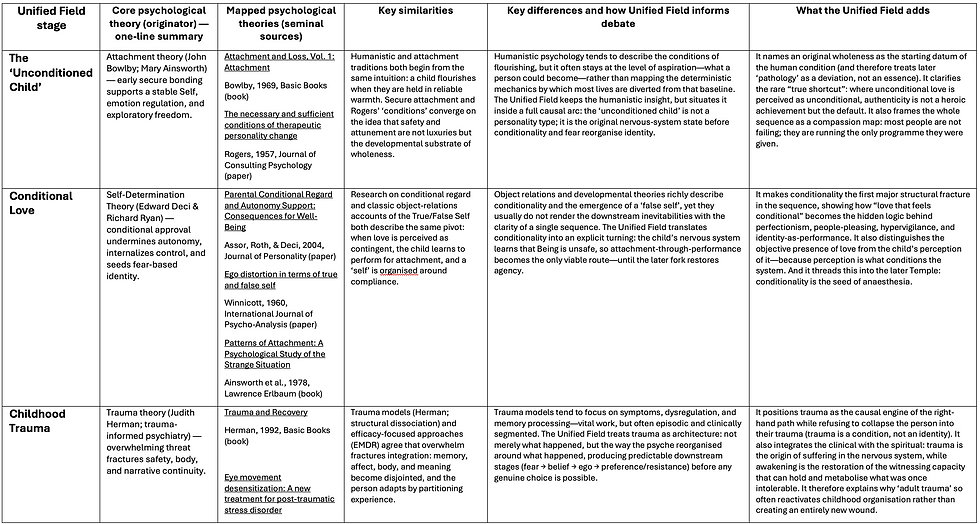
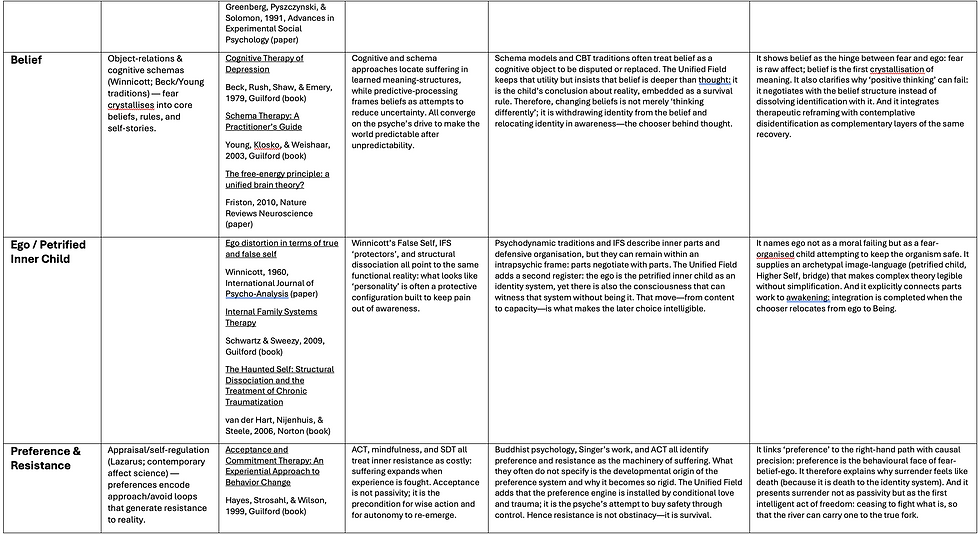
But what is the support for this you will ask? Of course, let me provide it for you. My meta-theory incorporates and integrates all the evidence-based theories of all the disciplines named so far and show how they may all be mapped onto my meta-theory. Let's start with psychology.
Psychology Mapped Onto The Meta-theory
Here is the evidence base with the published study and author named in the reference list and clickable links. It shows precisely how psychology may be mapped on the Meta-theory of the 'Unified Field of The Human Condition.'



Childhood Trauma and Conditional Love
Dr Maté believes that our symptoms and emotional reactions to present adult stresses are based on our childhood Trauma, not the current situations themselves, saying that:
“Emotions are responses to present stimuli as filtered through the memory of past experience, and they anticipate the future based on our perception of the past.”
Dr Maté wrote:
“Not the world, not what’s outside of us, but what we hold inside traps us. We may not be responsible for the world that created our minds, but we can take responsibility for the mind with which we create our world.”
Einstein said:
"I want to know God's thoughts; the rest are details. Science without religion is lame. Religion without science is blind. My religion consists of a humble admiration of the illimitable superior spirit who reveals himself in the slight details we are able to perceive with our frail and feeble mind."
We believe that the wounds from childhood Trauma keep us bound to them in chains. The Truth is that they alter our perceptions, distorting how we view the world and blind us to what I call ‘Real Reality’, which is also called ‘higher Truth’. We are not shackled. We can liberate ourselves. Trauma is a liar. Fear is a liar.
The root cause of the diagnosis of the human condition is a wound. That original wound is childhood Trauma.
The study of the weapon that inflicts that wound, the aetiology, reveals the heart-piercing sword of conditional love.
Conditioning by our parents, caregivers, society, and institutions that ‘govern us’ and media platforms turn us into junkies of 'imitation' love in all its forms (also through their collective ego), set by the expectations that they have of us.
Expectations are conditional. Real love means to accept someone exactly for who they are and who they want to be. Real love also means that you want them to find joy inside them. Where there is a real or perceived absence of unconditional love, the deep causal wound, its root, is named - childhood Trauma (also known as Adverse Childhood Experiences – ACEs).
Dr Judith Lewis Herman is an American psychiatrist, researcher, teacher, and Professor of Psychiatry at Harvard Medical School, who has focused on the understanding and treatment of childhood Trauma, said that:
“The mental health system is filled with survivors of prolonged, repeated childhood Trauma. This is true even though most people who have had childhood Trauma never come to psychiatric attention. To the extent that these people recover, they do so on their own. While only a small minority of survivors, usually those with the most severe abuse histories, eventually become psychiatric patients, many or even most psychiatric patients are survivors of childhood Trauma. The data on this point are beyond contention. On careful questioning, 50–60 percent of psychiatric inpatients and 40–60 percent of outpatients report childhood histories of Trauma. In one study of psychiatric emergency room patients, 70 percent had childhood Trauma histories. Thus Trauma in childhood appears a main factor that leads a person to seek psychiatric treatment as an adult.”
Surprisingly, doctors and lawyers have the highest incidence of mental illness and divorce in any group in society. There is deliberate denial of this by the institutions that govern them. They speak incessantly of 'secondary trauma', but how can you have this when they deny primary (childhood) Trauma. This buried and repressed unhealed emotional pain makes them numb to life: Numb to humanity. Creatives have the lowest incidence of mental illness and divorce.
Unconditional love is what allows you to make the choice at the fork in the road in the ‘Two Forks One Choice Model’ to give birth to the new you. Jesus said in John 3:3 that:
“Except a man be born again, he cannot see the kingdom of God.”
By this he meant that a metaphorical psychological ego-death is necessary to give birth to your Soul. This is not death of the petrified inner child: ‘The Law of Unconditional Love’ is the solvent that dissolves the ego’s armour, the thawing and unconditional holding that allows the inner child to come out of petrification, the end of repression of the shadow, the integrating force that ends the raging inner ego–shadow war by ending the need for war (because reality no longer has to be resisted), with restoration of perception and the hearing of the soft voice of the Higher Self. Jesus said in John 12:24, reflecting the shedding of the restrictive armour and rebirth through transformation leading to abundance:
“Except a corn of wheat fall into the ground and die, it abideth alone: But if it die, it bringeth forth much fruit.”
The "Law of Unconditional Love’
The 'Law of Unconditional Love’ underpins the ‘Triadic Reintegration Model’, which reintegrates the Higher Self, the inner child, and the shadow as the healed Soul. Both of these concepts are novel in this thesis.
Marianne Williamson says tha:
“A miracle is a change in perception from fear to love.” Without naming it, the miracle she was describing was what happens when you make the choice of BEing at the Fork in the road: I would say that “Unconditional love removes ALL fear, and that is the miracle of BEing.”
Unconditional love awakens your Higher Self so that it swims from the depths of your subconscious to the surface. Unconditional love is what your shadow needs to feel confident, trusted, and valued enough to emerge from the darkness. Unconditional love is the only thing that was truly missing for your inner child.
The meta-theory is a map. The paper on which the map is printed is unconditional love. Holding this paper and seeing the map is the healing of the human condition. While you thought that you needed a map to get somewhere, you suddenly realise that paper of the map is your destination and that destination was always unconditional love. You always had it in your hands. You just had to feel it to see it. It is when you feel unconditional love that you leave the ‘Temple of Emotional Anaesthesia.’ You had to go there to realise that all the ‘imitation love’, in other words, all forms of numbing, external validation, transactional love, and every other form of conditional love that you could ever receive could never give you the feeling of unconditional love. You had to ‘overdose’ on imitation love before you could see this. The ‘Law of Unconditional Love’ is the governing principle that explains the entire map.
A letter appeared as a historical document from Einstein to his daughter as a (perhaps apocryphal) poetic witness statement and illustrative authority. It points to an absolute Truth: That the 'Law of Unconditional Love,' is the most powerful force in the Universe that governs all of the Natural Laws, including the laws of physics and indeed all the laws of cause and effect, the basis of all science.
Einstein’s letter states:
”When I proposed the theory of relativity, very few understood me, and what I will reveal now to transmit to mankind will also collide with the misunderstanding and prejudice in the world.
I ask you to guard the letters as long as necessary, years, decades, until society is advanced enough to accept what I will explain below.
There is an extremely powerful force that, so far, science has not found a formal explanation to. It is a force that includes and governs all others, and is even behind any phenomenon operating in the Universe and has not yet been identified by us.
This universal force is LOVE.
When scientists looked for a unified theory of the universe they forgot the most powerful unseen force.
Love is Light, that enlightens those who give and receive it.
Love is gravity, because it makes some people feel attracted to others.
Love is power, because it multiplies the best we have, and allows humanity not to be extinguished in their blind selfishness. Love unfolds and reveals
For love we live and die.
This force explains everything and gives meaning to life. This is the variable that we have ignored for too long, maybe because we are afraid of love because it is the only energy in the universe that man has not learned to drive at will
To give visibility to love, I made a simple substitution in my most famous equation:
If instead of E = mc2, we accept that the energy to heal the world can be obtained through love multiplied by the speed of light squared, we arrive at the conclusion that love is the most powerful force there is, because it has no limits.
After the failure of humanity in the use and control of the other forces of the universe that have turned against us, it is urgent that we nourish ourselves with another kind of energy… If we want our species to survive, if we are to find meaning in life, if we want to save the world and every sentient being that inhabits it, love is the one and only answer.
Perhaps we are not yet ready to make a bomb of love, a device powerful enough to entirely destroy the hate, selfishness and greed that devastate the planet.
However, each individual carries within them a small but powerful generator of love whose energy is waiting to be released.
When we learn to give and receive this universal energy, dear Lieserl, we will have affirmed that love conquers all, is able to transcend everything and anything, because love is the quintessence of life.”
Unconditional love is the science of the Soul: It is the science of healing from the human condition. These Natural Laws are what is called reality. The meta-theory is that science of the Soul. So, the meta-meta theory is the ‘Law of Unconditional Love,’ it is the paper on which the ‘Unified Field’ is printed.The meta-meta theory shows why it holds true. Every element of the map may be related to the presence or absence of unconditional love. But it needs the paper to be real. And now you have it in your hands. You just need to feel it. The map is the journey. The paper is the destination. It was hidden in plain sight, like the ‘Holy Grail.’ Unconditional love is when you start listening to your Self, seeing your Self, valuing your Self, dis-armouring your Self, and loving your Self.
Childhood Trauma clads us with armour so that we cannot feel again. It makes us blind to unconditional love even where it exists. But the blind can see through feeling. Seeing is believing. The Buddhists would say that “Seeing is healing”. This means that simply seeing the mechanism, the physics, of the meta-theory, is the healing. Freud said that “Feeling is healing.” Love is Truth. Truth is a feeling. Unconditional love is that feeling. It is that seeing. It is that believing. And it all starts with a map, that you can see, but also feel. Now the door is open. Will you go through it and take that journey? Not convinced yet? Well do read on.
Lord Byron wrote “There are four questions of value in life, Don Octavio. What is sacred? Of what is the spirit made? What is worth living for and what is worth dying for? The answer to each is the same. Only love.”
Emmet Fox, the author of the book 'The Sermon on the Mount' wrote:
“There is no difficulty that enough love will not conquer: no dis-ease that love will not heal: no door that enough love will not open. It makes no difference how deep set the trouble: How hopeless the outlook: How muddled the tangle: How great the mistake. A sufficient realisation of love will dissolve it all. If you could only love enough, you could be the most powerful person in the world... This is the scientific application of love.”
Maps point the way to lost treasures. Alfred Lord Tennyson, Queen Victoria’s Poet Laureate, wrote:
"Love is the only gold."
Love is the unseen but very real energy that underpins the entire Universe. Poets, philosophers and even many scientists like Einstein would agree. It is what can't be seen or identified by science, but that is a limit of science, not of love. Love is the ultimately powerful Universal force that includes and governs all others, and is even behind any phenomena operating in the Universe. I truly believe that it is what a unified theory of the Universe would look like: the ‘Law of Unconditional Love.’
The map shows the ‘Bridge of Awakening.’ Rumi wrote “Love is the bridge between you and everything.” Let’s rename it the ‘Bridge of Unconditional Love’ shall we?
Plato could have been talking about the ‘Triadic Reintegration Model’ and ‘Law of Unconditional Love’ when he said that:
"Love is born into every human being; it calls back the halves of our original nature together; it tries to make one out of two and heal the wound of human nature."
The Neurobiology Of ‘Unconditional Love’ And 'The Right-Hand Route' of The Map
Across social-affective neuroscience, unconditional love can be described as a repeatable neurobiological environment: The child receives consistent cues of safety, attunement, and repair that shape reward, stress, and attachment systems. Neuroimaging of parental love shows coordinated activation of orbitofrontal and dopaminergic reward circuitry, suggesting caregiving is biologically coded as intrinsically rewarding rather than merely duty-bound (The neural correlates of maternal and romantic love.; Bartels, NeuroImage, 2004).
Oxytocin, released during nurturing contact, strengthens bonding salience and can reduce stress responses (The effect of social support on stress and oxytocin in humans.; Heinrichs, Biological Psychiatry, 2003).
When this buffering is absent—through emotional neglect, inconsistency, or conditionality—the developing nervous system is trained to expect threat and scarcity. Early deprivation has been associated with atypically enlarged amygdala volume and difficulties in emotion regulation (Prolonged institutional rearing is associated with atypically large amygdala volume and difficulties in emotion regulation.; Tottenham, Developmental Science, 2010), and meta-analytic syntheses of adverse childhood experiences link childhood Trauma to increased risks of depression, anxiety, PTSD, and substance use (The effect of multiple adverse childhood experiences on health: A systematic review and meta-analysis.; Hughes, The Lancet Public Health, 2017). This is precisely the clinical constellation that, in my meta-theory, maps onto the 'Path of Attachment' and the 'Temple of Emotional Anaesthesia'.
In my meta-theory this neurodevelopmental logic reads as the ‘Right-hand path’: If baseline safety and belonging are unreliable, the organism learns preference as survival strategy—clinging to what reliably produces relief (substances, compulsions, achievement, validation)—with reward-system skew setting off again via the path of the 'Quest For Love', not realising that all they will get is imitation love in the destination of the ‘Temple of Emotional Anaesthesia’ as downstream expression to lessen the pain of the human condition.
The crucial hope is neuroplasticity: Stress and reward circuits remain modifiable, and practices that repeatedly train attention, interoception, and safety (e.g., mindfulness-based interventions) can measurably reduce stress reactivity and symptom burden over time.
Triangulating Conditional Love, Preference, and the ‘One Choice’
This section does one very specific job: It shows how three claims that can sound ‘spiritual’ or ‘philosophical’ can, in fact, be triangulated using mainstream developmental psychology, clinical science, and affective neuroscience. It does not ‘prove’ metaphysics. It does not pretend that any dataset can adjudicate ultimate questions about Truth. What it does show—robustly—is that (i) early caregiving that feels conditional reliably shapes threat-sensitivity and self-worth regulation; (ii) those changes manifest as stable approach–avoidance biases (what this thesis calls ‘preference’ and ‘resistance’); and (iii) the capacity to interrupt those biases and choose differently is not evenly distributed across the lifespan, but is largely a function of later-developing self-regulation, psychological flexibility, and restoration of agency—all of which are measurable and trainable. The first fork is not really a fork - it is a ‘choiceless choice’ (the path is already set by conditioning); the second is the first true choice.
1. Translating This Thesis' Terms Into Testable Constructs
To triangulate evidence, it helps to translate this thesis' three terms into constructs the empirical literature already measures. ‘Unconditional love’ corresponds most closely to caregiver warmth/acceptance, secure attachment, and autonomy support, with ‘lack of unconditional love’ corresponding to conditional regard, emotional neglect, inconsistent or contingent responsiveness, and attachment insecurity. ‘Preference’ corresponds to learned approach–avoidance biases, experiential avoidance, threat hypervigilance, contingent self-esteem, and controlled/introjected motivation. ‘The one choice’ corresponds to the capacity for response inhibition, meta-awareness, and psychological flexibility: The ability to notice an impulse, tolerate affect, and select a value-consistent action rather than act out a conditioned avoidance programme.
2. Evidence That Conditionality in Love Cultivates ‘Preference’
Across multiple theoretical traditions, the same developmental story repeats: When a child experiences love, approval, or safety as contingent—granted when they perform, comply, achieve, or stay ‘acceptable’—the psyche learns to organise itself around maintenance of approval and avoidance of rejection. In self-determination theory, this is captured in the construct of parental conditional regard and its downstream effects on controlled (introjected) regulation, contingent self-worth, and affective cost. (The emotional costs of parents’ conditional regard: A self-determination theory analysis, Assor, Journal of Personality, 2004).
Importantly, this is not a niche claim resting on one paper: A more recent quantitative synthesis reports that parental conditional regard shows consistent associations with poorer well-being and maladaptive motivational and self-evaluative outcomes. In this thesis' language, conditional regard does not merely ‘hurt feelings’; it teaches the organism a rule: ‘Stay preferred. Avoid dis-preference.’ That rule is preference and resistance in embryo. (Parental conditional regard: A meta-analysis, Haines, Journal of Adolescence, 2023).
Attachment science translates the same phenomenon into ‘internal working models’: If closeness is unreliable or conditional, the nervous system calibrates toward vigilance, hyperactivation (clinging and scanning) or deactivation (numbing and self-reliance). Affective neuroscience adds a further layer: Early adversity is associated with enduring alterations in stress and emotion-processing systems—including threat reactivity and prefrontal regulatory circuits. This is not a claim that ‘the brain is damaged’ in a simplistic way; it is a claim that adaptation to an unsafe or conditional context has a cost when carried forward into adulthood. (Annual research review: Enduring neurobiological effects of childhood abuse and neglect, Teicher, Journal of Child Psychology and Psychiatry, 2016).
3. Evidence That ‘Preference’ Becomes The Adult Operating System
Once conditionality becomes the child’s operating system, ‘preference’ generalises: The person learns to orient toward what promises approval, control, relief, or status, and to orient away from what evokes shame, fear, grief, or rejection. In empirical terms, this looks like experiential avoidance and psychological inflexibility: Attempts to manage inner experience by avoiding it, controlling it, or organising life around not feeling what is feared. These tendencies are not moral defects; they are predictable strategies for coping with a nervous system that learned early that certain feelings, needs, or expressions were unsafe. (Psychological flexibility as a fundamental aspect of health, Kashdan, Clinical Psychology Review, 2010).
When researchers examine adverse childhood experiences (ACEs) at population scale, the pattern is striking: Higher ACEs exposure is associated with increased risk across a broad range of mental and physical health outcomes. That breadth matters for my thesis, because it supports my claim that the human condition is not one disorder but one mechanism expressing itself through many surfaces.(Adverse childhood experiences and associated health outcomes: A systematic review and meta-analysis, Petruccelli, Child Abuse & Neglect, 2019).
A particularly clean way to link ‘lack of unconditional love’ to adult ‘preference’ is to examine whether psychological inflexibility sits between early adversity and later suffering. A recent meta-analytic mediation model reports that psychological inflexibility significantly mediates the relationship between ACEs and adult mental health outcomes. In the language of my series of articles: Early conditionality loads the system with resistance; resistance multiplies pain into suffering. (Psychological inflexibility mediates the relationship between adverse childhood experiences and adult mental health, Li, Child Abuse & Neglect, 2025).
4. Triangulating The ‘One Choice’: From Conditioned Preference to Genuine Agency
My ‘one choice’ claim is easy to misread as purely rhetorical. But there is a precise empirical analogue: The transition from habitual, affect-avoidant responding to flexible, value-guided responding. In the clinical literature, that capacity is often operationalised as psychological flexibility. It is not a personality trait reserved for the fortunate; it is a trainable skill-set: Attending, allowing, decentering, inhibiting impulsive action, and acting from values rather than fear. (Psychological flexibility as a fundamental aspect of health, Kashdan, Clinical Psychology Review, 2010).
If the 'first fork’ is the developmental installation of the avoidance engine, the 'second fork’ is the moment a person acquires—or re-acquires—enough flexibility to notice the engine without obeying it. That is exactly what acceptance-and-commitment models aim to train, and why their results matter for my triangulation: A large meta-analysis reports that acceptance and commitment therapy (ACT) is efficacious across a range of clinically relevant outcomes, consistent with the idea that increasing flexibility changes the life-trajectory even when the biography cannot be rewritten. (A meta-analysis of the efficacy of acceptance and commitment therapy for clinically relevant mental and physical health problems, A-Tjak, Psychotherapy and Psychosomatics, 2015).
Neuroscience adds a complementary strand: Practices associated with mindfulness and acceptance are linked to measurable changes in attention, emotion regulation, and self-referential processing networks. These findings do not ‘prove’ a metaphysical Self. But they do support a modest and powerful claim: The capacity to relate differently to experience—to pause, to allow, to reframe—has a neural signature and can be cultivated. That is the empirical shadow of what my thesis calls the 'Bridge of Awakening': A shift from compulsion to choice. (The neuroscience of mindfulness meditation, Tang, Nature Reviews Neuroscience, 2015).
Put simply: There is a plausible evidence-based triangle. (1) Conditional caregiving and early adversity predict later threat-sensitivity, emotion dysregulation, and contingent self-worth. (2) Those features manifest as stable approach–avoidance biases—preference and resistance—that amplify suffering and increase reliance on anaesthetic strategies further enforcing the progression along the 'Quest For Love' to the 'Temple of Emotional Anaesthesia'. (3) Later-developing or later-trained regulatory capacities—psychological flexibility, inhibitory control, meta-awareness—predict the ability to interrupt that bias and choose differently. In this thesis' language: The first fork selects the 'Path of Attachment'; the second fork re-opens agency.
5. What This Section Does and Does Not Claim
This triangulation is intentionally conservative. It does not claim that every adult outcome is reducible to childhood love, although the vast majority are, (Relationship of childhood abuse and household dysfunction to many of the leading causes of death in adults. Felitti, American Journal of Preventive Medicine, 1998), nor that attachment history invariably determines destiny. It claims something both humbler and, frankly, more useful: Early conditionality loads the system toward preference; preference is a measurable mechanism; and the capacity to loosen preference is also measurable and trainable. That is enough to harmonise the bridge between the clinical psychopathological model (‘the root is lack of unconditional love’) and the Noble-Truth claim (‘preference is the engine of suffering’), while still leaving room for the thesis’ larger metaphysical imagination.
The Fractured Psyche

In this 'parable in a picture' the psyche is rendered as a jigsaw that once knew its own wholeness. Childhood Trauma is the shaking of the box, the scattering of what once fit. At the left end of the table sits the conditioned adult, tense with fear. In front of them the picture is incomplete, yet the tragedy his hand has become devoted to a piece that was never part of the original design. The ego (the red jigsaw piece) is held aloft like a precious fragment even though it cannot belong anywhere in the landscape of peace that the puzzle is meant to reveal. The true piece is banished: tucked under a cushion nearby - the shadow repressed. Another piece lies beneath the table, unnoticed in the half-light, representing the deeper Self that was exiled into the unconscious. At the right end of the table sits the integrated figure. Their puzzle is complete: The ''Bridge of Awakening' spans toward the 'Field of BEing', and the discarded red piece (ego) lies powerless on the floor. Nothing is hidden. Nothing is missing. The difference between the two lives is not intelligence, effort, or virtue. It is identification. One life is organised around the masquerade; the other has returned to what actually fits.
The ‘fractured Self’ is a ‘divided’ psyche. The ‘fractured psyche’ is not merely a psychological metaphor in the literature: It shows up as lived description, as phenomenology, and as formal theory.
In ‘The Myth of Normal: Trauma, Illness & Healing in a Toxic Culture’, which is in my ‘Suggested Reading’ list, Maté writes:
“They both represent a fracturing of the Self and of one’s relationship to the world… That fracturing is the essence of trauma.”
This connects with Dr Maté’s quote from his renowned book ‘In the Realm of Hungry Ghosts: Close Encounters With Addiction’ which is in my ‘Suggested Reading’ list, that:
“What we call the personality is often a jumble of genuine traits and adopted coping styles that do not reflect our true Self at all but the loss of it... The loss of Self is the essence of trauma.”
Jung, treats 'Fracture' as the native vulnerability of consciousness itself, writing in ‘Man and His Symbols’:
“Human consciousness has not yet achieved a reasonable degree of continuity. It is still vulnerable and liable to fragmentation.”
The wound in childhood Trauma, according to Jung, is a:
“Fracture of the psyche.”
Jung then draws the crucial distinction between a deliberate, functional 'Splitting of'” (attention, concentration) and an involuntary, trauma like dissociation: In that there is:
“A world of difference between a conscious decision to split off… and a condition in which this happens spontaneously… The former is a civilised achievement, the latter a primitive ‘loss of a Soul’.”
And in ‘Collected Works’ Jung writes:
“The tendency to split means that parts of the psyche detach themselves from consciousness… and lead an autonomous life of their own.”
Dr Maté agrees with Dr Jung, emphasising that healing is a process of “Self-retrieval”, where you recover lost parts of your Self and regain wholeness. The word ‘healing’ actually originates from the word ‘wholeness’, with its root also being shared by the word ‘health’, all meaning to 'become undamaged.’
So, Maté gives us the loss or fracturing of the Self, and Jung gives us fragmentation / splitting off / dissociation / loss of the Soul — different vocabularies for the same psycho-anatomical reality.
Professor Bessel van der Kolk, the doyen of Trauma, wrote in his seminal masterpiece on trauma, a veritable ‘Bible’ of trauma ‘The ‘Body Keeps the Score’, that describes the:
"Fragmented sense of Self, where parts of the individual's identity may feel disconnected from each other."
The Buddhist master Thích Nhất Hạnh wrote:
“When the mind is divided, the world appears divided... The mind that is divided cannot see clearly.”
Jung calls this fractured psyche when “One becomes two.”
Childhood Trauma divides the mind — and duality is the division made visible. Duality is the ‘fractured psyche’ described by Jung. Duality is thus the psychological scar tissue of emotional neglect.
The 'fractured self' gives rise to the ego. Before we become a ‘fractured self, we are an unconditioned child. We are all ‘guilty’ of being human.
The Ego
Aristotle wrote:
"Give me a child until he is 7 and I will show you the man."
Michael Singer, the phenomenal spiritual teacher and a key witness on your journey, who wrote the New York Times bestsellers ‘The Untethered Soul: The Journey Beyond Yourself’, which explore the nature of awareness, consciousness, the Self, and letting go of negative thoughts, and ‘Living Untethered: Beyond The Human Predicament’, both of which are must-read texts, wrote:
“There is nothing more important to true growth than realising that you are not the voice of the mind - you are the one who hears it.”
The ego is your petrified inner child wearing a suit of armour.
The child screams incessantly in your inner ear, telling you what to do out of terror. That voice in your ear is always in your ego’s language of fear. That is the voice that is running your life. This is the “Tyranny of the past”, a phrase used by Professor Bessel van der Kolk, when he describes how trauma keeps survivors captured by prior experience rather than being available to present reality. Van der Kolk has described how the terror and isolation at the core of childhood Trauma reshape both brain and body, with survival instincts explaining why traumatised people experience incomprehensible anxiety, numbing, and intolerable rage,
The ego doles out negativity to you, like poisonous sweets, through a sequence of negative beliefs, negative thoughts, negative emotions, negative behaviour, and negative outcomes. There is an absurdity in listening to the manipulative ego-mind. It is relentless, generating 60,000 negative, repetitive, catastrophising thoughts per day. Every fear, every limiting belief, every conflict, comes from the ego. It is self-will run riot.
The armour gives the ego a limited view of the world, and insists on that view being reality. The child speaks fear: The armour fights.
D.W Winnicott was a highly influential English paediatrician and psychoanalyst known for his groundbreaking theories on child development, particularly focusing on the mother-baby relationship, the inner life of the psyche, objective reality, fostering creativity, authenticity, a sense of BEing, and the development of the ‘True Self’ as being essential for psychological health. He contrasted the ‘True Self’ as the authentic, creative Self, while the ‘false self’ develops to meet external demands, often as a defence mechanism. He pioneered the integration of paediatrics with psychoanalysis, emphasising early environmental experiences, play, and the importance of a supportive, loving, ‘facilitating environment’ for healthy personality growth. He was one of the first academics to integrate psychology with spiritual concepts: What I call ‘psychospirituality’. Winnicott wrote about the fracture in the psyche that the ego (the ‘false self’) and the Soul (the ‘True Self’) that:
“The false self, if successful in its function, hides the True Self.”
‘The Maturational Processes and the Facilitating Environment’ Winnicott, 1965, Hogarth Press).
Michael Singer wrote:
“The ego is a cage that prevents you from connecting with your true Self.”
The ego believes that it is free, and wants to keep you fettered, enslaved, ill: The ego wants to attack. The ego wants you dead.
Marianne Williamson, the teacher of ‘A Course in Miracles’, and American Presidential Candidate, wrote that:
“The ego is our self-love turned into self-hatred. “Your ego mind is your self-hatred masquerading as self-love”.
Someone asked Paramahansa Yogananda, the Indian monk, yogi, and guru who is widely regarded as the ‘Father of Yoga in the West’, what the ego is, and he answered that it is:
“The masquerading self,”
Singer unpacks the ego as being:
“A mask out of thoughts.”
And that, is the ego. The ego is also called the ‘the persona’ as it takes everything personally, it is a socially ‘acceptable’ mask, and you identify with it as being who you are.
Singer states this simply in a way that you may never forget which, I quote in my article entitled ‘Psychospirituality - "You are Bothering Yourself About the Moment in Front of You": The Malign Legacy of Childhood Trauma’ that:
“One of the most amazing things you will ever realise is that the moment in front of you is not bothering you. You are bothering yourself about the moment in front of you. It's not personal - you are making it personal.”
Preference and Suffering
As the famous Zen teaching from the ‘Hsin Hsin Ming’ by the Third Zen Patriarch, Seng-T'san states:
“The Great Way is not difficult for those who have no preferences.”

Ego Holds on to Preference
This article names, with tenderness, compassion, love, and precision, what is happening to you: The insanity and rambunctiousness of the noisy, boisterous, disorderly, disruptive, uncontrolled ego that is rowdily running riot, ruling, and ruining your life, conning you into the illusion of choice.
The ego is conscious, but asleep, and yet it is the cause of ALL suffering, because it refuses to accept reality, living in a world of illusion, trying to control people, places and things to alleviate or obviate its fears: Of not getting what it wants, of getting what it doesn’t want, of losing what it gets.
But you can’t fight reality, as Singer says that:
"Reality is that which has already happened.”
As Byron Katie wrote:
“When I argue with reality, I lose. But only 100% of the time.”
Pain is inevitable: Suffering is optional. The ego’s resistance to reality, as a result of its preferences is what transmutes pain into suffering.
Spiritual Equations on Life, Pain, Resistance, Reality, Acceptance, Suffering, Surrender, and Meaning

Pain is inevitable: Jung believed that:
"There is no coming to consciousness without pain".
Suffering = Pain x Resistance
This means that if you don’t resist reality, you don’t suffer. Suffering is optional. The ego’s resistance to reality, as a result of its preferences is what transmutes pain into suffering. Yet very few people don’t resist reality at all: There is purpose in that – it teaches you about your self, and where you need to grow, evolve, and transform in order to surrender your ego further.
Suffering = Pain + Misinterpretation
Suffering. = Pain + Fear-Organised Identity
Where the Buddha said that all life is suffering:
Suffering ≠ Life
Suffering = Life + Interpretation + Resistance.
Suffering = Pain x Resistance x Resistance to resistance
Suffering = (Pain x Resistance)/Self-compassion
When the interpretive layer of the ego's illusions becomes visible, the spell weakens.
Buddha said “Work at the root.”
According to our clinical psychopathological model, which describes the root cause of the human condition:
Root = Lack of Unconditional Love
The interpretative layer is that “I am not loved, lovable, or worthy (of love).”
Peace = Acceptance
Suffering = Resistance x Clinging
Michael Singer says that:
“The paradox says that when you push something away, it stays inside you. If you push it away, you hold onto it. If you don’t, it goes right through you. A spiritual Master just says ‘Be as it may.’”
Spiritual Masters have no resistance. Most of us have some resistance. Therefore spiritual growth, evolution, transformation involve minimising resistance. This is why suffering teaches us so much.All growth relates to minimising resistance. Spiritual evolution is repeated surrender. In other words the entire spiritual journey is one of learning how to handle reality. It involves moving to a state of no preference.
In psychodynamic therapy one comes to realise that “I see these fears and the spell dissolves.”
Viktor Frankl wrote that:
"If life has meaning, so does suffering. Suffering is an ineradicable part of life.”
His equation is then:
Despair = Suffering - Meaning
Jung wrote powerfully and tellingly that:
"The foundation of all mental illness is the unwillingness to experience legitimate suffering".
And that:
"A psychoneurosis must be understood, ultimately, as the suffering of a Soul which has not discovered its meaning."
He believed that meaningful suffering is essential for psychological growth and that:
"Every psychic advance of man arises from the suffering of the Soul".
To surrender, to accept reality, and as Singer says:
“Let the pain go through you.”
Feeling the pain then letting it go, means to surrender one’s ego, which is the part of us that refuses to accept reality.
Jung believed that embracing suffering allows for the integration of the ‘shadow’: The hidden and repressed parts of the Self, which carries enormous personal power. Integrating our shadow with our higher Self and our inner child is the essential process called shadow work or individuation. This means to become whole and healed of the human condition.
The Meta-Meta-Theory of ‘The Unified Field of The Human Condition’

The models and metaphors in this series of articles – the ‘Path of Attachment’, the ‘Quest For Love’, the ‘Temple of Emotional Anaesthesia’, your one choice, the ‘Bridge of Awakening’, the’ Field of BEing’ – are not abstractions for their own sake. They are the synthesis of the all the disciplines, theories, and frameworks - maps made out of pain: My pain, your pain, the pain that others have shared with me in quieter moments, everyone’s pain.
You do not have to agree with every claim in this article. All I ask, as you read, is that you allow for self-compassion and the possibility that your exhaustion, sleeplessness, anxiety, and despair are not personal failings, but understandable responses of a nervous system shaped by early experience, conditional love, and expectation, and then exploited by a society and civilisation that created those conditions and that needs you numb for it to function as it does: That there is a way to BE that heals rather than invites triggering of unresolved childhood Trauma, manifesting as adult ‘stress’ or of the symptoms of ‘mental illness’.
Historiography refines the compassion argument here. When you treat addiction, judgement, and projection as historical phenomena as much as psychological ones, compassion stops being an individual virtue and becomes an epistemic achievement: The ability to see how a person’s suffering is not only their ‘choices’, but the downstream effect of conditions—developmental, relational, cultural, societal, economic, technological. This doesn’t abolish agency; it recognises that it can only be returned at the ‘second fork’, where it can actually be exercised. It also clarifies why societies routinely ‘write people off’: Not because humans are uniquely cruel, but because cultures prefer simple moral stories to complex causal stories. Historiography is the training in refusing that simplification. It also legitimises the hybrid method that I am using in this series of articles—evidence plus lived phenomenology plus contemplative insight—because it reminds us that even ‘objectivity’ itself has a history too. The idea that the knower can stand outside the known is not an eternal given – it may never hold true at all; it is an intellectual posture that arose for reasons, brought immense gifts, and has very real limitations. This thesis is not at all anti-objective; it is post-naïve. It insists that the study of the human condition must include first-person data (experience), second-person reality (relationship), and third-person data (measurement), because the human condition is made of all three. This is why a guide must always be a human BEing who has been on the very evidence-based journey that they are analysing: A 'wounded healer' - a term coined by Jung in 1951. And this is why you must take that journey yourself, and cannot imbibe it from a book. Historiography gives the concepts in this thesis their civilisational depth. It allows it to say: The human condition is a universal mechanism playing out in a historically contingent theatre—and treating it requires the precision of mechanism, the humility of history, and the impact of simply being human.

The flow chart doesn’t replace the Unified Field map; it’s the mechanism that sits beneath the human condition, the very psychological metaphysics of a life: A snapshot of the psychospiritual journey that we all undertake. It’s the sequence that quietly says: “This is law-fuli and l’awful. You are not broken; you are only human. It was never your choice. Don’t be ashamed. You deserve forgiveness, compassion, and unconditional love. It was nothing to do with you.”
Dr Gabor Maté, a world expert on trauma, attachment, authenticity, and addiction, wrote in ‘The Myth of Normal’ that:
"Addiction, disease, and mental illness are normal responses to abnormal situations… When so many of us are struggling, it's not a sign that we're broken. It's a sign that something in our environment, our culture, or our past needs attention."
Professor Brené Brown describes herself as:
“A mapmaker and a traveller… Tripping, falling, stumbling, trying to figure it out”
- someone who uses data and lived struggle to chart a course through felt emotions and universal human experiences she is still walking herself. That is all I am trying to do here. This article is a map –evolving, drawn in pencil and revised in tears – for people going through a very particular kind of ‘Hell’ on this Earth and this very lifetime. The point is not to get you ‘out’ of your humanity, but to help you find the bridge to a different way of BEing within it – the end of ALL suffering.
Marcel Proust, one of the most influential authors of the twentieth century, prescribed a journey to clarify our perception, writing:
“We do not receive wisdom, we must discover it for ourselves, after a journey through the wilderness, which no one else can make for us, which no one can spare us, for our wisdom is the point of view from which we come at last to regard the world.”
The clinical lens and the spiritual lens in this article become one map: The ‘Unified Field of The Human Condition.’ But this ‘right-hand path' - this step-by-step-wise progression of the human condition, its ‘path-ogenesis, can be rerouted, but not until we reach the ‘Temple of Emotional Anaesthesia.’
The path above may be described as my Eight ‘A’s, my Twelve ‘C’s, and my 7-steps as described below.
The Eight ‘A’s:
ACEs > Attachment > Addiction > Anaesthesia > Awareness > Acceptance > Awakening > Action
Singer says that:
“Awareness is who you are.”
Thich Nhat Hanh wrote that:
"Understanding is the only way out. If you understand, you will suffer less, and you will know how to get to the root."
The action is always compassion, forgiveness, and love.
The Twelve ‘C’s:
Conditional love > Childhood Trauma > Conditioning > Conflict Between Attachment and Authenticity > Choice is Illusory > Craving > Clinging > Compulsions > Captivity > Choice > Consciousness > Clarity > Compassion
The '7-Steps':
The meta-meta theory that I have devised, the 'Unified Field of the Human Condition', can be stated in seven steps — each visible in everyday life, and each (crucially) reversible. This is the universal ‘childhood trauma sequence’ of the human condition that underwrites this thesis: This is not as a moral story about weak people, but as a physiological story, a psychological reality, supported by and blended with the wisdom of philosophy and spirituality, about protective adaptation that became over‑learned. This sequence is where the article becomes for everyone.
Step 1 — The unconditioned child (original innocence).
The organism is born oriented to connection and safety. The nervous system expects attunement; identity is not yet built as armour.
Step 2 — Conditional love / attachment disruption (the first wound).
Repeated misattunement, threat, abandonment, or shaming teaches: Connection is risky; feelings are dangerous; needs are burdensome.
Step 3 — Protective adaptation (the armoured petrified inner child is installed - the ego).
To survive, the child builds a strategy: People pleasing, achieving, controlling, hiding, fighting, numbing. The strategy becomes identity.
Step 4 — Preference as command (craving / aversion becomes governance).
The adult’s inner world is run by compulsive 'musts' and 'shoulds' through fear and limiting beliefs: "I must be approved of; I must win; I must be safe; I must not feel. Preference becomes the human condition.
Step 5 — The 'Temple of Emotional Anaesthesia' (numbing symptoms as a way of coping).
Anxiety, depression, addiction, rage, perfectionism, compulsive work, dissociation — these are not random failures; they are anaesthetics and armour.
Step 6 — The 'Bridge of Awakening' (awakening through integration).
Turning toward what was avoided: Feeling, meaning‑making, Truth‑telling, grief, self‑compassion, non-dualism. Unconscious pattern becomes the first conscious choice of a life - the 'fork in the road' described in this article.
Step 7 — The' Field of BEing'.
Freedom, dialectic, love, peace, consciousness, compassion, Truth without fear, illusion, limited perception, compassion, the 'Seat of The Soul' (described at the end of this article), freedom from compulsion.
Addiction and The ‘Temple of Emotional Anaesthesia’
Jung wrote that:
“The foundation of all mental illness is the unwillingness to experience legitimate suffering”.

Choice


Flow as the Hidden Undercurrent of the Human Condition


This article has described the progression through every human life, from the illusion of choice when we don't have one, followed by the illusion of no choice when we actually do have one; the way suffering arises when the undercurrent of the flow of the river that is life is fought against by trying to swim against a torrent, instead of ‘going with the flow’ (not an accidental term); the way the ‘fractured Self’ presents as symptoms, signs, emotional pain, suffering, roles, and compulsions, all of which are resolved when we make the decision to choose who we are BEing at the second (the only real and only first) choice point.
Albert Einstein once said that:
“With each choice you make, you create your life.”
The image below is my ‘remake’ of the iconic film ‘The Matrix.’ Well, it’s not really a ‘remake’, it simply depicts Morpheus as your ‘Higher Self’ and Neo as you, being offered the blue pill of emotional anaesthesia or the red pill of awakening. Which will you choose?

Healing is to Become FREE
Healing from the human condition is liberation. You become FREE.
The acronym FREE is deliberate:
Feeling > Reality - Experiential Evidence
Truth is a feeling. Feeling first allows the evidence of Reality to become experiential after.
So while it is true that “Seeing is believing”, it is also true to say that “Feeling is believing”, that “Feeling is seeing”, and that “Truth is a feeling.”
Noetic refers to an ineffable inner wisdom, direct knowing, and intuition that goes beyond the five senses and traditional intellectual analysis. It describes states of deep insight or consciousness that provide a sense of authority and profound understanding and Truth. Noetic feeling connects with a person's inner feeling of Reality, separate from, prior to, and in addition to, purely rational thought.
In psychology, William James defined ‘noetic’ as experiences that feel like revelation or Truth, extending beyond, yet influencing, the intellect. Noetic feeling doesn’t arrive as an argument. It arrives as a recognition: “Yes. That.” It can be wordless and steady, not dramatic. It’s less like being persuaded, more like remembering. That’s why Truth is a remembrance of who you are before the world got to you: The unconditioned child full of the unconditional love that you can see in a baby’s eyes.
Truth is recognisable by a certain quality of inner contact: A settling, a coherence, a non-defensive clarity — something that feels like alignment with Reality rather than a victory of opinion, argument, or ‘concrete’ evidence. That’s the ‘felt Truth’ that this series of articles keeps circling: The nervous system ceasing to pre-emptively fight what is.
Faith, in this thesis’s sense, is not believing without evidence; it is the willingness, the felt capacity to live as though, and to entrust your Self to, Reality as being trustworthy long enough for evidence to become experiential. That Faith is Truth. It is a ‘gut feeling’ that “All is well, and that all shall be well.”

This is the moment a person cannot yet see the far end of the Bridge, and yet they feel that they can take the first step onto it through the open door of the prison that is the ‘Temple of Emotional Anaesthesia’, and then the next step along it. It is when the ego, the petrified inner child, feels safe enough to remove its armour, although it cannot yet ‘prove’ scientifically that the armour can be removed without consequence, and yet can feel bodily that this next step is real and that they will ‘see’ that they are safe. That is why Faith is less a doctrine than a scientific experiment in relinquishment: A small, courageous relaxation in the face of potential disturbance, a decision to stop rehearsing catastrophe and instead to meet the moment unarmoured; to ‘take the leap of Faith’. The old mind wants guarantees; Faith accepts only the next truthful movement, and then discovers — through direct contact — through seeing — that the world does not strike as the ego predicted: That the nervous system can survive without clenched protection and that what looked like danger was only the echo of a long-gone earlier danger. In that sense, Faith becomes the requisite bridge between parchment (feeling), map (seeing), and journey (healing): Not a refusal of sight, but the willingness to walk before sight can certify the landscape.
As it says in 2 Corinthians 5:7:
“For we walk by Faith, not by sight.”
This brings us to an insistence that the inner experiment is the evidence: That Faith proves that one can have Faith in it.
In Hebrews 11:1 it states that:
“Faith is … the evidence of things not seen.”
The Bridge is crossed one step at a time.
The armour only comes off one clasp at a time, but each unclasping is already a revelation: I loosened, and I did not die; I softened, and I was not abandoned; I surrendered, and the world did not end.
Faith is not a ‘mood’. It is a form of inner contact — a felt sense of alignment with Truth that remains when the nervous system stops defending.
That lived discovery is how Faith matures into seeing—not as an argument won, but as a Reality finally met.
Saint Augustine of Hippo wrote that:
"Faith is to believe what you do not see; the reward of this Faith is to see what you believe."
This emphasises that true Faith involves trusting in the unseen, with the ultimate reward being the manifestation or understanding of that belief. This is the power of feeling: Feeling sets you FREE. Feeling is healing.
In a letter to Jung, Freud wrote that:
"Psychoanalysis in essence is a cure through love."
Here, Freud was highlighting the importance of the therapeutic relationship in allowing patients to safely express their emotions.
This is the feeling that proves the ‘Law of Unconditional Love’ before science has had the opportunity to.
In the image above, Monopoly becomes a parable-in-a-picture: Not because life is a game, but because the ego so easily persuades that you must subjugate yourself to it in order to be safe. The scene captures the first miracle of awakening: Freedom was always in the deck. The cell was just a little plastic box. The broken chain on the table whispers the deeper point: What binds you is not iron but the ego’s illusions that you are shackled. This is the thesis in miniature: The ‘one choice’ is rarely heroic in appearance. It is not a conquest of the world; it is the relinquishment of the inner argument with reality. Once the spell weakens, the ‘Bridge of Awakening’ becomes visible on the board — not as a dramatic escape, but as the simplest act imaginable: The first step to freedom. The great insight of healing from the human condition is that the ego can try to convince you that you need to spend a lifetime trying to purchase freedom — through status, reassurance, achievement, control — while the exit was never a commodity. The ‘get out of jail’ card is not something earned; it is something recognised as being the most important card in the game and that you had the card all along.
Seeing The Mechanism is Healing

When brought and elevated to this cosmic view, so that you can learn to see the wound clearly, to understand the mechanisms that created it, have kept it open, bleeding, and in charge of your life –psychologically, philosophically, spiritually – and to discover that there is a way of BEing that is not organised around fear, and the awareness that this is the only exit route from the human condition, indeed it’s only cure, and the insight that this is down to a single choice point, is what all the disciplines and spiritual traditions have called Enlightenment, Self-realisation, Self-actualisation, transcendence, or Enlightenment.
We remember what the author and teacher A.H. Almaas, a great advocate of fusing psychology and spirituality, wrote:
“Your conflicts, all the difficult things, the problematic situations in your life are not chance or haphazard. They are actually yours. They are specifically yours, designed specifically for you by a part of you that loves you more than anything else. The part of you that loves you more than anything else has created roadblocks to lead you to yourself. You are not going in the right direction unless there is something pricking you in the side, telling you, “Look here! This way!” That part of you loves you so much that it doesn’t want you to lose the chance. It will go to extreme measures to wake you up, it will make you suffer greatly if you don’t listen. What else can it do? That is its purpose.”
Michael Singer says that:
“Earth is a place where Souls are sent to evolve.”
As Marianne Williamson says:
"A miracle is a shift in perception from fear to love—from a belief in what is not real, to faith in that which is. That shift in perception changes everything".
The Tools of Psychospirituality and The Human Condition
Each of the tools of transformation which may bring an end to the suffering of the human condition will be brought back to their direct relationship with the one choice: Choosing who you are BEing.


This brings us to the only question that you need to guide you at the fork in the road:
“What would love do now?”
How To Respond To ANY Situation - The Seven ‘R’s:
Reality > Relax > Release > Relinquish Resistance > Return to Presence > Respond > Rise
Never react! Viktor Frankl wrote that:
"Between stimulus and response there is a space. In that space is our power to choose our response. In our response lies our growth and our freedom".
He also famously wrote in ‘Man’s Search For Meaning’, which is in my ‘Suggested Reading’ list, that:
"Everything can be taken from a man but one thing: The last of the human freedoms—to choose one's attitude in any given set of circumstances, to choose one's own way."
The Seat of The Soul

Dr Maté writes:
“We can begin to live the Truth of who we are, rather than the story of who we were taught to be.”
The time has come for humanity to remember its heart.
‘The Institutional Übermensch: The Ego-Scaling Matrix, Affective Fields, and Trauma-Organised Autopoiesis’
Namaste.
Olly
References
A closer look at the dissociative subtype in PTSD. Lanius, R.A., Frewen, P.A.. 2015; 32(8):588-598. [Accessed 3 April 2024].
A meta-analysis of the efficacy of acceptance and commitment therapy for clinically relevant mental and physical health problems. A-Tjak, J.G.L., Davis, M.L., et al., Psychotherapy and Psychosomatics. 2015; 84(1):30-36. [Accessed 3 April 2024].
A randomized clinical trial of mindfulness-based stress reduction for posttraumatic stress disorder among veterans. Polusny, M.A., Erbes, C.R., Thuras, P., et al. JAMA. 2015; 314(5):456-465. [Accessed 3 April 2024].
A terror management theory of social behavior: The psychological functions of self-esteem and cultural worldviews. Solomon, S., Greenberg, J., et al. Advances in Experimental Social Psychology. 1991; 24:93-159. [Accessed 3 April 2024].
A theoretical upgrade of the concept of parental psychological control: Proposing new insights on the basis of self-determination theory. Soenens, B., Vansteenkiste, M., Developmental Review. 2010; 30(1):74-99. [Accessed 3 April 2024].
Acceptance and Commitment Therapy: An Experiential Approach to Behavior Change. Hayes, S.C., Strosahl, K.D., et al. Guilford Press. Guilford Press (1999).
Acceptance and commitment therapy: Model, processes and outcomes. Hayes, S.C., Luoma, J.B., et al. 2006; 44(1):1-25. [Accessed 3 April 2024].
Adverse childhood experiences and associated health outcomes: A systematic review and meta-analysis. Petruccelli, K., Davis, J., et al., Child Abuse & Neglect. 2019; 97:104127. [Accessed 3 April 2024].
Alterations in brain and immune function produced by mindfulness meditation. Davidson, R.J., Kabat-Zinn, J., Schumacher, J., et al. Psychosomatic Medicine. 2003; 65(4):564-570. [Accessed 3 April 2024].
Annual research review: Childhood maltreatment, latent vulnerability and the shift to preventative psychiatry. McCrory, E., Viding, E., Journal of Child Psychology and Psychiatry. 2017; 58(4):338-357. [Accessed 3 April 2024].
Annual research review: Enduring neurobiological effects of childhood abuse and neglect. Teicher, M.H., Samson, J.A.. 2016; 57(3):241-266. [Accessed 3 April 2024].
Attachment and Loss, Vol. 1: Attachment. Bowlby. Basic Books. Basic Books (1969).
Cognitive recovery in socially deprived young children: The Bucharest Early Intervention Project. Nelson, C.A., Zeanah, C.H., et al. Science. 2007; 318(5858):1937-1940. [Accessed 3 April 2024].
Cognitive Therapy of Depression. Beck, A.T., Rush, A.J., et al. Guilford Press. Guilford Press (1979).
Dimensions of early experience and neural development: Deprivation and threat. Sheridan, M.A., McLaughlin, K.A.. 2014; 18(11):580-585. [Accessed 3 April 2024].
Does trauma-focused psychotherapy change the brain? A systematic review of neural correlates of therapeutic gains in PTSD. Brakemeier, E.L., Daniels, J.K.. European Journal of Psychotraumatology. 2021; 12(1):1929025. [Accessed 3 April 2024].
Effects of early intervention on EEG power and coherence in previously institutionalized children in Romania. Marshall, P.J., Reeb, B.C., Fox, N.A., Nelson, C.A., Zeanah, C.H., et al. Development and Psychopathology. 2008; 20(3):861-880. [Accessed 3 April 2024].
Ego distortion in terms of true and false self. Winnicott, D.W.. International Journal of Psycho-Analysis. 1960; 41:585-595. [Accessed 3 April 2024].
Enduring neurobiological effects of childhood abuse and neglect. McCrory, E.J., Brito, S.A.. 2017; 58(4):338-358. [Accessed 3 April 2024].
Eye movement desensitization: A new treatment for post-traumatic stress disorder. Shapiro, F. Journal of Behavior Therapy and Experimental Psychiatry. 1989; 20(3):211-217. [Accessed 3 April 2024].
Full Catastrophe Living. Kabat-Zinn, J. Delacorte Press. Delacorte Press (1990).
How does mindfulness meditation work? Proposing mechanisms of action from a conceptual and neural perspective. Hölzel, B.K., Lazar, S.W., et al., Perspectives on Psychological Science. 2011; 6(6):537-559. [Accessed 3 April 2024].
Internal Family Systems Therapy. Schwartz & Sweezy. Guilford. Guilford (2009).
Learned helplessness. Seligman, M.E.P.. Annual Review of Medicine. 1972; 23:407-412. [Accessed 3 April 2024].
Maternal support in early childhood predicts larger hippocampal volumes at school age. Luby, J.L., Gaffrey, M.S.. Proceedings of the National Academy of Sciences of the United States of America. 2012; 109(8):2854-2859. [Accessed 3 April 2024].
Meditation experience is associated with increased cortical thickness. Lazar, S.W., Kerr, C.E., Wasserman, R.H., et al. NeuroReport. 2005; 16(17):1893-1897. [Accessed 3 April 2024].
Mindfulness practice leads to increases in regional brain gray matter density. Yerramsetti, S.M., Lazar, S.W.. Psychiatry Research: Neuroimaging. 2011; 191(1):36-43. [Accessed 3 April 2024].
Mindfulness-Based Cognitive Therapy for Depression. Segal, Z.V., Williams, J.M.G., et al. Guilford Press. Guilford Press (2002).
No evidence that mindfulness-based stress reduction alters brain structure: Two combined randomized controlled trials. Kral, T.R.A., Davis, K., Korponay, C., et al. medRxiv. 2021;. [Accessed 3 April 2024].
Orienting in a defensive world: Mammalian modifications of our evolutionary heritage. Porges. Porges, 1995, Psychophysiology (paper; reprint). [Accessed 3 April 2024].
Parental Conditional Regard and Autonomy Support: Consequences for Well-Being. Assor. Assor, Roth, & Deci, 2004, Journal of Personality (paper). [Accessed 3 April 2024].
Parental conditional regard: A meta-analysis. Haines, J.E., Schutte, N.S.. 2023; 95(2):195-223. [Accessed 3 April 2024].
Patterns of Attachment: A Psychological Study of the Strange Situation. Ainsworth, M.D.S., Blehar, M.C., et al. Lawrence Erlbaum Associates. Lawrence Erlbaum Associates (1978).
Preliminary psychometric properties of the Acceptance and Action Questionnaire-II: A revised measure of psychological inflexibility and experiential avoidance. Bond, F.W., Hayes, S.C., Baer, R.A., Carpenter, K.M., Guenole, N., Orcutt, H.K., Waltz, T., Zettle, R.D., et al., Behavior Therapy. 2011; 42(4):676-688. [Accessed 3 April 2024].
Preschool is a sensitive period for the influence of maternal support on the trajectory of hippocampal development. Luby, J.L., Barch, D.M.. Proceedings of the National Academy of Sciences of the United States of America. 2016; 113(20):5742-5747. [Accessed 3 April 2024].
Prolonged institutional rearing is associated with atypically large amygdala volume and difficulties in emotion regulation.Tottenham, N., et al. Developmental Science. 2010; 13(1):46-61. [Accessed 3 April 2024].
Psychological flexibility as a fundamental aspect of health. Kashdan, T.B.. 2010; 30(7):865-878. [Accessed 3 April 2024].
Psychological inflexibility mediates the relationship between adverse childhood experiences and adult mental health. Li, H., Li, J., et al., Child Abuse & Neglect. 2025; 160:107266. [Accessed 3 April 2024].
Relationship of childhood abuse and household dysfunction to many of the leading causes of death in adults. Felitti, V.J., Anda, R.F., Nordenberg, D., Williamson, D.F., Spitz, A.M., Edwards, V., Koss, M.P., Marks, J.S., et al., American Journal of Preventive Medicine. 1998; 14(4):245-258. [Accessed 3 April 2024].
Schema Therapy: A Practitioner’s Guide. Young, Klosko, & Weishaar. Guilford. Guilford (2003).
Self-compassion: An alternative conceptualization of a healthy attitude toward oneself. Neff, K.D.. Self and Identity. 2003; 2(2):85-101. [Accessed 3 April 2024].
Self-determination theory and the facilitation of intrinsic motivation, social development, and well-being. Ryan, R.M., Deci, E.L.. 2000; 55(1):68-78. [Accessed 3 April 2024].
The Compassionate Mind. Gilbert. Constable & Robinson. Constable & Robinson (2009).
The effect of multiple adverse childhood experiences on health: A systematic review and meta-analysis. Hughes, K., et al. The Lancet Public Health. 2017; 2(8):e356-e366. [Accessed 3 April 2024].
The effect of social support on stress and oxytocin in humans. Heinrichs, M., et al. Biological Psychiatry. 2003; 54(12):1389-1398. [Accessed 3 April 2024].
The emotional and academic consequences of parental conditional regard: Comparing conditional positive regard, conditional negative regard, and autonomy support as parenting practices. Roth, G., Assor, A., Niemiec, C.P., et al., Developmental Psychology. 2009; 45(4):1119-1142. [Accessed 3 April 2024].
The emotional costs of parents’ conditional regard: A self-determination theory analysis. Deci, E.L.. 2004; 72(1):47-88. [Accessed 3 April 2024].
The emotional costs of perceived parents’ conditional regard: A self-determination theory analysis. Deci, E.L.. 2004; 72(1):47-88. [Accessed 3 April 2024].
The free-energy principle: a unified brain theory?. Friston, K. Nature Reviews Neuroscience. 2010; 11(2):127-138. [Accessed 3 April 2024].
The Haunted Self: Structural Dissociation and the Treatment of Chronic Traumatization. van der Hart, O., Nijenhuis, E.R.S., et al. W.W. Norton & Company. W.W. Norton & Company (2006).
The necessary and sufficient conditions of therapeutic personality change. Rogers, C.R.. Journal of Consulting Psychology. 1957; 21(2):95-103. [Accessed 3 April 2024].
The neural correlates of maternal and romantic love. Bartels, A., Zeki, S. NeuroImage. 2004; 21(3):1155-1166. [Accessed 3 April 2024].
The neurobiology of stress and development. Gunnar, M., Quevedo, K., Annual Review of Psychology. 2007; 58:145-173. [Accessed 3 April 2024].
The neuroscience of mindfulness meditation. Tang, Y.-Y., Hölzel, B.K., et al., Nature Reviews Neuroscience. 2015; 16(4):213-225. [Accessed 3 April 2024].
The Posttraumatic Growth Inventory: Measuring the positive legacy of trauma. Tedeschi, R.G., Calhoun, L.G.. Journal of Traumatic Stress. 1996; 9(3):455-471. [Accessed 3 April 2024].
The self-medication hypothesis of substance use disorders. Khantzian, E.J.. Journal of Psychoactive Drugs. 1997; 29(3):231-244. [Accessed 3 April 2024].
Trauma and Recovery. Herman, J.L.. Basic Books. Basic Books (1992).
Disclaimer:
The information presented in this article explores the role of psychospirituality in mental well-being and recovery. It is for informational purposes only and should not be considered a substitute for professional medical, psychological, or psychiatric advice, diagnosis, or treatment. You should always seek the advice of your own qualified healthcare provider with any questions you may have regarding your specific condition or any medical concerns. Never disregard professional medical advice or delay in seeking it because of something you have read here. Integrating spiritual practices can be a valuable part of a holistic approach to mental health, but it should complement, not replace, care from licensed medical and mental health professionals.
Email me:



Comments