Engineered Exhaustion: Volume II of 'How Do ACEs Burnout?'
On Volume II of How Do ACEs Burnout?: ‘The Furnace, the Second Wound and the Alibi: How Institutions Burn Out the People They Reward’, read through the fifteen plates of its visual companion, ‘Engineered Exhaustion’.
I am delighted to announce the publication of the second standalone book in my trilogy, ‘How Do ACEs Burnout?’
Volume II: The Furnace, the Second Wound and the Alibi: How Institutions Burn Out the People They Reward
My new book is published and is available now!
For Volume I "How Do ACEs Burnout? The Fire, the Fan and the Fuel. Why the Brightest Burn First" click here:

Look at the chain before you read a word. It is beautiful. It catches the light. It is precisely the kind of thing a family hands down with pride and an institution polishes and hangs in the lobby, and that is the whole problem in a single image: the thing that binds us is the very thing we are rewarded for wearing. Notice, too, that it hangs against a blueprint. Exhaustion of this kind is engineered, not by a villain at a drawing board, but by an inheritance of conditional love, a selection system that prizes what that love produces, and a professional culture structurally unable to see either. Volume II is the blueprint of that engineering, read one link at a time.
The X-Ray That Cannot See
When we talk about a medical diagnosis, we carry a comforting expectation of absolute precision. I spent years as a surgeon living inside that expectation, and I know its consolations intimately. We want medicine to behave like engineering. A child falls off a bicycle; the X-ray shows that jagged white line straight across the bone; someone points at the film and says, “Well, there it is.” Broken or not broken. Clean, observable, and, most comforting of all, isolated to a single moment in time. The injury has a clear beginning, and human beings adore a clear beginning. We crave linear causality the way an exhausted body craves sugar: visible, categorised, neatly contained within a single frame of reference.
Then you step into the world of neurodevelopment, childhood adversity and professional burnout, and the X-ray machine is not slightly blurred: it is useless. The diagnostic landscape is not merely muddy; it is actively hiding its jagged white lines from us. The injury we are looking for did not happen on a single afternoon. Its symptoms do not appear until decades later, and when they do, they arrive wearing the most effective disguise human beings have ever devised: incredible success.
So let me speak to you directly for a moment. Perhaps you are reading this on your commute. Perhaps you are preparing for the board meeting, or you are a clinician catching up on the literature at eleven at night, and you feel insanely, inexplicably drained by work you are, by every external measure, superb at. If you think you are exhausted simply because you worked sixty hours last week, I would like to reframe your reality. This is not a piece about workplace wellness, about taking more holidays, or about squeezing a ten-minute mindfulness app into the lunch break you do not take. It is about something much older and much more deliberate: the neuroexistential architecture by which elite institutions systematically harvest our childhood survival adaptations, and then, when the harvest fails, bill us for the damage.
That is the territory of Volume II of How Do ACEs Burnout?, the middle book of the trilogy, and I gave it a title heavy enough to carry its cargo: ‘The Furnace, the Second Wound and the Alibi: How Institutions Burn Out the People They Reward’. Volume I, ‘The Fire, the Fan and the Fuel: Why the Brightest Burn First’, followed the fire into the person. Volume III, ‘The Pivot and the Crossing: From Rock Bottom to the Will to Love’, follows the person out of the fire. Volume II stands in the furnace itself: the institution that stokes the flame, the second wound it inflicts when the person finally breaks, and the alibi it has learnt to speak so fluently that it no longer hears itself saying it. This is not a book about being tired at work. It is a book about the collapse of the self, and about the buildings that profit from that collapse right up to the moment they disown it.
To accompany it I made ‘Engineered Exhaustion’: fifteen plates, a visual and theoretical companion that follows the entire causal chain of burnout. When I say the entire chain, I mean it literally. We begin with a child sitting on a nursery floor, and we end with a high-powered professional in total biological and psychological collapse in a corner office twenty-five years later, and the argument of the book is that these are not two stories but one. Followed link by link, that chain upends how we look at achievement, how we define ambition, and how we understand the modern workplace. It forces a question I have not been able to put down since I first saw it whole: are our highest-performing institutions running on a hidden fuel source? And if they are, whose childhood is burning?
I have tried to write it as I try to write everything, with one hand in the earth and one hand in the sky: the earth hand holding the data, every witness named and every number sourced; the sky hand holding what the data is actually about, which is love, and what happens to a human being when love says if. What follows is the whole volume in miniature, plate by plate, with the best of the conversation it has already started.
Conditional Love Drives Elie Corporate Burnout
That is my hypothesis. Conditional love is a biohazard. “What?” You may say? Yes, ‘no love’, in other words, ‘love if’, ultimately creates burnout: This is the synthesis of my ‘Meta-Framework of the Human Condition and How to Heal It’ as applied to burnout. Burnout is simply the endpoint of the ‘Exhaustion Engine’. Engineered by our parents, society, and the institutions, via their effects on fracturing our psyches, that are meant to govern and heal us. So what is the ‘Exhaustion Engine’? And how does it currently power elite institutions? And how could we imagine currently unimaginable awakened institutions that manifest healing and superabundance?
Burnout is bankruptcy of the false self. This is an impenetrable wall as the final stopping point of burnout as a 'Neuro-Existential' crisis. Philosophy made biological. This is the hardest lesson you will ever learn. My new book makes it easy.
Elite institutions systematically engineer exhaustion by recruiting, laundering, and exploiting the "warm face" adaptations of conditional positive regard. This cycle can be broken through ontological Re-Collection. This starts as the ‘Pivot’, and continues as ‘The Crossing.’ It’s a total change in engine from the friction-locked ‘Scarcity-Combustion’ engine to the limitless fusion reactor: From Arthur Schopenhauer’s ‘Will to Live’, via Friedrich Nietzsche’s ‘Will to Power’, to this trilogy’s ‘Will to Love.’ That takes us beautifully to Volume III.
The Injury Was Already Connected: The Evidence Was Not
Let us begin where the establishment begins, with its definition, because the definition is already the first symptom. The World Health Organization describes burnout as “a syndrome conceptualized as resulting from chronic workplace stress that has not been successfully managed” (‘Burn-out an “occupational phenomenon”: International Classification of Diseases’, World Health Organization, 2019). Read the last five words again: that has not been successfully managed. It is a linguistic masterpiece of evasion. A passive verb with no subject attached. Managed by whom? The institution? The manager? The employee? The parents who raised the employee? The sentence does not say, and the not-saying is the point.
Strip the subject out of a sentence and you hide the fact that the harm is distributed. The liability is scattered across nurseries and families, across schools and universities, across professional firms and hospital trusts and society at large: it is everywhere, and therefore it is nowhere. The passive voice paints a perfectly sterile portrait of a harm spread so thinly and so evenly that nobody ever has to take ownership of it. The stress simply appeared out of the ether, like bad weather, and unfortunately, regrettably, it was not managed. Nobody chose the weather. Nobody is liable for the rain.
I have a name for this evasion: the Jurisdictional Quarantine of Causation. It rests on a distinction that is the key to the whole mystery, the difference between the lived chain and the epistemic chain. In the lived chain, a person experiences a particular kind of conditioning in childhood. They build psychological adaptations to survive it. They become what Volume II will call an insecure overachiever. They are hired by a prestigious firm precisely because of those traits, praised and promoted for overworking, and then, one day, their nervous system burns out and their body collapses. For the person living it, this is one continuous, unbroken chain from the nursery to the hospital bed.
The epistemic chain, the way our sciences and professions actually study and measure the phenomenon, is fractured into silos. Medicine looks at the sick body in the present tense: today’s cortisol, today’s blood pressure. Law looks at liability, and at whether a particular workplace statute was breached during business hours. Psychology looks backwards at the nursery floor and the family. Occupational health looks at the rota and the ergonomics of the desk. Everyone holds a single piece of the puzzle, and because each of them speaks a different binary code, medicine in sick / healthy, law in legal / illegal, the economy in paid / unpaid, education in pass / fail, nobody is structurally capable of connecting the childhood origin to the adult collapse. The true cause of burnout is not being suppressed by some grand conspiracy. It is quarantined: parcelled out until no single holder is accountable for their parcel, and the sum of all the parcels is held by nobody.

Stand back from this plate and the asymmetry is almost comic. On the left: four clean, white, labelled boxes, the kind a well-run archive is proud of, each containing one tidy link, each link annotated as an ‘isolated data point’ of ‘siloed evidence’. On the right: the same links as they are actually lived, red-hot, welded into one another, carrying a load so heavy that the chain is splitting. Nobody put the links into separate boxes out of malice. The archive simply has no box shaped like a chain. That is what I mean when I say the injury was already connected and the evidence was not: the person was never in pieces. Only our knowledge of the person was.
It is rather like investigating a catastrophic motorway pile-up with the labour rigidly divided. One investigator is permitted to examine only the rubber of the tyres. Another may study only the leather of the steering wheel. A third reads the weather report for that afternoon. Absolutely nobody is permitted to look at the driver: their lifelong habits, their state of mind, who taught them to drive twenty years earlier, and why. You end up with a magnificently detailed report on tyre friction that tells you nothing whatever about why the crash happened.
The burnout literature confesses this fragmentation openly, even if it does not mean to. In a landmark systematic review, Lisa Rotenstein and colleagues examined 182 studies of physicians across 45 countries to establish how common burnout actually is. They found at least 142 different operational definitions of burnout in use, and because every research team was measuring with a different ruler, the estimated prevalence of overall burnout “ranged from 0% to 80.5%” (‘Prevalence of burnout among physicians: a systematic review’, Rotenstein, JAMA, 2018). Nought to eighty per cent. If a laboratory test told you that you had somewhere between a zero and an eighty per cent chance of having a disease, you would throw the test away. That is not a margin of error; it is a random number generator. A range that wide is not a confidence interval. It is a confession.
And it is a confession about what has been measured. Every one of those 142 definitions measures a sign: exhaustion, distance, failing efficacy. None measures the engine of which those signs are merely the exhaust fumes. Our literature has been ably cataloguing the smoke while nobody measures the fire. So we must leave the office. If we are to understand the engine of elite professional burnout, we have to go back to the place where the machinery was first installed: the nursery floor.
The Eleventh ACE: Love with a Condition on It
Here the data refuses to behave the way intuition expects. Many readers will know the ACEs, the adverse childhood experiences: the ten-item questionnaire that Vincent Felitti, Robert Anda and their colleagues built in the 1990s, and that reshaped public health (‘Relationship of childhood abuse and household dysfunction to many of the leading causes of death in adults: the Adverse Childhood Experiences (ACE) Study’, Felitti, American Journal of Preventive Medicine, 1998). Physical and emotional abuse, neglect, a parent incarcerated, substance misuse in the home: decades of data tie high scores to heart disease, addiction and early death. So the logical assumption is that the most burned-out professionals must carry the highest ACE scores. They must be running from catastrophe.
They are not, or not in the way the checklist expects. Mickey Trockel, Colin West, Liselotte Dyrbye, Tait Shanafelt and colleagues at Stanford and the Mayo Clinic, the most authoritative team in physician-wellbeing research, compared a national sample of American physicians with a probability sample of other American workers: emotional abuse in childhood in 16.3 per cent of the doctors and 16.2 per cent of everybody else (‘Assessment of adverse childhood experiences, adverse professional experiences, depression, and burnout in US physicians’, Trockel, Mayo Clinic Proceedings, 2023). Statistically identical. Mark Constantian and Nicholas Zaborek surveyed 252 board-certified plastic surgeons, as elite and as pressured a group as medicine possesses, and found them at or below the general population on nine of the ten standard categories. On one category they nearly doubled it, and it was the quiet one: emotional abuse, 19.8 per cent against 10.6 (‘Adverse childhood experiences (ACEs) in 252 board-certified plastic surgeons: prevalences, ACE clustering, and effects on adult health and behaviors, including self-defined depression, work addiction, and burnout’, Constantian, Aesthetic Surgery Journal, 2025).
Sit with the arithmetic. If the loud, catastrophic adversities were the primary fuel, then the furnace of elite medicine or corporate law should burn at a lower temperature than the rest of the nation, because statistically these professionals carry fewer of them. Yet the furnace burns hotter, in every survey, at every grade. Something else is feeding it: an invisible fuel source that the ten-item checklist cannot see, because the checklist was never designed to look for it. The mechanism is not an event that happened in a household with a name for what it was. It is a climate, and climates do not appear on checklists.
I call that climate the eleventh ACE: conditional positive regard, whose initials, with the dark wit the Universe seems to reserve for medicine, spell CPR. It has two faces. The cold face is what we have always recognised as harmful parenting: affection withdrawn, the silent treatment, the temperature dropping when the child fails or falls short. It is punitive, and we can see it. The warm face is where things become truly insidious. The warm face adds affection, warmth and intense validation when the child succeeds.
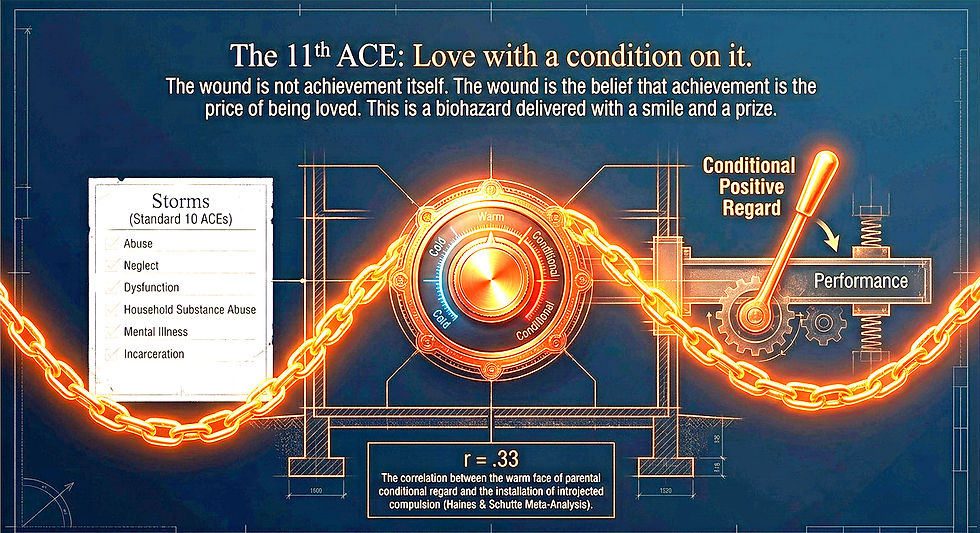
The quietest detail on this plate is the dial. Its needle sits at ‘Warm’, which is where every loving parent believes it rests, but the scale does not stop there: it continues, in the same reassuring copper, into ‘Conditional’. That is the eleventh ACE in a single instrument. Not the absence of warmth, but warmth on a meter. And the lever does the rest. Pull it, a gold star, a beaming face, the special ice cream after the spelling test, and the gears of Performance turn, smoothly, beautifully, for the next forty years. The ten storms on the left can be seen coming. The eleventh comes indoors, and it comes as weather we call love: a biohazard delivered with a smile and a prize.
I must push back here on behalf of every parent reading this, because I am one of the people who would object. If a child gets full marks in a spelling test or scores a goal on Saturday morning, and her parents beam with pride, cheer, and take her out for ice cream, that looks like healthy, ordinary, good parenting. We are supposed to encourage our children when they do well. How on earth is that an adverse childhood experience?
This is the most important distinction in the entire book, so let me be exact. I am not demonising celebration. The problem arises when the warmth is exclusive to the achievement. If a child notices that the highest wattage of parental love, the deepest gaze of approval, is only ever unlocked by performance, she learns a devastating developmental lesson: that her fundamental worth as a human being is not innate but a fluctuating commodity, which rises only when she produces a successful output. It binds her right to belong in her own family to her utility. She learns that she is a human doing, not a human BEing. The warm face is a biohazard disguised as a prize.
What this does to the professional adult is measurable. In an earlier study, the same Stanford and Mayo team looked at what they call self-valuation. Nearly three physicians in ten, against two other workers in ten, said that after a mistake they often or always felt more self-condemnation than self-encouragement: 29.8 per cent against 20.0. More than half of the physicians, against one worker in seven, said they often or always put off their own health care because of time pressure: 52.3 per cent against 14.9 (‘Self-valuation challenges in the culture and practice of medicine and physician well-being’, Trockel, Mayo Clinic Proceedings, 2021). Pause on that. More than half of the people whose entire vocation is the physical health of others are deferring their own. That low self-valuation, that readiness to abandon one’s own needs for the sake of the work, is the adult signature of conditional regard. It is the adult grammar of a childhood in which positive regard arrived with the report card, and in which having needs at all, needing rest, being ill, was treated by the family system as a liability: an interruption to the production of excellence.
The developmental literature has been measuring this for twenty years without ever thinking to follow it into the hospital. Jolene Haines and Nicola Schutte brought together 31 samples and 11,404 participants and found parental conditional regard travelling with introjected regulation at r = .33, and with contingent self-esteem at r = .29 (‘Parental conditional regard: a meta-analysis’, Haines, Journal of Adolescence, 2023). Introjected regulation is motivation by internal pressure: guilt, shame, and a desperate need to keep one’s self-esteem afloat. You do not do the task because you love it, or because you find it valuable. You do it because if you do not, you will punish yourself; you are trying not to feel worthless. To anyone who has not taken a statistics course lately, .33 may sound small. In a science of human behaviour, which is magnificently messy, a pooled correlation of that size across eleven thousand people is a blinking red light. They are pooled associations, not individual destinies, and I hold them as such; but they show that the transaction I am describing has moved beyond one writer’s clinical intuition.
And here is the part that unsettles almost everyone. When Guy Roth, Avi Assor and their colleagues separated the two faces, it was the warm face, conditional positive regard, that travelled with the feeling of internal compulsion and with a rigid, grade-focused engagement, while the cold face travelled with resentment (‘The emotional and academic consequences of parental conditional regard: comparing conditional positive regard, conditional negative regard, and autonomy support as parenting practices’, Roth, Developmental Psychology, 2009). The praise, not the punishment, is the better engine of this particular kind of overachiever, precisely because the warm face works. It produces the grades. It produces the piano recitals. It produces the obedience the parent wanted, because the child feels wonderful at the moment of achievement. But it produces them rigidly, compulsively, and at the cost of what the child is permitted to feel. The child becomes addicted to the warmth and terrified of the coldness that is simply the baseline whenever she is not achieving. Love withdrawn makes children sad. Love awarded makes them driven.
So how does a well-meaning parent tell healthy encouragement from the eleventh ACE, when the line looks so terrifyingly thin? I offer three tests. The first is the target of the gaze. When the child achieves something, does the light in the parent’s eyes follow the child, or only the result: the trophy, the report card, the gold star? Who is the parent actually making eye contact with, the child’s soul or the child’s score? The second is the stability of relational security. Does the child’s feeling of being safely, fundamentally loved survive a bad result completely unchanged? When she strikes out and loses the match, does the temperature in the car on the drive home drop, or does the warmth hold, whatever happened on the pitch? The third is the freedom to fail. Can the child fail, rest, be vulnerable, disagree with her parent, or simply be remarkably, gloriously ordinary on a Tuesday afternoon, without paying for it in lost warmth?
A parent can hold incredibly high standards, can push a child towards greatness, and still pass all three tests. Another parent can smile and praise constantly and fail all three, because the child knows, in the place where children know things, that the smile switches off the second the performance stops. None of this is about lowering standards to protect children. It is about uncoupling the standard of excellence from the child’s fundamental right to exist and to be loved. The warm face writes a lease on the child’s self-worth; the cold face threatens the eviction. Both forms of conditional regard, in the end, are in the real estate business.
Introjection: The Parent Who Moved In
The parent does not have to follow the child to medical school or to the Inns of Court to enforce any of this. The system becomes entirely self-sustaining, through the process psychology calls introjection: an external condition of worth, the parent’s requirement for success, is swallowed whole and becomes an internal prosecuting force. The judging gaze crosses the living room, then it crosses the skin, and eventually it lives inside the child’s own mind, where it needs nobody at all to sustain it. The external manager leaves the house. The internal manager never, ever leaves.

Follow the parent across the three frames: solid gold, then translucent, then a ghostly schematic of lines and measurements. The parent is disappearing. The beam is not. By the third frame nobody is standing in the doorway at all, and yet the light has found its way from the head to the heart, because it no longer needs anyone to shine it. That is introjection: the most efficient piece of engineering in the whole chain, because it costs nothing to run. Look too at the chain beneath the three figures. It has stopped being a chain and become a spring, wound tight and crackling with stored charge. That is where the energy of a whole career is kept, and where, decades later, it will be released.
The image in the book that cemented this for me, and for many readers since, is of a girl at a piano. She is eight. It is a Tuesday evening. Her father, who usually supervises her practice, is held up at a late meeting; her mother is upstairs running a bath; the door is closed, so no one can hear. She is playing a difficult piece, and she makes a mistake in the left hand. Before she starts again she does a tiny, almost imperceptible thing: she glances up at the empty doorway where her father usually stands. Finding it empty, knowing that absolutely no one is listening, she starts again and plays the piece perfectly, for nobody.
Why is she playing perfectly for an empty room? Because she is checking a watchtower to see whether anyone is inside it, and finding it empty changes nothing whatever, since the tower was never effective by being occupied. It is effective by being possible. The demand for perfection has been introjected.
I give this state a name from English property law: leasehold worth, as opposed to freehold worth. If you own your house as a freehold, you own it outright. The land is yours. No rent is payable to anyone, and nobody can re-enter and evict you because you had a bad month. If you hold a lease, you own nothing but the right to occupy for a term, and you must keep paying the landlord to keep that right. The child of conditional regard, the insecure overachiever, lives an entire life on leasehold worth. They do not own the right to exist; they rent it, and they pay the rent in achievement. The next examination, the next promotion, the next billable hour, the next successful operation: that is the rent. And the tragic clause in this lease is that the service charges keep rising, because every time you succeed and pay, that achievement simply becomes the new baseline. You can never rest on yesterday’s success, because yesterday’s success has already been spent. And the inner critic, the introjected parent, plays the absentee freeholder, never seen, always present, perpetually threatening to terminate the lease. Anyone who has ever felt like an impostor will recognise the landlord.
The Inner Panopticon
To understand the full structure of introjection we need a building. In the late eighteenth century the philosopher Jeremy Bentham designed a theoretical prison he called the Panopticon, and its design is diabolically simple: a circular building with cells around the outer wall, and a single watchtower at the centre. The cells are backlit by windows on the outside, so the guard in the tower can see the silhouette of every prisoner at all times. The trick is the tower itself. Its windows are fitted with blinds, so the guard can see out but the prisoners can never see in. No prisoner ever knows, at any given moment, whether he is being watched, or whether there is anyone in the tower at all.
Michel Foucault, writing two centuries later, saw what the architecture was really for: “to induce in the inmate a state of conscious and permanent visibility that assures the automatic functioning of power.” And he saw where it ended: “He who is subjected to a field of visibility, and who knows it, assumes responsibility for the constraints of power; he makes them play spontaneously upon himself; he inscribes in himself the power relation in which he simultaneously plays both roles; he becomes the principle of his own subjection” (‘Discipline and Punish: The Birth of the Prison’, Foucault, trans. Sheridan, Allen Lane, 1977, pp. 201–203). Because the prisoner never knows when he is watched, he must assume he is always watched, and so the physical guard becomes unnecessary. The prisoner becomes both prisoner and guard.
Carry that building into a human mind and the correspondence is exact. The Ego builds the prison. The Inner Critic is the prosecutor in the watchtower. And the inner child, the core vulnerable self, is the prisoner, permanently on trial for the right to remain: in the family, in the firm, in society. But the inner panopticon is worse than Bentham’s, because a physical guard can only see what you do. The inner panopticon can see what you feel. It monitors your thoughts. It catches you wanting to rest, or feeling vulnerable, or simply wishing to be ordinary, and it prosecutes you for the feeling before you have expressed it.

Look who is sitting in the inspector’s lodge. Not a warden, not a parent, but a small figure in a suit of armour, knees drawn up, head bowed. The guard of the inner panopticon is the frightened child as well: the prisoner promoted to warder, keeping watch over the cells in which the rest of the self is held. Then look at what the beams light up. Not crimes. Rest. Vulnerability. Mistakes. Appearance. This panopticon does not police wrongdoing; it polices being human. And the chain around the whole structure is gold, naturally. It was a gift.
This is where the material becomes most delicate, and where many high achievers will stop me. Surely, they say, what you are calling an inner critic is simply a strong conscience. A robust work ethic. What is wrong with holding yourself to a high standard? Nothing at all, and that is exactly why the distinction matters, because our culture confuses the two constantly.
A healthy conscience is a court of appraisal. It judges your acts. It speaks the grammar of guilt: I did something wrong; I hurt my friend; I made a mistake in that report. And because guilt is attached to a specific act, it has a mechanism of resolution. You can apologise. You can repair the error. You can make amends, and the conscience is satisfied; the case is closed. Guilt is actionable. The inner panopticon does not speak the grammar of guilt. It speaks the grammar of shame. It does not say I did something wrong; it says I am something wrong. It judges your fundamental standing as a person, and because it is judging your essence rather than your conduct, it can never be satisfied. No acquittal is ever final. Every hearing is simply adjourned to the next working day.
Conscience permits you to be a flawed human being. Conscience permits you to be tired, or hungry, or grieving, because none of those is a moral failing. The panopticon treats ordinary human fatigue as evidence for the prosecution. If you are tired, you are weak. If you are weak, you are unworthy. And the sentence for unworthiness, as every insecure overachiever knows in their bones, is exile.
The Constitutional Lock of King Burnout
If the panopticon is the courthouse in the mind, we must read the statutes it enforces. I call them the psychological constitution of the insecure overachiever, the Four Commandments of King Burnout, and they interlock like the bolts of a vault door.
The first commandment is Be Excellent: what the child, and later the professional, must do. But the research of Andrew Hill and Thomas Curran redefines what excellence means inside this constitution. Their meta-analysis of perfectionism and burnout separated perfectionistic strivings, setting high personal standards and aiming for excellence, from perfectionistic concerns, the paralysing fear of mistakes, the dread of evaluation, the sense of never quite being good enough. Perfectionistic concerns correlated with overall burnout at r = .41 across 34 samples, rising to r = .51 in work settings; perfectionistic strivings showed a small negative correlation with overall burnout (r = −.14) and no relationship with exhaustion at all (r = .01) (‘Multidimensional perfectionism and burnout: a meta-analysis’, Hill, Personality and Social Psychology Review, 2016). Wanting to do a good job is not pathological. It is not the drive that burns; it is the insecurity beneath the drive. So the true text of the first commandment is not aim high and be great. It is a negative command: do not fall short. Be faultless, so that you are not abandoned.
The second commandment is Be Compliant: who the child is permitted to be in relation to others. It is subjugation; it is anticipatory appeasement; it is the complete inability to say the word no, joined to a hyper-responsibility for the moods of whoever holds power in the room. The child learns to scan the room to see what the parent needs her to be, and she becomes exactly that. Twenty-five years later the adult does precisely the same thing with the senior partner, the consultant, the managing director, and is commended for her emotional intelligence.
The third commandment is the most frightening: Need Nothing. It dictates what must be abandoned, and what must be abandoned is the self. Guy Roth and Avi Assor interviewed 102 children aged five and six, whose parents used conditional regard to make them suppress sad feelings. The more conditional the regard, the less able these children were to recognise sadness in a face, to be aware of sad feelings in themselves, and to respond with empathy to sadness in others; and the warm face, conditional positive regard, carried its own unique negative association with all three (‘Parental conditional regard as a predictor of deficiencies in young children’s capacities to respond to sad feelings’, Roth, Infant and Child Development, 2010). Five years old, and already the capacity to meet sorrow, their own and other people’s, has been turned down like a dial. The child learns that having emotional or physical needs costs the caregiver’s warmth, and so begins, quite systematically, to erase her own needs. We meet her again decades later among the more than half of physicians who put off their own health care: she has trained her biology to ignore its own distress signals.
The fourth commandment is the lock on the whole mechanism: Never Stop. This is the missing stopping rule. When does the insecure overachiever get to rest? Never. Malissa Clark and colleagues’ meta-analysis anchors the field: across eighteen burnout samples and 10,319 participants, workaholism and burnout correlated at r = .33, and at ρ = .40 once corrected for measurement error (‘All work and no play? A meta-analytic examination of the correlates and outcomes of workaholism’, Clark, Journal of Management, 2016). That much one might expect. What is darker is the direction of travel. In a two-wave longitudinal study, Toon Taris, Ilona van Beek and Wilmar Schaufeli found that workaholism predicted higher introjected regulation six months later, while none of the forms of motivation predicted later workaholism (‘The motivational make-up of workaholism and work engagement: a longitudinal study on need satisfaction, motivation, and heavy work investment’, Taris, Frontiers in Psychology, 2020). The effect is small and the authors rightly call it tentative, but it points somewhere terrible: the overwork does not merely flow from the inner prison; it deepens it. Shame drives the overwork, and the overwork deepens the shame. A doom loop.
You never reach the point of having done enough, because in this system enough is not a quantity. You cannot reach it by billing three thousand hours instead of two thousand. Enough is a relationship. It is the state of being unconditionally accepted, and it can only be freely received from another person; it can never be earned in a transaction. And the four commandments lock together precisely to stop the person from ever discovering this. Trace the circuit. To be excellent, you must comply with every standard. To comply completely, your own needs must not interfere. Needing nothing allows you never to stop. And never stopping is the only way to remain excellent. It is a perfectly sealed engine of misery.

Notice that none of these gears can turn on its own. Excellence requires compliance; compliance requires needlessness; needlessness permits ceaselessness; ceaselessness secures excellence; and round it goes. Try to stop any one wheel and the other three seize. Notice, too, where the promise is written. Not on any gear, but on the base plate beneath them all, in a softer italic, as though whispered: …and you will be loved. The four commandments are the machinery. The fifth clause is the foundation it was built to stand on. It is also the only part of the mechanism that has never once been delivered.
Which raises the obvious question: why would anyone sign such a contract? What is the payoff? The answer is the secret, unwritten fifth clause, the consideration, in the language of contract law, that induces a person to suffer the first four. It is a whisper from childhood: …and you will be loved. If I am excellent, compliant, needless and relentless, I will finally be loved unconditionally.
Now return to contract law, because it has a precise name for what happens next. If you perform your obligations perfectly, if you sacrifice your health, your youth, your marriage for thirty years, and the other party never delivers its side of the bargain, that is a total failure of consideration. The insecure overachiever has honoured the contract flawlessly. They are chief of surgery. They are senior partner. But the warmth they are chasing is a mirage, and to stop working would be to stop the distraction: to sit in the silence and face the terrifying fact that the other party is never going to pay. The unconditional love is not coming. Not from this contract. Not on these terms.
I give this internal sovereign a name, borrowed and adapted from the recovery movement’s King Baby: the adult whose ego is at once terrified and omnipotent, the infant who believes the world revolves around his needs and is entirely helpless to meet them, and so demands total control because he feels total terror. King Burnout is King Baby with a practising certificate. Here is the tragic irony at the heart of the professions: a neurosurgeon, a chief executive, a King’s Counsel, someone holding life-and-death responsibility, someone society regards as the summit of competence, whose nervous system is ruled from within by a terrified, introjected toddler. A toddler with dictatorial power over the adult’s life, issuing impossible decrees for perfection, and possessing no capacity whatever to regulate stress or to apply the brakes.
But I am careful here, and I ask you to be careful with me. The gifts are real: the intelligence, the surgical hands, the devotion to clients and patients. The tragedy is not that the professional’s excellence is counterfeit. The tragedy is that magnificent, genuine gifts have been hijacked, placed under the command of a frightened internal regime. The original wound is simply the belief that excellence is the price of being loved, rather than a gift to be shared.
Trauma-Scouting at the Gilded Gate
The terrified sovereign does not stay in the nursery. Eventually, at twenty-two or twenty-five, King Burnout walks out of university and approaches the gates of the elite professional world: the law firms, the investment banks, the great hospital trusts, the consultancies. I call them, collectively, the Gilded Gate, and this is where the argument of Volume II turns from individual psychology to institutional architecture.
The organisational scholar Laura Empson gave the professions a phrase they recognised instantly: the insecure overachiever, exceptionally capable, fiercely ambitious, and driven by a profound and unshakable sense of their own inadequacy (‘If you’re so successful, why are you still working 70 hours a week?’, Empson, Harvard Business Review, 2018). My Gilded Gate hypothesis asks how so many of them come to be standing in the same buildings, and its answer is what I call trauma-scouting.
I must be scrupulously precise here, so that nobody mistakes the argument. Trauma-scouting is not a conspiracy. There are no oak-panelled boardrooms in which executives twirl their moustaches and scheme to recruit damaged children. Human Resources is not secretly reading ACE scores off CVs and saying, “Ah, this one was emotionally neglected; hire her.” Trauma-scouting is an emergent property of the selection system: an outcome nobody planned, but which the design makes all but inevitable. Build a recruitment and promotion system that ruthlessly optimises for people who will voluntarily work ninety-hour weeks without complaint, who will tolerate stopping rules so ambiguous that enough is never defined, who are exquisitely sensitive to evaluation and criticism, and who will defer their own gratification indefinitely, and then ask yourself: whom will you catch in that net?
You will catch, disproportionately, people raised under conditional regard. The securely attached, people loved without conditions who hold their worth as freehold, tend to look at a ninety-hour week and say, “No, thank you. I’m going home at six to see my family.” The secure person opts out of the mincing machine. The system optimises for a phenotype, not a history. The firm does not care why you are willing to work until three in the morning; it cares only that you are. The door does the sorting.
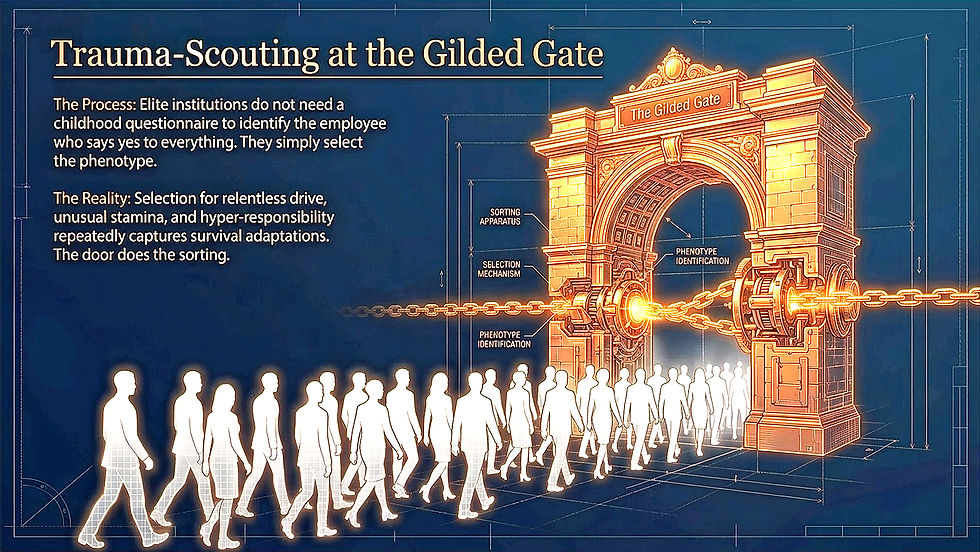
There is nobody at this gate. No recruiter, no interviewer, no villain with a clipboard: only the arch, the queue, and the machinery built into the stone. That is precisely what the hypothesis requires. The figures walk in willingly, glowing, many of them proud, and the chain they carry passes through the gears of the gate as though the arch had been built around it. In a sense, it was. Look closely at the queue, too. Every figure is made of light and grid lines, half person and half specification, as if each had already been drawn to the institution’s measurements before they arrived.
The contrast with the general population is telling. In Robert Anda’s analysis of the Kaiser ACE cohort, childhood adversity predicted serious job problems, financial problems and absenteeism (‘Childhood abuse, household dysfunction, and indicators of impaired worker performance in adulthood’, Anda, The Permanente Journal, 2004). In the elite data, thin as it still is, we see something quite different: fewer of the loud adversities, and a quiet concentration of the invisible ones, as in Constantian’s surgeons with their doubled rate of emotional abuse. I hold the full claim as an inference awaiting its study, and Volume II says exactly what that study would need to be. But the shape it suggests is a gate that behaves like a semi-permeable membrane. It rejects the loud traumas that disrupt work. It admits the silent traumas that fuel it. And because the people who succeed at the gate rise to run the gate, the institution comes to reproduce itself out of the very adaptations it selects, which is what I mean by trauma-organised autopoiesis. Let me be tender about this as well as unsparing: most of the senior partners and medical directors who now preside over the gate walked through it themselves, carrying the same chain.
Think of the institution, then, as a surrogate parent. A twenty-two-year-old walks into a vast, prestigious, globally recognised firm, carrying a lifelong sense of insufficiency. And the firm, in effect, says to them: “We are the best in the world. We reject ninety-nine per cent of the people who apply here. But we chose you. Therefore you are excellent. You are enough.” To a secure person, that is a job offer. They check the salary and the pension, and they sign. To the insecure overachiever, that job offer is an ontological rescue mission. It is the answer to a lifelong quest for love: the validation they have bled for since they were five years old.
Linguistic Laundering and Trauma-Harvesting
Once the insecure overachiever is inside the Gilded Gate, the institution needs a way to speak about these trauma responses that makes them sound like heroic virtues. I call this linguistic laundering: the mechanism by which an institution takes a childhood survival strategy, pins a corporate gold medal on it, and gives it a shiny new name.
Listen to the translations, because they are chilling. A child’s hypervigilance, the need to scan the room constantly to make sure the parent is not angry, is laundered into attention to detail. Performance-contingent self-worth, the terror of being ordinary, is laundered into ambition. The inability to set a boundary, or to refuse an unreasonable demand, becomes commitment. Anticipatory appeasement becomes being a team player. And the most tragic of all: parentification, in which a child had to act as an adult, managing the emotions of the unstable adults in the house simply to stay safe, is laundered into precocious leadership. “You are so mature for your age,” the institution tells the twenty-four-year-old. “We’re giving you a team.” Workaholism is, after all, the only addiction in the world for which we hold an annual awards dinner.
Society participates in the laundering, and we know this experimentally. In seven studies with random assignment, Jae Yun Kim, Troy Campbell, Steven Shepherd and Aaron Kay showed that observers are more willing to legitimise the exploitative treatment of workers, unpaid extra work, tasks that have nothing to do with the job, when those workers are described or perceived as passionate (‘Understanding contemporary forms of exploitation: attributions of passion serve to legitimize the poor treatment of workers’, Kim, Journal of Personality and Social Psychology, 2020). Write the word passion, or vocation, or calling, into the job description, and it becomes socially acceptable to work someone eighty hours a week until their body breaks. I call this the Passion Alibi. Once availability stands in for virtue, the person who cannot stop is not merely tolerated: they become the most ethical person in the building, and the colleague who goes home at six becomes, by the same arithmetic, the least.
There is an older European name for this harvest. Christophe Dejours, the French psychiatrist and psychoanalyst who founded the psychodynamics of work, showed more than forty years ago that workers build individual and collective defences against the suffering that work causes them, and that the organisation can come to depend upon those very defences (‘Travail, usure mentale’, Dejours, Le Centurion, 1980). That is the crucial nuance. The institution does not harvest the wound itself; the wound is messy, painful and unbillable. It harvests the armour the child built against the pain, and the armour is exquisitely productive.

Watch the material change as it falls. At the top: jagged, fractured, raw stone, the actual texture of a childhood spent reading a parent’s face. At the bottom: minted, polished, embossed medallions you could pin to a lapel at the awards dinner. Nothing has been healed in between. Something has only been renamed. That is laundering in its exact sense: proceeds passed through enough respectable hands that their origin can no longer be traced. Here the currency is a child’s fear, and by the time it reaches the appraisal form it has become the very thing we promote people for.

The Two Panopticons: Renting the Tower
Let me play devil’s advocate against my own theory, on behalf of the institutions. If the output looks exactly the same, if the spreadsheet is flawless and the operation succeeds, how can a law firm or a hospital realistically tell the difference between a genuinely gifted employee who simply loves the work and an insecure overachiever running on the fumes of childhood fear? Are we to expect Human Resources to become psychotherapists?
The answer is the heart of the systemic critique. The institution structurally cannot tell the difference, and functionally it does not want to, because to distinguish the two would require dismantling the economy of the two panopticons.
Remember the inner panopticon from childhood. The modern institution has an outer one: billable hours, league tables, algorithmic performance reviews, endless audits, 360-degree feedback. Building a total surveillance state to monitor every employee is extraordinarily expensive, and bitterly resented. But an institution does not need to build an oppressive outer panopticon if it hires people who bring their own inner panopticon with them. The outer tower simply rents the inner tower the child built decades ago. It costs the firm almost nothing. Every morning the individual brings their own internal overseer to the office, and the firm merely hands that overseer a megaphone and a KPI dashboard.
So the firm says, “You must bill two thousand hours.” And the internal prosecutor translates: “If you do not bill two thousand five hundred, you are worthless, and everyone will find out that you are an impostor.” The institution reaps the surplus value of that anxiety without ever having to demand it out loud.

Read the questions in the two towers side by side and you hear one voice in two registers. The outer tower asks about output; the inner tower hears a question about existence. ‘Is the output standard met?’ arrives as ‘Am I worthy?’; ‘Will I be promoted?’ arrives as ‘What if I fail?’. The lease between them is the most profitable document the modern institution never had to draft. The property was built decades ago, at the tenant’s own expense, on a nursery floor; it is staffed without a salary; and the watch never changes, because the watchman cannot go home. He is home.
Overflow versus Deficit: Two Ways to Work Very Hard
So the devil’s advocate is right about one thing: from the outside, you often cannot see the difference. Two people can sit at neighbouring desks at six o’clock on a Thursday evening, working the same hours at the same pace, and be running on opposite engines. Robert Vallerand’s work on passion gave psychology the vocabulary for this long before burnout became a dinner-party word: harmonious passion, freely chosen and woven into a life, against obsessive passion, which holds the person rather than being held by them (‘Les passions de l’âme: on obsessive and harmonious passion’, Vallerand, Journal of Personality and Social Psychology, 2003), and he later followed the obsessive kind into burnout itself (‘On the role of passion for work in burnout: a process model’, Vallerand, Journal of Personality, 2010). Volume II calls the two engines overflow and deficit.

The last row is the one to sit with. Every row above it records a difference so profound that it decides whether a life is lived or merely serviced; and yet the final row, ‘What the Institution Sees’, records no difference at all. Output on one side. The same output on the other, ‘often better, until the collapse’. That is not a failure of the institution’s eyesight. It is an honest description of the only instrument it has been given to look through. One person is pouring from a full cup; the other is bailing out a sinking boat; and every dashboard in the building scores them identically, right up to the day the boat goes down.
Read the table as a diagnosis rather than a judgement. The deficit worker is not lazy, weak or pretending: they are frequently the best performer in the building, because fear is a ferocious fuel and the inner panopticon never sleeps. Praise lands on them not as pleasure but as a stay of execution, and each stay is shorter than the last. Rest, which ought to restore them, registers in the nervous system as danger, because rest is the moment the panopticon’s beam finds them doing nothing. So they do not rest. And somewhere below the waterline, an account is quietly falling into arrears.
Somatic Decapitation
You cannot run a human nervous system at that speed for decades without the engine seizing. Elite training does not merely ask for your time; it trains you, actively and with considerable skill, to sever your mind from your body. I call this somatic decapitation: the functional severing of the calculating, cognitive head from the feeling, biological body.
I know it from the inside. For me it was a long theatre list, and the discovery, genuinely thrilling at the time, that I could simply decline to be hungry. Not ignore hunger: decline it. Refuse the message at the door. The signal continued to arrive for a while, and then, over years, stopped bothering. That was the first clasp to come undone between my head and my body. There are many, they come off one at a time, and each removal is applauded as a milestone.
This is the hidden curriculum of elite training, beneath the clinical knowledge and the black-letter law: students are being taught which signals are admissible. Tiredness: inadmissible. Fear: inadmissible, except as a joke afterwards. Distress at a patient’s death: admissible for approximately ninety seconds in a corridor, provided the list continues. Moral objection to a decision made above you: theoretically admissible, practically career-limiting, and everybody knows it. Hunger, fatigue, the need for the lavatory, the need for sleep: these stop being biological imperatives and become administrative matters, inconveniences to be managed or suppressed so that the work can go on.
And grief queues. A career in medicine delivers something like one unmetabolised death a week, and a career in criminal law delivers something structurally equivalent in a different medium, and none of it is disposed of by the simple expedient of there having been no gap in the afternoon. Unprocessed material does not evaporate for want of an appointment. It waits.
Here is the cruelty of the bargain: the nervous system has no selective filter. You cannot numb fear, fatigue and grief while keeping joy, desire, peace and love on the guest list. Close the gate and you close it on all of them. What remains is a brilliant cognitive machine piloting a numb meat suit. The professional face closes the ledger every evening; the body keeps the books. The nervous system remembers every unpaid debt.
Constantian and Zaborek’s surgeons show what the books contain. Remember that this was a group with fewer of the loud adversities than the general population. Yet among them, physical neglect in childhood, reported by only 2.8 per cent of respondents, carried an odds ratio of 19.27 for burnout and 35.29 for chronic fatigue, and emotional neglect carried an odds ratio of 11.58 for self-defined work addiction. If an exposure gives you an odds ratio of two, epidemiologists sit up. Odds ratios in the tens are rare in epidemiology. I hold these numbers with every caveat attached, a cross-sectional survey, self-defined outcomes, a rare exposure and therefore very wide confidence intervals; but rarity is not the same as harmlessness, and the direction is unmistakable. The body is screaming. The decapitated head cannot hear it.

Look at the shape of the two lines. The gold one, output, is the line the institution watches, and it never wavers. The pale curve beneath it, biological reserve, is the line nobody is paid to watch, and it has been falling from the very first year. When the gold line finally moves, it does not decline; it drops, vertically, and the chain breaks in a shower of sparks. That is the asymmetry of decline: the depletion is slow, silent and invisible for years, and the collapse is sudden, total and witnessed by everyone, who will all say they never saw it coming. They are telling the truth. They were looking at the wrong line.

There is a concept from emergency medicine that captures this better than any psychological term: compensated shock. When a trauma patient is bleeding internally, the body fights desperately to survive. The sympathetic nervous system clamps down on the peripheral blood vessels; it drives the heart faster; it robs the skin, the gut and the kidneys of their blood supply in order to defend the one number that gets written on the chart and read by the people walking past the end of the bed. So the monitor reads a perfect 120 over 80. The pressure holds. It holds beautifully. It holds right up to the moment the body runs out of reserves, and then the patient crashes, almost without warning.
That is exactly what is happening, psychologically and biologically, to the professionals in this book. Their output stays flawless. The spreadsheets are perfect, the operations succeed, the deals close, they make partner. The output conceals the internal haemorrhage right up until the morning they cannot get out of their car in the hospital car park.
The Bankruptcy of the False Self
Which brings us to the moment of impact. What actually happens when the insecure overachiever hits the wall? Volume II redefines burnout completely. It is not being very tired. Burnout is the total bankruptcy of the false self: the final expiry of that leasehold worth. And to show it, I take the three classic dimensions of burnout in the research literature, exhaustion, cynicism and reduced efficacy, and translate them from management problems into biological verdicts.
Exhaustion is not a current-account deficit. It is not something a weekend in the Bahamas or a long sleep can repair. It is somatic arrears falling due, with interest. Thirty years of ignored hunger, suppressed grief and deferred sleep have finally presented their bill, and the body’s account is empty.
Cynicism, in corporate language, is a bad attitude, a lack of engagement, a problem for the next appraisal. I read it differently. Cynicism is the forbidden no that the child was never permitted to say on the nursery floor, finally being spoken, forcefully, by the nervous system on the person’s behalf, because the cognitive mind is still too frightened to say it. The body says no because the mind cannot.
Reduced efficacy is not a dip in productivity, nor a matter for a time-management course. It is the ledger’s final verdict: the lease on the self has expired, and no further payment is possible.

Nobody is sitting at this desk any more, and that is the point. The bell that summoned the professional for thirty years lies on its side, its cord torn; it will not ring again. The stethoscope, instrument of a vocation, has been set down rather than thrown. And the chain, at last, is broken, though not cut in any act of liberation: snapped under load, its two halves lying where they fell, one trailing off the edge of the desk and out of the frame. This is what the institution will call a breakdown. Read the plate’s final sentence again: it is not the end of the person. It is the end of the terms. Everything in Volume III begins in the space that broken chain has left.
Across the larger project I call this the Dissolution Clause. An institution asked to fund prevention can say no and remain itself. An institution asked to accept that its founding categories are downstream artefacts cannot, because it is being asked to dissolve, and organisms do not consent to their own dissolution: they defend. That is why a profession must not know what it already knows. The false self is built on exactly the same clause. For thirty years it has defended itself against the one Truth that would dissolve it: that the love is not coming, not on these terms. Burnout is the moment the defence finally fails, the Dissolution Clause enacted at the scale of a single human being. And dissolution is not death. The persona commissioned on the nursery floor can no longer be maintained. That is a catastrophe, and it is also, though almost nobody can hear this at the time, a release.
But the institution does not see a release. At this moment of collapse it commits its final and most devastating act, and here I need two more of my own terms. The first is anxiety laundering. In a hierarchical institution, anxiety flows downwards like gravity. Trace it. The board is frightened of scandal, or of a fall in the share price, so it writes a strict and unrealistic policy to protect itself. That policy becomes a middle manager’s high-pressure quarterly target. The manager, frightened of missing the target, translates the pressure into a junior employee’s impossible ninety-hour week. And when that junior, our insecure overachiever, finally collapses under the weight of somatic arrears, what does the institution say? “You have a resilience issue. You need to practise better self-care. We are sending you on a mandatory wellness course.” Fear enters the top of the institution as a systemic, structural condition; it is washed clean of its toxicity at every level of management; and it exits at the bottom as a personal defect.
The political theorists Brad Evans and Julian Reid saw precisely what the cult of resilience asks of the people it is sold to: “The resilient subject is a subject which must permanently struggle to accommodate itself to the world, and not a subject which can conceive of changing the world, its structure and conditions of possibility” (‘Dangerously exposed: the life and death of the resilient subject’, Evans, Resilience, 2013, p.83). A resilience module is not a remedy. It is a request that the casualty adapt to the weapon.
The second term is the one that gives Volume II its title: the second wound. The institution has spent a decade praising the very behaviours that were destroying the person. It has harvested the enormous economic output of their trauma armour. And at the moment the armour finally cracks, it blames the individual for breaking under the weight of the very system that selected, shaped and rewarded them for breaking. Carly Parnitzke Smith and Jennifer Freyd have a name for this, too: institutional betrayal, the harm an institution does to people who trusted and depended on it (‘Institutional betrayal’, Smith, American Psychologist, 2014). The first wound was conditional love. The second wound is the institution that rented it, profited from it, and then disowned it. And the sentence the institution speaks as it does so, it was a resilience issue, is the alibi.
The Pivot and the Reverse Panopticon
I have painted a bleak picture, and I have done so deliberately, because a chain cannot be undone until it can be seen whole. We have followed it from the nursery’s conditional love, through the inner panopticon the child built to police herself, past the trauma-scouting of the Gilded Gate and the laundering of her armour into virtue, all the way to biological bankruptcy and institutional betrayal. The question now is the only one that matters: are we condemned to this cycle? We are not.
The first movement out is what I call the Pivot: the internal realisation that the inner critic, that terrifying watchtower, is machinery. It is an artefact of childhood survival, ingeniously built by a small person under impossible conditions. It is not the objective Truth of your worth. It never was. The voice that has been prosecuting you for decades was hired, as a child, to keep you safe in a house where love said if, and it has been working unpaid overtime ever since.
And here is the move that surprises people. The deepest step is not simply to see the prisoner with love, the frightened inner child in the cell. It is to see the guard with love. The Ego is not executed. It is honourably discharged from a duty it should never have been asked to perform. Wage war on the inner critic and you have merely built a second panopticon to watch the first; the war itself becomes the new surveillance. Thank it, see it, relieve it of duty, and something extraordinary happens: you are fully seen without being condemned, and the conditions lose their jurisdiction.

Set this plate beside Plate V and the reversal is almost exact. The same round building; the same armoured child at its centre; the same light falling from above. But in Plate V the child crouched, head bowed, while the beams hunted the cells for evidence. Here the child stands, open-handed, and the shield lies on the floor, cracking as it lands: not torn away by force, but set down because it is no longer needed. Nobody has demolished the building. Nobody has defeated the guard. The guard has simply been seen, and thanked, and relieved of duty. That is the whole pivot: not a war on the ego, but an honourable discharge.
The second movement is the reverse panopticon, and it is a shift in the affective field: the felt atmosphere that a family, a team or an institution generates and that everyone inside it breathes. The panopticon is a field of surveillance, in which you are constantly watched and measured to see whether you meet the conditions of acceptability. The reverse panopticon is a field of witness, in which you are seen, met and respected unconditionally as a human being, regardless of your output that day. The gaze is not abolished. Human beings need to be seen; that is not the wound. The wound was being seen conditionally. Reverse the valence and the same gaze that once prosecuted now holds.
This is, I should say, the heart of my own practice. What I call Prefigurative Re-Collection is the reverse panopticon practised by one person on another: seeing the highest and the whole in someone from the very first meeting, and holding that sight steadily, until they can see it for themselves. It is witness rather than surveillance, offered before it has been earned, because it was never the kind of thing that could be earned.
The evidence that people really do cross over is quietly moving. Ellbin and colleagues interviewed patients ten years after they had been treated for clinical exhaustion disorder, and asked them to reflect on who they had become. They did not say that they were finally back to their old selves. One of them said what the study took as its title: “Who I am now, is more me” (‘“Who I am now, is more me.” An interview study of patients’ reflections 10 years after exhaustion disorder’, Ellbin, Frontiers in Psychology, 2021). They had not returned to the false self that burned out. They had authored the true one. They had found the deeds to a freehold they did not know they owned.
The Prefigurative Institution
But how does a vast, entrenched institution change? Not, let me be clear, by burning the hospital down, or by tearing up the economy and starting again. Volume II places its hope in abolitionist insiders: people deep inside the system, senior partners, chief medical officers, veteran executives, successful by every one of the old measures, who undergo the internal pivot and then quietly refuse to pass the institutional fear downwards to the next generation. What they abolish is not the institution but the panopticon inside it. They act as fire breaks against anxiety laundering. Fear arrives on their desk from above, and it stops there. It is metabolised, rather than translated into someone else’s ninety-hour week.
The reparative institution does not need to be invented from nothing. Jennifer Freyd, who named institutional betrayal, also named its opposite, institutional courage: an institution’s commitment to seek the truth and engage in moral action even when that is uncomfortable, risky or costly. Among employees reporting workplace harassment, institutional courage was associated with better health and appeared to soften some of the harms of betrayal (‘Institutional courage buffers against institutional betrayal, protects employee health, and fosters organizational commitment following workplace sexual harassment’, Smidt, PLOS ONE, 2023): a particular context, but proof that how an institution responds to harm is itself a determinant of health. Amy Edmondson gave us psychological safety, “a shared belief held by members of a team that the team is safe for interpersonal risk taking” (‘Psychological safety and learning behavior in work teams’, Edmondson, Administrative Science Quarterly, 1999, p.350). And Carl Rogers gave us, seventy years ago, the phrase that sits beneath both: unconditional positive regard. The tools exist. What has been missing is the willingness to stop paying in the old currency.
There is a teaching in the Pali canon, the Sallatha Sutta, which every regulator, managing partner and medical director might be asked to read before taking office. A person struck by an arrow feels its pain. The untrained person, struck by the first arrow, then fires a second into himself: the lamentation, the self-reproach, the resistance. The pain of the first arrow is unavoidable. The second is optional. Institutions fire the second arrow every time they meet a wounded professional with blame, a capability review or a resilience module. The prefigurative institution refuses to fire it.

Notice what this plate does not show: no wrecking ball, no burning building, no barricades. The gears are still turning in every corner. The institution still works; the machinery of excellence is intact. What has changed is the currency. The Furnace pays in conditional esteem and collects in fear. The Reparative Institution pays in regard that does not have to be earned, and discovers that people who no longer have to purchase their right to exist have a great deal more to give. And look at the chain beneath the two columns. It has not been cut. It has simply been opened and laid down, in two lengths, one beneath each column, fastened to no one.

I call it prefigurative because it lives now, inside the old building, the world it hopes to bring about. It does not wait for the economy to change before it treats its people as owning their worth outright. It behaves as though that world had already arrived, and in doing so, for the people inside it, it has.
The Will to Love
The whole movement of Volume II can be stated as a change of engine. We have to move from what I call the Scarcity Combustion Engine to the Fusion Reactor of the Will to Love. It sounds poetic, and it is; it is also a rigorous psychological distinction, and its rallying cry is three Latin words: Sum ergo diligo. I am, therefore I love. Descartes, forgive me; you began with thought, and thought, left to itself, is precisely where the panopticon lives.
The Scarcity Combustion Engine is the engine this whole essay has described. It runs on deficit and fear, and its internal monologue is: I must achieve, I must produce, so that I might become worthy of love, and of survival. It burns the person as its fuel. The Fusion Reactor runs on overflow, and its monologue is: I am already worthy. My worth is freehold. Therefore, from safety and abundance, I will pour my genuine gifts and my excellence into the world. The first engine consumes the self to generate output. The second generates output as the natural radiance of a self that is no longer being consumed.
So how does a person know which engine they are running? From the outside, remember, the two can look identical: both at the desk at six on a Thursday, both producing beautiful work. Patrick Gaudreau has given psychology a careful distinction between perfectionism and what he calls excellencism, the pursuit of high standards without the demand for perfection (‘On the distinction between personal standards perfectionism and excellencism: a theory elaboration and research agenda’, Gaudreau, Perspectives on Psychological Science, 2019), and Volume II adds the existential clause: excellence without the fusion of your worth to the result. The test, in the end, is beautifully simple. When six o’clock comes, can you close the laptop? For the person running on the Fusion Reactor, the hours are just hours and the work is just work, and the laptop closes. For the insecure overachiever on the deficit engine, closing the laptop feels like an existential threat, a physical panic, because the hours are the receipt for their right to exist. They cannot stop, because enough is a relationship you receive. It is not a quantity you can add up to on a spreadsheet.

Every plate before this one was crowded: gears, towers, gates, funnels, ledgers, chains. This one is almost empty. No mechanism, no measurement, no blueprint grid. Just a ring of light. Look again at what the ring is: a single link. The whole volume has been about a chain, link after link forged from the nursery floor to the corner office, and here at the end is one link standing alone, closed upon itself, bound to nothing. That is freehold worth. It holds nothing and it is not held. It simply is, which is why its grammar is not if, but I am, therefore I love.
Notice the first sentence of that final plate. The World Health Organization classifies burnout as an ‘occupational phenomenon’. Volume II disagrees, respectfully and completely. Burnout is not an occupational phenomenon. It is the Human Condition laid bare, the place where the oldest human question, am I loved for who I am?, finally surfaces in the only language our institutions are equipped to hear, which is the language of output, absence and collapse. The fracture does not happen in the office. It happens years earlier, on the nursery floor, at the moment love says if.
So recovery is not a wellness technique, a protected half-day, or a resilience module. It is something far larger and far simpler: the discovery that the clause if you succeed, I will love you was never in the original contract of your worth. Your worth was always freehold. It was owned outright from the very beginning. You simply mislaid the deeds for a while.
This lens changes things. It changes how you see your own frantic drive to clear the inbox before you are allowed to sleep. It changes how you might look at the colleague who sends emails at two in the morning: perhaps they are not dedicated; perhaps they are terrified. It changes, if we let it, how we praise our own children at the kitchen table tonight. It asks us to stop staring at the smoke of the broken adult, and to look upstream, at the fire of childhood conditioning, and at the furnace that has learnt to run on it.
And it leaves me with a question I would like to leave with you, because I do not think any institution in the land has yet dared to ask it. If this Scarcity Combustion Engine, this deep, unhealed, childhood fear of being ordinary, is secretly powering the highest levels of law, medicine, technology and finance, then what would happen to the output of the global economy if an entire generation healed? Would the Gilded Gates grind to a halt, starved of their cheap, fear-based fuel? Or would we build entirely new institutions, ones we can barely imagine yet, powered by the Fusion Reactor of the Will to Love? That is not a question about productivity. It is a question about what we truly value, as an economy and as a species.
Think about it the next time you feel a pang of guilt for closing your laptop at six o’clock. The X-ray machine of human psychology may still be murky. But at least now we know exactly where to look.
Volume II of How Do ACEs Burnout?, ‘The Furnace, the Second Wound and the Alibi: How Institutions Burn Out the People They Reward’, can be read on its own or as the centre of the trilogy, between Volume I, ‘The Fire, the Fan and the Fuel: Why the Brightest Burn First’, and Volume III, ‘The Pivot and the Crossing: From Rock Bottom to the Will to Love’. Each volume can be bought separately, and all three come free with a subscription to my forthcoming resources on burnout, the Human Condition and healing: weekly extended articles, monthly books, and a growing library of audio, podcasts and videos.
I am delighted to announce the publication of my latest book, the second standalone book in my trilogy, "How Do ACEs Burnout?":
Volume II: 'The Furnace, the Second Wound and the Alibi: How Institutions Burn Out the People They Reward '
My new book is published and is available now! Click here:
For Volume I: 'The Fire, the Fan and the Fuel. Why the Brightest Burn First', click here:
Volume III release date 25th October 2026:
Volume III: 'The Pivot and The Crossing: From Rock Bottom to The Will to Love'
And perhaps the three books can ultimately be reduced to three questions.
What happened to us?
What did we build from it?
And what becomes possible when we no longer need fear to run the machinery?
And beneath all three, the question the Love Arc asks of every discipline that has ever studied us.
Were we loved, or were we loved if?
The first book asks what happened to the child. The second asks what the institution did with the adult that child became. The third asks what becomes possible when the adult finally turns towards the child, and discovers that neither their worth nor their freedom was ever the institution's to bestow.
See you in the next Part, the next article, the next book, the next video, the next audio podcast, the next stage of the journey.
I will be here, right beside you, if you so wish.
Olly Alexander
Sources
Adverse childhood experiences (ACEs) in 252 board-certified plastic surgeons: prevalences, ACE clustering, and effects on adult health and behaviors, including self-defined depression, work addiction, and burnout Constantian, M.B., Zaborek, N. Aesthetic Surgery Journal. 2025.
All work and no play? A meta-analytic examination of the correlates and outcomes of workaholism Clark, M.A. et al. Journal of Management. 2016.
Assessment of adverse childhood experiences, adverse professional experiences, depression, and burnout in US physicians Trockel, M.T. et al. Mayo Clinic Proceedings. 2023.
Burn-out an “occupational phenomenon”: International Classification of Diseases World Health Organization. 2019.
Childhood abuse, household dysfunction, and indicators of impaired worker performance in adulthood Anda, R.F. et al. The Permanente Journal. 2004.
Dangerously exposed: the life and death of the resilient subject Evans, B., Reid, J. Resilience. 2013.
Discipline and punish: the birth of the prison Foucault, M. (trans. Sheridan, A.) Allen Lane. 1977.
If you’re so successful, why are you still working 70 hours a week? Empson, L. Harvard Business Review. 2018.
Institutional betrayal Smith, C.P., Freyd, J.J. American Psychologist. 2014.
Institutional courage buffers against institutional betrayal, protects employee health, and fosters organizational commitment following workplace sexual harassment Smidt, A.M. et al. PLOS ONE. 2023.
Les passions de l’âme: on obsessive and harmonious passion Vallerand, R.J. et al. Journal of Personality and Social Psychology. 2003.
Multidimensional perfectionism and burnout: a meta-analysis Hill, A.P., Curran, T. Personality and Social Psychology Review. 2016.
On the distinction between personal standards perfectionism and excellencism: a theory elaboration and research agenda Gaudreau, P. Perspectives on Psychological Science. 2019.
On the role of passion for work in burnout: a process model Vallerand, R.J. et al. Journal of Personality. 2010.
Parental conditional regard as a predictor of deficiencies in young children’s capacities to respond to sad feelings Roth, G., Assor, A. Infant and Child Development. 2010.
Parental conditional regard: a meta-analysis Haines, J.E., Schutte, N.S. Journal of Adolescence. 2023.
Prevalence of burnout among physicians: a systematic review Rotenstein, L.S. et al. JAMA. 2018.
Psychological safety and learning behavior in work teams Edmondson, A. Administrative Science Quarterly. 1999.
Relationship of childhood abuse and household dysfunction to many of the leading causes of death in adults: the Adverse Childhood Experiences (ACE) Study Felitti, V.J. et al. American Journal of Preventive Medicine. 1998.
Self-valuation challenges in the culture and practice of medicine and physician well-being Trockel, M.T. et al. Mayo Clinic Proceedings. 2021.
The emotional and academic consequences of parental conditional regard: comparing conditional positive regard, conditional negative regard, and autonomy support as parenting practices Roth, G. et al. Developmental Psychology. 2009.
The motivational make-up of workaholism and work engagement: a longitudinal study on need satisfaction, motivation, and heavy work investment Taris, T.W. et al. Frontiers in Psychology. 2020.
Travail, usure mentale Dejours, C. Le Centurion. 1980.
Understanding contemporary forms of exploitation: attributions of passion serve to legitimize the poor treatment of workers Kim, J.Y. et al. Journal of Personality and Social Psychology. 2020.
“Who I am now, is more me.” An interview study of patients’ reflections 10 years after exhaustion disorder Ellbin, S. et al. Frontiers in Psycholo
Disclaimer:
This article is educational and reflective. It does not provide personal medical diagnosis, treatment or emergency advice. The author trained and practised as a doctor and surgeon for three decades and holds medical and senior medical qualifications, plus a PhD in Natural Sciences (Bio-engineering), and an MA from Cambridge in the History and Philosophy of Science and Medicine.
Readers with physical or mental-health concerns should seek appropriate individual professional assessment.
If you are in immediate distress, please do not wait to finish this book. In the United Kingdom you can call the Samaritans free on 116 123, at any hour. Elsewhere, your local emergency number or a trusted person will do.


Comments